Writer. This blog is an archive of things I have published elsewhere. Mostly these texts are about art. Other topics include Political Populism and blockchain.
Kristan Horton, Dr Strangelove Dr Strangelove, giclee prints, 27.9 x 76.2 cm Series of 200 photos (2003-2006)The most curious aspect of Kristan Horton’s Dr. Strangelove Dr. Strangelove is the number of times the artist claims to have seen Kubrick’s movie: by his count, over 800. The figure is excessive, to the point that you are tempted to doubt it. I have probably seen the Reese Witherspoon comedy, Legally Blonde, 10 times. That’s an estimate, and it was partly for practical reasons: laziness and a dearth of home entertainment options. In Horton’s case, the number of viewings may suggest fandom shading into fanaticism, or even something less comprehensible than that, but it is also simply in keeping with the conceptual rigor of his project.
A student of the film, Horton has been engaged in an ongoing process of reconstructing it. In each of the works 200 diptychs, a still from the movie is mirrored by its hand fabricated facsimile. For each one, the artist begins by making compositions that break down the volumes of light and shadow in the Kubrick original. Working with objects close to hand in his apartment, the wit of the enterprise comes with his choices of substitutions: a fork for an airplane fuselage, a tight close-up on a scoop of vanilla ice cream for clouds, a plastic bag for the sky. The net effect splits the difference between Horton’s artistic ingenuity and his humbling of the British filmmaker’s cinematic artistry into a mere series of constructions. Pursuing this line of enquiry helps to place Horton’s work within a larger trend that sees artists using the hand-made as a way to puncture the spell of illusionism. Considering that much of contemporary life is undergoing a process of fusion with the virtual world, it is a reassuring development, one that proves art’s relevance as a corrective to tendencies in the wider culture.
Geoffrey Farmer, For Every Jetliner Used In An Artwork…(2006) Of late, the airplane has taken on inordinate symbolic weight. Its’ a 9/11 thing; passenger airlines repurposed for their destructive power seem to confirm what we previously had only suspected: that our culture contains within it the seeds of its own annihilation. The airplane then is a loaded symbol, not least when Geoffrey Farmer drags a fuselage into a gallery for use as a kind of art stage set. Yet the effect in his recent show at Catriona Jefferies’ is more melancholy than sinister. Although the prop is easily redolent of economy class claustrophobia, the stronger feelings the Vancouver artist evokes are of movie spoof hilarity, along the lines of Hollywood’s 1990s ‘Airplane’ franchise. But this is just to prove Farmer’s larger point that the art gallery is a place of no real consequence.
Like a fifth column, Framer has always lurked in the shadows of his own practice. His aim is, however, not to destroy but merely express ambivalence. One constant in his work is the use of video to make literal the idea that the exhibition space is the site of something that’s already happened. So the artist has used an art gallery to show a video of himself skateboarding there after hours, or another to show video documentation of himself making tin foil sculptures with his feet. For his Jeffries’ show, the installation evolved, the viewer encountering traces of the artist’s nocturnal actions: His drawings pinned to the wall; the fuselage covered with scraps of colored fabric; the artist seen on a monitor wearing a child’s skeleton outfit and climbing a ladder. Creating layers of time and space in the gallery, Farmer reflects on the role of the artist as presence and actor: and of conceptualism as a practice that is, of necessity, always reanimated.
By Rosemary Heather
This text originally appeared in Flash Art, January/February 2007
Geoffrey Farmer is represented by the Catriona Jeffreis Gallery, Vancouver
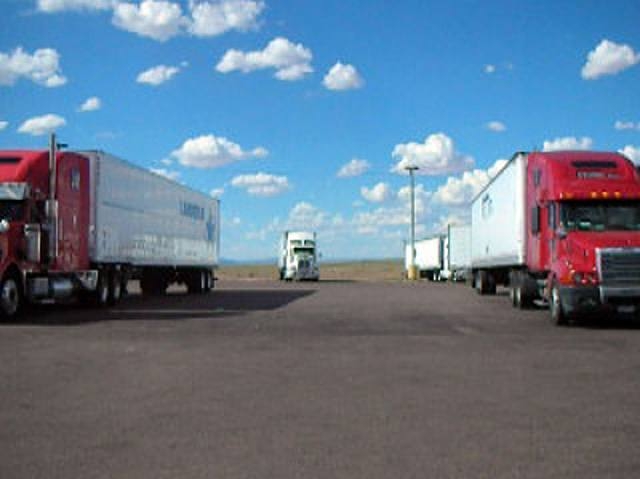
Anri Sala, Air-Cushioned Ride, video/film, 6 minutes 4 seconds (2006)
The romance of the truck stop may sound like worn-out material for an artist to draw on. The idea would seem to evoke a familiar landscape ¬- one that is, let’s face it, from the last century. In Air Cushioned Ride (2007) the Berlin-based Albanian artist Sala makes the territory his own. A car-mounted camera slowly circles a row of 18-wheel vehicles, a scene that is set against the dazzling blue big sky of some nameless open country. Along for the ride is a soundtrack that alternates between two songs, on a country music and a classical music station, respectively. For the show’s opening, Sala had this composite tune arranged for live performance. Producing a full-bodied replication of the work’s soundtrack was a combined and rather large group of authentic-looking country/western and classical musicians. It was a novel accomplishment and something of a technical feat. What it added to the piece as a whole is less certain. The artfulness of the adaptation is its weak point proving that, in conceptual practice at least, antipathy to technique remains steadfast. Sala’s film, on the other hand, is entirely artless and so that much more successful. Initial assumptions about the time and place of the work give way to the realization that the scene you are looking at is not necessarily in the proverbial mid-western US. Country music and long-distance trucking are Americanisms that are at this point merely part of the general condition of things in the West. It is this fusion of old world and new that the artist neatly encapsulates on his soundtrack. By articulating an idea about the universality of placelessness, Sala achieves an absolute contemporaneity. Bypassing the easy clichés of pop culture, he carves out a concrete piece of the present.
By Rosemary Heather
This text originally appeared in Flash Art, July-September Issue, 2007 Anri Sala is represented by Johnen Galerie, Berlin
Shannon Bool, The Serpent Heart, Photogram (2006) 131 x 101 cm Version 2 of 3, 1 Artist´s Version
RH
You used to do work on paper and now what do you do?
SB I’m still doing work on paper but I’m doing a lot of different things, a lot of photograms, photo collages, painting and drawings still, installation pieces or room pieces – pieces that are specifically adapted to exhibition space.
RH And what’s the thing that ties it all together?
SB I guess the content that I’m working with is similar in different works that I make. But then I always come to a different sensibility in making it. So something might lend itself to becoming a photogram or something might become a silk painting. Or something might become an architectural sort of project but this comes usually within the process or even before the process when I’m thinking about what I want to make. I want to work with this picture I found in the flea market. Or I want to work with the The Golden Notebook. Or I want to work with Martha Graham. And these things are usually parts of bigger bodies of work…I usually have two or three kind of bodies of work that are close together in content and then I try to keep free with the technical aspects of making it. Because often I make things more than once and the way I make it has to be very specific for it to function. I guess it’s kind of about form and function too.
RH You know what you want, you know how to get it and then you just…
SB Yeah, you just kind of pick up things along the way. Because the way something is made or using different mediums I think is just a sensibility that comes with trying to be really clear about saying something in a unclear way that doesn’t relate directly to the content. So my process is really necessary to show itself as content. And this is something I think that merges together with the original starting point of the idea that I have.
RH Why do you want to say something clearly in an unclear way?
SB I mean to say something in a non-narrative way, not one-to-one with the original, the original content or form rather, because I often use a photo or make reference to something that already exists. And so I don’t want to just simply appropriate – it just doesn’t work for me to work with one-to-one appropriation.
RH This is something I noticed, for instance, in Six or Seven Wolves (2005-2006), that the wolves are depicted in an indistinct way.
Shannon Bool, Six or seven wolves (glossy version) Photogram (2006) 162 x 101 cm Version 3 of 3, 1 Artist´s Version
SB Yeah.
RH And then also there’s only five of them…
SB Yes. This is a good example. I can take you through the process this way. This was in the Case Studies…Freud’s case study, “the Wolfman” where the patient’s Obsessive-Compulsive Disorder was traced back to this dream that he had explained in one of his sessions. He had this dream when he was about three or four, he said. And he looked out his window and he saw the six or seven wolves and they looked like white huskies. They looked like they were white wolves with (sheepdog) tails, they had really bushy tails and they were all staring at him. And it was completely unheimlich, uncanny. And he did a drawing in one of his sessions with Freud and he only drew…there’s five wolves I think in the photographs. He only drew five wolves in his drawing but he said there were six or seven wolves. So because of this Freud went through I think four pages of his own interpretation of why these two wolves could have been missing. He thought that the two wolves maybe stood for his mother because he had seen his mother having sex with his father’s wife in the doggy style position. And another example was, there was a fairy tale in Europe called the Wolf and the Seven Little Kids. It’s kind of like Little Red Riding Hood but with more characters. And I think there’s something about all of the kids getting eaten except for one who hides in the clock case-Freud also connects this fairy tale because the wolf has the baker whiten his paws to trick the baby goats.
RH Four pages of Freud’s analysis specifically about the fact that those two wolves were missing.
SB So what I wanted to do was to try and make my photogram as similar compositionally as I could to this drawing from Pankejeff, I think his name was, the patient. So I went through like literally hundreds of images of walnut trees without leaves to try and find one that worked like the one in the book, in the drawing that I had seen. And one of the reasons that the wolves were kind of similar is because I drew them myself. And when I was younger I drew, I think this is one of those Canada things, like I drew animals, wolves, wild animals quite a lot. So it’s just natural to draw wild animals…I researched Arctic wolves; I found them in the right positions and added these sheepdog tails. And then in the whole lighting process with the photogram you don’t really have that much control over what it’s going to look like because I’m using cheap computer prints on A3 transparent paper in this work in particular. And so how the wolves and the tree come together in the end is kind of out of my control to see how the borders will look or what will happen. I guess what I am what I’m trying to do is to clearly determine a certain kind of psychological space. Or a certain kind of attitude that comes from my re-assessment of a lot of different material values and a lot of different stores of meaning that comes from working through what I see.
RH This is quite clear, that you create this psychological space and the image of wolves looking at you seems very powerful. And it also has this real world reference to this actual psychoanalytic case study, a famous case study. This creates a division between the way the wolves are depicted and the idea of what’s depicted, and what’s beyond the surface of the work. This connects to what you were saying before about how the work embodies a relationship to the content.
SB Yes.
RH You said in a previous conversation that your goal was to create ornament as content?
SB Yes, something that John Dewey said is that ornament is usually dissociated from its sourced content. So if you have for example a Heriz carpet. I have a Heriz carpet at home.
RH What is that?
SB It’s a region in Persia. I stare at it all the time. The emblems and the ornaments in the Heriz carpet have been divorced for their original tribal and political associations. So two hundred years ago, three hundred years ago, the ornaments in these carpets served as a kind of admission to cultural meaning for the people who lived in this town who made these carpets. And then these carpets became very valued in the West. They became really popular because they’re quite tough and they’re also very harmonious, very geometric. And so they started to change the ornament based on the wishes of the Western consumer. So now a Heriz doesn’t have the same ornamental values, the meaning of the ornament is not there like it was before. It’s made for Western people now (and) the ornament isn’t associated with the meaning of the town itself. And this is something that I find interesting because when you’re using ornament today you can’t really take the face value of what it means.
…
SB In my Six or Seven Wolves drawings series, I was using ornament as an atmospheric quality. Its less of decorative thing. But then as I came further along I realized how ornament can kind of, can function as a base in its own right. You can take these…the original context it gets suspended and it becomes something else. It indicates something different than you would originally expect, something that’s not decorative. The purpose becomes depth in itself. Normally when you see ornament, you think of it as something that covers the surface, and it makes things pleasing to a viewer because you have a scientific relationship to geometric configurations that makes you feel good when you look at them. That’s why ornament can be very dangerous because it’s a cheap draw-in for the viewer. You don’t want to kill with kindness.
RH What do you mean dangerous?
SB If you work with ornament and it’s not specific it can just be something that, it can just be a pleasing element. It can be a darling, you know it can be something that you…
RH Which is not what you’re trying to do.
SB No. But I see it in contrast to using something that draws the viewer in. I think the draw, the ornament…I see it as its own entity. These days for example if you want to try and use Cartesian perspective to show deep space it’s really like a sleeping pill because you can’t compete with Hollywood. You can’t compete with all of these special effects things that have really simplified and flattened deep space. And so what I would like to do or what I try to do in some of my work, or a lot of my work, is to look deeply at a surface and to see what the surface resolves in a deeper way.
RH This segue ways nicely to the floor work Schraegraum (2005) This is a Photoshop work that actually translates Photoshop perspective into real thing on the floor?
SB Yeah it was more about the idea of living with a material on a regular basis. So we have a lot of surfaces that we take for granted.
RH Yes.
SB Or surfaces that are just in our space. So something like a laminate, it’s kind of a paradox that we accept it as a real spatial existence.
RH Right.
SB And also I think a lot of artistic developments take an angle on, on certain materials or certain kind of technology when it hasn’t really been pushed to its limit. We don’t really know how we can translate an idea like laminate into a different space. And it’s also dealing with more of like a suburban sensibility as opposed pop culture. Some kind of breakdown of values that are just generally taken for granted in a visual space.
RH I don’t think it’s a very common concern at the moment of dealing with conceptual issues in two-dimensional representation? It seems to me what you’re doing is kind of unique.
SB Yeah it’s not; it’s not a common practise definitely.
RH No, it’s not like the big collective project to develop cubism.
SB Yeah that’s true.
RH Maybe you can give some more examples of the idea of surface and space. What about Origin/Inversion (2005) It’s a wall drawing and it’s drawings of carpets?
SB Yeah, it’s both. One of the carpets is from a painting by Jan van Eyck and the other one is from a painting from Hans Memling. They’re both from paintings from the fifteenth century. Perspective started to get configured back into painting at this time. But these are paintings from the Northern Renaissance. And instead of this Cartesian Italian approach where it’s almost like a stage set because the perspective is so perfectly crafted, (where a narrative is really balanced into the composition), what you have with the artists who were working in the North, like Jan van Eyck especially and Hans Memling is a very meticulous rendering of surface. So the end effect is more a kind of atmospheric sense of content, the content is less about the narrative that’s happening and more about the resonance of the different materials that are depicted. And this is also the origin that I have of the work, Schrägraum (2005), the laminate (floor). Schrägraum is a term from Panofsky. He’s talking about how the perspective of the Northern Renaissance painters is often crooked. Because they didn’t have the linear perspective perfectly executed. What comes out of that is a different reading of the space. He wrote about its’ psychological quality, which I find interesting, too). So this (my point of origin in) working with these kinds of surface materials to see how they resonate into a new reading of space.
RH Well I mean, why put the drawing of the carpet on the wall?
SB I wanted to make it architectural, (and bodily)
RH It’s in the corner.
SB I designed it on the computer to go in the corner. In the original paintings, the carpets were on the ground and then the perspective goes up the floor with the carpet. Each carpet serves as the starting point of the painting‘s perspective. And what I did was I put them together, because they both have a slightly different perspective, and inverted them on the wall.
RH Then there’s the pedestal.
SB This is a piece of laminate that I also wanted to ground it with another aspect of fake material that would add to this atmospheric quality. So I, I built (the) sculpture to rest on the floor to give it more resonance.
RH It’s like an apron.
SB Oh yeah.
RH And then there’s this coffee stain here. What is it?
SB That’s a wheel.
RH Oh, okay.
SB This is the Wheel of St. Catherine.
RH Uh, huh.
SB Because this is from the Mystical Marriage of St. Catherine by Memling, And it’s St. Catherine’s wheel. These carpets are all from the Ottoman time. These paintings also show the emergence of capitalism at this time. The fact that people started to trade with the Orient. And this is one of the first examples of…
RH Merchant capitalism.
SB It’s a good example of ornamental qualities being taken out of their context and used in another artistic platform.
RH The ornament from the carpet being used in the painting.
SB Yeah, then it becomes about the wealth of the church and doesn’t have the tribal connotations anymore.
RH I was interested to hear you speak about your process being dissociative. So maybe you could talk more about that?
SB Well, the idea of dissociation in its basic terms is the idea of splitting off. So it’s the idea of you losing contact with the present world and going somewhere else but in a non-hallucinatory way. It’s more about splitting from yourself. I connect this to drawing and the process of making work. What I find interesting is to use a sometimes very dissociative process of making work, which has to do with the repetition of making. The idea of making ornament is also very dissociative. If you look at Outsider Art – or art from The Prinzhorn Collection, for example – a lot of it is extremely dissociative.
RH What’s The Prinzhorn Collection??
SB It’s in Heidelberg. He was a psychiatrist who started collecting his patient’s work and naming it “art” in its own right. I think it was in the 1920’s. (I am off in the original, it was from 1919-1922 that he really started collecting) There’s a permanent exhibition in Heidelberg, you can go and see it. And then Dubuffet and Art Brut took up these ideas. With this kind of art you don’t have the division between the self and the paper. The ego of the person goes directly onto the work itself. There’s also some sort of psychic connection to what you’re making. But when I think of dissociation it’s this idea of, especially when I’m using something like ornament, I’ll start with a very analytical perspective of something that I want to make; or something that I want to say. Then in the process of making it something else comes up and often this has to do more with continuing the process itself than staying with the narrative content. And it starts to layer itself and its something that you can’t really edit that carefully. You can’t start from the beginning and say oh, the work is going to be like that or I think the work should look like that because it never works out that way.
RH So you use narrative references, like ornament, to create content about the process of making art.
I think that relates to the fact that you it does create a psychological space in your work, like in Six or Seven Wolves, for instance. So, maybe we can talk a little bit more about that?
SB Yeah.
RH It’s kind of a fraught psychological space.
SB I guess you just never want to make it easy for the viewer.
Shannon Bool, Ostkreuz (2006) Oil on silk, 163 x 122 cm
RH Why not?
SB This is something that you can connect ornament to. The idea that it’s a comfort zone. It’s like icing or it can be like mashed potatoes in a work. And if you have too much of that it becomes less about creating the work in a smart way or understanding more complicated aspects of the work. It doesn’t go deep into anywhere, not even the surface. It just kind of satiates the viewer. And it has to do with being comfortable within your own process and comfortable within your studio process, and what you’re using, the materials you’re using. This mannerism that’s created, it’s dangerous. It’s the dangerous thing about ornament and it’s something that you have to avoid.
RH Have you read Adolf Loos’ Ornament and Crime?
SB Yeah, it’s great. But Loos was really hard on ornament. He compared ornament to Maori facial tattoos (I don’t want to quote Loos directly with “savages”), that they have ornament even on their face shows how lower they are the Darwinian scale. And he (wrote) about prisoners, that they tattoo and decorate their bodies and how this is another example of how low ornament is. I thought it was brutal when I first read it. But then the first time I went to Vienna I could see his point of view because everything is so ornate and decadent there. And then you go into this café that he designed, the Museum Café and it’s just like a breath of fresh air. And you see these Art Nouveau buildings everywhere and just coating after sugar coating of ornament. So I think that for ornament to function is has to be aware of this aspect of cancelling itself out. It has to know its limitations.
RH I read a book by Rebecca West, a book of essays. In one of them about the Nuremburg Trials, she said something about how she could see in German architecture the non-restrained detailing was indicative of the decay of that civilization.
SB But this is true in every art movement you have a point where the scales start to tip and the work becomes comfortable with itself and it becomes, it stops functioning because it knows what it’s doing too well. So that’s why I think ornament is dangerous because it has to be used in a new way. You have to look at it in a way that looks at its intrinsic value- not just its original intrinsic value, but the terms of how it functions in a space today.
RH Well bearing in mind this idea that it’s dangerous, this is one of the main tendencies in your work ornamentation, pattern, detail…And it occurs to me that this dissidence is built into it, there’s always a disruption in the pattern field…
SB This is this wall-paper work Liquid Pizzeria (2004) where I had an architect design this disruption in this pattern from cheap pizzeria wallpaper that you find in pizzerias in Germany. I wanted to use this idea of futurism, of depicting motion and space but using the wallpaper as the background for this motion. So I had an architect design this swirl for the wallpaper but then I hand collaged it because I wanted to, to me if I had just printed it out on the computer this work would have been too boring. So when you see it, it has these hand collaged little bits in it so it really slows down the reading of the work. Which is really mucked up.
RH But I mean this swirl, it’s a brick pattern, no?
SB Yeah.
RH And when you asked this architect to do it, what did you ask him to do?
SB I wanted to have some photo disruption in the space so she just showed me different designs and ideas and we sat through a session of looking at different things that could happen and then I decided on this one.
RH Can you talk about the floor?
SB Yeah, I just, this is an idea; this is another very dissociative idea. And I thought this work was really formal.
RH What’s it called?
SB It’s called, Partially Renovated Floor (2004) And it’s funny, because I thought this work was very, very clean and formal and then a conceptual artist that I met told me that it is more of a fetish work.
RH Oh, yeah that’s interesting.
SB Which is true.
RH Yeah, yeah.
SB And I think this work is highly dissociative because it came from being in one of the studios I worked in when I was at the Staedelschule in Frankfurt and staring at the floor for a year. It had originally been a studio from the Hermann Nitsche class so there was a lot of shit on that floor.
RH And, basically, you scraped it away?
SB I just renovated a part of it. But then you see the difference, and one of the reasons I did it was that the floors are very, very expensive hardwood floors, they picked the best kind of hard wood floor for the studios.
RH Is it parquet?
SB Parquet for the studio spaces and these studio spaces were supposed to become painting studios and the architect knew that but he still wanted this floor.
RH Right.
SB And then after twenty years it was covered, you could just barely see some of the lines of what had been underneath.
RH So what is this covered in?
SB You can see close up, like, just paint and dirt.
RH It’s just dirt.
SB Well mostly paint. I think. Like it’s mostly just oil paint that gets squished in different layers over the years. And then worn in dirt that gets stuck to the paint and also some other stuff like beer and…
SB But then one of the things that I found interesting… other content comes up after you sand through. I was showing a different part of the Staedelschule from a time when it was so rich. The school was so rich in the 80’s that they would send full classes of students off to China, all expenses paid for two weeks. And they had the money to say, oh, we’ll use the best parquet for the painting studios, no problem. So when you make these sorts of gestures,( like sanding and polishing the floor) other information gets implicated (into) the original intention.
…
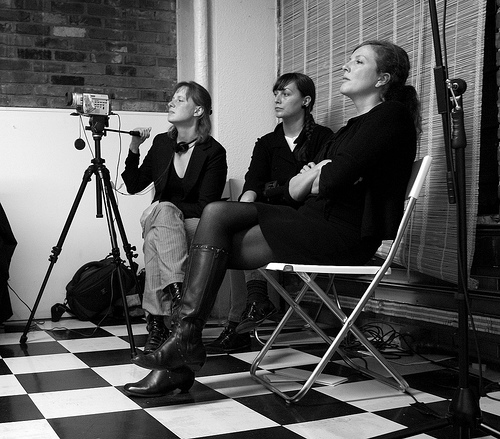
Melanie OBrian (foreground), Elizabeth Milton (centre) and Colleen Brown.
Melanie O’Brian, Director/Curator of Artspeak in Vancouver for the past six years, recently moved to Toronto to take up the post of Curator & Head of Programs at The Power Plant. With this appointment, O’Brian makes the shift from what’s known in Canada as the artist-run sector to one of the country’s major venues. We spoke over email in March, 2011.
RH: Your professional career up to now has been firmly rooted in Vancouver. How do you think this experience will translate to Toronto? Do you expect to shift your priorities, or will you continue with the type of programming you developed at Artspeak?
MO: My goal is to maintain a strong foundation in the local while intersecting with international practices and dialogues. My programming interests regarding site will undoubtedly shift at The Power Plant. At Artspeak I addressed the institution’s mandate to reflect a dialogue between language and contemporary visual art and I also extended the program outside of the limited confines of the gallery. Through the OFFSITE program (2008-2010), I took artists’ projects into various ‘public’ situations using the street, parks, print, large-scale advertising, building sites, the postal system, etc. While I certainly maintain a desire to do offsite projects in Toronto and address contextual specificities, the institutional spaces at The Power Plant will allow me to initiate projects that would never have been possible at Artspeak.
RH: Speaking about OFFSITE, why do you think art institutions feel the need to develop audiences beyond what you refer to as the “confines” of the gallery? Is this tendency artwork-driven or institutionally-led?
MO: Artists are engaging strategies that re-activate wide cultural, political, and economic discussions within the process of art production and its reception. Institutions are encouraging this activity, often arguing that the audience for contemporary art is wider than ever before. But only a select audience overtly sustains contemporary art’s dialogues. Contemporary art is intersecting with audiences on multiple levels from the gallery to the street, from the blockbuster to the festival, from the biennial to the incidental. Perhaps the spectacularization of contemporary art’s presentation is a point for discussion?
RH: Toronto has a wildly successful Nuit Blanche event, presenting public art works across the city for one night. It attracts an estimated audience of one million people. The number one criticism of the event is that it tends to feature spectacular artworks. This could be seen as pandering to the crowd, or it could simply reflect the changing nature of art. Any thoughts?
MO: These types of events are increasingly common, whether autonomous or embedded in the Olympics. They do not necessarily reflect the changing nature of art, but rather the changing nature of the art system.. Art fairs, biennials, and other large scale spectacles provide a point of comparison. They are formats that often request, if not demand, art that competes with or withstands the spectacle. I might add that in what could be touted as a post-relational aesthetics, post-participatory moment, artists and artworks must not just engage with the art system, but intervene in it and question it productively.
Interview by Rosemary Heather
This text originally appeared in the May/June 2011 issue of Flash Art.
Melanie OBrian is the Editor of Vancouver Art and Economies, an anthology of writing about the Vancouver art scene, which can be purchased here.
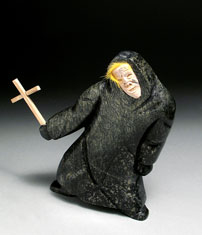
Samonie Toonoo, Missionary Man, Stone, antler, fur 9” x 8.5” x 2” (2007)
Ransacking the past, while denying any knowledge of it, has always kind of been the program for artists. Suppression of your antecedents is a good way to create a neat little package from your own historical moment. This was also true of pushed-to-the-sidelines non-Western traditions in art. A recent show of Picasso’s work at the Metropolitan Museum of Art in New York, for instance, gave viewers an eye-opening if perhaps not entirely intentional look at adjoining rooms full of his African and Oceanic source materials.
Not that it matters much at this point. Our own historical moment has a rather more pressing need to seek out continuities with the past and other artistic traditions. Motivated by this impulse, Scream helps to dismantle another long-standing partition, between Inuit art and contemporary practice. Scream is a companion exhibition to last year’s Noise Ghost, which featured Toronto’s Shary Boyle and Cape Dorset artist Shuvinai Ashoona, and takes a similar approach, pairing Ed Pien with Samonie Toonoo, artists who reside in the same two respective locations. Resonances in their work begin with an interest in the figure; it is a common denominator that points to a primordial intelligence always at work in art. Curator Nancy Campbell makes this reading explicit by titling the exhibition after the famous painting by Edward Munch. She connects three points on a map rendered in space and time. As the show makes apparent, once these connections are drawn, certain assumptions start to become undone.
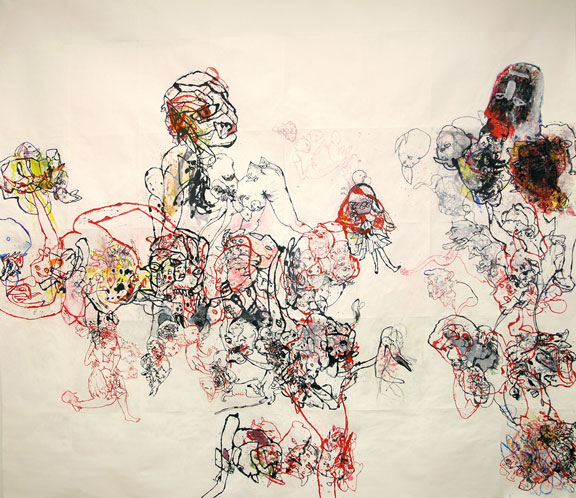
Ed Pien, The Offering, ink and Flashe on paper, 152.5 x 171.5 cm (2009)
The expressive potential of the figure is powerfully put to use in Toonoo and Pien’s work. Toonoo presents stone carvings, embellished with detailing – of a fur fringe on a hood or a face, sometimes a skull, carved in bone. Each carving tells a story, often tragic. Pien’s drawings are created through a process he calls monoprinting. Taking quickly drawn sketches in coloured ink, he creates overlapping compositions with the wet ink applied to fresh paper, often placed on top of other drawings, or cut out and collaged together. Combined into large densely layered composite pictures, the effect is mesmerizing.
By strictly adhering to the elements of line and color, but at the expense of volume, Pien creates drawings that look stencil-like, and further evoke the ancient art of Chinese brush drawing. Pien is an Asian-Canadian who immigrated to Canada from Taiwan at the age of 11. While reminiscent of Chinese art traditions, the artist reports he developed the monoprinting process in the course of his art practice. The technique is entirely his own. Born into a family of artists, Toonoo has deep roots in the artmaking traditions of his people. He adds embellishments to traditional-looking stone carvings, such as a figure brandishing a wooden hockey stick, or cross hung around the neck of a hooded figure, to clearly place his work in the contemporary world. Detailing allows Toonoo to align obdurate stone and Inuit carving techniques with drawing, and drawing’s aptitude for editorial commentary.
Loss of a need for boundaries, between not only artmaking epochs but also artmaking traditions, suggests we have arrived at a historical moment free from pastiche. Instead, artists are seeking out the terms for a deeper kind of renewal. Once again art proves its relevance as a prognosticator of what is to come: a loss of dominance for the West in a Globalized world.
‘We All Lie Together’, oil on canvas, 49" x 49.5" (2007)I’ve never forgotten what an artist friend once told me. Making paintings is an exceptionally weird thing to do. Applying paint to a flat surface, constructing the illusion of space in two dimensions: What could be the motive for this?
Among the legion of painters devoted to figuration, Michael Lewis maps out a distinct place. In his large-scale works, the dimensions of painting become the constricted space of everyday urban existence: the hotel hallways, office buildings and banquet halls. Windowless rooms contain faceless people, all of them suffering from some nameless torpor. Primarily a painter of interior spaces, Lewis frequently includes potted plants in his pictures to provide a (somewhat cynical) reminder of natural life. When Lewis does paint the outside world, his landscapes look suitably alien.
Sometimes the torpor in Lewis’s work is depicted. In ‘We All Lie Together’ (2007), a group of people lie on the floor. More often, torpor is just an ambience pervading the work. The artist uses a tepid palette of blue and green to serve psychological ends. There is no air in these rooms. Often the paintings are tinged with an undercoat of red, giving them an eerie vitality. The subtle reddish glow suggests a painterly corollary for disquiet.
Lewis used to be a bike courier and he told me this may be the reason why the mise en scene of his imagination always ends up looking like the lobby of an office building. In his paintings, people are busy but it’s hard to say what exactly they are doing. Allegories of office job deadness, bomb shelter anomie or consumer culture conformity all spring to mind.
More to the point perhaps is the claim Lewis makes in his paintings that his medium conveys meaning. His work recalls a quote of Rene Magritte, who described painting as “the art of putting colors side by side in such a way that their real aspect is effaced.”1 In Magritte’s view, a successful painting achieved just that, a kind of poetic coherence, one that “dispenses with any symbolic significance.” Lewis’s work achieves this coherence. His paintings give an impression of profundity; numerous potential readings could result. Our willingness to invest in the work’s reality is connected to the artist’s motives when making it. In the end, however, all readings hit up against the limit of what Lewis’ works actually articulate: the artist’s skill at painting.
1. Frasnay, Daniel. The Artist’s World. “Magritte.” New York: The Viking Press, 1969. pp. 99-107
By Rosemary Heather
This text originally appeared in Hunter and Cook, Issue 09
Michael Lewis is represented by the Meredith Keith Gallery.
Michael Lewis’ website is here.
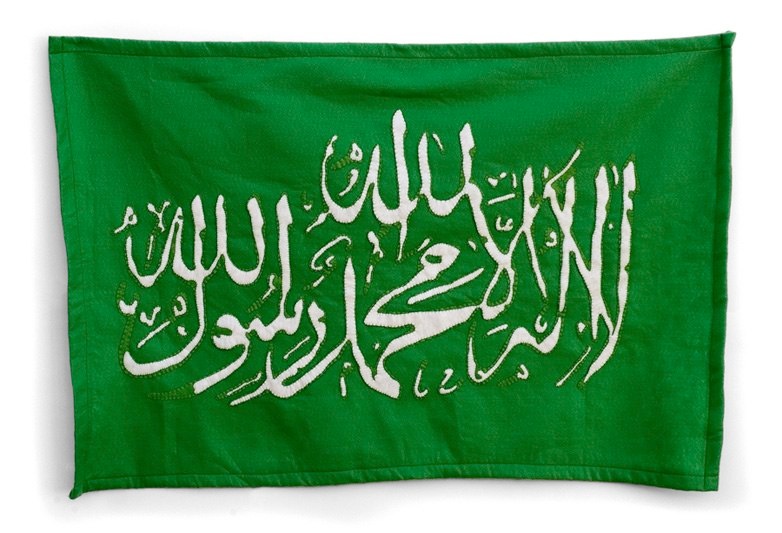
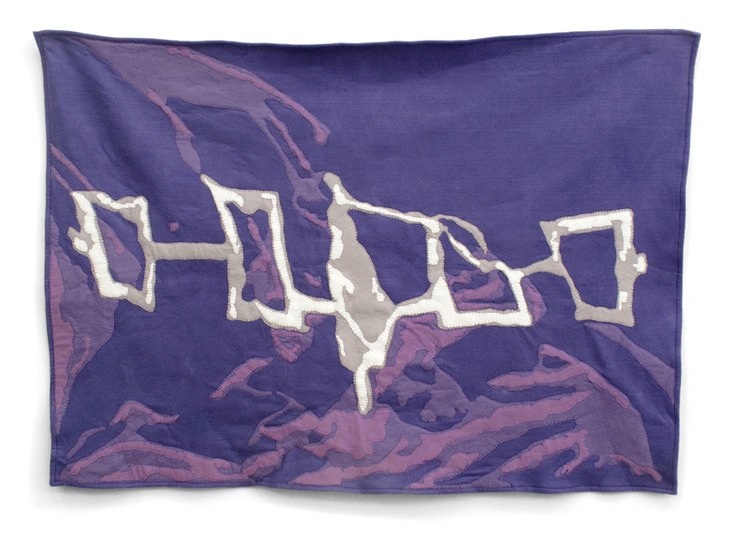
Miles Collyer makes felt flags based on images he finds online. Few works of art convey ideas about the world we live in so effectively. Today, a flag could stand for the frivolity of a regatta, or the half-serious declaration of micro-nationhood. Collyer chooses to focus instead on symbols of political conflict; flags that express the statehood aspirations of disenfranchised groups. In the single video he showed at Toronto’s G Gallery, Collyer painted a pennant black and animated it, making the felt triangle appear menacing. It was the only flag that flew in the show, and it clearly announced what territory Collyer wants to claim as his native ground.
We live in a world where images condense territories, which is also a good definition of the Internet. Recreating found images as life-sized replicas in felt, Collyer takes particular interest in the distortions that data transmission brings. Working from digital files, Collyer matches the crudity of pixelation with his chosen material’s lack of finesse. With meticulous care, he sews chunky, abstract artworks. The ripples of a flag that once flapped in the wind are given form as a layered, two-dimensional object. The result is eerie: the flag’s distortions lack detail, and thus take on the contours of a topographical map. Subjected to a multi-step process of translation, Collyer’s works continue to convey a message about their origins. The effect is an uncanny one, which brings to mind the Surrealists’ belief that they could find beauty and truth in a flea market.
Collyer trained as a photographer, and this work is ultimately an investigation into the power of the photographic image. In a previous series of photographs, Collyer confronted this issue directly. He took portraits of himself wearing a variety of coloured knit balaclavas he had found in thrift stores. Even when styled as a fashion statement, the balaclava speaks the language of political insurgency. The images Collyer made cannot escape this implication; they draw resonance from the idiom of 21st-century terrorism.
Miles Collyer, Haudenosaunee, felt and thread (2007)
With his flag series, Collyer looks at the politics of the image from a different angle. The innocuousness of felt neutralizes the political flag, and yet its message remains undiluted. This is not because his audience knows much about the political struggles of, say, the people, whose flag Collyer has used as source material. Rather, it is because the picture frame flattens and condenses information into form. Flag symbolism is cultural expression at its most basic or, dare I say, primitive; this is why Collyer can create soft, distorted versions of the real thing and still find that they pack a powerful, atavistic punch.
By Rosemary Heather
This text originally appeared in the Spring 2011 issue of Canadian Art.
You can find more info about Miles Collyer here.
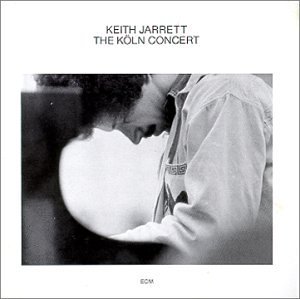
Keith Jarret, The Köln concert, 1975
If you want to make a German laugh, tell them you have been listening to Keith Jarret’s The Köln Concert (1975). This very pretty recording of the artist’s live solo piano improvisation in Cologne is one of the biggest selling jazz albums of all time. The laughter will be out of slight embarrassment for you. Not because of the unadulterated pleasure this album offers the listener, although somehow that is embarassing too, but because it was at one time a cultural behemoth that has few referent points in the present. The Köln Concert is my musical guilty pleasure, because listening to it always makes me cry.
Like few other albums, the Köln Concert holds special significance for me. At certain times in my life I have become fixated on it, listening to it repeatedly. I have this relationship with only two other records, Neil Young’s After the Gold Rush, and Substance, the Joy Division singles compilation. Each elicits from me a specific brand of melancholy, one that risks being ‘worn out’ through overindulgence. And just as easily as these private episodes begin they will be over, the music to be forgotten for sometimes years on end.
If the virtuosity of Jarret’s improvisations is in some sense his music’s content, I suspect that at one time in Germany the Köln Concert represented a welcome freedom from the past. Today, however, it can sound more like solipsism, a self-absorption of the man into the realms of his exceptional musical technique. Like the New Age spirituality with which The Köln Concert shares a 70s provenance, Jarret’s music works hard to free itself of its inheritances, which makes it ecumenical at best; at its worst it sounds dangerously like musical kitsch.
For the jazz enthusiast, I am sure there is nothing embarrassing about liking Keith Jarret. But save for the work of Thelonious Monk –who no coincidence is also a virtuosic pianist– I don’t listen to jazz. I came to the record through Nanni Moretti’s 1993 film Caro Diario (Dear Diary). In it, music from The Köln Concert accompanies a sequence where the camera follows the director on his moped, riding through the scraggy outskirts of Rome on a late summer day. Arriving at the site where Passolini was murdered, the camera gazes through a wire fence. Marking the spot is a weathered concrete sculpture, and beyond it lays a disused overgrown football field. Overall, the effect is devastating. Jarret’s music redeems the desolation of the landscape, at the same time as the film sequence brings out the tragic dimension of its beauty. I am not alone in feeling this way; I originally went to see Caro Diario because a friend told me it made her cry, which in art is a high recommendation. Today you can watch the clip on YouTube. Most of the comments are in Italian, but a certain gentlemen, dariobr83, echoes this emotion when he says, “every time I watch it I feel shattered…”
Rosemary Heather
This text was commissioned for Song-Ming Ang’s Book of Guilty Pleasures, a collection of 100 contributions from different artists, curators, musicians, and writers on their aural guilty pleasures, co-edited with Kim Cascone. It can be purchased here.
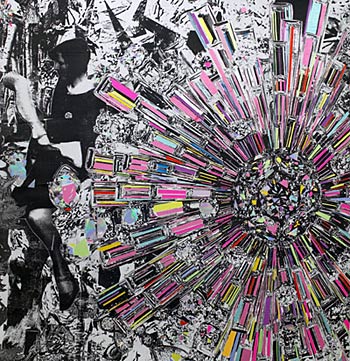
Kirstine Roepstorff, Pink, 2004, Courtesy Galleri Christina Wilson
In his famous text Collage, written in 1959, Clement Greenberg talks about the “shock value” of the technique. Somewhat shocking in itself, the remark harkens back to a time when mere artistic innovation could have the power to be troubling. Little did Greenberg suspect that the alarm was justified. By introducing fragments from the outside world to the surface of the painting – real things like bits of newspaper, or oil cloth – Cubist period Picasso and Braque helped to predict the demise of old world aesthetic standards, a protracted process that art continues to undergo to this day.
An avant gardist himself in his critical practice, Greenberg was contemptuous of the then commonplace idea that the extraneous elements used by the Cubists represented the necessary corrective of “reality” in the face of the growing abstractness of Analytical Cubism.” Scoffing at the suggestion that things glued onto a painting’s surface were any more “real” than those depicted within the picture plane, he went to all but extraordinary lengths to prove why this might be true, and invented a theory of modernism in the process.
At the time, Greenberg’s argument that the cubist technique of “depicting flatness” – a painterly method of self-cancelling 3D illusionism – represented the salvation of the medium did have some persuasive value. In the 1950s, the class divide between high and low regimes of taste was readily apparent. It was a cultural climate that gave credence to one of the American critic’s more outlandish ideas: the notion that medium-specificity adhered to rigorously enough could make painting immune to the influence of the wider culture. But as with any self-regarding elite, whether persons or art practices, an insularity practiced to this extreme is in itself a kind of death knell.
What I am referring to here is not of course that perennially popular– and maybe finally over – conversation about the Death of Painting, but rather the connected event of the death of necessary skill or technique in art practice.
This was the future that was augured by collage. After all, when Braque stuck, as Greenberg says, “a very un-cubist graphic depiction of a tack with a cast shadow” onto his 1910 painting Still Life with Violin and Pitcher, he was not only placing it there as a reminder of the medium’s illusionistic past, he had also discovered an entirely new category for the practice of art, one that would go on to almost swallow the discipline whole: the readymade.
Although Duchamp’s innovation in this respect was roughly contemporaneous – and it was the French artist who made the possibility explicit – the Cubist choice of the still life as the genre best suited to their radical form of artistic experimentation looks, from the perspective of today, like nothing so much as the readymade’s foreshadowing.
Contrary to Greenberg’s argument, so elegantly rendered, about continuity of the aesthetic ideals that his version of modernism ensured, collage represented the first puncture hole in the visual arts’ commitment to the principles of classical culture. The moment of deflation that is collage, the implications of which Greenberg tried so hard to resist, was nothing so much as the noise of real life rushing in. Listen for it now and you can still hear the whooshing sound.
By Rosemary Heather
This text was commissioned for Fleur du Mal, 2007 (Daddy III. A project of Peres Projects, Berlin). Guest edited by Kirstine Roepstorff, Fleur du Mal can be purchased here.





 Rosemary Heather