To better understand this new digital horizon, first, forget about the VR headset. It’s optional.
Text: Rosemary Heather Illustrations: Connor Willumsen November 17, 2022
Maybe you got your first impression of the metaverse from Meta founder Mark Zuckerberg’s awkward demonstrations. Donning the Oculus virtual reality headset, Zuckerberg presented the metaverse as an immersive digital social landscape where, in his words, “you’ll be able to sit as a hologram on my couch, or I’ll be able to sit as a hologram on your couch.” Reaching only as far as a virtual reality Second Life, the tech billionaire omitted what is both exciting and concerning for anyone invested in our newest digital horizon. What does the metaverse mean for our creative lives and professions?
In his book The Metaverse and How it Will Revolutionize Everything (2022), author and venture capitalist Matthew Ball suggests that the metaverse is best understood as an evolution of massive multiplayer online (MMO) games like Roblox or Fortnite. With huge user bases, these MMOs thrive without the use of virtual reality. World of Warcraft boasts over 100 million players. Minecraft welcomes 130 millions players every month. The concurrent player record for Fortnite was 78 million of its 350 million registered users worldwide. The population of these games equal the planet’s largest countries and earn revenues to rival the most successful companies on Earth.
Players in these games are building worlds and are protagonists in their own stories. In Fortnite, you fight to be the last player standing. Minecraft offers a different kind of survival game—acquire resources to build or perish. Social media—Facebook, etc.—likewise, are powered by user agency in an online world. Together, MMOs and social media form the pistons and engine of the 21st century economy.
Ball defines the metaverse as a series of interconnected online worlds “that can be experienced synchronously and persistently by an…unlimited number of users”. MMOs lay the groundwork for this. Ball discusses rapper Travis Scott’s 2020 concert in Fortnite. Attended by 28 million users, the 10-minute long show gives a foretaste of what the metaverse might be like. MMO events can take place at a massive scale, with real world effects. Scott debuted a new song during the show, which subsequently went to #1 on the Billboard charts. Ball describes the technical workarounds Fortnite used to make the concert possible. (Attendees were actually split between 250,000 copies of the event.) All MMOs have ways to accommodate this challenge of player concurrency. It’s one of the many problems that must be solved before the metaverse becomes a reality.
Bigger picture, the metaverse—this series of interconnected online worlds—will happen when another technical challenge is solved. Herman Narula, co-founder of metaverse technology company Improbable and author of Virtual Society: The Metaverse and the New Frontiers of Human Society says that to be viable “the metaverse has to involve experiences in which value is exchanged from one world to another.” That is, starting with MMO games and their economies, the economic systems of other online entities, like Amazon, plus other entities yet to exist, at the point when these entities interact with each other, the metaverse will be born. Connecting all of these worlds will be digital assets like cryptocurrency, and other non-monetary forms of digital tokens. The metaverse, in other words, is a use case for the digital asset economy. While speculation drives the crypto economy today, crypto-based play-to-earn games like Axie Infinity point to the future of digital assets online. Axie players buy, earn and trade an in-game cryptocurrency, which they can cash-out to fiat after a two-week holding period. In the metaverse, online environments will “talk” to each other, players being able to earn, spend and transfer currency from one world to another. For instance, online vendors could earn crypto selling in-game apparel and then spend that money on, say, Spanish lessons elsewhere in the metaverse.
Virtual environments need to be populated with all manner of virtual assets, thus marketplaces emerge for developers to contribute and earn passive income as they build and populate these worlds. However, the potential of the metaverse extends beyond in-game purchases, or the trading of assets via an online exchange. Narula, calls the metaverse “the internet of experiences”, and though these experiences require value exchanges, they need not replicate what is already available in the gaming world. Narula states, “any valuable metaverse strategy has got to involve experiences that are not currently extant in video games.”
What the online experiences that constitute the metaverse will look like is anyone’s guess, but at their core is the same open-source ethos and chain of accountability that powers cryptocurrencies and blockchain technology. Far from the dystopia described by author Neal Stephenson, who coined the term ‘metaverse’, these emerging worlds will center on, in William Ball’s words, “collaboration, creativity, and self-expression.”
From the beginning, the online world thrived because of its users. Technologists provided the tools, but internet users truly built the internet. The build-out of the metaverse will follow a similar path. While providing payment rails for this world, blockchain technology offers added benefits for users. The peer-to-peer transactions blockchain makes possible gives users much more agency than is possible in Web2. Open source tools combined with blockchain will create a user-owner internet—i.e. Web3, perhaps a better term than the metaverse to describe the next era of the internet.
Original text can be found here. Commissioned by Sebastian Frye @ East Room
This essay looks at blockchain-based staking networks as a prototype. Staking is a way to collectively manage a network using cryptocurrency dividends to incentivize participants. A staking network also provides the tools for decision making. In this basic form of network governance, the foundation is laid for a new era of internet citizenship. Broadly speaking, the first internet gave voice to the individual, and gave a home to niche concerns. Communities were built based on common interests without regard to location of participants. This ability to “connect” people, was a much ballyhooed capacity of the early internet. The next internet gives this connected populace new powers; specifically, a new understanding about the kinds of self organization the network makes possible. With the first internet, platform interfaces like Facebook and Google brought communities together—and grew massively rich in the process. The next internet changes the narrative. Power shifts away from the internet giants, by giving voice not only to niche but also collective interests. With the current internet, the value created by network effects has accrued to the entities that own a platform and its network. By contrast, staking enables the value created by a network effect to accrue to the users of that network.
Staking is an incentive/disincentive mechanism for the alignment of group action. As such, staking presages cryptocurrencies creating a new kind of internet, one based on the self-organizing tools blockchain makes possible. This includes the mainstream emergence of the DAO (decentralized autonomous organization), a format for collective governance, as a new type of online organization. Taking first a look at how the conditions for staking are embedded in the current UGC (user generated content) internet, the essay ends with recommendations to 221A for 1) running one or more nodes as part of the organization’s conceptual and business practice; 2) creating a staking pool pilot project to promote crypto web adoption in the legacy arts community.
Introduction
The culture of the current internet is an effect of users embracing the technology—specifically, in the form of user generated content (UGC), i.e., posting photos to Instagram or family news to Facebook, writing restaurant reviews on Yelp, participating in discussion boards on Reddit, or setting up a side-hustle on an ecommerce platform like EBay. Most internet users don’t do all of these things, but they probably do a few of them, daily. Blockchain technology offers a further iteration of this hands-on relationship to the network. The current internet profits from UGC by monetizing user data. Blockchains hold out the possibility for users to own and make money from their data—just one example of the utility blockchains can bring to internet usage.
“Blockchains are in the process of building an internet with stakes.”
UGC creates much of what we experience as contemporary culture today. Internet-based communities thrive globally. Through memes, tweets, message boards, chat rooms and other forms of shared internet content, UGC generates today’s cultural conversation. The negative effects of this are well-known. UGC is a vehicle for fraud, bullying, and disinformation. The consequences have been world changing. Weaponization of UGC by foreign and domestic actors created the still unfolding Brexit drama—just one example. Another: the global pandemic is best understood as a public health crisis, but UGC distorts the problem. Internet born tribalism needlessly politicizes the issue. Viral videos of anti-masker tantrums become flashpoints for culture war polarization. Covid19 vaccines bring a post-pandemic world into view, but UGC-fuelled anti-vaxxers threaten to prolong the crisis, needlessly.
Blockchains have the potential to be UGC on steroids, with all the attendant good and bad effects. This is already evident in the booming global culture that surrounds cryptocurrencies. However, looking beyond blockchains used for financial speculation, other possibilities come into view. Blockchains are in the process of building an internet with stakes. [1] This is UGC with stakes for the user, to be won or lost. More mundane than a dystopian Libertarian-led future, blockchain based solutions offer a chance for a better internet.
The Internet
The writer Joshua Cooper Ramo has a maxim: connection changes the nature of an object[2]. It’s a useful idea. For example, in the aftermath of World War II there was broad agreement that fascist ideology was a bad thing. The fight against resurgence included the banning of Nazi affiliations. Network connection wreaks havoc on this principle. Not only does Facebook not ban Nazis, it gives them a platform. Facebook is indifferent to the negative unintended effects of its own power, claiming not to be the “arbiter of truth” in Mark Zuckerberg’s words. But the power of the platform creates connections between the would-be Nazis among us. Connection changes the nature of the object. In this case, the Nazi creed is no longer constrained by the laws of sovereign nations—or even the shared values upon which the post-war consensus in the West was built.
Cooper Ramo writes: “The act of linking our bodies, our cities, our ideas—everything, really—together introduces a genuinely new dynamic to our world. It creates hyperdense concentrations of power. It breeds fresh chances for complex and instant chaos.”[3] He notes that we are at the early stages of this epochal shift, which is as consequential as the Enlightenment or the Industrial Revolution.
“NETWORKS DEFINE US BEYOND THE ABILITY ANY ONE OF US HAS TO OPT OUT OF USING THEM.”
The origins of this transformation began in the late 1960s when ARPANET[4], a project of the U.S. Department of Defence, began to study how to share information across a network of remote computers (a node is a nexus of data transmission on a network and the initial network consisted of four nodes). The solution they chose was packet switching, in which data is broken up and transmitted across the network, then assembled again at its destination. Packet switching ensures broken spokes in the network are inconsequential. Designed to ensure that data seeks the most efficient path of transmission, a broken spoke means data shifts to another path. The operational resilience guaranteed by packet switching makes use of the redundancy built into network topography. Duplicated paths of transmission overcompensate for potential failure points in any one part of the network. This foundational internet is in essence a distributed computing operation, and carries within it the seeds of what will become blockchain technology more than 40 years later.
The Blockchain Internet
Today’s internet is a success because the protocols at its base layer have been designed as open source and not proprietary. Using these freely available technical specifications private companies have each built their own little corner of the web. The utility of the technology for these companies derives, however, from each segment’s connection to the wider network. In this sense, the network is collectively managed. Through self-management, each section of the web contributes to the viability of the network as a whole; at the same time, the network as a whole isn’t dependent on any one part of the network to remain viable.
The story of the contemporary web[5] starts with private entities building proprietary applications on top of this network made from open protocols. 40 years on, Facebook, Amazon, Netflix and Alphabet (Google), are amongst a “new breed of companies that are the fastest growing in history”.[6] Collectively known as FAANG, these companies have created immense value, and changed the world in the process, all because each one found a business use case for networks. The global popularity of user generated content has been key to their success.
Through the network—and its extension through mobile and web apps—FAANG have shown an incredible ability to scale. Their business model combines free use of apps and platforms with data collection of the resulting online activity. Users readily incorporated UGC into their lives because of its utility as a “social” media[7]. The network enhances already existing social networks through the facility of connection, offering a form of convenience and personal affirmation that is difficult to resist.
With UGC, citizens of the world become de facto citizens of the internet, because of what these internet tools enable users to do. This agency plays a foundational role in 21st century commerce. In 1980, the futurologist Alvin Toffler coined the term “prosumer”[8], which combines consumer and producer into one. Toffler suggested the idea in reference to what he predicted would be a trend of mass customization, in the wake of a saturated market for standardized products. Toffler foresaw the lack of differentiation in mass production leading to bespoke products tailored to consumer tastes and needs.
With the advent of network society, customization took on a different form. The reason for this was not only a need for market differentiation. Far more important is the kinds of user agency digital tools enable—i.e., our UGC powered digital life. On a digital platform, as the saying goes, the product is you (and your data). Toffler’s customization became a reality in the 21st century activity of creating one’s personal brand—for profit, social status, or just for fun—which UGC helps to facilitate.
A further factor is basic economic necessity. For many, UGC is a source of income. The rise of the internet has a parallel in the rise of neoliberalism. Neoliberal ideology, a belief in unregulated free market capitalism, has driven economic policy in the West for the last four decades. It’s legacy is a ruinous landscape of short-term jobs and stagnant wages. Neoliberalism has created an army of underemployed or undercompensated workers. This underemployment creates a highly motivated workforce, who are supplementing their income through the quasi self-employment offered by the “gig economy”. Writing in the Guardian, George Monbiot notes that neoliberalism “redefines citizens as consumers.”[9] Tofflers’ coinage offers a better fit: neoliberalism redefines citizens as prosumers. The gig economy of part time, on call, or temporary employment is arguably a species of UGC. Whether working as an Uber driver, delivering take out orders for DoorDash, selling your crafts on Etsy, or setting up an ecommerce business on Shopify, the performance rating you get from your customers is key to the continued viability of your gig employment. This market micro segmentation of the side hustle workforce makes good on Toffler’s vision. In the end, it’s just a more extreme version of the UGC invitation to become both producer and consumer of your own content. The need to secure wages is one driving factor behind the popularity of prosumption.
Web platforms have been shepherding users along this road to personal brandom for some time now. In early promotions of the network as a social technology, this idea was sometimes expressed by companies placing the prefix “my” ahead of a product or platform. For instance, the Facebook precursor, Myspace, which was the biggest social network by user base from 2005-2008; or CocaCola’s music download site MyCokeMusic.com, which had a relatively brief two-year existence in Europe.[10] Putting the user in the driver’s seat is the implicit message too conveyed by the “i” suffix appended to Apple products—the iPod, iPhone, and iPad (released in 2001, 2007, and 2010, respectively). Apple smartphones and their competitors enabled the creation of the mobile app economy. While at first, use of Facebook was limited to university students, by 2006 the app was made open to the public. The subsequent explosive use of the two products[11], Facebook and smartphones, is a clear case of business symbiosis. By the time of his death in 2016, Alvin Toffler had seen the prosumer become a dominant economic force, with the user playing a starring role in the rise of these technologies.
Recent years have proven, however, that UGC agency comes at a cost. There may be a symbiotic relationship between platforms and their user base, but only the platforms
got fantastically rich in the bargain. If prosumers created the internet behemoths, the behemoths repaid them with an erosion of their personal well being on a number of fronts. On the neoliberal internet, precarity is a way of life. Worker entitlements, such as health benefits and paid sick leave, threaten gig economy profit margins and tend to be avoided, if possible.
In 2020, a group of app-based companies in California, including Uber and DoorDash, sponsored the Proposition 22 ballot initiative. Prop 22 was successful, ensuring that gig workers in the State would continue to be classified as independent contractors and not employees. This, the most expensive ballot initiative in California history, is worth mentioning because of the way it exemplifies the Gordian Knot of problems facing an internet-based workforce. The platforms behind Prop 22 spent over $200 million USD to avoid costs associated with employing, as opposed to contracting, their workers. In advance of the ballot vote, Uber bombarded its drivers with messages urging them to support the initiative. A group of Uber drivers fought back with a lawsuit against the company, claiming that the “barrage” of messages violated their employment rights. The lawsuit was ultimately unsuccessful because it could not prove that drivers would face penalties from Uber for not supporting Prop 22.[12] Regardless, Uber subjected its drivers to a kind of app-based psychological warfare. The workplace intimidation was implicit, if not liable in a court of law. The case shows that, in addition to precariously employing its workforce, Uber imposed a disciplinary regimen on its drivers, even if more implied than stated. This is in addition to the monitoring drivers are subject to via the performance ratings they get from their passengers.
The Uber story is part of a larger tale about today’s participatory surveillance culture spawned by UGC. The tracking of user data creates today’s familiar bastions of internet empire (Facebook, etc.), while also subjugating users as fully surveilled points of aggregate data.[13] The thinking around surveillance capitalism is beyond the scope of this essay. Still, the concept should be noted in passing because of the way the surveillance capitalist extracts value from internet relationships. Facebook, for instance, monetizes the data related to not only your internet purchases, but also your interests—the groups you belong to, the conversations you participate in, the stories you “like”. So there is internet commerce made up of the platform as a marketplace for goods and services; then there is another commercial internet, one that profits from the data internet usage produces. The internet self is thoroughly enmeshed in the imperatives of internet commerce. These are imperatives that play out in the form of algorithmic behaviour modification or control. The relationship is “top down”. As noted, however, this top down dynamic (me as a highly differentiated but still categorized Facebook user subject to algorithmic nudges and manipulations) is still dependent on a “bottom up” dynamic, one that consists of my online life, an entity that comprises me and all my myriad internet-based relationships.
Having an internet life is an already established behaviour. Within it lies the seeds of the next internet, one that extends today’s UGC-based forms of internet agency and commerce. The sharing economy, as represented by AirBnB and Uber, can be seen as an early form of this new type of internet relationship. You can rent out your home on AirBnb through a connection made possible by the network. Using AirBnB is different from subletting your home through newspaper want ads or even using Craigslist, because of the app’s reputational scorecard. Though not perfect, online reputation metrics instill a sense of confidence about a transaction. AirBnb and other sharing economy apps are living documents of this form of internet-based relationship.
Creating, while simultaneously documenting, collective events in real time is a fair definition of what the internet does. It’s also a pretty good definition of the blockchain.[3] Bitcoin, the original blockchain use case, was invented in 2008, and is the brainchild of a person or group of people known by the pseudonym Satoshi Nakamoto. Blockchains today create the backbone of a new type of internet. A blockchain is in essence a database, but one that is duplicated thousands of times across a network of computers and is subject to ongoing self-audits to reconcile its content. On average, these self-audits happen in regular intervals (depending on the blockchain), each one producing a block of data, which is added to the list (the chain) of transactions. This is a way of using the network that has obvious benefits. The blockchain database isn’t stored in any single location, meaning the records it keeps are truly public and easily verifiable. No centralized version of this information exists for a hacker to corrupt. Hosted by thousands of computers simultaneously, its data is accessible to anyone on the internet. Since its invention, the Bitcoin blockchain has operated without significant disruption. To date, any problems associated with Bitcoin have been due to hacking or mismanagement of applications associated with the blockchain, not the infrastructure itself. In other words, these problems come from bad intention and human error, not flaws in the underlying infrastructure.
A network of computing nodes make up the blockchain. Together, nodes create a powerful second-level network, a wholly different vision for how the internet can function. Every node is an administrator of the blockchain, and joins the network voluntarily (in this sense, the network is decentralized). Collectively, the nodes on a blockchain manage a ledger of transactions, which is constantly updated according to a cross chain agreement, or consensus. (Because of the role node operators play in network consensus, they are often also referred to as network validators.) The Bitcoin blockchain operates according to the proof of work (POW) consensus algorithm. POW offers each validator an incentive for participating on the network: the chance of earning bitcoins.
Nodes are said to be “mining” bitcoin, but the term is something of a misnomer. In fact, each one is competing to win bitcoins by solving computational puzzles. By design, nodes operating the POW algorithm have a low probability of success in each competition, in effect randomizing the process. This guarantees an averaging out of successful validators across the network[14]. Bitcoin’s cross-network computing process, which undergoes regular self-audits, ensures that the data it manages is secure. However, while it is extremely difficult to override the network, this form of data security comes at the cost of an excess expenditure of network resources.
Blockchains burn electricity to mint coins; specifically, POW blockchains do this. Bitcoin, as the marquee example of a cryptocurrency, is often derided as being extravagantly wasteful for this reason. Proof of stake (POS) is the proposed solution to this problem.
The Staking Internet
Bitcoin was the raison d’etre of the blockchain as it was originally conceived. In the decade following bitcoin’s invention, thousands[15] of other versions of this blockchain use case have been created, to varying degrees of success.[16]
A bottom-up internet already exists, to the extent that it was built by UGC. But the agency UGC provides users comes with considerable costs. These are not limited to the invasion of privacy that comes with tracking of user activity across the network (those ads you see on Facebook connected to your Google search the day before). Free access to internet platforms also enables all manner of internet fraud, imposture and distortion of information.
Blockchains turn the internet into a mechanism that can create value and authenticate digital information. With Ethereum, the number two blockchain by market capitalization (Ether is its native token) blockchain technology gains an additional layer of functionality[17]. Launched in 2015, Ethereum has the most active developer ecosystem of any blockchain. The platform was first envisioned by the technologist Vitalik Buterin in a white paper he wrote when he was seventeen. Buterin’s vision was to make blockchains programmable through the implementation of automated, chain-based “smart contracts”[18]. Blockchains use networks as secure, encrypted data verification mechanisms; building on this capacity, a smart contract executes on a blockchain when certain pre-specified conditions are met. A data feed of real time information would trigger such an event. A simple example would be a successful bet placed on the outcome of a sports match, which would then prompt a cryptocurrency payout. An online ecosystem that combines the legacy internet with blockchain technology enables this kind of chain-based automation.
In Buterin’s vision, Ethereum has the potential to create a global computer, or what he calls the Ethereum Virtual Machine (EVM). If fully realized, Ethereum creates a network that thrums with countless automations. Smart contract use cases are in development for everything from cross border finance and solar grid management, to home purchasing (transfer of title) and voting in elections. This vision for the EVM is notable for the way it gives the user a more direct role in certain kinds of transactions, while displacing the people and bureaucracies that previously acted as intermediaries for them. Blockchain users can leverage the network for direct (peer-to-peer) interactions with a vast field of potential connections globally. This is today’s internet, in other words, but with a powerful added dimension of functionality made available to the user.
Blockchains are a mechanism for creating digital network-based value. A smart contract based ecosystem for digital assets is being steadily built out to leverage this value.[19] The staking internet plays a central role in this ecosystem, in two ways: as a vehicle for financial investment, and as a function of network security.
As a financial investment, a staking internet is an internet with table stakes for its users. In a gaming enterprise, investing table stakes means you are willing to risk losing your stake for the chance of winning more than you bet—poker, sports betting, etc. In a business context, Wikipedia defines table stakes as the “minimum requirement to have a credible competitive starting position in a market.”[20] It’s a similar proposition of winning or losing on a bet in a game, but with higher real world consequences.
What staking means in the context of a network is somewhat different. The competitive starting position of networked table stakes is by definition a collective proposition. This is true not simply because staking is a form of pooled investment; in general, traditional financial products—a pension fund, for example—also fit that definition. The difference resides instead in the internet-based, peer-to-peer nature of the staking relationship. Simply put, staking is an evolution of certain types of behaviour the internet makes possible. Automations combined with self organization contribute to the viability of whatever good on a network is under collective management.
As a function of network security, the staking internet is a foundational part of the EVM. Staking is made possible by the proof of stake (POS) consensus algorithm. In late 2020, the Ethereum blockchain began the process of shifting from POW in favour of the less resource intensive POS, a long promised upgrade for the platform. POS achieves network security in a similar way to the POW blockchain protocol: through the management of a shared ledger that is reconciled at fixed intervals by network validators. However, whereas POW requires cross network computing to verify each transaction, POS takes a different approach to achieving network consensus. POW blockchains incentivize network participation by rewarding node operators with coins. With POS, validator nodes stake coins (i.e., make a security deposit) in exchange for the right to help manage the network. Stakers earn interest on their deposits from network transaction fees, with stakes locked in for a specified amount of time. For each block produced, validators are selected according to a randomizing algorithm. Through this randomizing process, each validator is incentivized to help manage the network via the chance to win a block of coins. Equally, validators lose some or all of their stake in response to any action that is detrimental to the network. Leaving the POW protocol for POS allows Ethereum to process transactions faster, promising greater mainstream viability. Ethereum’s move to POS is still early enough in its implementation to be considered unproven. If successful, it will help to scale the network, in theory creating a cryptocurrency ecosystem that rivals legacy finance.
The Emergent Internet
“We’re at the Early Stages of a Truly Novel Structure That can Organize Humans and Money”[21]
Olaf Carlson-Wee
Blockchains have the potential to shift the top-down internet into a more equitably bottom-up technology. Incentivization to form relationships on the network is at the heart of the cryptocurrency story. Because it’s still in the early stages of its development, most blockchain success stories adhere closely to the original raison d’etre for the technology: internet money. But that will change. Networks + crypto presages a new era of networked relationships. Financial incentives made possible by crypto have the potential to transform the relationship users have with their internet lives. Particularly ripe for change is the top-down dynamic in which users enrich the internet giants in exchange for the privilege of having a digital life.
One proof of concept for a bottom-up internet derives from staking; i.e., the user’s participation in the proof of stake protocol. For the typical user, staking as it currently functions is a way to earn interest on your crypto, much like earning interest on your savings account in a legacy bank. In many important ways, however, staking is an entirely different proposition. An investment in a stake is an investment in the staking protocol. Staking is a prototype version of a more fully user controlled bottom-up internet, in other words.
These negative effects of internet use are well-known. However, the advantages of UGC are such that users tend to overlook its downside. The value created by users is primarily social—though this generalization should of course include every business opportunity that comes from participating on the network, along with all businesses launched on the internet or because of it. In terms of producing a skilled army of content creators, however, UGC lays the foundation for the next era of internet use, one that is underpinned by cryptocurrency networks. This means, potentially, that social interactions on the web (restaurant or product reviews, commenting on and liking your friend’s post, producing and sharing memes, etc.) could be profitable for users. Further, the enhanced utility that users get when UGC is combined with cryptocurrency will in all likelihood have other more profound effects, starting with the users’ relationship to the network.
Staking blockchains have the potential to reset the balance between the proprietary web and its vast global user base. The large internet entities get their massive scale because of how easy it is to coordinate users on the internet. Users come together on the current internet most typically by virtue of common interest and shared emotion. In the best version of this internet, money is raised through crowdfunding for people in need. In the worst, the internet crowd becomes a mob, one that bullies without consequence. Staking promises a better internet, one on which altruism and self-interest align, and where bad actors get penalized.
“Token networks… align participants to work together toward a common goal.”[22]
Chris Dixon
Currently, this kind of alignment happens at the level of the crypto token. As Chris Dixon, quoted above, notes: the common goal for today’s active crypto networks is “the growth of the network and the appreciation of the token.”[23] This feedback loop drives the creation of value in the cryptocurrency industry. Joel Monegro describes it as a process in which token holders are “stakeholders in the protocol itself.”[24] Another way of saying this is that successful network projects benefit from network effects[25], but with users investing in the network itself. Early investors in bitcoin or ether are also creators of the network. This happens either through the building of products or services that help extend its functionality, or through pure speculation on the tokens. The thousands of tokens[26] that come after bitcoin and ether, took a similar approach (if not to similar success in the majority of cases). If cryptocurrencies get derided as ponzi schemes it is because of this curious tautology that lies at the heart of their inception: users of the network own the network. Running a blockchain node or staking on the network offer two variations on this idea.
A large part of crypto activity today focuses on speculation.[27] But this happens alongside the many blockchains that are prototyping other kinds of use cases for the technology. Innate to this stakeholder internet is the true meaning of decentralization. User-owned networks reduce the role of intermediaries and allow users to directly accrue profits that typically go to large entities like Google et al..[28] Staking is only the beginning of this transformative approach to online life, one that in future will include users owning and profiting from the data that accrues from their activity online.
Decentralized Autonomous Organizations (DAOs)
The UCG internet is the result of an ongoing mass collaboration. This starts with the router that connects users to the network, on up to the posting, commenting and sharing of daily internet use. Most users don’t think about the underlying network infrastructure that makes UGC possible—or they do, but only when their network stops working and they need to contact their internet service provider (ISP) to troubleshoot the problem. Outages in network service tend to be temporary and easy to fix. Similarly, most users don’t think about the role they played in expanding their ISP network when they plugged in their wifi device. In this sense, everyone with an internet router runs a node on the network. However, the network is rarely thought of in this way. Instead, an internet driven by UGC agency dovetails all too perfectly with the imperatives of neoliberalism. The neoliberal ideology of self-actualization fits nicely within the UGC fairytale, which gives users a voice, an audience, and in some cases material success. This ideology disconnects users from their agency as a collective entity, however, even as users enjoy the benefits of their digital agency on a daily basis.
There’s an argument to be made that legacy media instills the disconnect users have to the role they play in helping the large internet platforms to prosper. No longer passive receivers of the broadcast media, the UGC internet populace nonetheless are passive about the personal cost of their internet use: free labour, daily surveillance, and behaviour manipulations. Up to now, reasons to think about the role each user plays in the UGC mass collaboration have been lacking. But crypto networks, and specifically staking networks, provides a reason—and more importantly an incentive—to having a more hands on relationship with the network. The opportunity is not to just earn interest on one’s crypto but a shift in perspective. Staking offers a step forward in a much needed reorientation of users’ relationship to the network. What previously was freely given away to the large internet entities becomes a new form of collective power. At its most basic, this power resides in an understanding of the role we can play in the management of staking networks and the seeds of a new agency this gives us.
As a leading art organization, my recommendation is that 221A stake on and set up and run one or more blockchain nodes. This would be the first step in an educational outreach initiative to explore what an internet underpinned by cryptocurrencies could mean for artists and arts organizations internationally. The longer-term objective would be to create a DAO as a collective experiment in online community building.
Bitcoin mining is now dominated by a few large players. Huge resources are needed to run a profitable mining operation, pricing most people out of the market. Staking offers a counter narrative. It is simple to stake on a network using an app. To run a node and become a validator on a staking network requires a more serious investment of business resources. In its own particular way, however, staking has the potential to fulfill the original vision for bitcoin: a decentralized network that rewards everyone who participates in its management.
221A would be a leader in building a stakeholder network of organizations. Beyond this, the goal could be for 221A to expand their node/staking activity into the running of a DAO. Blockchain technology enables the creation of a network owned and operated by its users. The format of the DAO adds governance mechanisms to staking-based network engagement. The potential that DAOs offer for creating new relationships, between users and the network and between arts organizations, is still at a very early stage. As an organizationally innovative arts organization, 221A is well positioned to explore the potential of this technology in the formats of staking/node operations and DAOs. Below, I propose one idea for a pilot project designed to introduce artists and arts organizations to the crypto space, with a view to securing their longer-term participation on the crypto internet.
A 221A Staking Pool Pilot Project
I recommend that 221A explore setting up a staking pool; i.e., pooling the crypto resources of participants with the purpose of earning crypto dividends on a staking network. For instance, a minimum amount of ether could be determined for participants to join a 221A run Ethereum Beacon Chain node. Terms of participation—such as timeframe of commitment (how long the investment is locked), what percentages of revenues are (calculated in proportion to amount invested), and terms for participants to exit—could be programmed into a smart contract. Other decisions could be determined through a DAO, with investment in the staking pool giving participants voting rights (one vote per investor). Further, a pooled investment on a crypto network could be the preliminary stage of 221A setting up an artist’s trust. In the trust, revenues from pooled resources could be allocated as determined by DAO participants. If it functions as a nonprofit, the staking pool and trust should not violate the terms of 221A’s nonprofit status, though of course more research on this question would be needed. Overall, the project’s goal would be to create better awareness about the next web and its utility for new forms of collective intelligence and network-based collaboration.
Footnotes
[1] Tech billionaire Peter Thiel, cofounder of Paypal and an early bitcoin investor, one of the most high profile proponents of seasteading, is an investor in the Seasteading Institute. See: https://www.seasteading.org/
[2] Joshua Cooper Ramo, The Seventh Sense: Power, Fortune, and Survival in the Age of Networks (New York: Little, Brown and Company, 2016)
[5] Though often used interchangeably, the internet and the web are two different things. The former refers to the open protocol network; the latter, to the proprietary internet that has been built on top of it.
[8] Alvin Toffler, The Third Wave: The Classic Study of Tomorrow (New York: William Morrow, 1980).
[9] “Neoliberalism sees competition as the defining characteristic of human relations. It redefines citizens as consumers, whose democratic choices are best exercised by buying and selling, a process that rewards merit and punishes inefficiency. It maintains that “the market” delivers benefits that could never be achieved by planning.” George Monbiot, “Neoliberalism – the ideology at the root of all our problems,” The Guardian, April 15, 2016. https://www.theguardian.com/books/2016/apr/15/neoliberalism-ideology-problem-george-monbiot
[14] In theory—the near monopolization of bitcoin production by a few players in an ongoing problem. China has dominated in recent years, but that could be changing. Tom Wilson, “Crypto asset manager sees bitcoin mining shift from China to North America,” Reuters, February 11, 2020 https://www.reuters.com/article/us-crypto-currencies-idUSKBN2052FW
[16] Estimates are that, to date, over 1700 cryptocurrency experiments have failed. The list includes many scam or joke coins. Coinopsy is a site that indexes failed coins. Though easily dismissed as noise, a quick scan of the site provides a snapshot of an internet ecosystem made up of professional and niche communities that were thought to have a potential user base for a cryptocurrency token. See https://www.coinopsy.com/dead-coins/
[17]Ethereum has inspired many rival smart contract platform projects. When judged according to the amount of “meaningful economic activity” each one shows, these so-called Ethereum killers appear to have failed in their mission. See : Matthew Finestone, “Ethereum Enhancers, Not Ethereum Killers,” Coindesk, October 14, 2020, https://www.coindesk.com/ethereum-enhancers-not-ethereum-killers
[18] The concept of smart contracts was first proposed by Nick Szabo in 1994. In 1998, Szabo also proposed the idea of bit gold, a digital currency that is recognized as the precursor to bitcoin. https://en.wikipedia.org/wiki/Nick_Szabo
[19]2020 saw huge growth in the popularity of decentralized finance, or DeFi, most of it built on the Ethereum blockchain. See: Alyssa Hertig, “What is Defi?” Coindesk, December 3, 2020 https://www.coindesk.com/what-is-defi
[24] “When a token appreciates in value, it draws the attention of early speculators, developers and entrepreneurs. They become stakeholders in the protocol itself and are financially invested in its success. Then some of these early adopters, perhaps financed in part by the profits of getting in at the start, build products and services around the protocol, recognizing that its success would further increase the value of their tokens. Then some of these become successful and bring in new users to the network and perhaps VCs and other kinds of investors. This further increases the value of the tokens, which draws more attention from more entrepreneurs, which leads to more applications, and so on.” Joel Monegro, “Fat Protocols” Union Square Ventures, August 8, 2016 https://www.usv.com/writing/2016/08/fat-protocols/
[25] “The value of a product or service increases according to the number of others using it.” “Network effect,” Wikipedia. Facebook is the par excellence example of a business benefitting from a network effect. For multiple millions of users, their personal networks on Facebook provide a value that banishes any thought of leaving the platform. https://en.wikipedia.org/wiki/Network_effect
[28] That is, the dominant global tech companies collectively referred to as FAANG: Facebook, Amazon, Apple, Netflix and Alphabet (formerly known as Google).
KIKA THORNE, MEDICINE (2009/12), ELASTIC, HARDWARE, 60′ X 13′ X 11′.
As the circle of projection becomes the rectangle of screen, the transition is a form of the question “How can one thing become something else?”
If cinema and its precedents picture and extend what we can see and experience of our world, what does medicine do? Locate that experience in the body and maybe more to the point in the cells of that body, which are “elastic and magnetic — oscillating, communicating.”[1] What is medicine? Not cinema but its antidote, the artwork that you stand inside, an apparition of that technology which evokes its memory—pays homage to it—while dispensing with any need for cinema’s projections. A kind of medicine for our time, medicine is technology that extends and transforms our world by moving its users deep inside the moment of their own being.
—
Think of this essay as structured by a relationship between two concentric circles. In the largest, outside circle we have the field of ideas associated with the concept of posthumanism[2]; in the smaller circle inside of it we have an artwork that can be seen to embody certain aspects of this concept’s meaning. It is important to specify that the idea of posthumanism designates not a progression but a shift, one that we can detect evidence of in Thorne’s work. The “post” appends the “human”, tethers it—to drop the chronological metaphor—to the extended environment within which we are all immersed regardless. The shift resides in a change in how we understand this, a now-in-process transformation in our perception of what constitutes our realm of being.
The concentric circle is proposed as the notional structure for this text as a way to contextualize Thorne’s work in a fashion that is explicitly non-linear. No theory of progress is at work here. The circle is the right spatial metaphor as it implies a concatenating field of associations, or in other words, modulating ripples of meaning. The two concentric circles propose a relationship, one that subsumes the broader framework of posthuman thought within a much more specific context: that is, an artwork made by Kika Thorne, which is as it should be.
In her own words, Thorne articulates the central investigation of her recent work as an attempt to bridge the divide between “utopianism and the capacities of the artwork.”
The artist’s long standing engagement with anarchist thought is important to the understanding of her practice as a whole and is the framework within which her use of the word “utopianism” takes its meaning. Thorne identifies as formative a milieu of artist-architects with whom she first began to develop her art practice, specifically naming Barry Isenor and Kenneth Hayes, creators of the seminal architecture zine, The Splinter (1989-1994)[3]; Marie-Paule Macdonald, coauthor with Dan Graham of the equally influential, Wild in the Streets: The Sixties (1994)[4]; and Luis Jacob, Allan Antliff and Adrian Blackwell, with whom she started the Anarchist Free School (1999) in Toronto’s Kensington Market. Working with this cohort and others, especially Adrian Blackwell, Thorne participated in the production of a number of projects intended to function as critical-Utopian introjections into public dialogues about urban and social issues that were urgent to their time. These projects took place under different guises, the group at different times and with differing configurations of members naming itself: The C-Side Collective, Fabricator, the October Group, the February Group and the April Group (which included Cecilia Chan and Christie Pearson) among others.[5]
How can making art be a political act? Art as an experience emanates from a particularity, a location in a time and place. In a literal sense, location is a limitation. An art context can only temporarily be a command center for activism; the opportunities it offers for the building of a lasting communal culture are limited. Instead, art allows for experiments in a different kind of potential, one that every artist seeks to realize in their work. Artworks can transform you when they simultaneously enhance and obliterate the circumstances in which they are encountered. How this translates into a politic, into an enacted Utopianism as opposed to an imagined one, is the central question of Thorne’s work, one to which she proposes possible solutions that are entirely in keeping with art’s circumscribed realm of efficacy. It is important to emphasize that posthumanism is not intended to evoke a cyborg future for humanity. Instead, the term “recognizes the embeddedness of human beings in not just its biological but also its technological world.”[6] This is an embeddedness that, in the artist’s terms, extends to the molecular level. Thorne quotes Walt Whitman: “My tongue, every atom of my blood, form’d from this soil, this air.”[7] Similarly, Thorne describes medicine, an artwork constructed from elastic cords, as a kind of molecular event, the artist working with materials to produce “an affinity of matter… the electrostatic energy of rubber’s stored bond distortions inducing vibration. I am not the author of this energy, just a collaborator.”
Posthuman thought holds out the possibility for a new vantage point for the human, one that emanates from the ground up. The goal it proposes: for the human perspective to become embedded within its wider environment, which is also true of the particular vantage point of Thorne’s immersive sculpture facilitates for its audience. In the posthuman, the human being becomes humbled, its assumed omniscience pulled back to earth to become grounded in, and refracted through, the material world in all of its multifaceted capacities. Posthuman thinkers seek a way forward out of an impasse of environmental destruction and unending economic crisis by ushering in a new era of human self-demotion. Considering it practical limitations, what can art bring to the conversation? Examination of Thorne’s work medicine can show how a collapse of perspective, of subject-object positioning, brings with it a necessary decentering, immersing its subjects within the concatenating vibrations of the paradigm that is now emerging.
The work medicineuses a single aperture in the centre of a gallery wall to structure a circle of 88 radiating black elastic cords that extend outward across the room to meet the rectangular frame of the far wall, which in the version of this work I saw at Toronto’s G Gallery[8], happens to be the frame of the space’s floor to ceiling glass-window entrance. A dazzling work, medicinehas a powerful effect far beyond the modest sum of its materials. It derives strong graphic impact from the contrast between the black cords the bright white light of the gallery space. As Adrian Blackwell, the artist’s frequent collaborator notes, medicine is “highly architectural as both constructed space and a linear drawing.”[9] Experience of medicine also impacts the body. The installation fills the space, to a certain extent displacing or impeding gallerygoers, who choose to negotiate the work by entering into it, engaging with an experience not available to those who choose to remain at its perimeter.
In its simplest form, a historiography for the artwork can be found in the precedent that will come to be understood differently, in a new light, when considered from then viewpoint of its successor, and vice versa, a circle crossing over itself, each helping the other to more clearly define its significance to its time. Thorne notes that the precedent for medicine is British artist Anthony McCall’s Line Describing a Cone (1973)[10], a film of a white dot on a black background that over a thirty-minute duration becomes a circle describing the space within the circumference of its frame. As the circle grows the projector beam gradually expands to become a cone of light. Writing about the work, Colby Chamberlain notes the work, “utilized the barest elements of film—celluloid and projected light—but it clearly needed to be experienced as a three-dimensional object, like a sculpture.[11]”
When comparing Line Describing a Cone with medicine, it is easy to detect two distinct paradigms: postminimalism and posthumanism, respectively. McCall’s “solid light installation” (one of a series the artist made) can be considered postminimalist in that he theatricalises cinema so that it becomes pure event, one that foregrounds the medium’s structural components. Line… forgoes a dependence on narrative and instead implicates its audience corporeally in the construction of its meaning. The posthuman implications of Thorne’s work reside in subtle variation on and extension of McCall’s accomplishment, as I hope will become evident below. What Line Describing a Cone/medicine share in common is, first, their formal structure: both artworks formally mimic the (film-based) spatial arrangements of cinema, projecting image and light through a lens across a room onto a definite field in front of it that is usually, but not always, a screen. Second and more important, both works forego the cinematic image, the very point of cinema, in favour of becoming the image itself. The appellative “Cinema without an Image” applies to both artworks, but it is arguably of greater significance in relation to medicine, in that Thorne’s work subsumes within it salient features of contemporary experience, the everyday distortions of time and place that come with the use of the internet, being one example. A text about McCall’s work at the Harvard Film Archive notes, “McCall’s focus on activating the participants and the site transcended the medium and pared the artistic process and concept down to its paradoxical and essential crux.”[12] Implicit to this statement is the idea that Line Describing a Cone encapsulates cinema as an art form, as if from the work’s vantage point we see the medium in a rearview mirror receding in historical time. Arguably this is the meaning of the activated spectator of the postminimalist artwork who, no longer the passive viewer, is invited to occupy the exhibition’s figural center stage along with the work. Though the light cone creates a definite boundary, one that could be transgressed, the cinema without an image is in this case a theatre with an elective proscenium. With the advent of the digital era, film seen as a light projected is almost a thing of the past and perhaps this was a message Line Describing a Cone subtly intimated. Making use of the material components of cinema, Line Describing a Cone is cinema made whole, seen within framework of the historically-determined form of perspectival vision that made it possible; as Adrian Blackwell observes: “film has a unique relationship to perspective, because it constantly repeats the act of projection that is perspective each time it is shown.”[13] By contrast, because of the way it changes the audience’s relationship to the artwork, medicine can be seen to shut the door on the historical era perspective that McCall’s work encapsulates. Enter into medicine and you cross a threshold, the work creating a space for its audience that is no longer the stage for a performance (i.e., the performance the audience enacts when it joins the artwork on the stage of postminimalism.) Instead of a space constructed to facilitate perspectival relationship to the artwork (or the transgression of such), medicine creates the experience of that relationship breaking down. Every position the audience might take in relation to medicine is the correct one and at the same time no more necessary to its experience than any other. Parity between audience and work is at the core of medicine‘s meaning, its relativism exactly scaled to the body of each participant who engages with it.
German art historian Erwin Panofsky, writing in the early part of the last century, noted that the geometrically correct perspectival space of pictorial representation was an invention of the Renaissance.[14] In a passage taken from his essay Perspective as Symbolic Form (1924-25) that could also be describing the radiating lines of Thorne’s work, Panofsky writes:
I imagine the picture…as a planar cross section through the so-called visual pyramid: the apex of the pyramid is the eye, which is connected with individual points in the visual image…the relative position of these “visual rays” [determining] the apparent position of the corresponding points in the visual image.[15]
Panofsky’s goal was to denaturalize linear perspective and recharacterize it as historical style, making it apparent that at the very least linear perspective is unfaithful to the physiological truth of how we see the world. From the vantage point of the early 21st century, a certain resonance comes from noticing that the German historian was writing around the time of cinema’s (the camera’s) first decades, when we can assume the art of “almost scientific”[16] pictorial representation was receding into the past of its historical relevance[17]. A further interpretation might extrapolate: Panofsky’s text suggests the symbolic, historically-specific purpose perspectival vision was meant to serve, which was to foster a broad, if not to say colonialist, cohesiveness. Out of the homogeneity of the picture plane that realizes “in the representation of space precisely that homogeneity and boundlessness foreign to the direct experience of that space”[18], come ideas about a further homogeneity: that of the beholder’s worldview. Certain implications are obvious, say an Imperialism that conquers to assimilate all within its dominion, to give one example. A similar kind of extrapolation could be made from Thorne’s work, inferring from the concrete example far reaching implications. Panofsky describes a visual pyramid at the apex of which is an eye, but he does not note that this description leaves the Renaissance regime of vision in a curiously disembodied state. By contrast, visual experience of medicineis an incorporated aspect of its experience as a whole. Medicine posits a body integrated with its environment, not floating above it but grounded in and extended by virtue of the immediate materials through which it is made. In other words, an experience of medicine is like an experience of the embedded perspective on the world posthuman thought argues for.
As a non-Humanist work (in the Renaissance sense) medicine can be described within the framework of the Actor Network Theory (ANT) developed by French sociologist Bruno Latour and his colleagues, which has gone on to become foundational for what is now emerging as the body of Posthumanist thought. It pays dividends to note certain affinities, however superficial, between the work and the theory. For instance, the networks theorized in ANT “exist in a constant state of making and remaking.”[19] Similarly, medicine’s requirement of total body immersion will reward participants with an experience of scale that is contingent and variable. Each body becomes the measure of the work, each individual negotiation of medicine “making and remaking” it. However, variability in experience of the work should not be understood to evoke ideas about relativism. Panofsky’s translator Christopher Woods writes, “Perspective since the Renaissance also means relativism. It suggests that a problem is always framed from a particular point of view.”[20] In the world medicine describes, however, there is no point of view, only relationships produced within—and that produce—its network.[21]
Medicine dispenses with any need for linear perspective as a necessary component of the artwork. Instead, the work retains only the trace elements—the skeletal outlines of—the cinematic regime of vision that was so central to the experience of the 20th century. The lines of the work converge but never cross; they don’t culminate in an image, or follow the beginning-middle-and-end logic of a film narrative. While referring to cinema in an overt way, the work offers its participants an entirely other experience, in the process pointing to certain emerging characteristics of the Zeitgeist. For instance, in a time of massive digital image proliferation and distribution, medicine cannot be pictured. It definitively does not exist in this way, although the lens of the camera can seek to capture its various aspects, resulting in striking photographs (especially portraits, as if producing a quaint memorial for ‘the human’). This suggests proliferation of the image is the same thing as loss of its meaning as a singular entity. In this sense, medicine has little in common with the pictorial homogeneity which Line Describing a Cone can easily produce as an artwork. The latter activates the subject in a similar way perhaps, but never as a beholder of the work. Instead, a loss of perspective for the participant is central to its experience, which is no less coherent as a result.
Christopher Wood notes “Renaissance perspective…had in Panofsky’s eyes the virtue of insinuating a perfect equilibrium between the claims of subject and object.[22]Medicine, however, requires no subject in “equilibrium with its pictorial object.” Rather, a visitor subsumes medicine within him or her-self in the same way that they are subsumed within the artwork. In addition to there being no correct perspective from which to view the work, the concept of taking a position outside of it is all but meaningless to the worldview it defines[23]. Instead, engaging with the work requires a degree of entanglement within it, the audience’s visual perspective being no longer sovereign but an incorporated and intermittent component within its material. Engulfing the subject, medicine constructs contemporary experience from a position inside, producing within itself certain characteristics of the world we find ourselves emerging within.
[2] A related context for posthuman thought is the Deep Ecology movement Thorne suggests the rise of posthuman thought illuminates the demands of the Deep Ecology movement to which she belongs. Naess, Arne. “The Shallow And The Deep, Long Range Ecology Movements”, a Summary. Originally published in Inquiry (Oslo), 16 (1973). Naess states seven main tenets of the movement. I quote from each section: 1. Rejection of the man-in-environment image in favor the relational, total-field image. Organisms as knots in the biospherical net or field of intrinsic relations. 2. Biospherical egalitarianism-in principle. The “in principle” clause is inserted because any realistic praxis necessitates some killing, exploitation, and suppression. The ecological field-worker acquires a deep-seated respect, or even veneration, for ways and forms of life. S/He (sic) reaches an understanding from within, a kind of understanding that others reserve for fellow humans and for a narrow section of ways and forms of life. To the ecological field-worker, the equal right to live and blossom is an intuitively clear and obvious value axiom. Its restriction to humans is an anthropocentrism with detrimental effects upon the life quality of humans themselves. The quality depends in part upon the deep pleasure and satisfaction we receive from close partnership with other forms of life. 3 Principles of diversity and of symbiosis. Diversity enhances the potentialities of survival, the chances of new modes of life, the richness of forms. “Live and let live” is a more powerful ecological principle than “Either you or me.” The latter tends to reduce the multiplicity of kinds of forms of life, and also to create destruction within the communities of the same species. 4. Anti-class posture. Diversity of human ways of life is in part due to (intended or unintended) exploitation and suppression on the part of certain groups. The exploiter lives differently from the exploited, but both are adversely affected in their potentialities of self-realization. 5. Fight against pollution and resource depletion. In this fight ecologists have found powerful supporters, but sometimes to the detriment of their total stand. 6. Complexity, not complication. Organisms, ways of life, and interactions in the biosphere in general, exhibit complexity of such an astoundingly high level as to color the general outlook of ecologists. Such complexity makes thinking in terms of vast systems inevitable. It also makes for a keen, steady perception of the profound human ignorance of biospherical relationships and therefore of the effect of disturbances. 7. Local autonomy and decentralization. The vulnerability of a form of life is roughly proportional to the weight of influences from afar, from outside the local region in which that form has obtained an ecological equilibrium. This lends support to our efforts to strengthen local self-government and material and mental self-sufficiency. But these efforts presuppose an impetus towards decentralization. Local autonomy is strengthened by a reduction in the number of links in the hierarchical chains of decision.
[3] Published in Toronto, TheSplinter used the self-publishing “zine” (from “fanzine”) format to create a platform for grassroots dialogue about architecture. The terms “zine” originates in the D.I.Y. ethos of punk, and punk attitude defines the tone Hayes and Isenor adopted for the missives they launched against the world of establishment architecture practice. http://laforum.org/content/articles/architects-architecture-activism-by-david-jensen
[4]Wild in the Streets is an artist book, a “mini rock opera” in part based on the 1968 film of the same name. Whereas the film brings b-movie sensationalism to the revolutionary impulses of 1960s youth culture, Graham and MacDonald use the reference as a way to reflect on the failed promises of that cultural moment. https://www.frieze.com/issue/article/the_psychedelic_fantasies_of_the_sixties/
[6] Cary Wolfe, What is Posthumanism? (Minnesota: University of Minnesota Press, 2010) xv.
[7] Walt Whitman, Song of Myself, Section 1, (Digireads.com, 2006)
[8] Kika Thorne, mediCine, G Gallery, Toronto, July 13 – August 12, 2012.
[9] Adrian Blackwell, “White Wall / Black Hole System: drawing lines between cinema and architecture, galaxies and souls”, poster accompanying the G Gallery exhibition.
[10] McCall cites as precedents to Line Describing a Cone,Warhol’s Empire (1964) and Michael Snow’s Wavelength (1967). Both are works that emphasize the material aspects of cinema as a process, to create an experience of the medium that is largely external to the images each one projects.
[14] Erwin Panofsky, Perspective as Symbolic Form, trans. Christopher S. Wood, New York: Zone Books (1991) 27. Originally published as “Die Perspektive als ‘symbolische Form,’ in the Vorträge de Bibliothek Warburg 1924-1925 (Leipzeig & Berlin, 1927), pp. 258-330.
[16] With perspectival techniques of the 15th century “painting is sometimes indistinguishable from science.” Christopher S. Wood, “Introduction”, Perspective as Symbolic Form, 23.
[17] Blackwell “today photography, film and video persist as its living descendents”, ibid.
[21] Within the logic of ANT, this network would be comprised of every component that produced the result of visitors appearing at the gallery door, including the artist’s friends and colleagues, meaningful art historical precedents, the institutions of art education and the Liberal Arts generally, a local art community and the mechanisms by which it publicizes itself, not to mention, the systems responsible for the manufacture of black elastic cord and wall paint, cars, public transit and bicycles, etc. Furthermore, ANT assumes these “networks of relations are not intrinsically coherent” but they can potentially of course crystallize as such.
[23] Taking an outside position suggests a number of ideas, all of them arguably concerns no longer relevant to the 21st century, including: mastery and the hierarchy that falls beneath its summit; the proprietary advantage and subject-forming resolution associated with a point of view; the romantic individual who decides to reject the world; the militant who actively fights back against it; and the avant-gardist who presumes to lead it.
This essay originally published in the catalogue for, The Wildcraft, Kika Thorne’s solo exhibition at the Art Gallery of Windsor, 2012.
Lynne Marsh, The Philharmonie Project (2011). Photo: Trevor Good
Moving beyond the iconic architecture of Berlin’s Philharmonie building, Lynne Marsh makes an artwork about what happens behind the scenes. In the process she reveals something not previously thought worthy of our attention—a space and the people it animates when they work there. Marsh’s work about technicians filming the live video broadcast of the Berlin Philharmonie’s performance of Carl Nielsen’s Symphony No. 5, could even be said to create the space she reveals in the process; arguably, it didn’t exist before she filmed it. Disclosing the mechanisms at work behind the spectacle, Marsh creates by implication a portrait of the broader system within which we are all enmeshed.
To understand this proposition, first consider what Marsh doesn’t show us. Viewers of The Philharmonie Project (2011) never see an orchestra performing. Instead, we are presented with a tightly focused performance of four technicians in a recording booth. Each one has a specific role, calling out numbers corresponding to the bars of music and camera angles that film the musicians as they play. A companion piece shows these camera shots in a dry run—the camera choreography in rehearsal before the concert begins. We see empty chairs and sheet music stands on a stage devoid of performers. Shown in the gallery, Marsh positions the two videos at either end—or side, recto/verso—of an angled platform that bisects the room on the diagonal. Set on a scaffold, the structure is the design of the architect team June 14 (Johanna Meyer-Grohbrügge and Sam Chermayeff). Audiences sitting on the top of the platform gaze down onto Marsh’s video of the Philharmonie team working together as they film the 45 minute-long performance; on its underside, viewers see the artist’s video of the performance in dry run. The soundtrack unifies these elements, broadcasting Nielsen’s Symphony as it is punctuated by voices of the film technicians. The installation brings together the videos of two distinct moments in time that are musically synchronic. Together they describe an event that is never made visible to us. It is only discernable in terms of its absence; or rather, in terms of the space Marsh defines with her work.
Translating the musical score, the technicians’ work is a performance in itself. Like the camera shots they coordinate, they move together and overlap, performing almost as a singular entity—like the entity of the orchestra itself. The scene conveys all the drama of the music that accompanies it. This is also true of the companion film, which substitutes the intended subject—i.e. the orchestra playing—for the shot; as the framing choreographs incidental images of the empty stage, the camera becomes an extension of the music it articulates. The point of a symphonic work is to envelop the listener in within a totalizing system of harmonic logic and dissonance, and Marsh too envelops her audience within that system, while at the same time ensuring that its apparatus is, figuratively, laid bare. In Philharmonie, virtual space becomes intelligible via the very devices that disseminate its contents. This space exists not in what the camera films or its extension as broadcast. It exists rather in the elements the artist brings together, the filmed spaces, performers and installation. Together these elements create a kind of extra visible dimension, one that points to the infrastructure of which it is an expression.
In his text Notes on Gesture (2000)[1] Giorgio Agamben proposes “gesture rather than image is the cinematic element.” In Agamben’s terms, images are static whereas “the gesture always refers beyond itself towards a whole of which it is a part.” Marsh’s work provides us with a precise expression of this idea. Shot from just below eye level, her camera stays focused on the upper bodies and heads of the camera technicians working within the cramped space of the recording booth. Beyond the context she creates in the gallery, the artist offers no explanation about what they are doing. In the absence of knowing, we interpret their gestures. The musical score animates the performers, the camera frame emphasizing the intense focus of their concentration.
Agamben writes: “an idea is a constellation in which phenomena arrange themselves in a gesture.” The shifting plane of the cinematic image proposes an end point as its organizing principle; narrative films will always carry viewers to the end of the story they tell. By their nature, artworks engage viewers in a process that leads to a different kind of conclusion; the narrative resolution of any one work is an understanding of the mechanism by which you grasp its meaning. Similarly, as a discursive medium, film has an innate potential to dramatize this process of meaning unfurling, a gradual coming into understanding. The process is, however, not necessarily linear. Rather, phenomena gather into meaningful configurations—in Agamben’s words, into constellations. The significance of this metaphor resides in the space coordinates it conjures up. Further, Agamben resolves his concept in the notion of a “gesture”; filmic space is embodied space. As with living beings, in every instance of its existence, a film intimates the moment of its demise. Marsh’s artwork engages with this concept of gesture by finding deep within the Philharmonie building a space and performers that we can understand as the end points of a broader constellation. Meaning inheres in the apparatus of spectacle implied. By framing a symphony performance at several levels of remove from the actual live performance, Marsh articulates a space that exists as a result of it.
In Philharmonie, the space Marsh illuminates takes on a high degree of specificity. The tight focus of her camera frame offers a glimpse into a vista that, prior to Philharmonie,was left largely unconsidered. By implication, the artist depicts the vast machinery of job segmentation, the performance of which, at each point in the system, the entire entity depends. Like every totalizing vision, this dystopia lacks air and sunshine; Marsh presents a vision of contemporary existence that, in place of the pleasures of everyday life, offers instead the (not inconsiderable) blandishments of job professionalism. If the universe we see, as expressed by Philharmonie, is airless and tense, that is because the artist pictures with great clarity our modern condition of mediation. In the end, Marsh’s vision is less dystopic than factual. She finds a way to express a truth about the world we all live in: Philharmonie is a lens through which we can view our own circumstances. It’s a portrait of the embodied world as it is simultaneously disembodied by the constellation within which it functions.
[1] Giorgio Agamben, Notes on Gesture, Means Without End: Notes on Politics (Theory Out Of Bounds), (Minneapolis: University Of Minnesota Press) 2000.
Ontario Veterans’ Memorial, Queen’s Park, Toronto, Canada. Artist: Allan Harding MacKay, with landscape architectural firm Phillips Farevaag Smallenberg. Inscribed with text written by poet Jane Urquhart. Unveiled 2006. Photo: Veterans Affairs Canada.
This series of interviews takes an in-depth look at public art on transit. Artists face a contradiction when making art for public transit. Works can reach a very broad audience, but the chance for engagement is fleeting. Creating a work is further complicated by the conditions of display and the number of stakeholders involved. Artworks need to be long-lasting and/or low maintenance, while safeguarding concerns about the human rights and health and safety of passengers. As such, art on transit is a heightened form of the challenge faced by any artist making public art. In these conversations, art writer Rosemary Heather, and Yan Wu, Public Art Curator for the City of Markham, talk with three public art professionals about the complex job of helping artists make art for public transit. Mariam Zulfiqar speaks about the curatorial role she held with the Art on the Underground in London, UK from 2010-2015; Brad Golden talks about the work he did to bring extraordinary public artworks to the new TYSSE – the Toronto-York Spadina Subway Extension; and Ben Mills provides insights into how he ushers dozens of projects to completion as co-lead of Public Art Management, the public art consulting firm founded by his mother, Karen Mills.
Ben Mills – Vice President, Public Art Management Ben has spoken on the subject of public art at numerous conferences and events and has appeared as a guest on CBC Radio One as well as The Artworld Demystified on Yale Radio WYBC. He has helped organize free guest lectures at OCAD University with artists such as Sandro Martini, Phaophanit + Oboussier, United Visual Artists, and Vito Acconci. From 2012-2019 he was the curator of the ARTablet, two large-scale digital and new media-dedicated art platforms located at 130 Adelaide St West and 88 Queens Quay West in downtown Toronto, organizing exhibitions of the works of: David Rokeby, Tori Foster, Chris Kennedy, Casey Reas, Eelco Brand, Gerhard Mantz, Tom Beddard, Alex McLeod, Mustafa Hulusi, Tracey Emin and Elmgreen and Dragset. He holds a BA from Western University in addition to a certificate from the Sotheby’s Institute of Art.
Rosemary Heather: I’ll start off asking about the type of work you’ve done on public transit, and maybe give an example of that?
Ben Mills: The most recent one that I’ve worked on we partnered with The Planning Partnership (TPP) which is an architecture firm in Toronto and did the planning and management and competition and selection for the Metrolinx Eglinton Crosstown project. One of our first tasks was really sitting down with the Metrolinx team, as well as their design and architecture team, to investigate and identify appropriate sites within the six intermodal stations that we were focused on for the project. They wanted to do something that was impactful but also highly integrated.
So, we focused on the six major intermodal stations, which are spread quite evenly from East to West. We organized it kind of like a stop light; with green sites, yellow sites, and red sites. Green sites were locations where there were far fewer restrictions as far as mechanical aspects, advertisements, entry ways, things like that. The yellow sites were ones where there were some areas of restrictions but not too many, the artist just had to be aware, and basically we had plans and elevations where we marked out these zones so artists would have almost like a colouring book, or a simplified view of it, and we would indicate potential conflicts that might impact their art in those yellow zones. The red sites where ones which were very heavily restrictive for safety, regulatory reasons, advertising as well, because you have to be aware of all the various stakeholders that are involved in this—the advertising revenue generated for these various transit agencies—so we wanted to make sure they were striking a nice balance between all these areas and all these stakeholders. You know, with transit projects you are limited in terms of things that would limit an ingress or egress or flow of people coming through. Also, because Metrolinx wanted things to be highly integrated and when you look at transit networks with successful public art programs, the works are highly integrated.
So, once we nailed down all the sites, we concurrently did open calls for credentials that were issued across a variety of newswire services, both nationally and internationally. We had a very good response from that. We reviewed all the candidates; for those projects, we just asked for credentials, it’s an unpaid stage and we didn’t ask them to produce concepts yet, and from there we reviewed all the candidates alongside the Metrolinx team as well as members of our jury. From there we used a scoring matrix to create a finalist list. Those artists were then paid a fee to generate concepts. We put together a very extensive package of information for the competition brief the artists then used when generating their concepts. There were Q & A periods with the design-and-build teams so they could better understand the site, because this was done so far in advance of anyone being about to do site visits. Very seldom are there opportunities for artists to do site visits when we are planning this far in advance, so all of this stuff is done remotely and through drawings and renderings. That’s for cost considerations, the bigger the project is, the more expensive it becomes and the harder it becomes to integrate it, and that’s when you sort of get sticking art on a surface rather than thinking holistically about it long term.
Long term durability and maintainability are two areas of the main focus for these things, because they are high impact, high activity areas, a lot of people going through, security concerns, etc. We don’t want to saddle these agencies with heavy, onerous maintenance requirements. We want to make sure these things stand up over time, but we also don’t want to limit the artists’ possibilities with what they can do. It’s all about artists and fabricators doing these things, that understand it, and you can see lots of examples of effective public art in transit systems throughout the world…and in Toronto too! It’s something that…I don’t want to say it’s newer here, because if you look at the Yonge-University line you can see integrated artwork there, but if you look in comparison to the Sheppard line, you see an expanding of that process on the Sheppard line, and with the newer stations in Vaughan and that extension North, there is a building up as you learn what you can do and can’t do. It’s difficult to experiment, especially with transit.
RH: That’s a comprehensive overview of your role. Maybe I could ask you a bit more about that? I like the idea of creating a scoring matrix at the initial stage of choosing the artist. It sounds like a tool that would put you and Metrolinx on the same page, because it’s very technical or objective.
BM: The interesting thing with those matrices is they vary from project to project, but with transit, you really want to have a balance of aesthetic and technical aspects for the jury, for their consideration, because art shouldn’t be evaluated purely on technical merits, or evaluated purely on aesthetic merits necessarily. It’s sort of this balanced compromise between the artist, the work they are presenting, their track record—which includes references and things like that to make sure they deliver things on budget—and the technical feasibility of things. We want to make sure we are open and allowing for possibilities but also, we want to make sure that all of those constraints are really laid out in advance, so that artists are working from those on down, rather than up to something and they have to change it based on site conditions or other things. We don’t want to compromise a work to the point that in effect it’s losing its meaning, but if you know all those things in advance, and you lay out as many of them as you can, you are going to get better results at the end of the day.
RH: So, you bring that to the table with Metrolinx?
BM: As well as TTP—The Planning Partnership—they were integral to it, because we’re not architects, and the members of their team and their ability to interpret drawings and provide expertise on these things, and details that art consultants and artists might overlook or not think about. So, they have been an incredibly important part of our team for that project.
RH: Can you talk about the aesthetic side, because that’s your area of expertise when you’re dealing with these bodies; can you talk about how you would advise them from that perspective?
BM: It’s visual art. It has to pass the eye test. Whenever you are doing a competition and receiving proposals, if it’s done well and you have a great list of finalists, there usually is at least one that stands out, almost immediately; and the more you look at it the better grows, just like great art. But sometimes you get a concept and are a little taken aback, and then you develop an interest and love for it. At the same time too, one of the voices we lend to the project is making sure that you are getting artists that are proposing original ideas. It’s not to say we have seen everything ever made, but a huge portion of our job is looking at art. I’ve been looking at art my entire life—I’ve been doing this for going on twelve years, so I’ve been working in the field for just over a decade—but making sure that no one is trying to pull a fast one, or a rehashing of something that didn’t pass. You know, engineers, architects, sometimes clients haven’t seen as much and we want to make sure what’s being done is site-specific and impactful for the community and of interest, but also a heavy consideration for diversity and diverse voices depending on where the project is. Budget can dictate that too. When you are working in transit, it’s not an easy commission situation for someone that’s never done public art before. It’s a lot of back and forth, and there are a lot of team members involved. It’s mostly an art procedure, but you have a lot of elements of design that are involved in it, and that’s different than the artistic process, and maybe artists aren’t always as comfortable or as familiar working with designers, engineers, contractors, fabricators, and getting these things to the point where it’s doable and feasible for the project. It’s sort of about striking a balance.
RH: Could you describe the mentorship projects you’re involved in for emerging and mid-career artists?
BM: Generally what we do with mentorships, the artist will work alongside us in navigating the steps taken to complete a public art commission. And usually they commission a smaller work, and for the most part the fee they are paid is to attend some meetings—we do a lot of Zoom calls, and group calls with them to go through the different stages. We will review boilerplate contracts with them, so that they can understand what goes into a contract, we will talk them through the commissioning and fabrication process, depending on what the work is, and that might involve a shop visit to a fabricator’s shop to see them making something in progress, and explain how we interface with them and artists interface with fabricators—because ninety five percent of the time these things are built in a fabrication shop because of the engineering requirements. A lot of artists with the exception of a few, build these massive scale things—you’re looking at a situation of a Mark di Suvero, and we’ve done several projects with the Chilean artist Francisco Gazitua, but for the most part we have drawings done and they are engineered and everything, but the artist is making it himself with his studio team. There’s a lot of components that go into it. It’s not usually one thing. You need several cooks to make the souffle work.
Yan Wu: I have a question along the same lines. Basically your work as an art consultant on the one hand is to provide advice for the clients, but on the other hand you also provide a mentoring role for the artist, especially as we get into the case of integrated art. Metrolinx deliberately didn’t choose to call its program a public art program, but an integrated art program. It’s interesting that you mentioned working with the artists and looking at the potential of the artwork. It is to ensure when the work is integrated, it doesn’t end up with a Frankenstein situation. I’m interested in your response to that and how you navigate that and work with artists in that case…especially when you are always looking at existing works, but in fact imagining future works.
BM: When we’re reviewing credentials, yes, it’s based on a track record of projects they’ve done or artworks they’ve made. When we do a competition where they are paid, they actually do produce renderings imagery and details and we usually ask for a lot of information and backup materials supporting that. For a competition where an artist is paid, say, five thousand dollars to come up with concepts, they’re providing digital renderings of the works, what the material is, how they think it will be installed, timelines, fabrication, delivery, installation, fire code information on those materials, if there is painted surfaces what that paint is, how is it applied to those surfaces, if damage is done how is it touched up, etc. etc. So, when we are reviewing credentials, yes, it’s based on their past work and the potential, what you see and what you think they can do. Sometimes too, if artists have ideas that they have worked on, but weren’t selected or produced, but it might help illustrate other ideas they are working on, they might show us that. We’ve worked with some painters who have done some sculptures with us, but they hadn’t produced sculptures physically because they didn’t have the money to do it or the opportunity to do it, but they have been working on these ideas in their minds. Or their artwork you can see it translate into sculpture in a way, which is kind of a gut feeling thing. We talk to artists and see if it’s something they are interested in doing, something they have thought about doing. If they are, sometimes you are working in the animation, 3D design field, saying “Oh yeah, I’ve been playing around with this sort of thing”. We can assess that and say, “This is a great idea. Would you be interested in doing something like that?” It doesn’t always have to be built. Produced stuff helps, because it shows that you have made things, but you know, in some situations, when you have a modest budget and you have an artist who is interested in breaking into the field, it’s an interesting way to give them that stepping stone into the public art realm. The way that we sort of navigate all these things is constant email, phone calls, coordination. We’re a middleman in a way, and we work for the clients… although it’s tricky with public projects because if it’s a public agency, our involvement with the artist’s process is much more taken back because we can’t be seen to be showing favoritism towards the artists or influencing anything. In other projects, I always say I’m always available to talk, whether by email or over the phone. It’s my job to make sure artists aren’t left in the dark. I know a lot of artists who were hesitant to do public art projects. Particularly in the past. When I first started doing this, I got turned down a lot, it was a lot of convincing. I got turned down all the time. Now I think with Instagram and stuff coming out and the Public Art Fund and things like that—though the Public Art Fund has been around a lot longer than me—but there is a lot more receptiveness to it. We also want to make sure the artists aren’t totally left to their own devices. They can use us as a resource. I’ve been involved in about 100 projects; Karen has been involved in over 200. It’s not like we have done everything, but we have done a lot of different media in public art in a lot of different forms, and a lot of different budget sizes, so I would like to think that we have some expertise on that and can help them from going down a path that’s a nonstarter. Because it is art, but there are a lot of building concerns, a lot of engineering concerns that you want to take into consideration, safety, maintainability, effectiveness; what materials hold up and what materials work and what doesn’t. We are a bit of a Swiss Army Knife. We want the artists to ask us any questions, and if we can’t answer it, then we interface with the client or find the expert from the client team that can assist them with it. If it’s an engineering or architecture question, I can’t answer that.
YW: In the conversation we just had with Mariam Zulfiqar, she pointed out that on the Tube in London everyday there are roughly 3.4 million passengers, and the maximum amount of attention to the art you can expect from them is one second, which is already a very generous investment on their end. You said you had worked on over 100 projects and Karen had worked on over 200 projects. Among those, it’s hard to strictly define whether the space is public or private because you work with developers a lot, but nevertheless they all have a public interface. I wonder what makes transit space different, in that case? Places like parks and plazas are public spaces for people to gather, but transit is not. It’s actually not encouraged for people to dwell.
YW: How do you catch the nature of transit space in this sense and convey it to the artist through a design brief? How do you describe or address this characteristic to the artist?
BM: A lot of it has to do with context, where it is, there might be some area history that you could include in the brief. There are sometimes where clients or agencies want it to be a bit more prescriptive, but at the same time, sometimes it’s best to provide as much historic, cultural, aesthetic information. Because if you say you are doing a transit project in a part of the city that was built in the 18th century, it’s different than if it is in a brand-new city that’s been growing. Markham for example is booming but at the same time it used to be a lot of farmers’ fields, and you don’t want every station to have something related to the history of farming, for example. You want there to be some variety, but you also want to make sure you are not dropping in an alien from space. There are aesthetic considerations, if you are in an area that is mostly mid-century modern. Maybe you play off of that. Or, Indigenous histories, those are very important to incorporate too, and making sure that you are providing opportunities for Indigenous artists; that it’s not a white artist making work about Indigenous histories or something like that and further appropriating their culture, which is incredibly wrong, and we’ve been doing for long enough. So, there isn’t one approach, there is a whole variety of approaches. We want the commissioning body to be happy with the work at the end of the day. We want the people who are using these systems to hopefully appreciate and notice the art—you always find with effective projects that people either love it or hate it; if they don’t notice it, then you’ve basically failed [laughter]. It’s so subjective. I’ve done lots of projects where people tell me they love it, and other people tell me they hate it more than anything. It’s not up to me, we have an important role in the project, we are part of a shepherding process, but for finalists the ultimate decision is up to the jury. We don’t have a vote or influence on that; it’s more we talk about if we think someone has been plagiarized or something, which does not happen a lot, it has only happened once. And it wasn’t direct plagiarism, it was just close to something else we had seen. It was a very long time ago and it wasn’t transit.
You want to try and strike that balance. Offer as much information to the artists that they can use in their research, because they might find some thread in there that leads them down a path to something spectacular. If you try to focus it too much on one thing or the other, or tell them what to do, you get into a situation where people are just trying to check boxes, and it’s like…does that result in the best installation at the end of the day? I would say no. Again, it’s subjective. You want to give them that freedom in terms of content, aesthetics, and whatnot, while at the same time giving them the technical restrictions. I think if you put too many restrictions on it too, it becomes “Well, what can I do”? Sometimes, that’s all you can do. If your budget is limited and you have too many things that are tricky and you don’t have the budget to coordinate all these things. Sometimes different coloured tiles might be the best approach and still gets a great result at the end of the day. But if you don’t have three million dollars to do something massive, you want to work within that. You don’t want to try to get something that you think is worth a million bucks for a fraction of that budget. It’s getting what you paid for and trying to make the most of it and getting enough bang for your buck.
RH: In terms of working with the jury, have you had any sort of push back from Metrolinx, for instance, in terms of them not agreeing with a jury’s decision?
BM: No, the jury was involved in the selection of the finalists too, so everyone was on the same page. For the most part in Toronto, the owner has veto power—and I’m not talking about transit projects. That’s something different. In general, the owner has veto power, but it doesn’t happen often. It’s only happened once in my career and that involved a change in ownership; or you could get a drastic change in budget, if something happens. For Metrolinx, the jury was very formal, because it was a government agency that we’re working through, a public agency. In other projects, art should be adjudicated like a conversation, where you are sitting around and talking, and everyone should feel free and clear to talk based on their expertise, and interest and understanding of it. We always have artists on our juries, and we have art experts on our juries. Occasionally we will have architects on them. For Metrolinx we did. But for the most part, it’s a conversation and a discussion. Deciding what works the best and building a consensus. It’s not always easy, but we always come to a consensus.
Karen did a memorial project at Queen’s Park where there were over two dozen veterans that were there as part of the review committee. She got everyone to agree! I don’t know how she did that, but she’s magic. She raised two sons and a daughter who are all working in cultural fields, we’re all still talking and love one another, so she gets a lot of credit for that, and my Dad too, obviously. It can be a challenging process at times, but making sure everyone is sitting around the table and hearing concerns from all sides and everyone’s on the same page. So it’s not just this owner saying “I want what I want”. All of our clients, they appreciate this process once they start getting into it and see what is possible. They see the benefit to their development or their park, or whatever, or their transit system. It’s a nice break from the nuts and bolts of building something, because construction and development is a very temperamental process, and art is sort of a nice reprieve from that, but it’s still in their wheelhouse in talking about technical things—”How do we build it? How do we install it? How is this taken care of?” As long as you address those things in advance, you don’t frustrate these people. It’s having those answers and having those responses in a timely manner and figuring out how to build these things and knowing how to do that, then you are speaking their language and they know, OK you aren’t just some guy wearing a beret and sleeping in all day long. The artists also see the development side and they see that they aren’t just greedy developers out to make money. And you get the contractor at the table and they’re talking about how these things are built and how they are brought in and everyone realizes the crossovers between their different areas of work and expertise, and you build that Venn diagram where everyone meets in the middle and can see we are all on the same page, we just need to sit around a table, or on a Zoom call, and talk about it.Ontario Veterans’ Memorial, Queen’s Park, Toronto, Canada. Artist: Allan Harding MacKay, with landscape architectural firm Phillips Farevaag Smallenberg. Inscribed with text written by poet Jane Urquhart. Unveiled 2006. Photo: Veterans Affairs Canada.
YW: It’s interesting to hear different perspectives and approaches which I have found all very unique. We see this interview series as a way to present an assortment of voices. You’ve already touched on that by saying there is a difference when you are dealing with the private sector versus public agencies; you play a different role, and each brings different challenges. I would like to hear more about this comparative study.
BM: There are similarities and differences. With Metrolinx the interfacing with the City was slightly different than with the private developers. With Metrolinx and the City it was fairly smooth because, from the getgo we were focusing on interior locations—there was the question of why aren’t we doing some more stuff outside. With some of the stations it was either on property they didn’t own—and also as the title says, it’s the “integrated” art program. So, with working with the City, working closely with City Staff, reviewing our site plans, the budget, the timeline, the nature of the competition, the sites we were thinking of, and then you are also interfacing with planning and urban design. Then we have to go through TPAC (Toronto Public Art Commission) for review and recommendations or comments, and then you go through Community Council and then you go through City Council. Then you can go off to the races when all the approvals are in place. At the same time, leading into that you are also dealing with your clients, doing your internal reviews and assessments for how you want to approach the site, because it doesn’t always happen that you can sit down and the City says “Yeah it’s a great idea. You can go ahead”. I wish! [laughter]. But you know, as they say, if it was easy it wouldn’t be worth doing. It’s not that there’s conflict, but it’s about understanding things from all sides, but also understanding what’s feasible and what’s doable.
You talk to a lot of people who have built these things. With our role for these things we are working from start to finish. The clients understand that role because they are involved from start to finish but they maybe aren’t as heavily involved with the correspondence and coordination with the artists and fabricators. When you are looking at TPAC, you are reviewing the planning stages of it and then you are updating it once the project is done. You aren’t working on it day to day, and it’s not their job to do it. Same thing with planning and same thing with the City Staff. Also and the people at the City, they are involved far more on the front end and then just making sure everything gets done at the end of the day. So, I guess we have a much clearer…maybe that’s not the right word…but a clearer perspective is maybe the way to describe it. Because we are involved in it day to day to day. From the very beginning to the very end, we are the buffer for the client, the fabricator and the artist, and sometimes we have to be the whipping boy for periods of time for any of those parties, the City included. We get criticized a lot; we get compliments and stuff, but you do get criticism and it just goes with the territory and you can’t take it personally, and if you do, you shouldn’t be doing this. At times it feels thankless, but it’s not, but at times it can feel that way, these things, they’re a challenge. It’s not rocket science, but it’s not just picking things and dropping them in place and these things happen by magic. You really have to wear a lot of hats to do this effectively, and the foundation of that is an understanding of art, but also the first floor and the front door is having an understanding of construction and development and fabrication, what you can do and what you can’t and not ignoring that, and thinking “Well, the builders will figure it out” because that can raise a whole host of other issues.
RH: You said earlier that artists were reluctant to participate. They just saw a field of complications and not being able to execute the work on their terms? I’m guessing that was the issue.
BM: Yeah, and lawsuits, horror stories of projects going sideways, where artists lose money. Or one of the common concerns that was expressed to me in the early days was “Oh I know-so and so who did this project and they were awarded the project but they had to manage the whole thing soup to nuts, and the time considerations and requirements and management of money that was coming in and going out to the various trades and understanding contract terms, it became overwhelming.” In many situations, what was expressed to me—and I don’t know if that was just how some of those projects were managed, whether it’s the consultant or the owner that’s doing that, or the commissioning body—but one thing that Karen, my Mom, has always been very strong in is her willingness and ability to drive this as a process, but also being there to assist or help the artist or explain things to the artist so they’re not left with these things that aren’t necessarily their areas of expertise. But also explaining those sorts of things to clients, so they have a better understanding “We aren’t handing this million dollar project over to this artist and hope they do what they say they are going to do”. And a lot of colleagues of mine that work in this business have complimented me, or complimented Karen through me, about how she has really refined the procedure of commissioning public art. Because a lot of times it was sort of like “Oh, just figure it out.” The fabricator might have been in charge of that, and there might be compromises to the work, because you want to make sure you are maintaining the artist’s moral right, and it depends on what country you are working in too, because legal standards are different…
So we are a bit—I don’t want to say the operator, but maybe the conductor—helping to make sure this whole public art symphony doesn’t sound like a cacophony of noise. It’s a lot of work on our end, but it’s more just…it took me at least a dozen projects completed before I felt fully comfortable managing these things, because there is just a lot involved. And we deal with different situations, different personalities, different budgets, different schedules, and you really learn from projects that don’t go perfectly smoothly, you try to make sure that doesn’t happen again. It’s like that old saying, you learn more from your failures than from your successes. It would be nice if all projects were easy, but they’re not. But you just have to see that end goal. For us, these projects are permanent, and we want to be respectful to that, and we want to leave a place better than how you found it. That’s the hope at least.
YW: Maybe just one last question, simply out of curiosity. Since people like to quantify experience, I wonder, as a lot of times the public art production process can take multiple years to complete and projects happen concurrently, how many projects are you handling at the moment?
BM: In terms of number of art sites right now? They are all in different stages of development. I have three that were just installed, but there are still just finishing touches. I don’t know, about a dozen or so. It varies. You don’t make a ton of money doing this. It’s not as glamorous…no one gets into this to make a lot of money. You don’t get rich doing it. Period. I don’t know anyone that does. And artists who do this, it isn’t really an opportunity for them to make a ton of money, either, necessarily. These things cost a lot to make. You want to make sure they make as much money as possible and the artist is getting paid fairly but it’s not just going into a massive fee and you get this tiny little thing at the end of the day and it’s like “Where did all the money go”? So, yeah, you have to have a bit of a fly-tape brain, don’t delete emails, make sure you get things in writing, and you have to stay on top of things. If anyone has ever done renovations, you have to make sure everything is explicitly laid out and as little is left to chance as possible. Otherwise, little things can snowball. It happens and you want to address all that as soon as you can. Yeah, you just bounce around. A lot of the times I feel like a chicken running around with its head cut off, lots of different things to do; you’re working with artists, you’re working with developers, you’re working with fabricators, and they all have different ways of talking about things and it’s like they all speak different languages. I don’t know. I can’t do anything else. I’m unemployable in any other field, but I figured out that I wanted to do this in my late twenties and changing careers was the best decision of my life. I’ve learned from the best. I know I had a huge leg up because I learned this from my Mom, but at the same time, she doesn’t suffer fools gladly. She hasn’t really had a lot of employees over the years, because really, it is a consulting job. It’s not something where you can’t have a massive staff because that’s where you get gaps in communication and you want to make sure you are on top of all of it and sort of see the whole picture, and make sure you understand the minutia.
I’m always learning, and she’s always learning. We play off one another very well. We have a unique relationship, as all children and their parents do, especially when you are working together—but the apple didn’t fall far from the tree. I was very resistant to trying to do this when I was younger, and I think I wanted to work in this business and the longer I resisted the more I wanted to do it, so it sounds cheesy, but I really feel like it’s my calling, and I learned it from the best.
Interviews conducted by Yan Wu and Rosemary Heather on November 11, 2020 as part of Markham Public Art’s Becoming Public Art: Working Models and Case Studies for Art in Public, a nine-week virtual summit presented by the City of Markham in partnership with ART+PUBLIC UnLtd. Framed by current discussions happening at the intersection of contemporary art, public realm issues and urbanism, the summit features working models and case studies that address the challenges and opportunities faced by those working in this constantly evolving field.
HIGHWAY 407 – TTC Transit Station – Toronto (unveiled, 2017). Artist: David Pearl. The artwork is silk screen printed with frit enamel onto low iron glass, creating a line of colour that follows the passenger’s movement throughout the station. Photo: Ian Trites.
This series of interviews takes an in-depth look at public art on transit. Artists face a contradiction when making art for public transit. Works can reach a very broad audience, but the chance for engagement is fleeting. Creating a work is further complicated by the conditions of display and the number of stakeholders involved. Artworks need to be long-lasting and/or low maintenance, while safeguarding concerns about the human rights and health and safety of passengers. As such, art on transit is a heightened form of the challenge faced by any artist making public art. In these conversations, art writer Rosemary Heather, and Yan Wu, Public Art Curator for the City of Markham, talk with three public art professionals about the complex job of helping artists make art for public transit. Mariam Zulfiqar speaks about the curatorial role she held with the Art on the Underground in London, UK from 2010-2015; Brad Golden talks about the work he did to bring extraordinary public artworks to the new TYSSE – the Toronto-York Spadina Subway Extension; and Ben Mills provides insights into how he ushers dozens of projects to completion as co-lead of Public Art Management, the public art consulting firm founded by his mother, Karen Mills.
Brad Golden, Owner, Brad Golden + Co – Public Art Consulting. For over forty years, Brad Golden has directed and collaborated on award-winning projects that engage public spaces and landscapes. From large-scale collaborations with architects and engineers for public clients to consultation for public agencies and private development clients, Brad has become recognized for creating and coordinating both permanent and temporary artwork programmes involving the integration of art, architecture, landscape construction and urban design.
As a former public artist himself, Brad has garnered several prestigious awards for his work including a Governor General’s Award of Excellence, City of Toronto Urban Design Award of Excellence, City of Etobicoke Urban Design Award of Excellence, Ontario Association of Architects Allied Arts Award, Canadian Society of Landscape Architects Award of Excellence and a Financial Post Design Effectiveness Award.
Brad has been a guest critic and lecturer at the Schools of Architecture at the University of Toronto and University of Waterloo and guest critic at the Cranbrook Academy of Art and at Ryerson University.
Committed to communicating the value of art and design in the public realm, Brad participated as a member of the inaugural design review panels for the City of Vaughan and Regional Municipality of Wood Buffalo (Fort McMurray). He is founder, past host and producer of Designers Talk, a monthly radio programme which addressed a wide range of issues in design.
Rosemary Heather: What are the differences between commissioning public art on public transit and other types of public space—eg., condo developments and public plaza or park spaces. Can you walk us through some examples?
Brad Golden: I could talk about the TYSSE – the Toronto-York Spadina Subway Extension, which is six stations that extend north from what used to be Downsview Station into Vaughan Metropolitan Center. That was a very special project and was brought about in a world that is quite different than the world we live in now, on the project delivery side of things. The delivery method was called design-bid-build, which is when the client hires a design team—architects and landscape architects, engineers, etc.—allowing the client to have a very direct relationship with these design consultants. The consultants produce a series of documents and then those documents are put out to tender. The contractor that wins the bid builds the project while the consultants continue to be engaged in the delivery of the project, in service of the client. The project that I am currently working on, and have been for a while—first on the client side and now on the project delivery side—is through a PPP or Public-Private Partnership (also known as AFP-Alternative Finance Procurement.) The structure of AFP project delivery, and the way these projects are run, have a significant effect on what presence art can have within the project, what role the artist plays and how they operate within that context.
Public art in transit is typically a component of capital project programmes. There can also be temporary projects and those delivered through the advertising media providers, by way of the ongoing occupation of the screens in what is called Run-of-Schedule. We see this type of media based art all over the world. We see it in Times Square, we see it in different transit facilities globally, but that’s a different program than capital projects. What we’re talking about, in my world, is capital project delivery. That’s when there is an investment of dollars for new stations, or for new lines, through the policy of the Transit Agency, based on a specified percent of the construction cost of the project, typically one percent. The one percent will not typically include the construction cost of the tracks, switchgear, transformer stations, etc.—so let’s just call it one percent of the architecture or of the public facing components.
Public art in transit is interesting because it is art in a truly public space. When we talk about the other type of work that I do—working with developers, it’s quite different. In that case, there is a more personally-influenced delivery of art, where the vision of art is put in the hands of the private development sector. Whereas in public transit, it is very much a public process, and an expression of public will—even if expressed politically—that’s why I think public art in transit is so fascinating.
It starts with the artist procurement stage in public transit projects. The call for artists is as broad and public as possible, typically through open calls. Transit agencies may limit the geography of how broad that call will be, for example, it may be within a metropolitan, provincial or national jurisdiction. Sometimes the call will be international, as it was with TYSSE, but the appetite for international calls has been reduced. Partly because of budgets and also partly because of current politics.
As I mentioned, artist procurement of a public project is often through an open call, so it’s as broad and open as it can be. Subsequently, there is a short-listing process that will often look at artists’ past work and credentials. In the private sector, by comparison, public open calls are possible but they’re very rare. Why are they rare? Because there’s risk. If you run a public call, based on artistic excellence and not on experience, you run the risk of selecting someone who may not be that experienced. And for developers, there is permitting criteria attached to the delivery of the public art. Receiving a building permit and occupancy of a building can be tied to the completion of a public art project, each of which has significant dollars attached to them, if they are delayed.
With integrated public art projects, where the artist delivers their work as a component of the building process, there is an additional degree of complexity imposed on the building process. Where money is potentially lost for every day there is a delay, that’s risk and risk has cost. That’s one of the main reasons you don’t see a lot of open calls in the private sector. It’s also due to a perceived lack of control on the overall process, and developers are typically risk-averse. Developers are primarily delivering a product to the marketplace and that product is their building and public art is part of the total package of that building. So, there’s a disincentive for developers to deliver what could be seen as a controversial public artwork because that also imposes project risk. If the developer perceives that public art could be a disincentive to potential purchasers, that’s a problem.
With TYSSE, the TTC (Toronto Transit Commission) was very brave in that they commissioned six international artists to deliver artwork, very early on in the process. The artists became members of the design team, without presenting specific proposals. The artists were involved in the development of their artwork, at the same time the stations were being designed. Getting the artists involved as early as possible is usually considered ideal but not all artists are interested in, or capable of working at, that preliminary level. Some would rather be given an opportunity that is more specifically defined, that they can respond to and push back against. Many artists see their role as quite distinct from that of an architect. In other words, I’m an artist, don’t ask me to design a building and some critics would say, you shouldn’t be asking artists to design buildings, they’re supposed to be delivering art. And, if art is to have critical content—well that’s a whole other discussion. It’s a very rich topic.
Selecting an artist to be a member of a design team inherently creates a bias because, if you’re procuring artists who have previously worked with architects, or have the ability to work in that context, you have, defacto set up a limit as to which artists are qualified or best qualified, according to certain criteria, to work in that context. And, that may not always be the best artists, depending on how you define best.
When you deliver art as architecture and architecture as art, it’s a specific expression and should be understood as such. It may not always be apparent where the “art” is, which can be problematic. Art can get relegated to the role of enhancing architecture, in some cases enhancing impoverished architecture as clients or commissioning agencies cut design budgets—leading to the redirection of public art budgets to service architectural budgets, in the aegis of integrated art.
I believe that a well-delivered decorative arts program in architecture can be wonderful—look at the buildings we love and celebrate. One of my local favourites is the Canada Post Office, now incorporated into Scotiabank Arena, formerly the Air Canada Centre. The Louis Temporale friezes on that building are an exquisite essay on the transportation of goods and communication.
There really is a pendulum of public art expression, over time. Modernism tended to be less interested in integrating decorative arts, so the practice of public art became more sculptural in form, and became autonomous from the building. Kind of like the frieze fell from the building into the plaza. There are incredible examples of art in public space; Chicago is an incredible city for this. There’s a fantastic Picasso, Calder, Dubuffet and more. All have become icons of their time. Locally, we have Henry Moore’s The Archer at Toronto City Hall. Less accomplished examples of these monumental sculptures became ubiquitous and came to be known as “turds in the plaza” or “plop art” because they were seen as indifferent to their context, physically and socially. So, public art shifted back to an integrated expression.
TYSSE is a really interesting study because we have a spectrum of artwork integration. In some stations you can’t tell where the boundary is between the art and architecture, and in others you very clearly can. None of the TYSSE artworks are free standing sculptural forms as the TTCs public art policy is geared toward integrated art.
RH: How much does the consultant act like a curator for these projects, typically?
BG: We’ve been talking about artist procurement and how the process varies from public to private sectors. In the private sector, the consultant usually performs a little bit of a curatorial role in that they put together a long list of artists for the client to consider. The prospective artists are typically those who have some experience in the field and those whose work is relevant to the particular project that has been defined; whether it’s a freestanding opportunity, an integrated landscape opportunity or an architecturally-related opportunity. You try to match the artist with the project, based on their capabilities and on their past work and also on the client’s aspirations for the artwork programme, including their risk tolerance, or stated in a more positive way, on their interest in public art patronage.
In the public transit context, the consultant facilitates the artist procurement process in accordance with best practice. A professional jury selects a shortlist, in response to the terms of a public call for artists and the consultant performs no curatorial role. If you’re an artist, with little experience building public artworks, transit projects can provide a great opportunity, because they engage an objective, public procurement process. There’s no curation from an individual.
Yan Wu: You mentioned TYSSE and the artists who were selected very early on in the process, and then were involved in the designing of the station—you can tell by how the elements are integrated into it. What’s your role in that process, from selecting the artists to conceiving the works for the sites?
BG: I’ll tell you a little bit about my role in how these artists were selected. It has to do with championing a fair and equitable procurement methodology and that’s really important. On TYSSE, there was an international call for the architects, based on the aspirations for the architecture on that project which were both significant and optimistic. It was great because the mandate was that the TTC would deliver international quality public spaces that would really respect the transit rider. They wanted to deliver very rich experiences and recognize the importance of public space.
YW: It is exceptional in the city. I give you credit for it.
BG: Not me, but the vision of the client at that time. The TTC aspired to excellence and to respecting public space to the extent that the resulting public spaces are almost ecclesiastic or cathedral-like. So, that speaks to values and that speaks to political will, which can also lead to push back, depending on the values of the time.
As the TTC’s public art consultant for that project, I worked with a wonderful colleague named David Lawson, who was in charge of the overall architectural vision of the stations, including the integration of art. I said to David: If the aspirations for the architecture are international, we should equally set the bar for the artists and conduct an international call. He wholeheartedly agreed. David was an amazing mentor who, unfortunately, passed away way too early. He never got to see the finished stations and artworks.
So, we put out an international call, through all available channels, soliciting artists for this project. We had responses from artists around the world. We then distributed the artists’ submissions to the design teams and asked the teams to create a ranked short list of artists they were inspired to work with. We then conducted a week-long series of face to face interviews, in a matchmaking process since we weren’t selecting proposals at that stage—we were selecting artists on the basis of their past work and their interest in the project.
For the interviews—the architects interviewed the artists, and the artists interviewed the architects, and they ranked each other. At the end of the process, we looked for the highest correlation between the two rankings. It was a bit like speed dating. The procurement of the artists was at a very early stage in the design process. Call it schematic design or conceptual design; the actual form of the building was suggested but not resolved. The artists became members of the design teams, working with the architects at that point.
At the point where we made the pairings, the artist and architect became a singular design team. Another important point—it’s subtle but it’s really important—the artist was not hired by the architect but by the TTC. Before I got to TTC, the artist was typically hired as a sub-consultant to either the project designer or to the builder. I said “No, that’s not cool” because that’s putting the artist under the thumb of somebody who has a different agenda, not necessarily counter to the interest of the artist, but their interests are different. Delivering artwork is not necessarily what they’re pursuing as a building contractor. So, I recommended that the TTC should hire the artist directly. The artist needs to have equal say at the table with the other consultants. To their credit—and again, they’re a confident client who listens to their consultants—they agreed. From there on in, the artist was an equal at the table.
Because we procured the artists, prior to development of concepts, we set up a stakeholder review panel. At different stages of artwork development—at the conceptual stage, at the design development stage, and then at the stage of integrating the artworks—the architect and artist together would present their work to the review panel. The artist and architect, as a collaborative team, would present their ideas about how the art and architecture would work.
That is how we championed an art programme where there was no artwork proposal at the artist procurement stage. Artists are often hired on the basis of proposals. You have a jury that is reviewing different proposals. We didn’t do that. So, there’s a lot of risk involved there as you’re hiring an artist without knowing what will be designed, whether it will be achievable for the budget, what the maintenance requirements will be, etc. We set up a working group / steering committee. We had the artist and architect present to the steering committee. Separate steering committees were set up for groups of stations. Included on the steering committee was one of the jurors from the initial artist procurement stage. Through their continuous involvement, throughout the entire process, the steering committee, in particular the person who was on the jury and interview team, became champions of the art programme. To a greater or lesser extent, the participants who had a continuous role in the artwork development process also helped shape the art, through discourse with the artists and designers. An important role of the community representative was to make sure that the artists weren’t making any missteps, since they aren’t always totally familiar with the subtleties of the specific context of each station, particularly with international artists.
YW: And this transit line produces a continuous experience. It’s amazing.
BG: It’s not the easiest to deliver succinct messages about the complex topic of public art, the relationship of procurement to production and the process by which large, complex infrastructure projects are delivered. But that’s what’s interesting about this whole discussion. It’s about public art capturing the much larger currents of culture and society. The TYSSE public art programme is a great example. It’s one that I’m incredibly proud of and one that may not happen again, partly because of the alternative procurement methods that we talked about earlier.
From an art expression context, there was no overriding mandate or thematic request for the artists on TYSSE. I’m very much against predetermining content. Without being overly dramatic, I think that can be dangerous. There was consideration of relevance to an audience in a public transit environment that the artists had to be aware of, but the TTC didn’t say, “Make it red and make it about transit.” Artists were given the opportunity to determine their content and to develop their respective ideas. I very much want to protect, as much as possible, what artists want to say, understanding of course, the public context they’re communicating within.
YW: Some stations have a chapel or church-like feeling in a certain way. It’s as if through the work and the space you achieve an experience of transcendence.
BG: David Pearl’s artwork at Highway 407 station is one of the artworks that can deliver that transcendent experience. You rise on the elevator, from the platform up into the concourse and then to street level. You ascend into this dramatic, shifting, colourful space, I mean it’s pretty special. It’s transcendent, it’s almost ecclesiastical. Depending on the time of day and the time of year, that space will be a different colour. I’ll tell you something else that’s wonderful about that particular project. David is an artist whose medium is glass. So, the art isn’t an image imposed upon glass as an interlayer. It’s made by an artist who understands what glass is as an artistic medium and understands its transmutable aspect, the capturing, the diffusion and diffraction of light.
YW: Can you talk about the controversial art project [1] by realities-united, at Pioneer Village Station? They are nice objects in themselves, but not activated. Why can’t this button just be pushed on? realities-united, Lightspell, Pioneer Village TTC Station, Toronto, Canada. Photo: Toronto Star.
BG: The challenge with the Pioneer Village station artwork, called Lightspell, is a really interesting one, because it involves artistic expression, public voice, public space and service delivery. The TTC has a mandate to ensure that their passengers experience a safe and comfortable environment. They also have to uphold Canadian law—including those relating to human rights and hate speech. So, there is a real question how to support the intent of the artwork while adhering to these laws and respecting the TTC’s service mandate if, for example, somebody were to input on the artwork display: “kill blank”, whether “blank” be a person or a racial or marginalized group. The artwork presents a publicly addressable, eight character capable display that does not have a censorship code written into its programming. The artwork presents a crucible of social discourse in that it asks the questions of how do we communicate in public space and do we need controls to limit that discourse? The artists recognized that the artwork presents its own control such that, if somebody does not like what somebody else has said, then all they have to do is to say something else. In terms of the artwork mechanism, if somebody did type “kill blank”, somebody else would simply have to type “love blank”, for example. You just have to say something else; change the conversation. But we live in a world where the ephemeral is easily made permanent, through phones and social media. It’s not like these forms of media didn’t exist when the artwork was conceived but the length of time it takes to deliver an artwork project, in a transit environment, is so long, that the implications of the control of and access to social media has evolved considerably and is still very much, as we know, a current discussion. That’s why the commissioning of Lightspell isn’t that easy to complete and why, I believe that, despite its difficult birth—perhaps because of it—this artwork succeeds. It’s an important artwork that raises questions about public space and societal propriety within it.
[1] LightSpell, an artwork at the TTC’s Pioneer Village station, has to date never been turned on. Created by Tim Edler and Jan Edler of Berlin-based realities-united the interactive piece was conceived to allow transit riders to input simple text messages, using keypads on the station platform, to appear in lights in an overhead installation. Hate speech and human rights legislation have prevented the work from being activated.
Interviews conducted by Yan Wu and Rosemary Heather on November 11, 2020 as part of Markham Public Arts Becoming Public Art: Working Models and Case Studies for Art in Public, a nine-week virtual summit presented by the City of Markham in partnership with ART+PUBLIC UnLtd. Framed by current discussions happening at the intersection of contemporary art, public realm issues and urbanism, the summit features working models and case studies that address the challenges and opportunities faced by those working in this constantly evolving field.
The Palace that Joan Built, 2014 Mel Brimfield and Gwyneth Herbert Live performance at Stratford station with East London Brass and Upbeat Choir Image by Benedict Johnson.
This series of interviews takes an in-depth look at public art on transit. Artists face a contradiction when making art for public transit. Works can reach a very broad audience, but the chance for engagement is fleeting. Creating a work is further complicated by the conditions of display and the number of stakeholders involved. Artworks need to be long-lasting and/or low maintenance, while safeguarding concerns about the human rights and health and safety of passengers. As such, art on transit is a heightened form of the challenge faced by any artist making public art. In these conversations, art writer Rosemary Heather, and Yan Wu, Public Art Curator for the City of Markham, talk with three public art professionals about the complex job of helping artists make art for public transit. Mariam Zulfiqar speaks about the curatorial role she held with the Art on the Underground in London, UK from 2010-2015; Brad Golden talks about the work he did to bring extraordinary public artworks to the new TYSSE – the Toronto-York Spadina Subway Extension; and Ben Mills provides insights into how he ushers dozens of projects to completion as co-lead of Public Art Management, the public art consulting firm founded by his mother, Karen Mills.
Mariam Zulfiqar is an independent curator and commissioner. Mariam’s curatorial and research interests are diverse and include cultural policy, interdisciplinary collaboration, moving image, art in the public domain, discourses around public spaces and the history of ideas. As an independent curator Mariam worked with various arts and cultural organisations and commissioning bodies including Film and Video Umbrella, 1418 Now and Art on the Underground. She was previously Deputy Director and Chief Curator at UP Projects. Mariam has guest lectured at international and UK based educational institutions including Goldsmiths, the Royal College of Art, McGill University, Canada and National College of Art, Pakistan. Before returning to undertake her Masters, Mariam collaborated with the diplomatic sector on a variety of cultural exhibitions and events across the UK. In 2013 Mariam was the recipient of the Queen Elizabeth Diamond Jubilee Scholarship fund and invited to Barbados to undertake a two-month curatorial research placement. Mariam received a BA in Public Art & Design from Chelsea College of Art and Design and MA in Curating Contemporary Art from the Royal College of Art.
Rosemary Heather: To start, could you talk a bit about the work that you have done with public art on transit?
Mariam Zulfiqar: I was at Art on the Underground, the official public art program for the London Underground, from 2010-2015. Our team was small and while permanent commissions were happening around me, I was working primarily on temporary commissions. To give an example of the kinds of commissions I was doing, one of the small but monumental commissions is the Tube map cover. You can pick up a Tube map in any station, it is a small, leaflet sized piece of print and the cover presents a commissioned artwork every six months. I had an amazing time working with a number of different artists, Imran Qureshi, Daniel Buren, Tracey Emin and Mona Hatoum; they (and many others) produced a cover while I managed that project over the five years.Tube map covers presented at Piccadilly station. Image by Daisy Hutchison.Tube map cover by Daniel Buren, 2014.
What I always found really interesting about that project, was it’s a tiny small thing that you can pick up in the station and take with you, but it puts art into the hands of literally millions of people every year. It creates an experience where art isn’t this rarefied thing that you do when you go to the museum or the gallery. It’s something you pick up and encounter and it goes into your pocket, and you might scrunch it up and throw it away at the end, but you have this moment with it.
At the other end of the scale is a project I did in 2014/2015 with Mel Brimfield and Gwyneth Herbert. That project was marking what would have been the 100th birthday of pioneering Theatre Director Joan Littlewood. There was an initiative all around the country to mark this 100th birthday with Fun Palaces, which was an idea she had with architect Cedric Price, but they had never been able to realize that project. To mark what would have been her 100th birthday, theatres all over the country were coming together to essentially reinterpret what a Fun Palace could be now. We commissioned Mel and Gwyn as they had been developing an idea around Littlewood for a while and invited them to realise the work at Stratford station, which is one of the flagship stations where Art in the Underground presents commissions. It is located a ten minute walk from Theatre Royal Stratford East, which was the theatre where Joan Littlewood was based. It ended up being a huge project that manifested as a film, drawings, posters, photography and a three hour live performance at Stratford station. Gwyneth Herbert composed eight new songs that were performed with her band, East London Brass and Upbeat Choir. Six months later we had a screening of the film at PictureHouse cinema, which was five minutes down the road from the station, and then also a cabaret in Theatre Royal Stratford East. It was a way of presenting the project within the station, but also anchoring it back into the surrounding community. We worked with about 200 participants in total on that project. There was a very extensive period of research that the artists had done, and because it was a live performance there were a lot of rehearsals. In comparison to the tube map, you’ve got a completely different type of project happening. With the map, they print 14 million copies every six months, so it’s the biggest print run that an artist might get, unless they are doing stamps or money but then on the other end of the scale you have this enormous live performance that happened in the main thoroughfare where the Jubilee line comes in. The station staff told us that 58,000 people would have seen or heard that performance in that three hours. So, two examples of very different projects, reaching massive audiences but being delivered via very different mediums.
RH: That’s fascinating. You mentioned the audience numbers, and it’s quite a unique opportunity. Of course we know there are all types of art projects that could be considered public art—from monuments (historical and contemporary) on to more experiential or social-based works, but rarely does an artist have an opportunity to have an audience that’s that big—and kind of a captive audience. Did you have a way of measuring that, that could determine future projects?
MZ: In the time that I was working with London Underground, they had 3.4 million journeys per day, and we knew that there are certain stations, the gateways to London and intersecting stations are incredibly busy. We also knew that some of the outer stations are not so busy, but we never excluded the quieter stations. We always tried to have an expansive presence across the network because people are choreographing themselves in very different ways. Understanding the way in which the commuter uses each station was important, along with working with station staff to understand impact.
The audience for the work is made up of commuters, residents and tourists—who, for example, may not necessarily be in such a rush to get from A to B. Then you have families, and people with disability access to consider too. In terms of the audience experience, there was no one way of thinking about it. For measuring figures we could track how many people were coming through the station via gate line figures, but all those people don’t necessarily see the work.
On the Gloucester Road platform, for example, which is an empty, disused platform, we know people are going to see the artwork while they are standing around waiting for their train. You can’t escape the artwork that’s there, and some ambitious projects have been on that platform; a recent one was by an artist called Heather Phillipson.
Whereas Mark Wallinger’s Labyrinth is across the entire network, with one in every station and you come across the work in unexpected spaces in each station. New projects were not driven by audience figures, rather by site, context and audience experience.
RH: As the curator, you had the experience of past projects, and that must have been very important for your role in terms of being able to judge if the project was appropriate for this context. Could you talk a little about that?
MZ: Each station is unique and this provides different challenges and potentials. Thinking about the context, audience encounters and engagement are an essential part of my job as a curator but they’re also something the artists are also thinking about. Many aspects feed into what makes a project appropriate. How the work is created and why, and where it will be sited are all important.
Mark Wallinger, Labyrinth, 2013. A multi-part work installed in all of the London Underground’s 270 stations (as seen at, top to bottom, King’s Cross, Baker Street, Embankment, and Green Park stations). Commissioned by Art on the Underground. Photos: Art on the Underground.
Mark Wallinger’s Labyrinth, a permanent commission marking the 150th anniversary of the Tube, is designed for people to go up to the work, run their finger along it, whereas a project like Transporter by Harold Offeh, was created in collaboration with young people from West London. Both are presented in very different parts of the stations.
Again going back to the Mel Brimfield and Gwyneth Herbert’s The Palace That Joan Built, that project engaged academics that had been studying the legacy of Joan Littlewood, as much as it engaged people that remembered working with her, or young people who had never heard of her; in the end, 200 people fed into the project and it mirrored Littlewood’s own ideas on inclusivity. Parts of the project were presented in the station but also back into community venues which also mirrored Littlewood’s approach of taking theatre to the people.
I led on the staff engagement for the 150th anniversary of the Tube because the staff are a major part of how a transport network operates, but they are also another audience for the work we were commissioning. In this context, appropriateness is also about ensuring that the station staff are empowered to talk about the work and have ownership. I took almost a year to complete it all—270 stations on the network needed a visit.
Yan Wu: What fascinates me is how Art on the Underground considers transit as a space, a space to host and disseminate. You mentioned that commissions happen in two streams, temporary ones and permanent ones. The purpose of this interview series in part is to collect working models and ideas that maybe one day can be borrowed and reproduced here. In Canada, besides media screens and advertising spaces, the dominant model of commissioning art in transit is still to do with permanent works, very much like architectural elements. I wonder what kind of infrastructure a program like what you just described requires, in an administrative sense, and on the awareness level? A program that can live with the stations and the entire transit system.
MZ:Art on the Underground benefited from the legacy of Frank Pick, who was Chief Executive of London Underground. Frank Pick wanted people to have a very clear London Underground experience. He commissioned the Edward Johnston font, the Harry Beck Tube map, the iconic London Underground logo and commissioned Charles Holden to make those beautiful art deco stations on the north end of the Piccadilly line. Art on the Underground was really operating under an enormous art and design legacy that the London Underground has in its foundation. There are Man Ray posters from the 1950s for the London Underground, they were even commissioning textile artists to do the seat fabrics. He was very mindful about branding and Art on the Underground continues that legacy of working with artists and designers.
In that sense what you are talking about Yan, is how to start a program from scratch? I would say, it’s not necessarily about borrowing a model that already exists, but it’s about looking at the situation that you are in, and the context you are in, and identifying what that context calls for and needs, and then building from there up, rather than importing a model coming in, because that model may not work. But if you go from the ground up and do a thorough analysis of the situation, and the context, and the site, and what it is that you are trying to achieve, you may end up building something that is entirely unique and fitting to your network.
YW: Right, very interesting how your program’s origins actually tied into the aesthetic movement at the time, which really was the driving force to make it happen.
MZ: Yes, and also I think every place has its own unique situational politics that’s playing out. Canada has its own politics in terms of the way in which it navigates politically with its own First Nations, and the way in which land is, compared to the UK, much more disputed. The dynamics of a post-settler nation need to be considered. I noticed this also in Australia as well. My sister lived in Australia for many years and I would visit there, and the conversations in those places are charged with a different kind of politics, and those politics need to be considered and inform any model you are creating. In that respect, what you will produce is a balance between the production of art and the production of something else completely. What kind of future are you trying to bring about? And how is what you are designing now working to bring about that future? In that context, the ingredients that you are working with are very different compared to what I was working with on the London Underground. And that’s how you will come up with something that is site specific and situationally specific, it will be unique.
RH: Yeah, I think the concept of ownership, because it’s public space, because it’s public transit, that’s a good premise to start from for a public art program in Canada. In the UK, contemporary art is very much a part of the popular conversation in a way it isn’t here. So we need to focus more on the task of developing the audience. And that’s why the infrastructure pieces here take the more familiar form of this idea of “art in public” rather than an ephemeral or temporary project.
MZ: I see what you mean about ephemeral projects, but I think people are open and receptive to good ideas, whether they are temporary or permanent. Both have their value, it’s a question of figuring out why one would have more value than the other in a given context.
I studied public art for my BA, and the history of how art ended up in the public domain, coming out of institutional critique, and the fact that artists wanted to be beyond the gallery’s limitations or the institutions limitations and were coming out into public space in order to make and present their work, which is a very interesting history applicable to certain geographical and political and historic contexts.
In that respect, I think the Tube sort of becomes this really interesting space, coming back to this idea of “public”. Because the London Underground, yes, it is accessible to the public, but the stations are closed after certain times. Public does not mean it’s just there and accessible all the time. It’s also not free to use. There are all these things that sort of make it sit somewhere between public and private. It’s publicly accessible but it’s privately managed and run. There are all these complex layers in how one gets their head around what “public” really means.Wrapper by Jacqueline Poncelet. Edgware Road station. Image by Tierry Bal.
And I think this idea of contemporary art having a developed audience… in my experience I found people were incredibly receptive to very challenging ideas. I was always really mindful of the fact that I’m highjacking someone’s view. I’m intervening in someone’s eye line, and I have to be really thoughtful about how that intervention happens, both for the audience, but also for the artist. Somebody could be having a terrible day, somebody could be having a great day, you just never know—with 3.4 million people, that’s 3.4 million moods you’re navigating. And then there is the one artist who I am working with. So, there was a lot of balancing that needed to be done around this notion of “public”, and this idea of public space and who gets to have a voice and be present.
YW: I just think about the transitory nature, and think about how durational work can happen in a place, because you cannot control the attention span, you know maybe they give you one second a day…
MZ: Even that, I’d be happy with! [Laughter]
YW: So, thinking about durational, time-based work, and how it unfolds in this kind of environment.
MZ: Two good examples of that are The Palace That Joan Built—the film was an hour long and we had a structure on the mezzanine floor at Stratford station, and the film was just playing for six months on repeat every day. But then within that duration, I’ve got to think about the station staff member who is there for eight hours and has to listen to the same thing again and again. The customer might whizz past it and see a second of it, but the station staff members might call me up and say “I think I’m going to lose my mind!” I always used to imagine that people coming off the train walking past the moving image, let’s say they were a minute different every day, they’d see 60 minutes of a film over 60 days but in completely the wrong order [laughter]. I liked to reflect on how people reconstitute the work given their own engagement with it…
I worked on a project called the Canary Wharf Screen that was a really large screen that we had at the far end of the Canary Wharf Station, which is an incredibly busy station in the middle of the financial district of London. The thing with the Canary Wharf Screen that was lovely was that as you got to the escalators to go down to the Jubilee Line, it was right there in front of you—you couldn’t miss it. I saw people going down and occasionally come back up and walk around and go and sit in front of the screen and watch a film for a couple of minutes.
We invited several different partners to come and program; Film and Video Umbrella were one, the BFI (the British Film Institute) were another, I think Animate, and they all had three-month slots to program what they wanted to program. That’s a really good example of a fleeting experience—you are on the move and the work is on the move too.
Then you’ve got other examples. I did a load of platform-based presentations. I worked with a school in North Harrow…the London Underground had commissioned 100 artists to mark the 100th anniversary of the London Underground symbol, called the Roundel. They had 100 works of contemporary art and we were putting those works in various different frames that they have all over the Tube network. There was a school close to one of the stations in North Harrow and we approached them and asked if their students wanted to be in a group show. We had the students work and the artists work all printed in the same kind of format where you couldn’t tell the difference between the professional artist’s work and the student work, and that was presented on the Metropolitan line. There you have again a situation where you are travelling through several different stations and seeing these frames on the platforms as the doors open and close in front of you. And you’re on the move and the work isn’t. And you could pass that same artwork every day again and again for a year. So that idea of moving—you’ve got a moving train, a moving passenger, and a potentially moving artwork, as well; or, you’ve got a moving train, a moving passenger, and static artwork. I think they all produce different outcomes and different experiences, and different encounters, as a result.
Interviews conducted by Yan Wu and Rosemary Heather on November 11, 2020 as part of Markham Public Art’s Becoming Public Art: Working Models and Case Studies for Art in Public, a nine-week virtual summit presented by the City of Markham in partnership with ART+PUBLIC UnLtd. Framed by current discussions happening at the intersection of contemporary art, public realm issues and urbanism, the summit features working models and case studies that address the challenges and opportunities faced by those working in this constantly evolving field.
Rebecca Belmore and Osvaldo Yero, waabidiziiyan doopwining (to see yourself at the table), 2019. The Hart House Centennial Art Commission. Photo: Toni Hafkenscheid.
In this series of interviews, Markham Public Art looks at the topic of public art on campus. What kind of a public does an artwork create or speak to in this context? How does it differ from works made for other parts of the public sphere? In these conversations, Yan Wu, Public Art Curator for the City of Markham, and art writer Rosemary Heather speak with four curators about the work they do in the context of university life. Emelie Chhangur and Lisa Myers talk about their work with Tania Williard on her commission for York University’s Glendon Campus; Barbara Cole speaks about being the Curator of Outdoor Art at the University of British Columbia’s Morris and Helen Belkin Art Gallery, a rare position in the university context in Canada; and Barbara Fischer delves into her role as the Executive Director and Chief Curator at the University of Toronto’s Art Museum. Universities are highly complex institutions that serve multiple publics. Despite being dedicated to the production of knowledge, these conversations show how contemporary art finds ways to challenge and invigorate the production of the public sphere on campus.
Barbara Fischer is the Executive Director/Chief Curator of the Justina M. Barnicke Gallery and the University of Toronto Art Centre as well as an Associate Professor, Teaching Stream and the Director of the Master of Visual Studies program in Curatorial Studies at the John H. Daniels Faculty of Architecture, Landscape, and Design at the University of Toronto.
Rosemary Heather: We are having this conversation with you today to ask these interesting questions: What is public art on campus, as opposed to elsewhere? What’s the difference in the kind of public sphere that it constitutes? Maybe you could just start with a quick overview of UofT’s campus collection, its history, policies, who manages it, and its current focus?
Barbara Fischer: It’s a big question. UofT is a huge apparatus: 80,000 students and three campuses. Across North America, university galleries came about because universities were collecting, in all kinds of ways, manners, and shapes, often with very eclectic results. UofT has an art collection that goes back right to the university’s beginnings. Alumni would give a piece as a donation; a faculty would commission something in honour of the opening of the building or faculty; alumni passed away and the estate would give works; and these things kept accumulating. In effect, the University is full of collections everywhere. Here and there and everywhere. Not all part of the official UofT Art collection. Faculties and colleges have their own: Victoria College; Massey College; etc. And then there are the libraries’ collections; the Medical Faculty collection, and so on. Eventually, it was clear that somebody had to take care of these things—and art works are specific objects of care. They’re not like books. They’re not like lawns. They’re not like trees. So then you have curators—sometimes part-time, then becoming full-time. Once you have the curator, you start to have the need for policy, because the curator can’t do everything or accumulate anything; and then you have to formalize the spaces, galleries and proper vaults, to take care of the collection. For instance, Hart House, which is a student-centered cultural centre at the University of Toronto, started an art collection in the early 20th century to serve its many spaces. With time, as the need arose to build a museum standard space to be able to properly care for works that had been there for nearly a century and had become ever more valuable—they were also in demand for exhibitions around the world, so someone had to organize and keep track of their whereabouts. Anyway, collections started in this very eclectic way and it still is a very eclectic assembly of things that belong to different faculties and so on. UofT doesn’t have a unified approach.
The Art Museum is responsible for four specific collections—you can see them on the website. To add into these specific collections, an art work has to go through our Acquisitions Committee and layered approval process. Meanwhile, others can continue to bring works into their offices and so on and those would not come under the purview of the Art Museum. That is the case with the outdoor works, as well. Faculties may commission a piece, or someone donates a work and it doesn’t go through acquisitions. I’m being very logistically oriented here, but that’s part of the story.
I should also say that the history of the Hart House collection is exceptional in many ways. The building was gifted to UofT by Vincent Massey. From the beginning it was the intention was to have art on display in the House, which is a kind of “art in public space” program because the space is open to students and to visitors and so on. The House also allocated financial resources to purchase works, with the idea that they would function in place-making ways. Art to be there for the visitor created an environment or a stimulating space of sorts. Active purchasing made it a very different collection. There was a capacity to actually invest in and develop its direction, rather than accumulating passively—which is, by the way, how most collections are assembled.
RH: Right, through donations.
BF: Exactly, and then become manifestations of class interests.
BF: Yes, it comes directly out of the Hart House story. The Art Museum and Hart House continue to allocate money for purchases—though it’s not a big budget. When I arrived at the JMB (Justina M. Barnicke Gallery)…
RH: What year was that, Barbara?
BF: I started at the JMB in 2005, and then in the new configuration of UTAC (University of Toronto Art Centre) and the JMB federating happened in 2014*. Arriving at Hart house, the collection was very much driven by its history of class interests and a certain nationalist and colonial settler idea of art. It was focused on painting. It had deep roots in the Group of Seven and their circle of advocates, many of whom were connected with UofT, Hart House, the Arts and Letters Club, the Art Gallery of Ontario and National Gallery of Canada, all of that (the racialized underpinnings of which was the subject of Deanna Bowen’s really important exhibition). It was also almost exclusively centered on painting as the idea of art—which still today if you ask someone to think of art, they think of painting rather than anything else. That was the focus of the collection under my predecessor. So I decided we really needed to start first of all to look into a more expansive range of work and artistic concerns, including photo-based works considering principles of meaning-making through reproduction, but also to really move to include works that had a different way of speaking in public spaces. That is, artists who were coming with a different consciousness about what the idea of art was to space: Will Kwan’s piece “Flame Test”, a series of flags apparently set ablaze by various protests around the world; in other words, looking at the contestation of nationhood and nationalism, globally, is one of the works we got in the very beginning, as well as Michael Fernandes’ participatory conceptual work Room of Fears. More recently, we were able to acquire some of Jalani Morgan’s photographic works documenting events in the Toronto history of Black Lives Matter, and Erika DeFreitas’ embroidery—just really expanding the idea of how art works in this public space that Hart House is, reorienting or shifting what the politics of art in public spaces might be. When the Centenary of Hart House came up, 1919 to 2019, shortly after the release of the TRC’s (Truth and Reconciliation Commission) call to action, including to cultural institutions, from an indigenous perspective, it was a critical opportunity for the House to address its history, but also to look forward, and to insert an Indigenous voice, thinking about that. It’s not even really a question. It was more than time to address the place, where we were, where this house is, what the legacy was of that, of what settling in this particular place had meant. Also, how to look differently forward; and so we thought of the Great Hall because that’s such a symbolic place and is often considered the ceremonial centre of the University. There are graduation ceremonies, big inaugurations, Chancellor and Presidential speeches are held at Hart House in the Great Hall, so it’s really a very important centre, and there was that one wall that was empty. The North wall. White and open—this amazing potential space, and all along the side are portraits of the wardens, the history of the wardens of the house. It’s a portrait gallery in the traditional sense. It has all of the trimmings, if you will, of the way in which aristocratic spaces were constructed, or other white, Western ceremonial spaces were constructed, by having the portraits of historical figures aligned on a wall to tell you about the history of a place. So it was really really important to think about that space. The centenary project is really one of the most important art projects to have been mobilized at Hart House in terms of art and what art might be able to do in this public space—which it is, it’s shared by people from within the University, but also so many others. I don’t make a distinction between outside and inside for the idea of “public”. For me, that doesn’t make sense; especially not in the University. Many multiple publics come through the spaces inside and outside and are equally considered, I think, publics in the multiple sense. From the beginning, it was a very intensely consulted commission. A lot of conversations with Indigenous Elders, faculty, and administration—from engineering all the way to VP Students. Multiple constituents were involved in every part of the process, and we appointed an all-Indigenous jury. They were the ones who recommended names of possible artists who they felt could address the situation. Who had the experience in making projects of a certain scale and place and sensitivity and sensibility. We also invited others to submit names to that list and then the jury made a short list. Each of the nine shortlisted artists were commissioned to make a proposal, which was then exhibited. This became a way of talking through how individual artist projects resonated, considering potential limitations and strengths. It was a very interesting process because the exhibition was up for, I think, something like six weeks. Then the jury met and decided on the final work and then there was another process of review considering the resonance or connotations of the work. Even though there were five people on the jury, they would not necessarily see all the nuances that might be involved and it was too critical of a space and occasion to not know as much as possible about what a given proposition entailed, how it would speak, how it might act in that space. In the end, it was clear that Rebecca and Osvaldo’s work, Waabidiziiyan doopwining (To see oneself at the table) was the right work, and just struck the right questions about past and future. Central to it is the role of the mirror—as something that can reflect what has been or was, or is, but also maybe the potentiality of that space: who else might be at the table, or who was not yet conceived to be at the table. So it just offered this big opening of ways of thinking and place-making in this particular space that, I think, everyone felt was really strong, a strong gesture. It’s meant to be a permanent piece. It relates of course to the portrait—to see yourself at the table is an idea of portraiture, and there are still the portraits in this portrait gallery and in some ways it’s very site-specific. As for Rebecca and Osvaldo, neither of them really spoke about the portraits that are there, the other paintings that are in that space. I think I’ve always been someone who argued against the tradition of portrait galleries at the University, for many many multiple thousands of reasons. For some reason in this instance, I am thinking that there is something very site-specific and disruptive and ingeniously questioning in Osvaldo and Rebecca’s work, about what else there is in this room and how it speaks, how their work speaks vis a vis the other works that are in the space. There is a question in there that is very productive. I think in the long run I’m looking at this place and believe that we need to further the conversation about the role of the portrait gallery. I believe that some other thinking has to be mobilized.
[* In 2014, the University of Toronto’s two major art venues—the Justina M. Barnicke Gallery and the University of Toronto Art Centre—were combined to create the Art Museum at the University of Toronto.]
Rebecca Belmore and Osvaldo Yero, waabidiziiyan doopwining (to see yourself at the table), 2019. The Hart House Centennial Art Commission. Photo: Toni Hafkenscheid.
RH: Is your thinking analogous to the symbolic removal of statues?
BF: I would think definitely, but maybe more nuanced. I think Osvaldo and Rebecca’s piece actually asks the question a bit differently. It doesn’t talk about removal, it talks about presence and absence, which I think is a more nuanced approach to this question. It opens it up as the future horizon, in a way, of who is not there yet in this space and who has been excluded for centuries, from before the space even existed, through colonization, and all of that. I would say that there is a power in negotiating a removal. It’s a powerful and interesting—and needed—question. Like defunding the police. I would not call for the destruction of these particular portraits—though I am for strategic removal. We may consider moving them into a space where they are in different dialogue with something else that can talk about this question: what is visualized, what’s made visible, what is permanently visible, what’s tangentially visible, what’s excluded from visibility? What/who is a part of, speaking in the symbolic, visual field of this place? Which the University has to ask, and must ask really, in terms of seeing place as an opportunity for other visibilities, for a change of the visual field. It’s a matter of the politics of the visual field really, the physical place and visual field as the matrix, as the ideological matrix in which we function, which reproduces certain things by virtue of a permanence. To not reproduce this idea of permanence and evoke other possibilities, I think, is so critical. Osvaldo and Rebecca’s work does that so brilliantly because it doesn’t substitute a presence per se by virtue of the mirror. I think the dynamics of what is art in public space, that’s the question, period. What is there long or short, and what remains and what doesn’t remain, what’s permanent, what is ephemeral, and what kind of commitments will be made to what is there for long and what’s there for short. As a culture, as a place to which many belong, to which many don’t have access in the same equal ways, that’s really the question of art in public space. Art can contribute in really unique ways, because it speaks to it, it is reflective of that situation and condition in a way that architecture often isn’t, because it asserts itself as a presence that’s immobile and that is a monumental structure of our public space. Architecture is the structuring of our public space, whereas art can actually talk about it and take it as a subject and contest it and contend with it and warp it and détourn it, and all of that.
Yan Wu: I think it’s an important conversation because it’s about the infrastructure and how you have to go out and make a space for art, and what you have to do to make that happen. We also spoke with Emelie Chhangur and Lisa Myers and they did a beautiful project on the Glendon Campus at YorkU. I’m curious about how everybody works and how things happen and if there is a model we can learn from and reapply it elsewhere. Something I learned from Emelie and Lisa is how to open up the process of art making and it is part of their curatorial strength that through the process they develop a sense of ownership and sense of belonging, and then build a community and then community becomes part of the maintenance plan of the work. Because usually we have the annual maintenance work— the bronze has to be polished and waxed every year—but now this idea of maintenance has shifted. So how do we develop policies that will encourage and ensure artworks like Rebecca’s can happen?
BF: Yeah that’s a really good question. What your example brings out is a deep questioning of the current understanding of public art, which often is understood to be a permanent fixed thing in the visual field that needs to be, regardless of its value and story, needs to be treated like a collected work, with all the maintenance and all the protocols and all of that, which is a certain idea of art and a very particular kind of art; and whether to shift into the temporary only is a question. I mean I think there are two things: one is the UofT campus is already a visual field right now with permanent work, and just to be frank, I think every single outdoor work is by a male artist and most are portraits of men. So what is the commitment that we indicate with that, as a campus and as a space, and what permanence does that have? What it provides is a question: do all the other voices in the rupture with the permanent become ephemeral only, the voices that come and go, and is legacy of this a kind of permanent that will be passed on and live after all of the ephemeral voices have come and gone? That cannot be, is really not an option! We have been approached and asked: why are there no other type of portraits? It’s not just the artists but also that the portraits are pretty much exclusively of white folk. It’s this old problem that is the problem of public art in cities everywhere, in Europe and North America, not everywhere but in the western-colonial context. People are asking: why are there no portraits of black folk? Why are we not there, literally and permanently also to be recognized? Then the question becomes: what does the permanent and the ephemeral do to each other, and how do we renegotiate that towards a different understanding of how art works. Ideally, there needs to be some strategic thinking about invoking permanence at this time—and the calls for action are definitely in that direction, I would say. In terms of my interest on going, what interests me a lot about the campus is that it is a space, a public space where a multitude of voices are possible, and new voices and new voice making is possible and interdisciplinarity is possible, and how to engage that and activate that as part of the visual field, as part of the conversations that can be had, I think that is sort of the future possibility. I think that’s where our next question really lies. I don’t know, what do you think, in terms of this permanence?
YW: My understanding is on the practical side. My idea of permanence is tied to budget size. It’s become clear to me that with public art on campus as a capital project on the university level, or a public art project as museum public programming, ultimately it’s a different level of funding support and budget size. Then because of the size of the budget, there is a tendency to ask for the work to have permanency to make it worthwhile—it’s an understanding of the value. Process-based work, for example, has less tangible materiality, but the impact it creates can be more permeating and has a larger audience and a larger concrete impact on the individuals that constitute the community, but it is considered less important because it’s not tangible. The professional labour tends to be less recognized as value and all the impact on the community is hard to quantify as value. I think this idea of permanence is really tied to ideas of where the value lies.
BF: Yes. It’s odd how un-interdisciplinary we are when you think about performance and music, and all of those are “intangible”, they’re performance, they’re living moments, and we are completely accustomed and comfortable in that zone of intangibility; but when it comes to visual art, we have it as a sort of permanent marker, as a marker of history, as imbued with the visual image of history that came up in those monument destruction comments: “It is our history, so we have to leave it because it is a visible marker of our history.” I think there is something that is also part of that question, the Western idea—and I think a lot of artists might be upset with that—but the Western idea of a permanence around art, as held in a collection, is very enshrined in the constitution of ideal culture, really. We have a culture—James Clifford pointed out how possessive that terminology actually is in Western culture. We “have culture”, culture is having something. It’s a physical thing that we have. Considering Robert Smithson’s entropic project does art have to live past its lifetime? Can art live and and expire, I mean in the sense of its last breath, by being given to the elements it is in? There are certain strange contradictions that befall things that have to be permanent. I’m thinking also, is deliberately disrupted and queried in performance work, like Diane Borsato’s work where she retrieved the tea set from the collection, or in so many aspects and potential of repatriation, the re-introduction of an object into a living context.
YW: To use it is to decrease its value.
BF: That’s right. We have to protect things at all costs to be permanent, even if they weren’t even meant to be permanent. It’s a very specific construct, so I find that fascinating. On the other hand, when we work with the permanent collection and have the ability to look back at historical things that are from outside of our time and bring them back to see them in the present, they are of course not the same as what they were then, or they become richer or more complex or we see them differently because of the present, or the present already produces a change to what a permanence might be; it is already not what it was, always.
RH: The best example of that is the reception to the statues that people see as symbols of colonial power and tear them down. The context changed.
BF: That’s right. A different lens makes them into something different, literally, palpably different. In terms of artworks that do reside in a collection that are not necessarily permanent in the sense of “marking physical space permanently”, they are an archive, if you will, of potential meanings that can be invoked also to have other meanings, with whom the living can have a dialogue that invokes something new. So with the Art Museum, we still collect with that intention of having works in the collection that can be activated and become new reasons or produce prompts to have a new conversation with. But, I think in terms of public space and permanence in public space, it’s really fraught.
YW: The whole notion of permanence is questionable. The very definition of it is questionable. Whether it is in administrative terms, materiality terms, or in ideological terms. The idea of permanence as a cultural representation also requires a certain level of the unified voice and unified view, and then that is the problem right, because it’s a depiction of a certain thinking.
BF: It fixes itself in the visual field to be there and is of course a part of reproducing that sphere, in a certain way. And currently, we are questioning on all fronts what is being “reproduced” there.
RH: Yes, exactly. Especially in the university context.
BF: I think I’m maybe at that point, where there could be a monument and a counter monument.
RH: That’s a nice idea.
BF: To invoke history but in a counter-narrative way that points out the limits of history and its supposed “permanence”; thinking about signs to un-permanentalize them by détourning, estranging, disrupting their truths.
YW: You kill the permanence that was injected at the moment by juxtaposition with the present context. In Chinese, we’d say it’s another way of incarnation. It’s a temporary permanence that’s constantly being renewed.
BF: And it shows you that meaning is inherently impermanent, that inside of whatever we thought of as permanent there’s always the possibility of its demise, in a negative way, but also maybe reincarnation, or thinking new—the ability of thinking differently is so critical to thinking the visual field.
RH: I like the idea, Barbara, of a counter work because I really am against destroying artworks, in general. I understand the drive to remove, but I don’t know about erasure, because I get the value of historical works. That idea, “all art is contemporary” is very powerful to me.
BF: It’s the question of what we are leaving “in permanence” and what isn’t there, or would potentially never be there as well, though; after all the ephemeral is gone do you still have all the old permanent monuments in place? countering the arguments in space, in public space, can be really productive.
YW: Yes, the public and the counterpublic. We need to keep up with the times and renew the build, renew everything. Maybe it’s not a good analogy but some of the sculptures that use old style painting and the painting technology evolves over the years, so when the work needs to be restored, they restore it with the current technology for painting. The same idea for all cultural presentations. It needs a state of the art coat of paint.
Interview conducted by Yan Wu and Rosemary Heather on November 5, 2020 as part of Markham Public Art’s Becoming Public Art: Working Models and Case Studies for Art in Public, a nine-week virtual summit presented by the City of Markham in partnership with ART+PUBLIC UnLtd. Framed by current discussions happening at the intersection of contemporary art, public realm issues and urbanism, the summit features working models and case studies that address the challenges and opportunities faced by those working in this constantly evolving field.
Esther Shalev-Gerz, “The Shadow”, Inauguration September 16, 2018, University of British Columbia, Vancouver, Permanent installation 24000 three-shade concrete pavers, 100x25m
In this series of interviews, Markham Public Art looks at the topic of public art on campus. What kind of a public does an artwork create or speak to in this context? How does it differ from works made for other parts of the public sphere? In these conversations, Yan Wu, Public Art Curator for the City of Markham, and art writer Rosemary Heather speak with four curators about the work they do in the context of university life. Emelie Chhangur and Lisa Myers talk about their work with Tania Willard on her commission for York University’s Glendon Campus; Barbara Cole speaks about being the Curator of Outdoor Art at the University of British Columbia’s Morris and Helen Belkin Art Gallery, a rare position in the university context in Canada; and Barbara Fischer delves into her role as the Executive Director and Chief Curator at the University of Toronto’s Art Museum. Universities are highly complex institutions that serve multiple publics. Despite being dedicated to the production of knowledge, these conversations show how contemporary art finds ways to challenge and invigorate the production of the public sphere on campus.
Barbara Cole is the founder and principal of Cole Projects. She is an artist, curator, educator and curatorial consultant in public art. In 2017, she was appointed Curator of Outdoor Art at the Morris and Helen Belkin Art Gallery, University of British Columbia.
Rosemary Heather: Could you give us a quick overview of the campus collection at UBC, its history, policies, who manages it, and its current focus? We realize it’s a big question, but please feel free to answer it whichever way you feel comfortable.
Barbara Cole: The first artwork in the collection was commissioned in 1925, followed by a donated work in the late 40s. There were quite a few commissions and donations in the 50s and 60s, two works in the 70s, nothing in the 80s, and one donation in the 90s. The Morris and Helen Belkin Art Gallery moved into a new purpose-built building in 1995 and it was after that that the Gallery became more involved in overseeing and managing the outdoor art collection. In the decades leading up to the 2000s, I think it’s safe to say the criteria for accepting works into the collection wasn’t as consistent or defined as it is now. In the 2000s, the University developed a Public Art Strategy, the role of the University Art Committee was more fully defined, and the Curator of Outdoor Art position was created. This position was pretty new when I came into it in April of 2017, and I’d have to say that even now, I’m still getting familiar with the collection and the workings of the University. I work closely with the Belkin Gallery team, but also with folks in Campus and Community Planning and Building Operations. I also work with a subcommittee of the University Art Committee that’s focussed on art in public space. The UAC deals with all acquisitions, outdoor art among them. I bring some of the more logistical issues to the subcommittee, ask for their endorsement and then bring forward requests for recommendation to the full UAC. When the Belkin curatorial team wants to purchase or commission an artwork, we present to the UAC and they in turn make a recommendation to the Provost. That’s how the process unfolds. There are only 25 works in the formal outdoor art collection, although there are many other works on campus, that have come to be there in a whole variety of ways that fall outside my purview. There are some works that have enormous cultural significance to the campus community, but they aren’t necessarily considered to be part of the collection. So, to offer a kind of summary of all of that, I’d say, from 2000 onwards, the Belkin took on a much more active role in the outdoor art collection, perhaps more in line with, and a subset of, the gallery’s overall collection—and you’ll see a real shift in the kinds of artworks that were acquired or commissioned from that point forward.
RH: That’s interesting that there is a specific role for the outdoor collection. I don’t think that’s always the case. What was happening before 2000?
BC: There were different versions of the University Art Committee in previous decades, but in the early 2000s it was broadened to include faculty, students and external art professional members. One of the first artworks the Belkin became involved with was Rodney Graham’s Millennial Time Machine.
RH: So that means it’s a much more intentional and conscious thought given to the collection, rather than it being a random series of donations or commissions. Can you say a little bit about that? Is there kind of a theme or overarching goals? You mentioned Rodney Graham. That’s a very prominent Vancouver artist. Would that be part of the mission, to collect artists of that stature who come from the city?
BC: Well, I can only speak for now in terms of what the curatorial direction is. And certainly, what we’re trying to do is address the context of the university as a site of experimentation, exploration and research—to take advantage of that as a context and as a situation for an artist to be immersed within. So, in terms of commissions, we’re looking first for an artist who is interested in developing an idea over time. In the outdoor art program, we can accept a donation, we can purchase a work, or we can commission. I’m talking about a commission here. While there are already completed artworks that might come our way that need to be sited, I’m most interested right now in artists who want to work collaboratively, across disciplines, to develop a project over time that is specific to UBC. So, the important focus is on research. And I think in general, a lot of folks aren’t aware to what degree research figures in so many artists’ practices. How do we make that research public?
RH: So that’s working within the university as an expanded field for art practice, but specifically with an emphasis on the campus, the outdoor campus itself.
BC: Yeah, it fits within the trajectory of public art, in that it’s really the spaces between the buildings that we value as citizens—we think of that space as a democratic space and a space that should be protected at all costs. There is a lot of learning to be done between the buildings, and on campus we can take those spaces and make them active.
RH: Would you say that’s also a characteristic of Vancouver? That maybe the urban context is so—I don’t want to say encroached upon—but it has such a strong component of the wilderness or nature. And there’s a heightened awareness of that in Vancouver, that maybe doesn’t exist in Toronto in the same way?
BC: I don’t know, perhaps. As an important aspect of this place of Vancouver, I want to acknowledge that UBC is on the traditional, ancestral and unceded territory of the Musqueam. As the curator of the outdoor collection, it’s really important to me that the gallery has made a commitment to building an ongoing relationship with Musqueam and through their guidance, furthering our understanding of this land and what it means to live and work here. So, in terms of Vancouver and public art, I’m seeing a growing awareness of territories, land, and histories from perspectives that extend beyond the settler lens.
Yan Wu: It’s interesting to hear you say that outdoor space on campus is a learning space, how the outdoor collection plays a teaching role, and how it can become the platform and vehicle for research. Because one main goal of the summit and this interview series is to collect working models, to learn how things are being done, how interesting projects are achieved.
BC: I think as you know, since you’re involved in public art, every project is completely different. Right? There’s no overall formula. This has proven true for me with the work I’ve done through Other Sights for Artists Projects as part of a collective working in public space, as well as through my work as a public art consultant for many years through Cole Projects. I mean, the thing about public art is that you can learn lessons, but they’re seldom lessons you can apply to the next one. Each situation and context is unique and the lessons aren’t really transferable.
YW: So, it’s really about the individual. What I learned is that a successful project really depends on whose hands it is in, which makes a huge difference. So just to hear the person tell the story is invaluable.
BC: Yeah, and another important aspect is that, whether it’s the consultant or the curator, it’s imperative you put the artist first. In a consulting role, you’re often expected to put the client first and I always felt that that was a really bad move. Anyway, as a curator of public art, the role evolves along with phases of production over a time span that can last as long as five years before a project is brought to fruition. Sometimes it’s about developing a curatorial framework and other times it’s about project management and oversight. When I started at UBC, I inherited a project that was already underway and that was Esther Shalev-Gerz‘s artwork, The Shadow. Esther was perhaps one of the first artists with a socially engaged practice to be commissioned by the University to develop an idea specific to the situation and context of UBC. Rather than acquiring an already existing work, or supporting an artist to realize an idea they had already developed, Esther was commissioned to begin a process of investigation. She started her research quite broadly, first in philosophy, then gravitating to the Botanical Gardens, and then boom, she had this idea that she wanted to see to fruition. By the time I came on, it was about how to make that project feasible and how best to realize it. There’s that kind of role to play in a project, right?
And then a very different project that started in 2018, with an artist in residence position in the outdoor art program with Holly Schmidt. Holly is a very experienced and quite brilliant socially engaged artist, who developed a research project under the overarching umbrella of Vegetal Encounters, a project that investigates how we might learn from the natural ecosystems of plants, the different ecologies that exist between the buildings, and how we might apply that knowledge during this time of climate crisis. The way we set this residency up was that it was to be a slow residency, one that didn’t have a fixed end date. We started with a moving target of at least three years and within that, we left open what the final outcome would be. The intention was for Holly to follow the trajectories of her research with manifestations of artworks of different durations along the way. It has been a really fantastic residency so far. Holly has worked with different faculties and students—coming into classrooms, mycology classes, botanical classes. She’s worked on a series of weather forecasts that are very poetic, that are installed on windows reflecting not only the climatic conditions, but the impact of the climate on the body. They’re very beautiful phrases, a kind of daily forecast that appear as reflective texts on windows. They mirror not only the outdoor environment, but the person reading the text. Another piece she’s been working on has been with a group of students to design outdoor classrooms that can be assembled and disassembled easily and move around campus to different locations. This is especially important now with the impact of COVID-19. She’s also working towards a series of fireweed fields, replacing lawns with fireweed as a metaphor of resurgence, hope and healing. Holly is an artist who very much embraces the notion of making research public. She’s not afraid of presenting herself as a non-expert. She situates herself within different situations and then brings people in to learn from in a very public way through walks, podcasts, talks, workshops, a whole variety of ways to participate. Within all of that, Holly is consistent in acknowledging our host, trying to connect with Musqueam as much as possible and drawing upon their knowledge in respectful ways. She’s been taking the Musqueam language course, amongst a number of other ways to connect.
This kind of slow, durational project is really important to include as part of the program. A commission doesn’t always have to manifest as a large-scale permanent artwork in order to have a lasting legacy. Things can exist in the public imagination for many years without there being a physical object. So we’ve been working towards more performative and temporary works as well. In the early months of the pandemic, when the University was shut down, we worked in collaboration with the School of Music to invite eight different student musicians and one composer to respond to some of the deserted spaces on campus—to make sound in this very altered sonic environment—to respond to this new set of conditions. We did a series of performances for the grass and the squirrels. The series was called Sonic Responses.
YW: Is there any documentation online?
BC: Yes. With COVID-19 and the new public health restrictions, we had to very quickly beef up our documentation of things that we do in order to reach our audiences. So yeah, we started working with Aya Garcia, who is a local videographer, and worked with her through Sonic Responses and continued working with her through the Belkin’s current exhibition Soundings.
With Soundings, I become more involved than I would typically with what’s going on inside the space of the gallery. But this one is quite a bit more integrated with the outdoor art program because so many of the works are being responded to in other places around the campus. The documentation needs have been huge because we’ve had to limit the number of people gathering. Videos and stills are up on the Belkin website. In the case of Sonics, you can see each of the performances, and there is a map showing where they took place. You can go on your own walking tour and hear the pieces in situ if so inclined.
All of that to say that we’re interested in a range of work—temporary, durational, as well as permanent commissions that relate more to research. That’s not to say that we aren’t pleased when donations come our way. Recently, we received a donation of Stela I and Stela IIby Elza Mayhew, who is a Victoria based artist. This pair of sculptures first made their appearance in the Venice Biennial in 1964 and I think Mayhew was among one of the first women artists to be featured. This donation really benefits the overall collection, adding a woman into what is currently a male dominated collection. The sculptures are a really wonderful abstract pair made from cast aluminum, an unusual material for the time.
RH: That’s fascinating about your COVID response. Yan has done some very effective programming to adapt to the situation, with the Art Museum, and with Markham. But I haven’t heard of the idea of performances that the public experiences through its documentation, specifically, which happens to be online because of the pandemic, so that’s quite interesting, because that constructs a different type of space. We were talking with Barbara Fischer about the kind of space that’s being constructed online because of the pandemic. This is a different way to construct it, through, as you said, the imaginary space of the university and people’s experience of it. That’s super interesting. Can you say a little bit more about your role? Are you the sounding board with these artists—with Holly for instance—does she come to you with an idea and then you work through it together?
BC: Holly and I connect pretty frequently. Whether it’s planning or troubleshooting, trying to form new collaborations or new partnerships, it’s varied in terms of the things that we try to work through together. But yeah, it’s a pretty close relationship.
RH: In terms of your role to, as Yan said, create this space of knowledge production within the campus itself, do you create wayfinding maps, or something similar for students?
BC: There is an outdoor art walking tour brochure that relates to the information about the collection on the Belkin website. We’re working now on unifying our outdoor art signage across campus. The signage includes a QR code that takes the viewer to the website where you can see videos, interviews and access other kinds of information to help understand the artwork and how it came to be there.
My work is really three pronged. One is to commission new work; another is to steward the collection, maintain and take care of the works; and to refresh or enliven the works in the collection and invite responses to it. I’m super lucky working through the Belkin because it’s a really incredible team. The curation is rigorous and challenging. Naomi Sawada does most of the public programming at the gallery, including conducting tours of the outdoor collection. There’s also an amazing communications team for putting out information and building the website as a research tool.
RH: Just to follow up on something I said before, I get that you’re not interested in collecting monuments, but more creating experiences to activate the space. Is that correct? It’s not like a museum that has goals about collecting specific artists…
BC: I’ve always felt that a diverse collection is a good collection and by that I’m mostly referring to duration. I wouldn’t rule out doing a commission for a large-scale permanent work again. I just think there also has to be room for other projects from the immediate to the longer term. I feel the same way about municipal public art collections as well. They really need to be dynamic programs.
YW: You mentioned donations. For public art projects, placement is an important aspect. I wonder for those non-commissioned works that are donated, do they usually go into storage, or will they find a place on campus right away—how does that happen with the placement of a donation?
BC: If a work comes forward, we wouldn’t accept it to just go into storage. We don’t have any storage! If somebody approaches us with a donation, unless we feel like we can find a good placement for it, we won’t accept it.
YW: So siting is already part of the consideration when accepting the work?
BC: Absolutely. With the Mayhew, it was quite a process of finding the right location for it. In the end, I’m super happy with where it’s going. There are some great sight lines and the nearby architecture is of the same era and with a similar aesthetic. It will be in a location on campus where there aren’t many other artworks—It kind of extends the reach of the collection. I don’t think I mentioned that in addition to going through an acceptance process with the University Art Committee, anything that is installed on campus has to go through a development permit process. The Development Review Committee reviews the application and then the proposal goes through an open house to get comment from the broader campus community. So, beyond acquiring the work and it entering the collection, there’s a whole other kind of process that it undergoes before it meets the ground.
YW: Right. That’s interesting. And I guess, I have one last question. I’m curious about the shift: you have been in the field of public art for a long time, first as a public art consultant for many years, and now as a public art curator for a university campus. I mean, in terms of the type of work you do, how do you see this shift? What made you accept this post?
BC: It really brought together a number of strings from my career, making art, teaching, working for municipalities and private development and curating. I taught at Emily Carr in the 80s and 90s and it was a big part of my practice. I’ve always been really interested in art and public space and I gradually moved from art production into curation. I worked for Vancouver’s public art program as a consultant for about five years and then in 2005 I founded Other Sights and at the same time Cole Projects. Other Sights has always really fueled me, working collaboratively to produce temporary works in public space, and doing that alongside public art consulting was an interesting combination of experiences. I started to find that by around 2015, the work I was doing with private developers was becoming less and less rewarding. It seemed like the developers I was working with were not as respectful of the public art process as they used to be. I think to be a good public art consultant you have to be transparent about how decisions are made and maintain a high degree of integrity, otherwise, why would an artist want to work with you? So not wanting to compromise too much, I was starting to search for something else so the timing was good. When this job came along, it seemed like a really great opportunity to meld together these different interests and to have an impact. So, yeah, I decided to go for it.
YW: I am glad they created the position, a precedence set in the country.
Interview conducted by Yan Wu and Rosemary Heather on November 10, 2020 as part of Markham Public Art’s Becoming Public Art: Working Models and Case Studies for Art in Public, a nine-week virtual summit presented by the City of Markham in partnership with ART+PUBLIC UnLtd. Framed by current discussions happening at the intersection of contemporary art, public realm issues and urbanism, the summit features working models and case studies that address the challenges and opportunities faced by those working in this constantly evolving field.
Koomuatuk (Kuzy) Curley and Ruben Komangapik, “Ahqahizu”, 2016. York University, Toronto. The 26-tonne granite boulder depicts the Inuit legend of a spirit playing soccer with a walrus skull. Photo: York University.
In this series of interviews, Markham Public Art looks at the topic of public art on campus. What kind of a public does an artwork create or speak to in this context? How does it differ from works made for other parts of the public sphere? In these conversations, Yan Wu, Public Art Curator for the City of Markham, and art writer Rosemary Heather speak with four curators about the work they do in the context of university life. Emelie Chhangur and Lisa Myers talk about their work with Tania Williard on her commission for York University’s Glendon Campus; Barbara Cole speaks about being the Curator of Outdoor Art at the University of British Columbia’s Morris and Helen Belkin Art Gallery, a rare position in the university context in Canada; and Barbara Fischer delves into her role as the Executive Director and Chief Curator at the University of Toronto’s Art Museum. Universities are highly complex institutions that serve multiple publics. Despite being dedicated to the production of knowledge, these conversations show how contemporary art finds ways to challenge and invigorate the production of the public sphere on campus.
Emelie Chhangur is an artist and writer, and Director and Curator, Agnes Etherington Art Centre (Kingston, ON) and, formerly, Senior Curator, Art Gallery of York University (Toronto).
Lisa Myers is an artist and independent curator, Assistant Professor in the Faculty of Environmental and Urban Change (formerly the Faculty of Environmental Studies) at York University (Toronto). Myers is a member of Beausoleil First Nation and she is based in Port Severn and Toronto, Ontario.
Rosemary Heather: Can you give us a quick overview of the campus collection you are each associated with, its history and policies, who manages it, its current focus and your respective roles?
Emelie Chhangur: I can begin. In the context of a university gallery, I think it differs from institution to institution as the priorities of these institutions are different. The AGYU (Art Gallery of York University), for instance has quite a significant collection of public art on the campus, which came out of the purview of Loretta Yarlow, the first director of the AGYU. She established a commissioning project that was a collaboration between visiting international artists and the sculpture studio. Over the years, there were some gifts that felt more like they were driven by an agenda of “enlivening the campus” and that sort of sensibility, but also like so many public monument situations, the campus would replicate works seen in other campuses, the same way cities do. Nevertheless, we are talking about a project driven by campus redevelopment. The care and maintenance of that collection, of course, falls into the hands of the AGYU, but it’s slightly different than, say, how acquisitions would happen for the collection that sits in a more conventional vault scenario.
Lisa Myers: I work as an Assistant Professor in the Faculty of Environmental and Urban Change (formerly the Faculty of Environmental Studies) and so I’m on the campus and I do experience those public pieces. My only knowledge of them is through my interaction or my walking by them as landmarks—you know, for example: there’s that orange sculpture in front of our building. As a curator I should be much more informed and interested in all the art all around me but that hasn’t been my focus since I’ve been at York. I’m really thankful for Emelie’s knowledge of this.
EC: I think this is very interesting. I felt compelled to answer this question in the context of production and protocol—as if the sculptures are contained units and this is certainly the case for the sculptures that we’re talking about. I don’t really like the word “landmark” on campus, but they’re very much contained and, if I think of Lisa’s work in the public sphere, it’s much more a fluid or discursive or ephemeral or performative engagement with the land or with artists in that way. So it’s very interesting to think about. I came out of the gates of talking about the most easily recognizable kinds of public art that are situated and very immobile—large steel works of a very particular time. My impulse wasn’t to talk about a program of what I would consider public art at the AGYU over the last 15 years or so that took place in the public sphere as social practice projects or street processions or civic ceremonials, and those other other parts of the program. I should have distinguished the permanent versus impermanent aspect of public art.
LM: I think what you said Emelie invites me a little more into a response, so I do have some more things to think about and say. Just thinking about more recent works of public art—and maybe you know more about how they connect to the permanent collection, or not—but thinking about the large Inuit carving that is outside of the Sports Center, the name of which I don’t remember…the thing about the campus is that it’s so huge that you can be there forever but you always know how to get your building and you know the name of that building so I’m being very transparent about my non-knowledge of this… But what was interesting to me is this work is coming out of a particular professor’s research area and inviting an opening up and trying to make visible a kind of presence of Inuit artists that we don’t see on the campus, or indigenous artists either really, except in some places, like in the first student Student Centre, where Maria Hupfield has some permanent work.
EC: This is super interesting to think about too because I’m realizing there’s also these other aspects of what public works are on York campus. They came out of a student fund to buy work, and of course Maria graduated with an MFA in 2003—I think—because I was just starting at the AGYU, so this could have come through that as well. Some of the works are not necessarily a part of the AGYU collection, but are part of an ongoing purchasing fund of student’s work that gets installed, which is awesome. And, if we’re talking about purviews and policies and who looks after things, this can start to become a bit of a nightmare as to who is responsible for what. Sometimes, the goodwill to have things in the public sphere and to support artists’ work goes without proper signage, or they are put in places that can be touched, which is sometimes cool and great, but sometimes it also destroys the work. Then there’s always a question of who is responsible for maintaining them, how did they come into the collection, etc. It offers up a way of thinking about this idea taking care of works in perpetuity.
LM: I love the layers that come out of this. Now that I’m talking about it, I realize I do have something more to say. I did look around the campus to look for Indigenous art, to look for Indigenous presence, in a visual kind of way, and we did this as a part of Jane’s Walk, a big group of us. Another piece that was brought up that we stopped at and talked about was the Gitxsan artist Ya’Ya (Charles) Heit’s carved and painted panels in Osgoode Hall, which I assume is also just part of Osgoode Hall’s collection, right? So that’s another interesting work that stands out to me, that I’ve noticed, and that means something to me, because I really think about the Gitxsan and the Wet’suwet’en and the law, like Canadian law and how those are really important associations for me. Those are just more of my responses to these things I’ve encountered, rather than me being an expert on what these collections mean or how they are managed.
EC: I’m glad you brought up law schools. They are places on university campuses to look at. They tend to have a good collection. They tend to manage the collection well. They tend to get donations and they tend to purchase. I’m just thinking of the Agnes Etherington Art Centre right now at Queen’s University and I’m just thinking of this major donation that the Law School just had of a painting by Norval Morrisseau, right at the moment that Queen’s Law School is getting rid of its John A. Macdonald name. Law schools seem to be a progressive entity on a campus, in the sense of an engagement with art practices and an appreciation of the work of contemporary art.
Yan Wu: Does the Law School have a separate, not a public art curator, but someone who oversees and does the planning for the direction of their collection? If it’s progressive, is there a progressive mind behind it?
EC: I don’t personally think so, not to my knowledge anyway. I think it has something potentially to do with who alumni are, or potentially that the Law School has money. And maybe there is a kind of history in general of law firms or the milieu being engaged with collection building. York, for instance, has an artist-in-residence, so they are sort of engaged and thinking about artists thinking about law, which I would just offer as another public art practice. One doesn’t always default to thinking about artists participating in law and policy as falling into the realm of public art but it certainly does to my mind.
YW: Do you have any examples of work coming out of that?
LM: Yes, Anique Jordan. I think she was the last artist in residence at Osgoode, that I know of, and she did a public performance called Evidence about a legal case from the late 1880s involving racism and injustice experienced by a Black woman named Clara Ford, which responded to history law files. Do you know more about it, Emelie?
EC: I know some because this piece, Evidence used the story of Clara Ford, which started with the project that the AGYU commissioned for Migrating the Margins. I wasn’t able to attend the performance. I do believe that the performance overlapped with your Community Art for Social Change class that hosted the Young Indigenous Women’s Utopia collective from Saskatoon. I think Tanya Willard was in town at the time doing the site visits at Glendon, we visited some of your class and that was the weekend before COVID.
RH: I would just say maybe there’s a connection between the law and public space? Because they’re both concerned with the public sphere and maybe have more of a consciousness about the implications of legislating the public sphere. Maybe that accounts for this greater receptivity to art? Can you talk more about the commissioning process, and specifically about the Tania Willard piece?
Tania Willard, Surrounded/Surrounding, wood burning fire ring from the exhibition Soundings: An Exhibition in Five Parts at Agnes Etherington Art Centre. Photo: Tim Forbes.
EC: Lisa, do you want to talk about the Tania Willard piece proposed for the Glendon campus and the commissioning process?
LM: We were going to put out a posting or call for submissions. We were developing the call and having meetings. But through a discussion with our committee we decided that we wanted an artist who could engage with the community at Glendon campus and this conversation took in consideration recent works. Once we decided to work with Tania Willard, I did convey an experience I had with her work from the show Soundings that was at the Agnes Etherington Gallery, that has traveled across the country and continues to travel. My experience was, at the opening, a performance where Tania’s work Surrounded/Surroundings that she made in 2018 was used by another artist, Jeneen Frei Njootli, for a performance.
EC: There are aspects of that piece that, I gather, were quite private. I’ve seen images of the procession from the Agnes Etherington Gallery to Brant Street and the Four Directions Indigenous Centre at Queen’s, but then there were aspects of it that the artist didn’t want made public as image documentation. Which is another super interesting thing about public work that isn’t always just available for the public to see whenever they want, but actually is constituted through the experience of a public being there.
LM: This is in the installation at Agnes Etherington and you can see there are stumps that are seating and there is a laser-etched metal burning fire pit kind of thing. There are also words that were, I think, lasered into these logs, as well. So this work, yes you could sit on it, but it also, within the white cube, had the feeling of an artwork that you had a limited sense of interacting with, its an artwork therefore you might not touch it. The point of this performance, the two artists, Tania and Jeneen, both invited everybody to help them, to pick up a stump, take it outside. And so that was this moment of like rupture, of like okay, we can touch this thing and not only that we’re going to put them outside so people can sit on them outside. Then this pit was hauled outside on a cart. When we got outside, Jeneen Frei Njootli was doing a performance that I believe was an interpretation of a score, which also appeared on the wall of the gallery. It’s a print on paper and it’s a score that is a graphic notation of a wood pile, and this graphic notation manifested in a public space through the performance of Jeneen Frei Njootli(External link), which involves chopping wood with a large sound tool that she had created out of an axe that had copper leafing on it, and that also became a sound tool with a contact mic. The performance continued and she put the contact mic on the fire pit piece and it was on a cart and we all moved as a procession from the front of the gallery to the Four Directions Indigenous Student Centre at Queens and there was food and refreshments for us to share. In the backyard of that space, there was a teepee setup and all of the stumps and this big fire pit were placed there inside the teepee. Then the artist started a fire inside of this fire pit and so there was this gifting of this fire pit, which offered not only a kind of functional place to warm yourself, but also invited everyone to gather around. It ended with this feast and a kind of gathering. To me there was a beautiful thing that kind of came from the gallery. The journey that this work took from the gallery to outside of the gallery engaging, with people and sound being part of that, and then that sound continuing as the thing was hauled down the street to this other building with this microphone attached to it, so you heard the sound and all the vibrations that came with it going over the pavement, resonating out of the speakers as we moved along and then becoming this place for us to gather and have a feast together. Now that piece is still there and that is part of the Student Center as a gift. The way that I saw Tania Willard work in this really community-engaged way, on a different territory from her own, and also with people from other nations, she’s Secwepemc from the interior Secwepemc territory in BC but the relationship building that happens in her practice, I think is so important. So as soon as we talked about doing something at Glendon I really thought about Tania, but I didn’t push for that because I knew that we were going through a group process to find an artist to make work. But I really loved the spirit of this work and the way that Tania works with community, so that was something very special that struck me about Tania’s work. When we did get to the point where the discussion came around to a few artists, I spoke to my experience with Tania’s work and the way that she worked across Nations and worked in a very engaged way. I didn’t see her practice as parachuting in and just sort of doing a very quick responsive, symbolic gesture. I knew that she would be engaged with the community, the campus, its history and the student body, the faculty and meeting everyone. So that’s what ended up happening is that when we invited her for a campus visit, Emelie took the lead in bringing her into the city and meeting many people and walking the Glendon campus, to really be able to respond to it. She very quickly came to this idea of creating this piece with the working title: “Ancient Country Seat”. Cast concrete is her chosen material for this work. It relates to the architectural features on the outside of the mansion, it was the original settlement on this land where Glendon campus is. That mansion has a lot of cast concrete features, on the fencing, around the back railings, and different things like this, so she wanted to be in conversation with those sorts of features and so these seats or benches she proposes to make would also create places for gathering. The designs will come from different workshops with students, so she’s setting this template of a kind of bench of some sort but the design and the nuance of that work will come from the process of connecting with the Indigenous students. Then these would be public spaces. I think Emelie and I did a really good job of communicating between the artist and the administration at Glendon, because they were like “Well, are people allowed to touch these things?” and we had to kind of advocate that these things needed to be used and that their value as artworks is that they offer spaces for students to be together.
EC: On the Agnes side of things, it was gifted to the Four Directions at Queen’s and it’s very much valued: a living entity at the Four Directions, where fire is kept every Monday. So, it still continues to have this incredible function for gathering and ceremony. That was an intentionality of Tania’s work for Soundings—this idea that it would be gifted, and there’s a number of works from Soundings that have been acquired by different entities at Queen’s and they proudly host these works on their buildings. It really was a moment of a public art awakening at Queen’s that has transformed the way that the campus is actually thinking about itself, and which might be a bit different than York. I mean I think it has a lot to do with geography, York being in the north of the city and it has developed over time from being basically in a field and really trying to create a sense of being its own city. And Queen’s being in the middle of Kingston, very very present in Kingston, at one point in its history Queens considered building a moat around itself to be separated from the rest of Kingston! Now it’s thinking about the permeability of the campus and the wider context in which it operates. Public art, contemporary art, and these kinds of works that lend themselves to participation, I think, are important for Queen’s in imagining its future. I was lucky to be the one with Tania at Glendon doing the site visit and just being able to experience how she observed everything, from these concrete colonial structures, to what the plantings were, where the trees came from, a sense of the incredible landscape that surrounds Glendon—Glendon is a really beautiful campus—and the way she quickly synthesized these things. I think it’s worth mentioning that this project represents the first presence of Indigenous people at Glendon. But there’s a lot at stake for this piece. The impulse toward creating a work that gathers people and that creates gathering spaces—and it’s not to say that there aren’t Indigenous students and faculty—is key. Often Glendon students and even faculty will go to the Keele campus for meetings, for the Indigenous Advisory Council, all of that stuff—so Tania’s work is tasked with creating these spaces at Glendon anew, and by invitation, and I think this was also part of Tania’s desire, also in general for all BIPOC students at Glendon, because they also don’t have a place to gather. There’s a real lack of spaces for students to convene, organize, hang out, so that was also a part of this. It really has become a catalyst for the involvement of many entities, from consultation, but also thinking about producing aspects of it: from sculpture studio with fourth-year students and bringing together the Keele and Glendon campuses, which don’t always work together to grounds and facilities staff. They’re in different parts of the city, so the project is like Tania’s curatorial way of bringing things together and putting things into relation and bringing new forms into the world, which I deeply believe is the role and function of the curatorial. I think it’s just worth mentioning this curatorial approach of the artist and which is used in all the aspects of the project’s making.
YW: I wonder, how did this project come about, who initiated it?
EC: It came about with some funding that was earmarked by York and set aside and it was given I guess—Lisa, correct me if I’m wrong— to the Indigenous Council at York.
LM: I think it was an initiative through Glendon. It was Yann Allard-Tremblay who is an Assistant Professor in Political Science and Sociology at Glendon, who knew that Glendon wanted to do something, or he may have even advocated for something to happen, I think that’s probably more accurate, he had advocated to create some visual presence, as a Wendat First Nation person, he was very much advocating for more activity for Indigenous students and making more of a visual presence at the Glendon campus. So he was chairing this committee that was working through the commissioning of things like this. That’s how it was first brought to my attention through Yann’s work.
YW: It was Yann’s advocacy and then you were brought on board, and then Emelie was brought on board, and that’s how the project was produced, shaped into the way it is. It’s a different curatorial approach, including the artist themselves to really shape the project.
LM: Yann brought it to the Indigenous Council. I’m on the Indigenous Council as well and so then he said he was putting together a committee and invited me to be on it, and then Emelie was also invited, which I was very thankful for because I think your expertise in commissioning artists, bringing together budgets, working with artists from an institutional positioning is really valuable. As an independent curator myself, I work with artists a lot and I know a lot, but when you are in an institution, from the position of a curator, there is so much knowledge and skills that you acquire from navigating that.
EC: We talked a lot about this at the committee level, of how this project is also instituting different practices and protocols around working with Indigenous artists and to commission public works or in general. How would this set the precedents of those processes and maybe do something different institutionally that didn’t replicate institutional structures—York didn’t really have these things in place, anyway, so it was the right opportunity to create them, from this point of view. Lisa, Tania and I took time to co-write a collaborative-style contract and to think about the contract as a document that was reflective of a kind of practice and process that was not entirely rooted in the bureaucracy or institutional framework of the University, but also from an artist point of view and being respectful of particular processes that need to take place, including community engagement and seeing this project happen over a longer period of time than parachuting something in, for instance, or something like that. So, this also was an opportunity to change or constitute the processes and protocols around this work for York’s wider systems.
YW: Part of the intention of this interview is to learn about the working models everywhere, and when moving forward, how we should do things, if we want to do something equally respectful in a beautiful way in the future and how to do it because I think that’s the question in everyone’s mind. You see something and you think, how can we do it?
EC: I mean it’s always on my mind. I think this way of thinking radically changed my curatorial practice. I was very interested in the temporality of making and of following the trajectory of a project and letting that lead the decision-making practices around it, rather than going into a project with an outcome in mind. Of course, at Glendon, there was a desire to have a public work, but actually the parameters of that were quite open. But to me it’s always been a dialogue between working with individuals and groups and communities and artists all in collaboration, often not necessarily having a natural affinity to begin with, but also how that process of working and how the different cultural protocols and social economies manifest in those projects have bearing on the institution’s practice—it’s a practice I’ve come to call “inreach”—but nevertheless, it is the ways in which the institution itself bends to meet the methodological demands of the people that the institution is working with, and really implicating the institution in that practice that matters. Even when you’re working with an artist from elsewhere over three years, the artist is obviously not going to live in situ—ha! it would be awesome to have that kind of budget—and besides, the artist has other things to do, but really the institution or actually the curator and the community members who are working on the project are the ones continually engaged in the locality and the specificity of the project for themselves. All of the projects I did in the social sphere of Toronto were always about how an artist’s practice lent itself to creating new allegiances and relationships between individuals who lived in Toronto as well as their renewed relationship with the official entities and institutional structures of the City of Toronto itself.
RH: Maybe you could say a little about Out There because it was quite important initiative from York and it encompasses all of these ideas about creating relationships; and I would just say everything that you and Lisa have been talking about is quite different, from there being a sculpture on campus that you walk by and maybe vaguely wonder who it’s by, who the artist is—or not—and that’s typically the experience we have of a lot of monumental public art. The kind of innovation that you are both engaged in represents a new and a different era in how we think about public art in public space.
EC:Out There was a cheeky response to the downtown art community being like, “All the way out there?” But it quickly became an operative concept and a vision. A vision not a brand because it was an operative concept of difference that differed from itself and so in doing so it was not differing from downtown, not thinking of “out there” as being geographically-related to a centre, but actually differing from itself, which mean the art institution and the transformation happening within the institution itself… The subject of Out There always was the institution and practice itself. But I think about one of the last big projects I did at AGYU was on the Line 1 Subway extension, with poets and rappers and dancers and singers from Jane-Finch and Scarborough, with Bárbara Wagner and Benjamin de Burca. It was also part of a more than decade-long mentorship program for young poets and rappers. It brought two of Toronto suburbs together, the east and west ends, who don’t always hang together. But it took up the public sphere and I remember, Elder Duke Redbird said to us “Whatever you do on that new subway will determine its future use” so we went in with intention of this new subway extension that for me represented the geographical realignment of the City of Toronto after so many years of advocating from “out there”, and in fact that was the moment that we retired Out There—because we were like “We are so here” folks!—and really taking up that civic space as a place of performance and as a platform to showcase and frame the incredible talent that is the Jane-Finch community and finally finally ! driving in that final stake that Out There was always about: we value the artistic innovations of our locality! We are not peripheral to a center that determines the aesthetic criteria of a place! We are, in fact, the driving force behind it. Concepts of movement and migration and belonging, were taken up in part as a subject of that film but also as being in movement on a subway that was linking geographies of Toronto. The curatorial set to me is, of course, the artists and individuals with whom I am working, but also the entities, the city entities with whom we have to work to get the work done. So in Ring of Fire, which was the procession that I did in 2015, it was also the 52 Division of the Toronto Police that were, in my opinion, part of the curatorial set. What we’re bringing into relation in the curatorial as it pertains to the civic sphere is also the rappers from Jane-Finch and 52 Division of the Toronto Police. They sit side-by-side as equals in this project—only the rappers are way better artists, obviously. The curatorial for me is always about relations that are created.
YW: We talked about this new process, which is about maintenance. Normally with a stand alone piece there is a maintenance plan. When you are creating a gathering place, I think it’s a different level of maintenance and care. And the artist and the curators, you are the professionals you know how to mediate these gathering processes and make them become a gathering place. And when you are gone and the students and I think that they can take it over they can share it but how to think about this caring and the gathering as part of the maintenance plan of this new type of public art piece.
EC: Tania’s piece is an awesome example of this. This is because it is simultaneously about how one engages—even to include the Facilities Department at York—in the process of making this piece so that they have bearing on its development as an art work; so everybody feels a sense of ownership of it as a work and so they can care to take care of it. It is important for people to know a public work’s history, its story and what makes people care about work like this is anecdotes that come from being involved, of being able to tell us a story about it, of having an experience of its making and the more people you engage with that, the more people take up this concept of care in a real way that makes these pieces like living entities. I guess this takes us back to the beginning of our conversation. I’m interested in crafting the desire to know these works as living entities that persist through time, I think.
LM: And the expertise that those different facilities, or all the different people that we were in conversation with around this work—that hasn’t been made yet, let’s note—but like I think having the conversation about what’s this concrete going to be? How heavy is this thing going to be? The questions that were posed to us invited the facilities guy, invited his expertise into the making of the thing. And so I feel like that is part of its making, and so he feels an ownership or a kind of connection to it maybe is a better word and also an accountability to it, that you know he was part of that process and growing of that thing. So he has a relationship. There are a bunch of different relationships that have built around this making, and he also has the institutional memory that will be carried on because he was part of that, just as one person out of the whole. I think those are all very valuable and really interesting to reflect. This has really been an excellent reflection. It makes me clear on the things I have to keep in mind as I try to shepherd this work through the institution to its realization.
YW: When will it be done?
LM: I don’t know because COVID has pushed things off. And I think there is a kind of push—I’ve heard there is a bit of a push between Glendon and the artist to say “Let’s just fabricate this somewhere”. But I want to advocate for being true to that process that they agreed to, and so I would say it’s off by a year or so at least.
Interview conducted by Yan Wu and Rosemary Heather on November 5, 2020 as part of Markham Public Art’s Becoming Public Art: Working Models and Case Studies for Art in Public, a nine-week virtual summit presented by the City of Markham in partnership with ART+PUBLIC UnLtd. Framed by current discussions happening at the intersection of contemporary art, public realm issues and urbanism, the summit features working models and case studies that address the challenges and opportunities faced by those working in this constantly evolving field.
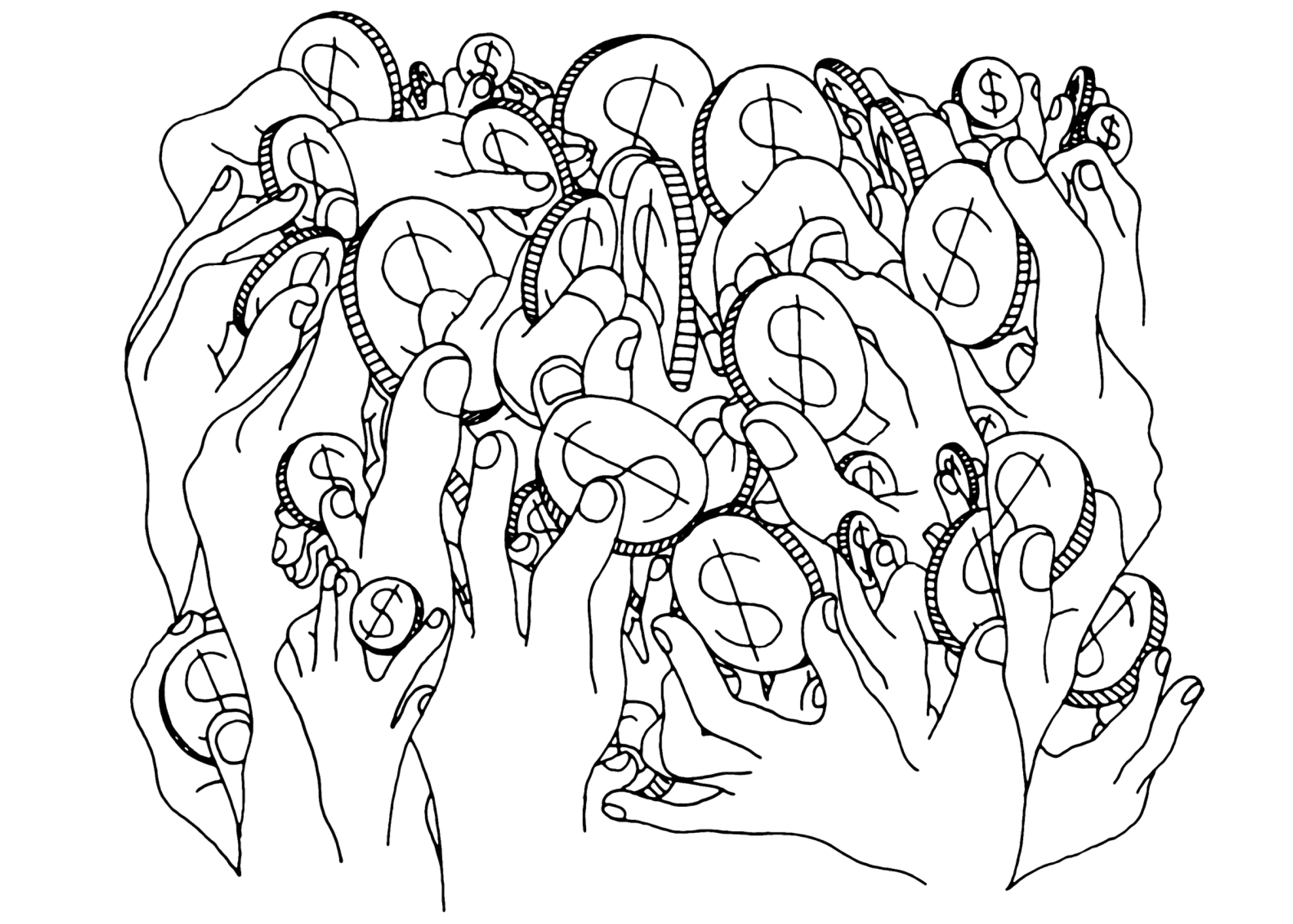
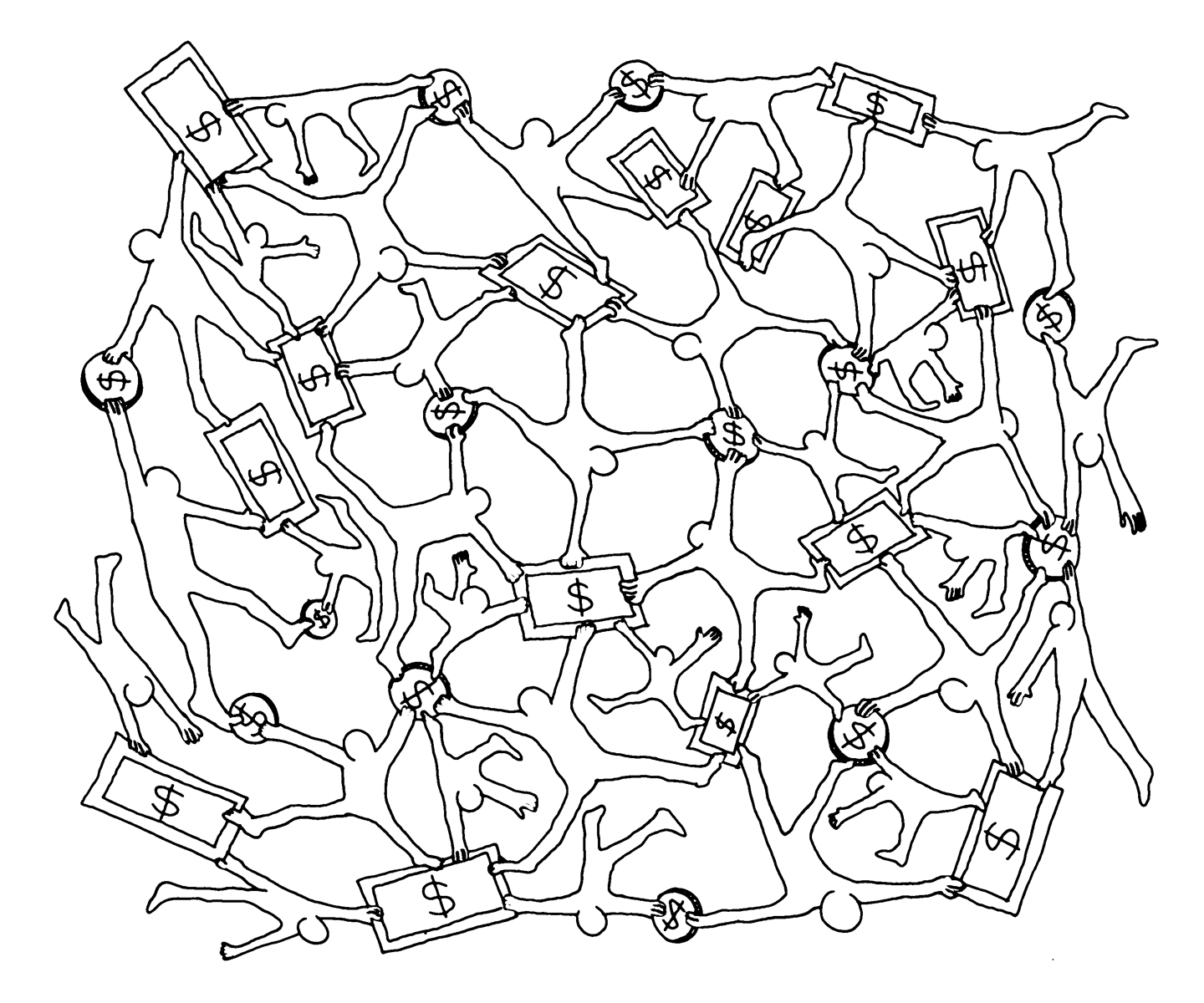

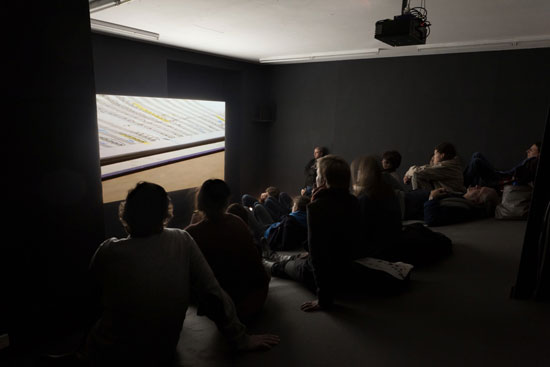


 realities-united, Lightspell, Pioneer Village TTC Station, Toronto, Canada. Photo: Toronto Star.
 Tube map covers presented at Piccadilly station. Image by Daisy Hutchison.
 Tube map cover by Daniel Buren, 2014.


 Wrapper by Jacqueline Poncelet. Edgware Road station. Image by Tierry Bal.


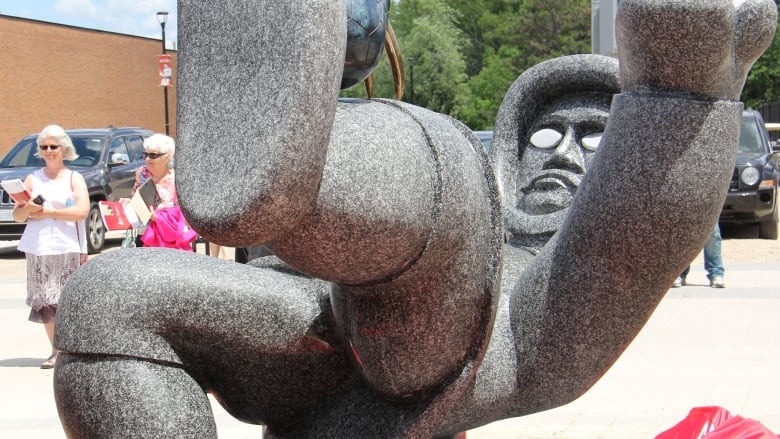

 Rosemary Heather
