Writer. This blog is an archive of things I have published elsewhere. Mostly these texts are about art. Other topics include Political Populism and blockchain.
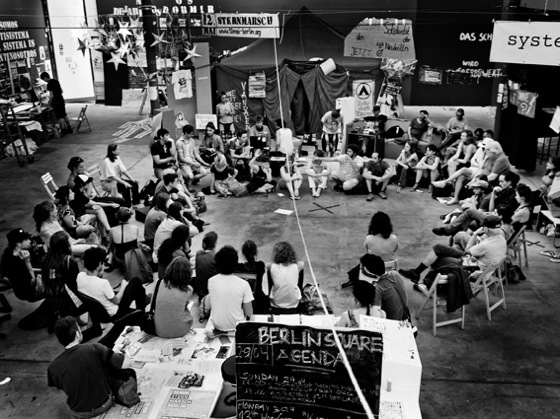
OWS at the Berlin Biennial, 2012. Photo by Marcin Kalinski.
Much reviled, widely derided, the 7th Berlin Biennale (BB7) achieved its aims regardless. The biennale curator, Polish artist Artur Žmijewski, proposed art as a problem and activism as the solution and in the process created the circumstances for reconsideration of both. In keeping with his tendency to be a provocateur and bully, Žmijewski (creator of, among other works, the highly discomfiting video 80064 (2004) in which he persuades a Holocaust survivor to have his faded Auschwitz tattoo redone) poses this question with a brutal hauteur. He titled his curatorial essay “7th Berlin Biennale for Contemporary Politics” and made a show at the BB7 press conference of declaring his antipathy to art.
Banishing much of what contemporary art audiences expect to see at an event like this, Žmijewski and his co-curators replaced it with works, often by nonartists, that were unambiguously political in intent. At the Kunst-Werke (KW), the event’s primary venue, the walls were hung with banners and painted with the murals and stencils of street art made by various artists and activist groups. On the level of sheer visuality, the exhibition suffered from too narrowly defining what political art looks like. In this sense, the BB7 was guilty of the oft-repeated critique that overtly political art risks addressing merely the known enemy. Along with street art, the KW presented a number of works that shared in common a taste for devising small problems—little moral dilemmas—for the visitor. In an installation by Jonas Staal related to his New World Summit, an “alternative parliament” event organized during the Biennial, a passageway was hung with the flags of the various participating insurgent groups, positioned low to the ground and close together, creating a kind of gauntlet to be run to get to the other side. Teresa Margolles’ stack of giveaway posters featured gory images of one year of drug war murders in Juárez as they had appeared on the front page of one of the city’s tabloids. Also free to take home were Łukasz Surowiec’s replanted seedlings that had originally taken root in the ground around the Auschwitz-Birkenau concentration camp. Of most consequence perhaps, Khaled Jarrar invited the biennale audience to stamp their passports with the seal of the nonexistent State of Palestine. Take up this offer and you would have joined an international community in solidarity with the Palestinian people, a gesture that under certain circumstances—attempting to enter Israel, for instance—could mean the loss of rights you otherwise take for granted. At center stage within this mise-en-scene of political theater, on the main floor of the KW were representatives of the Occupy movement itself. Imported from New York, members of Occupy Wall Street, along with Spain’s M15 and Russia’s Pussy Riot, among others, had set up camp for the duration of the exhibition. The consensus in Berlin seemed to be that moving indoors somehow neutralized the movement; more than one person told me the BB7 was “occupying” the Occupiers (clever!). Who made this rule, so widely agreed upon, that activists have to be cold and wet as opposed to warm and dry to be effective?
Lukas Surowiec’s Berlin- Birkenau Berlin Biennale 2012
Activists at the venue, who were busy painting signs for an action they would undertake later that day in support of the Deutsche Guggenheim’s nonunionized workers, reported being happy to have a base in Berlin from which to expand their operations. “You never know where it’s going to blow up,” one of them told me. Where it will not blow up—and we can be certain of this—is inside the walls of an art institution conducting business as usual. This is of course Žmijewski’s point. The tactics of the Occupy activists and their cohort might be a little crude, their handmade signs a little embarrassing, but at least the time frame they are working in is “now.” The alternative is the deferred time frame of the avant-garde that tends to structure art world thinking about political ideas. As Žmijewski notes, the “label of ‘bad art’ is frequently deployed, as if by targeting the form, one needs not be concerned about the message.” Whether he believes as he claims that the biennale takes part in “transformative social processes,” Žmijewski performs the service of helping us subject to scrutiny claims to political efficacy made on both sides of the argument. When confronted with the vernacular style of political protest arrayed throughout the KW, all I could think of was how feeble the tools are that we have at hand to combat the power of the financial elite, precipitators of financial crises for which they, to a person, remain not held accountable. Žmijewski’s exhibition provokes profound questions about how we experience history—by definition it is understood in retrospect, even when vast sectors of the population suffer from its machinations. It is for this reason that I felt genuinely moved by the 7th Berlin Biennale and the generosity it displayed toward political activism, which will carry on regardless, whether or not the art world continues to give it attention.
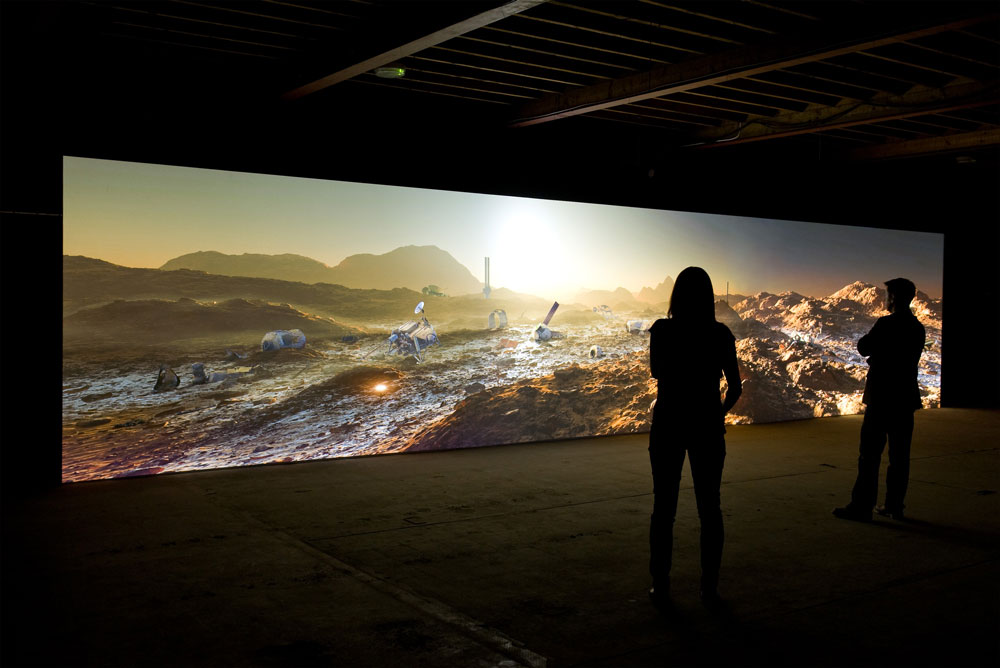
Kelly Richardson Mariner 9 2012 Installation view Courtesy of the artist and Birch Libralato / photo Colin Davison
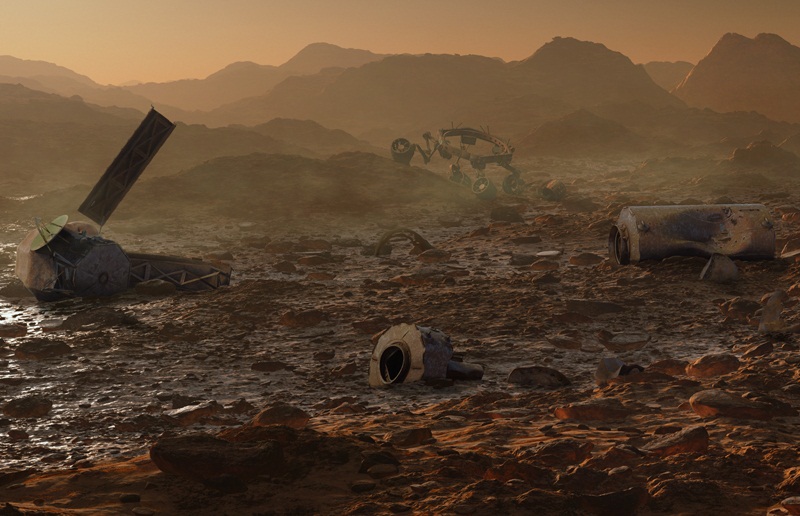
As part of the Future Projections program at this year’s Toronto International Film Festival, UK-based Canadian artist Kelly Richardson brought a scaled-down version of her amazing new work Mariner 9 to the Royal Ontario Museum. A panoramic video installation, Mariner 9 presents a detailed portrait of the surface of Mars as it might be seen in the future—littered with space junk, but still apparently uninhabited.
Commissioned by Tyneside Cinema in Newcastle, the TIFF installation offered North Americans a foretaste of the touring mid-career survey of Richardson’s work (also organized in the UK) that will arrive at Buffalo’s Albright-Knox Art Gallery in February 2013 and, in smaller form, at Vancouver’s Contemporary Art Gallery in 2014. This survey promises to be an event in itself, with eight rooms at the Albright-Knox to be taken over by her work. In this email interview, Richardson talks about the origins of Mariner 9, our fascination with life on Mars, and what that might mean for the future of life on Earth.
Rosemary Heather: There was an almost unnerving coincidence at seeing Mariner 9 in Toronto at the same time that NASA’s Curiosity was exploring Mars. It makes your project seem more real, almost as if you are doing the advance work—mapping the mental territory—for this new era in space exploration. Care to comment?
Kelly Richardson: The idea for Mariner 9 did come about before I became fully aware of when Curiosity would embark on its mission to the red planet. The opportunity I was given to develop the work was during a residency as part of Tyneside Cinema’s Pixel Palace program. The timing was perfect for the commission to be presented in parallel with the Mars mission.
Because of the unique problems the piece introduced, I spent the majority of time during my two-month residency researching and developing the various approaches I could take to produce the work so that, by the end of it, I would be ready for production to begin. Interestingly, by this point—the end of the residency and the beginning of the creation of Mariner 9—Curiosity had departed for Mars.
As we had planned to launch its UK exhibition within days of NASA’s anticipated landing, roughly eight months later, the work was produced entirely during the time it took for Curiosity to leave our planet and arrive on Mars: simultaneous missions. Mariner 9 premiered in the UK three days before NASA’s landing, and given that I had included Curiosity in the work itself, I was obviously thrilled when it landed successfully.
RH: One goal you’ve said you have for the work is to produce an immersive experience for your audience, which the installation delivers when presented at full scale, as it will be for your show at the Albright-Knox. Is it correct to say this effect in part derives from the authentic look you were able to give the piece? Can you also say something about the kind of research you had to do to achieve this look?
KR: I’d say the convincing Martian landscape certainly contributes to the immersive quality of the work. I wanted people to feel as if they could step onto Mars and I did overhear a number people in the UK telling one another that that’s exactly how it felt.
This is the first piece I have done that was entirely digitally produced. Usually I begin by filming existing locations, which I then alter digitally to create the work. However, as I couldn’t film on Mars I had to take a different approach.
I discovered that NASA knows exactly how Mars is constructed and that it had made this data available to the public, which could then be brought into a 3-D program to faithfully create the lay of the land. Using images of the surface of Mars taken from various rovers as a reference, I could then texture my digital version by creating similar rocks, sand, etc., to produce a photorealistic terrain. So that’s exactly what I endeavoured to do—and of course, it wasn’t nearly as straightforward as I’ve made it sound here.
I put a great deal of research into actual missions that had gone to the planet to recreate digitally the graveyard of partially functioning and corroding remains from various spacecraft you see in the work. And as it is a “futurescape” several centuries from now, I also researched current thinking about what future rovers may look like.
Lastly, I wanted the scene to be set during a dust storm, which is one of the most difficult effects to achieve in 3-D. Research aside, the skill set required for the whole of this work was huge. In the film industry, it would have required a large team of people. Two of us (my partner Mark Jobe and I) worked on the project full-time for 10 months. We basically started from scratch, as we had to learn several new programs and methods of working to achieve the desired look.
RH: I love the way, even when describing the project, you convey a sense of why it is so compelling to you—the recent Mars exploration adding extra urgency. I am wondering about the sound. You took great pains to include details that give the piece visual verisimilitude; is this true also of the soundtrack? I recently saw Christian Marclay’s The Clock and noticed how the sound from one segment will often carry on over top of subsequent clips, providing an element of continuity (along with the timepieces) to the artist’s otherwise disparate selection of movies. Can something analogous be said about Mariner 9? Is the soundtrack what makes it truly immersive?
Kelly Richardson Mariner 9 2012 Installation view Courtesy of the artist and Birch Libralato / photo Colin Davison
KR: I’d say it’s equal parts visual to audio that makes the work immersive. The installation, at 43 feet by 9 feet, takes up far more than your immediate and peripheral fields of view. In fact, it’s so large that you really can’t take in the whole of the piece without physically moving around it.
In England, it was common to see people sitting in front of one area for a good while, and then relocating to another area for an equally long time. Holly Hughes, who is curating my mid-career survey at the Albright-Knox, also noted that when you walk around the work, the light changes as it would in front of a physical landscape and many people have noted how three-dimensional it looks, without the use of 3-D technology.
The sound does play a huge part in the immersive quality of Mariner 9, though. During my research I discovered that we don’t actually know what Mars sounds like. All attempts to record audio on Mars have failed so it’s mere speculation at this point as to how it would behave on the planet.
In lieu of this information, I created a soundtrack which, again, attempts to convince the viewer that they’re there, providing the tools for a suspension of disbelief. It is 5.1 surround sound, made up of a dust storm swirling around the room; faint, strange, rhythmic sounds; and mechanical sounds associated with the movement of spacecraft. The nature of the sound also reflects the function of the visual, which is both hypnotic and strangely beautiful, but equally unsettling.
RH: Finally, I guess the biggest question is, Why Mars? Aside from the current focus of American space exploration, are there other reasons this project took Mars as its subject?
KR: Over the last few years, I’ve been increasingly interested in the way science fiction allows us to experience what life might be like in the coming century. Scientists and futurologists can speculate on what the future might look like, but artists are capable of visualising those futures, making them tangible. If hindsight is always 20/20, experiencing these potential futures offers us a window through which we can view our present time and the direction we are headed in with some measure of clarity.
Mariner 9 presents Mars as littered with the rusting remains from various missions to the planet. Despite its suggested abandoned state, several of the spacecraft continue to partially function, doing their job to look for signs of life, and possibly transmitting the data back to no one.
That search for life—to know that we’re not alone in the universe—is fascinating on many levels, but it’s also a beautiful, endearing endeavour, particularly for us as a species. We are destroying much of life as we know it, literally consuming our planet, at a truly alarming rate. I’m interested in that contradiction at this critical time in history when current predictions for our future are not just unsettling, but terrifying.
Brad Phillips’s preferred meeting place in Vancouver is Reno’s Restaurant at Broadway and Main. “It’s quiet there, and we will be able to talk,” he says.
In the condo-choked gloss of Canada’s most beautiful city, Reno’s offers a step away from the fray. Albeit of a dying breed, Reno’s is the type of diner you can find pretty much anywhere on the continent. In keeping with Phillips’s practice as an artist, it’s situated at a studied remove from current trends.
As Christopher Brayshaw, the Vancouver critic, photographer and co-founder of CSA Space, remarked to me, an artist concerned with appearing hip would never reference John Cheever. But Phillips does (Unknown Painting, 2005), and Cheever provides a revealing clue to understanding the appeal of Phillips’s art. A paragon of WASP experience in the mid-20th-century US and the writer of matchless tales of suburbia, Cheever created fiction whose power lies in intimations of dark undercurrents that run through domestic life. Phillips makes art with a similar effect. He is an artist who takes photographs and makes paintings in a photorealist style (meaning photorealism is less a goal than a by-product of his practice, but more on that later). Like refractions of light through a crystal, his work creates surface tensions with what’s left unsaid.
A Toronto native, Phillips moved to Vancouver in 2002. Like Cheever, whose relationship to pop culture is at this point etiolated at best, Phillips makes work that appears to have little in common with his city’s dominant art practices. Photography is central to his work, but he uses the medium more as a tool than as a mechanism deployed to reflect back on the genres photography creates. This is not to say Phillips’s work lacks an international audience. Represented by the Zurich gallery Groeflin Maag until it closed in 2010, Phillips is an artist arguably appreciated more outside his home country than within. His work has been purchased by some noteworthy collectors: Toronto financier and philanthropist W. Bruce C. Bailey was an early supporter.
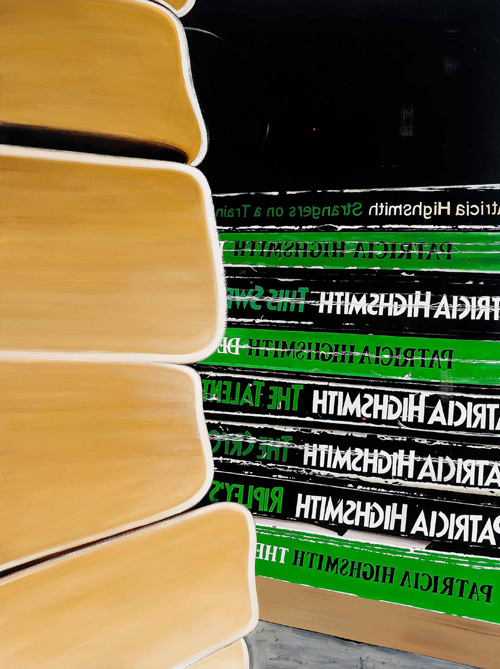
Brad Phillips, One Month of Reading in the Mirror (2007)
It is possible Phillips’s work flies beyond the sightlines of full art-world appreciation in Canada because he makes art in a fashion that is deceptively straightforward. His work is plainspoken in a way that is perhaps more intelligible to the European eye. Phillips hews a vernacular style that constructs a world from the materials at hand, as evidenced by his habit of making paintings about books he has read. One Month of Reading in the Mirror (2007), for instance, presents a stack of books by the writer Patricia Highsmith, their spines cracked from use. Not surprisingly, Phillips, a maker of paintings, gives his literary references a surface form. He presents books to be judged by their covers, so to speak. For an exegesis of their references, viewers will need to look elsewhere—including to other works made by the artist.
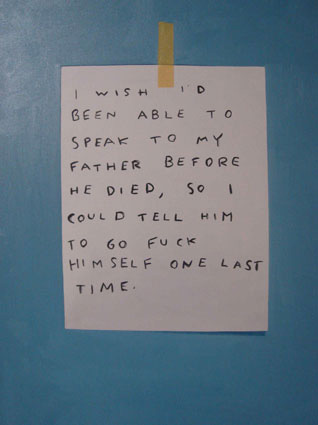
The implied deferral of significance between works is the method by which Phillips constructs an edifice of meaning through his practice as a whole, his titling of a work being a pointed element within the piece’s overall composition. This is especially true because his work is always figurative with a focus on the still life (Sentimental Monochrome, 2009) or landscape (Summer of Whatever, 2003), and he has made many paintings in which the signifying element is reduced down to a declarative text. The work Richard Prince (2009), for instance, is a painting of a piece of paper taped to a wall, with a note scribbled on it that reads like a one-liner from Prince’s own Joke series (1986–ongoing): “I wish I’d been able to speak to my father before he died, so I could tell him to go fuck himself one last time.”
Brad Phillips, Richard Prince, Oil Painting, 2007
The punch line hits its mark, but it gets a laugh that’s more queasy than funny. Richard Prince poses questions about which components of Phillips’s work are autobiographical, as the reference made to the work of the American artist seems less a clever homage than a discreet form of self-revelation. Similar conclusions can be inferred from the text painting Doctor Shopping (2010), which features a tightly framed list of doctors’ names on a black background. The slight angle given to the list of names and the shadowing in the lower right-hand corner subtly position the viewer, and more explicitly the artist (Phillips is tall), as if perusing the list within the lobby of a medical building.
Brayshaw notes that Phillips’s painting technique is “faux naive”; the artist’s photorealist style risks the appearance of simplicity. Close inspection of the canvas reveals great painterly skill, but it is a technique deployed as a means to an end. Phillips avails himself of a dry finish when applying paint to the surface of the canvas. It is an effort made in firm disavowal of the drama of the brushstroke, and also a way for the artist to maintain a fidelity to his pictorial goals.
“There are no happy accidents in the making of my work. I know exactly what the painting is going to be when I start, and that’s how it looks when I finish. In between, nothing happens except execution,” Phillips says. In a similar fashion, he uses titles to banish ambiguity, all the better to summon full engagement with his works’ melancholic ambience.
In making his works, Phillips uses a camera, but he reports that he mostly knows what image he wants before he takes a photo. While he sometimes exhibits the photographs he takes, they mostly become the bases for his paintings. At each step in the process, Phillips excerpts and revises. Every component in his repertoire—whether paintbrush or camera—is only a tool to facilitate his exceptional talent for pictorial composition. One Month of Reading in the Mirror presents what we assume is a gathering of books read, but this record from the artist’s life is angled, as if seen in a mirror. In this way, Phillips constructs a metaphor for self-reflection: we are what we read, so to speak. Another work, Major Depressive Episode (2011), features a chain lock on a door in close-up. The focus on this detail, combined with the work’s title, is almost cinematic in effect, its impact deriving in part from an implied honesty about the artist’s circumstances.
Rather than being painterly or expressive, Phillips makes artworks in the service of narrative. He has a story to tell, and each painting is not so much a chapter as a sentence in its overall composition. A Modern Painters review of the artist’s exhibition at London’s Residence Gallery last year notes that Phillips focuses on details as if “he had zoomed in until his eyes reached the satisfying flatness of the written word.” Literature finds an equivalency in the clarity and flatness of Phillips’s skill with pictorial denotation.
Phillips’s use of a realist style and his dry application of paint give his work a certain verisimilitude. In the words of John Cheever: “Verisimilitude is…a technique one exploits in order to assure the reader of the truthfulness of what he’s being told.… Of course, verisimilitude is also a lie.”
Phillips uses visual art as a means of self-portraiture. He authors certain truths about himself through the fiction of painting. In the midst of the current ethos of Internet and reality TV–based self-disclosure, his modus operandi strikes one as almost old-fashioned. As Vancouver writer Kevin Chong notes in conversation, Phillips’s work is self-revelatory, but not in the style of the up-to-the-minute Facebook status update. Making paintings is, after all, hardly the quickest way to get your message across. The same could be said of the presentation of art exhibitions. Art occasions slowness and contemplation, which, as the American artist Kerry Tribe has noted, is a proposition that is a “tiny bit radical” when considered in relation to the value today’s culture places on instantaneous content transmission.
Phillips concedes that in recent years his work has become more directly autobiographical. The Victoria-based fiction writer and critic Lee Henderson notes in an email that Phillips’s earlier work tended to favour what Henderson calls “goth girls [Untitled, 2001] and other midnight imagery: a van parked in a vacant parking lot in front of a black sky [The Last Party, 2002], a silhouette of a forest at night and so on.” The imagery, Henderson says, was in keeping with “a young man’s experience.”
Today, Phillips’s work is both subtler and more polished. Perhaps not coincidentally, he matches advances in his painting skill with the recognition of the value of his life as subject matter. His directness of expression, however elliptical, is a measure of his confidence as a maker of artworks, an assuredness that belies the self-recriminating eye with which he often seems to regard himself.
Phillips admits that this new tendency to make works that refer more directly to his own experience leaves him feeling exposed, though he has found that his audiences recognize the vulnerability he risks and respond accordingly. When he cites influences, other artists hardly figure, although he does count himself a fan of Hans-Peter Feldmann, Joan Mitchell and Edwin Dickinson. Phillips says his influences come more from the traditions of literary fiction. In particular, he says the confessional poetry of writers like Robert Lowell, Elizabeth Bishop, Anne Sexton and Sylvia Plath has had a huge impact on his work. “They made such beautiful prose out of their lives and I realized I could do that in painting,” he tells me.
In keeping with the efflorescence of cultural innovations during the 1950s and 1960s, the confessional poets discovered fresh territory to explore in their work by freeing themselves from the constraints of propriety that had governed poetic expression up to that time. Free verse went hand in hand with the revelation of personal intimacies that were sometimes considered shameful. Phillips likewise uses his work to intimate personal difficulties. They can be as commonplace as insomnia, in Twice a Day or Insomnia (2010), or as bleak as those suggested by Deadbeat Dad (2007), one of a series of works the artist has made of the back of a framed photograph—paintings that pack an emotional punch disproportionate to the bare facts of what they depict.
Brad Phillips, Deadbeat Dad, Oil painting, 2007
Phillips’s admiration for the work of the confessional poets is, like much else in his practice, a kind of throwback. Viewed in the light of today’s ultra-confessional culture, this connection suggests that Phillips has found a permission set by their example—permission for art to be the vehicle for the imparting of intimacies that gain a life beyond the moment.
By Rosemary Heather
This text appears in the Fall 2012 Issue of Canadian Art.
Poster from Kevin Rodgers, OUT OF ORDER, 2012 McIntosh Gallery in London, ON.
In a 1972 text that takes the Watergate scandal as its stepping off point, Hannah Arendt writes:
The deliberate falsehood deals with contingent facts; that is, with matters that carry no truth within themselves, no necessity to be as they are…
It’s hard to think of a better analogy for contemporary art practice, or at least a certain tendency within it. Watergate may be far from the concerns of contemporary art but the manipulation of contingent facts is often the way art gets practiced today.
The characterization of art as a species of lying is long standing. The idea dates back to Plato. As a bulwark against the temporal nature of existence (which changes and ultimately expires) and the non-omniscient perspective of human beings, Plato posited another reality, one that was more real than the one mere mortals’ experience. It’s a schema that takes solace in the possibility of transcending the imperfectness and contingency of everyday life.
For Plato artworks were non-ideal, mere approximations of their referents, if potentially seductive regardless. Today art trades in a subtle variant on this idea of art’s essential deception. Dispensing with the framework of the meta-physic, contingency is no longer a problem. Instead it represents the opportunity every artist engages with. With each instance of reception meaning crystallizes anew, which is why such a high value is placed on the actual encounter with the artwork.
However, encountering an artwork provides no guarantee that meaning will derive from it. In the best scenario, contemporary art aims for a kind of freedom enjoyed by the spectator in the contingent moment of understanding. But it’s not a freedom easily won, and the reason for this is directly connected to the way art intermingles with falsehood.
Installation, Kevin Rodgers, OUT OF ORDER, 2012 McIntosh Gallery in London, ON.
In a certain type of art practice things are made to stand in for other things. This type of practice makes literal the idea that appearances are deceptive. The art encounter that results will require viewers to hunt for the meaning of the facts presented to them. A mental operation will be required that is often tough because exceedingly subtle. Back to Arendt:
“deception [is] so very easy up to a point…it never comes into conflict with reason because things could have indeed been as the liar maintains they were…”
Artworks similarly never come into conflict with reason. If a work defies logic it simply isn’t successful. It fails the demand that it be in some way interpretable.
The best works of art are open-ended and susceptible to multiple interpretations. The onus placed on the viewer in this transaction accounts for the dissatisfaction about art often expressed by contemporary art audiences. Arendt gets at this idea when she says “factual truths are never compellingly true.” And the demand placed on the viewer is perhaps never greater, and meaning is never more elusive, than when artists present an assemblage of facts, things standing in for other things, with only minimal clues about how to grasp their intention.
How do we access the meaning an artwork implies except through the hard surface of the facts presented? In the end, there is only this surface, a set of appearances held in tension with one another and, implicitly, held in tension with what isn’t there. The clues and lack of clues work together to create a kind of surface coherence, the edits or cuts becoming as important, as you will come to understand, as what is left in its stead.
Rosemary Heather
Commissioned on the occasion of the show, this text appears on the poster give away that accompanied Kevin Rodgers, OUT OF ORDER, McIntosh Gallery in London, ON, 19 July to August 11, 2012. The exhibition was the culmination of the artist’s PhD research at The University of Western Ontario.
More information about Kevin Rodgers work can be found here.
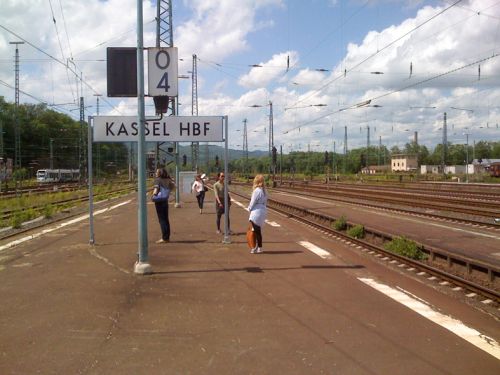
Susan Philipsz, “Study for Strings”, 2012, Documenta 13 Hauptbahnhof, Kassel, photo: Metropolis M
June 9-September 16, 2012
By Rosemary Heather
Mindboggling, exhausting, a blockbuster, whatever superlative you choose for it, Documenta 13 stands as some kind of nirvana for denizens of the artworld. Presenting an in-depth picture of contemporary art practice with the work of over 200 artists, as well as dozens of events featuring professionals from a wide range of fields—including hypnotherapists, priests and political scientists—an exhibition this big hardly lends itself to neat summation. Everyone’s experience of Documenta 13 can’t help but be a different one. Recognizing this, artistic director Carolyn Christov-Bakargiev avoids stating an overall theme. Instead, as is appropriate, art finds its definition through the artworks presented, the Documenta 13 experience offering less bird’s eye view of contemporary production than an arduous, if pleasurable, trek through its underbrush.
After arguing with unhelpful Deutsche Bahn staff in Berlin about train tickets apparently lost or delayed in the mail (buy a new one, I was told), things improved. Meeting the first of numerous acquaintances I would bump into in the city, I was pointed in the direction of a work by 2010 Turner Prize winner, Susan Phillipsz, one of many projects located in the train station. Positioned at the far end of Track 8, the artist’s Study for Strings (2012) presents an audio piece based on the eponymous composition by Pavel Haas that was written in the Terezin concentration camp in 1944. Fanning out on speakers arrayed across a number of the tracks, Phillipsz aligns cello string with railroad track to create a doleful, layered experience of a location once used to deport Jewish families to Nazi death camps. The work offers a shimmering instance of Christov-Bakargiev’s curatorial goal to create an exhibition that presents “the shared practices of knowing of all the animate and inanimate makers of the world, including people.” Peer into the weirdness and incoherence of this sentence and you can grasp a useful idea: Demoting humans to just one element amongst others in the experience of being offers a way forward for a crisis-addicted planet in the early 21st century. Artworks are a mechanism by which we can grasp this reality. History precedes the artist and the artwork and it’s the latter’s special task to create the circumstances through which the viewer experiences its meaning in the present.
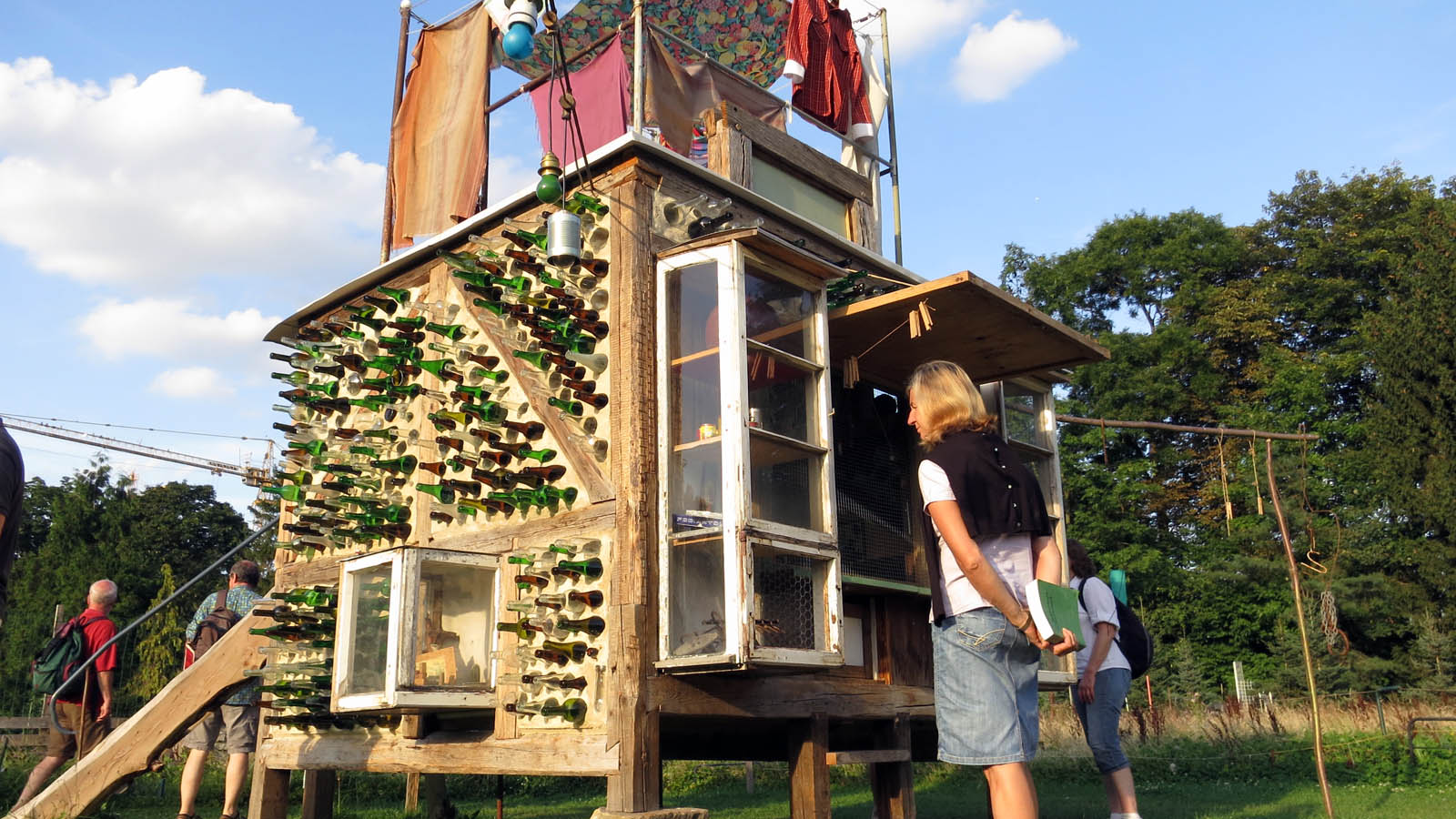
As is typical of an ambitious contemporary event, Documenta 13 supplements art presentations in conventional museum spaces with many many off site locations, including Kabul (naturally), Cairo, Alexandria and Banff. The “walk-in” art experience often associated with the off site location sees perhaps its finest use at Documenta in Pierre Huyghe’s assemblage of animate and inanimate elements found in a clearing in the expansive Karlsaue Park. Composed of piles of rubble, a reclining nude sculpture with a beehive as a head and a white dog with one leg dyed pink running loose, the work proposed itself as “plants, animals, humans, bacteria…without culture.” To become culture-less is a lofty if not impossible ambition, but the piece did have the effect of evoking the Sci Fi mise en scene of a post-apocalyptic world. Instead of eliminating culture, Vancouver’s Gareth Moore proposes to construct it from scratch. In residence in the park for the past year, Moore homesteads a forest enclave, constructing a place for himself to live that includes all the elements of an incipient society. Flagstone paths lead to various way stations, including garden, workshed and lean-to for napping. Spiritual needs are met in a quasi temple, which like the rest of this grand, beguiling project attests to attention the artist has paid to vernacular modes of architecture. Herculean effort was also at work in Geoffrey Farmer’s installation of 16,000 figures cut out from the pages of Life Magazine. Spanning the years 1935-85, the artist creates a delicately monumental artwork that suggests a figural double for photography’s—and latterly, the internet’s—decontextualizations. Constructing culture from detritus is also the theme of Lara Favretto’s massive pile of scrap metal. Assembled by the artist, she then removed various “sculptural” elements from it, replacing them with concrete casts and installing the originals in an adjacent building as if they were artefacts in a museum. A mental operation connects the two parts of the work, the mind finding relief in the separation of order from chaos, making this piece akin to the best conceptual artworks.
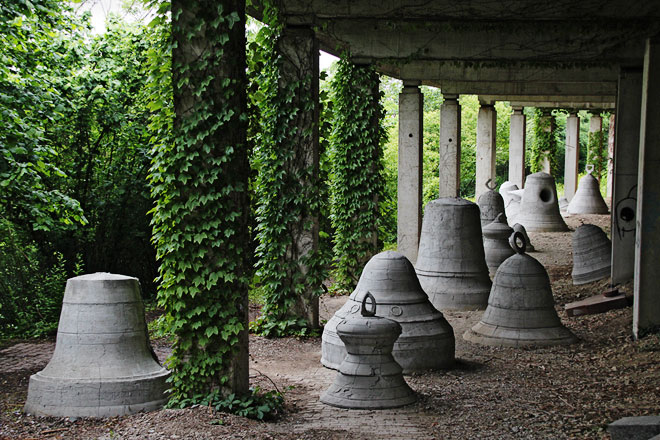
However overwhelming, Documenta’s organizational commitment to ensuring massive projects are fully realized can’t fail to impress. Argentinean Adrián Villar Rojas presents roughly fashioned concrete sculptures of people and animals together with giant casts of forms that look like discarded bells or overturned flower pots, all of it strewn on the different levels of a hillside terraced garden. The figure of the classical ruin is writ large and improbable. Nearby, in a nineteenth century bunker carved into the side of the hill the team of Allora and Calzadilla film a griffon vulture in ambiguous proximity with the white-gloved hands of a flautist. The musician, a prehistoric instrument specialist plays a 35,000 year old flute made from the wing bone of one of the bird’s ancestors. While only feint sounds emit from the instrument, the idea of an ancient and unbroken avian lineage suggested by the buzzard sent shivers down my spine. Achieving a similarly eerie frisson was Michael Rakowitz’s use of the Kunsthalle Fridericianum to present an archive of reconstructed books representing volumes housed in the same building that were destroyed by bombing in 1941. The artist presented the books in a display that included other remnants such as fragments from a meteorite and shrapnel from ammunition rounds used to destroy the Bamiyan Buddha statues in Afghanistan. Equally provocative in its cultural elisions was French-Algerian artist Kader Attia’s installation, which compares makeshift repairs done on African masks, the seams of each fix clearly visible, with documentation of the grotesque injuries and “repairs” endured by soldiers in WW1. Among the best received works in the exhibition was Tino Sehgal’s group of youthful dancers performing a cappella pop songs in a darkened room. The presentation dissolves boundaries between stage and audience, as visitors’ inch their way around the room, walking between the performers who occasionally embrace them. For the public, the low risk of having to tentatively navigate a space in the dark offers the pleasing reward of a gentle disorientation. More bracing—and widely discussed—was French choreographer Jerome Bel’s performance piece. Working with a Zurich-based troupe of mentally disabled actors, Bel had them, each in turn, perform not a play but tell their own stories and perform dances they choreographed themselves. Bordering on the confrontational, self-acknowledged as a “freak show”, the ultimate effect was humanizing. The sum of my own experience was expanded upon in ways that continue to resonate.
This article originally appeared in Border Crossings Issue No. 123
Geoffrey Farmer, Leaves of Grass, 2012. Installation view at Neue Galerie, Kassel. Courtesy the artist and Catriona Jeffries. Commissioned and co-produced by dOCUMENTA (13) / photo Anders Sune Berg
Neue Galerie, Kassel June 9 to September 16, 2012 By Rosemary Heather
Geoffrey Farmer’s Leaves of Grass is one of the big hits of dOCUMENTA (13). Toronto critic Rosemary Heather caught up with the Vancouver artist by email to ask about the inspirations, processes and resonances behind the astonishing work—which, as Farmer noted, ended up surprising even himself.
Rosemary Heather: There’s quite a story behind the making of Leaves of Grass. The work features a great number of figures cut out from the pages of Life magazine that have been mounted on dried-grass sticks. Someone told me there were 30,000 figures, but you have amended that, saying it’s closer to 16,000, which is still a huge number. Can you tell me a bit of the backstory here?
Geoffrey Farmer: The collection of Life magazines came from the Morris/Trasov Archive. They (Michael Morris and Vincent Trasov) knew that I had been working with image collections, and about three years ago they asked if I might be interested in it. There were approximately 900 magazines in the collection, spanning five decades, from 1935 to 1985. In the beginning, Life was a weekly; in 1978, it became a monthly. So we had a lot of magazines from the 30s, 40s and 50s. We had fragments—a few pages—from 1935, and then complete copies after that. This includes the first issue that had Time co-founder Henry Luce as publisher; he bought it in 1936 and changed it to a photojournalistic format. The last issue we had, from 1985, was on AIDS.
In Kassel, the work is displayed on the second floor of the Neue Galerie in the loggia, which is a long, sculptural corridor with huge arched windows overlooking the park. The view brought to mind the miniaturization of the world. I was already thinking about how photography has a tendency to make sculpture, and I liked this in relationship with the loggia. The piece is in chronological order and is displayed on a 124-foot table, which is viewable from both sides. There are 16,000 figures, and each figure has two sides. Although the image arrangements may appear chaotic, I took great care in their placement.
During my studio visit with dOCUMENTA (13)’s curator, Carolyn Christov-Bakargiev, we talked about Paul Klee’s drawing Angelus Novus and Walter Benjamin’s essay “On The Concept of History.” I showed her a film made in 1961 by Arthur Lipsett, Very Nice Very Nice. In it, he uses images from Life, as well as found film footage and sound clips, all montaged together. It contained a quality I wanted to find for the piece. I mentioned to Carolyn that he committed suicide a few weeks before his birthday in 1986. She was curious as to what was happening in the world around the date of his death. So we were looking at timelines, and I began to think about chronology as a composition.
It was a gruelling project, but I wanted to be transformed by the experience. In the last few months, we had about 90 volunteers helping us. We had quotas to keep. We worked in shifts. There was a small group of us who, in the end, I think, were working 20-hour days. I was amazed at the generosity of everyone working on the piece. It was a communal experience. A lot of conversation happens when you are sitting together working around a table. If someone didn’t agree with the image selection or strongly felt an image should be included, they would hold the image up for a vote. We had meals together, a fantastic cook and friend came in to make lunches and dinners. I wasn’t expecting the piece to grow in the way that it did.
There is another story, though, that I want to mention because I think it relates in a broader sense.
When I was very young, my teacher asked us each to bring a leaf to class. She then got us to place the leaf on a piece of paper. Above the paper was a metal screen stretched over a wooden frame. She lowered the frame, and then she gave us a toothbrush dipped in gouache paint to rub on the screen. When I rubbed the toothbrush over the screen, it sent out a fine spray of paint over the leaf and the paper. Then she lifted the screen, and then lifted the leaf off of the paper. Even though she was holding the leaf in her hand, it still appeared on the paper. This deeply shocked me.
When I first saw William Fox Talbot’s early leaf-photo experiments, I recognized them as being linked to this early experience. When I read Roland Barthes’ Camera Lucida, I also had this recognition. Absence existing simultaneously within presence.
RH: Your anecdote brings to mind a certain uncanny quality the work has. When the figures are cut out from the magazine and brought together again in the amalgamated form, the first thing you notice is the discrepancy in scale between them. This suggests their lost context (the scale that naturalizes each figure within its photo) and makes apparent the essential strangeness of the photographic format, which you evoke in your answer above. So is the work just an expression of a relationship you have always had with photographs, or is something else going on?
GF: I think there are many things that are going on in this piece and I hope people get a sense of that. In one of the last issues of Life, I found a small image of Susan Sontag’s book On Photography. It is about one centimetre by one centimetre. It appears at the very end of the piece, next to a tiny Lady Diana. I think, in some ways, the piece is dedicated to Sontag and to her writing. Not to say there is a warning there, but perhaps there is.
RH: So ideas about the work proliferate in the same way the figures seem to…this suggests why knowing their exact number is not important. There are enough of them to push the mind into the territory of something not previously experienced. Was this a goal you had in mind? Or did you set out to do one thing and in the end discover you had accomplished something else?
GF: I am not really conceptual. I don’t think up a concept and then execute it. I learn through discovery and from direct contact with the material I am using. Even though the work might emanate out of an idea or interest and may have a horizon, I don’t really know exactly what I am doing.
For example, the title partially came from the fact that I was using grass, in a literal way, to mount the images onto, but also because I was looking at Walt Whitman’s use of writing cut-ups to make the poems for his book Leaves of Grass. He spoke about wanting to write a modern portrait of the United States, and I thought that the piece could be looked at as a kind of portrait. I also liked that the first Documenta was in 1955 as part of a horticultural show, and that it occurred on the 100-year anniversary of the publishing of Leaves of Grass. There was a special article in Life on Whitman in 1955, with pictures of his grave that are now in the piece. I also liked that the term “leaves” can refer to the pages of a book and to grass—to something without much value. I thought this related to the form of a magazine.
I didn’t really consider what the effect of looking at so many images would have on me. At certain points in the project, I had a hard time sleeping. When I closed my eyes all I could see were images. I was going through 30 magazines every morning to make selections. And then we would see them again for cutting, again for the gluing, again for the sorting and then again for arranging.
I knew from the beginning that it was important the figures be placed in chronological order, and that their arrangement was important. It hadn’t occurred to me that it would be a strange kind of history lesson. It was like a slow-motion flip-book.
It wasn’t until we had finished making the work that I realized the piece is very much about factory life. Factory farming, the war factory, the death factory, the automobile factory, the Hollywood factory, the personality factory…. History emerging out of a factory. In the end, it takes on the appearance of a conveyor belt.
I was asked to pick a song that the viewer could then download as part of a dOCUMENTA (13) phone app. I chose Over The Rainbow as sung by Judy Garland in the movie The Wizard of Oz. American soldiers used to play it in Germany as a kind of anthem at the end of the war. In the movie, it is a hopeful song, but when listening to it and looking at the piece, it has another effect, making the piece, and history, feel like a very strange dream.
Kerry Tribe, There Will Be _______, 2012, Installation view, Courtesy the Power Plant / photo Toni Hafkenscheid
Toronto-based writer Rosemary Heather spoke to Los Angeles-based artist Kerry Tribe during her solo exhibition Speak, Memory at The Power Plant (24 March – 3 June 2012).
This excerpt is part of a longer conversation, most of which took place in a taxi on the way to the Toronto airport. Heather notes, “Setting out to do this interview, I devised a theory of how to understand Tribe’s work. As often happens, however, our conversation overtook any hope I had of getting Tribe to commit to a particular hypothesis about her art practice – it defies easy encapsulation. This made talking to Tribe about her work much like the experience of engaging with it: the process is an end in itself.”
ROSEMARY HEATHER: One way that I thought of talking about your work is through the lens of Here & Elsewhere (2002). You remade a piece by Jean-Luc Godard, in which he interviews children by asking them metaphysical questions. Can I locate that as a framework for your work as a whole?
KERRY TRIBE: The idea of remaking something?
RH: Yes.
KT: I don’t know if I would think of it as remaking so much as returning. At UCLA when I was a graduate student I organized a series of screenings — a 24-hour unofficial film festival — because I discovered a little pocket of money in the graduate program that allowed me to rent some titles.
I had never seen Godard’s television series France/Tour/Détour/Deux/Enfants (1977) and a friend recommended it, so I screened it. I just screened the first two episodes. I was really struck by what happened when this big father of avant-garde film and video (who was a Maoist and tough and rigorous and making images that were often difficult to look at) set out to interrogate this little girl and little boy about heavy political and philosophical issues. The little girl’s responses, which were down-to-earth and sometimes confused, were totally compelling to me. What was it about the presence of this little girl? There’s one point in the video where her face appears — her name is Camille Virolleaud — and over it is the word “Verité” in big letters. And I thought: There’s something accurate about that. We all want to identify with this simple, you might say, Cartesian subject position that says: Yes I know. I’m here. I only exist once. I walk through my life. I understand things or I don’t, even if we know better. I mean, even if feminism, psychoanalysis and critiques of capitalism tell us that this simple belief in one’s own self-identity, agency and autonomy is inadequate, it’s nevertheless compelling. I wasn’t so much interested in specifically remaking that Godard video, or in pointing directly back to it but rather in trying to see what would happen if some of those questions were asked again. At one point, Godard asked Camille about her room. It’s very bright and it’s clean, and who cleans her room? (I’m paraphrasing.) And she says something like either her mother or the housekeeper does it. And he asks, Well who pays your mother to do this? And she thinks probably nobody does. Do you think maybe The State should pay her? And, Is The State a man? Or a woman? And so on. It’s great stuff.
And these are questions that continue to be urgent. And yet in the end, it didn’t seem viable to do that in 2002. When I tried to work the explicitly political questions into the script it just fell flat. It was actually dreadful.
RH: Can you elaborate? What does your piece look like? Read the full interview here.
This interview was commissioned by the Power Plant, Toronto. A longer version will be forthcoming.
Flip Project Space, How to Make a Delicious Tea, ARTISSIMA LIDO, 2011, Eloise Hawser. Martin Soto Climent. Patrick Tuttofuoco. Per-Oskar Leu
We understand what kind of knowledge the photographic image makes available to us. We know about its status as copy, and the technologies that produce it. We intuitively know that an image isn’t real precisely because it is reproducible. So why try to make all of this visible?
Flip’s How to Make a Delicious Tea has an answer to this question, or more correctly, offers a sophisticated articulation of the circumstances that provoke it. A predominate feature of contemporary experience is the dynamic of image proliferation. Like the light of the sun, images may now elucidate the world in such an all encompassing manner that they defy our ability to see them with any clarity. Flipfinds a way to embody this dynamic through an ongoing collaborative process. Working with a group of artists, they produce a composite artwork. How to Make a Delicious Tea createsa material analogy for the image and the way today it is more process than singular entity.
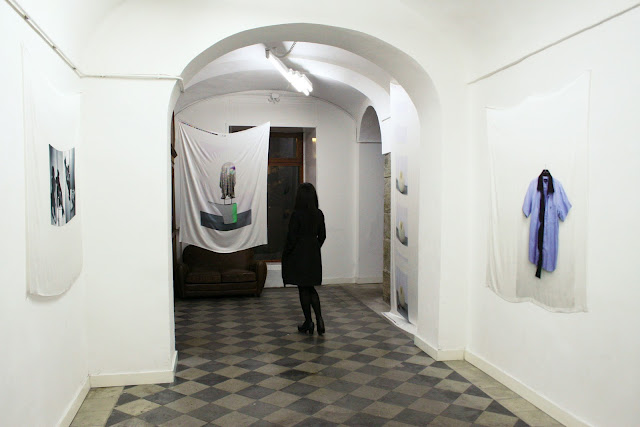
Located nowhere in particular How to Make a Delicious Tea exists as versions of itself that take shape according to the context within which it touches down. Working with pre-existing artworks, the project turns them in to images that are printed onto silk for display as an art exhibition.
If every image now exists as a process, this is because images now exist as expressions of the network that circulates them. Reproducibility and connectivity turn the image into endless versions of itself, a veritable chain of impressions with slight variation. Flip uses silk to perform a kind of transubstantiation, one that enacts a mordant commentary on the many potential layers of a photograph’s insubstantiality.
Somewhat intimate, almost embarrassing to the touch, silk could be said exceed the boundaries of its materiality. It is substance with a suggestion of vaporousness at its edge. Similarly, the best artworks slip beneath the boundaries of attempts to define them. And photographing artworks will always exacerbate the problem, in the guise of saying something definitive. Combining these elements, Flip creates an analogy for the essential contextlessness of digital image reproduction. Silk is used here is not so much like the printed page as the fathomless space of the internet.
How to Make a Delicious Tea makes silk into a self-reflexive medium. Silk transforms mere image, so divisible, back into indivisible luxury object. As a material, silk will distort the image reproduced on it. It drapes with specificity, and so undermines the original’s reproducibility as copy. It’s a kind of triumph, to halt the infinite slippage of the digital. But the respite is only momentary. Photographed, the artworks start to circulate again.
Annie MacDonell, Shea's Hippodrome, (1914), cardboard diorama, 20 x 20 x 30 in., from the series 'Vaudeville Interiors'
Recent history tells us that the experience cinema offers is excessive. The belief that it is necessary to go to a theatre to see a film is already a thing of the past. Cinema was an industrial innovation. Based on an economy of scale, the commercial premise of the business is that each member of its audience possesses a quotient of popular taste that the industry can replicate and nurture in each new film it devises. The basic assumption of the format used to be that this mass psyche could be unlocked by a film’s presentation in a setting of anonymous camaraderie; in other words, the belief was that people would want to watch movies together in the dark. But these conditions now appear to be unnecessary, or so the popularity of sub-par viewing formats like YouTube and iPod movies would seem to suggest.
In her exhibition, The Castle and other works, Annie MacDonell looks at this history from the perspective of today, a moment when cinema is being eclipsed by newer formats of entertainment. Giving depth to this view, her show looks beyond film to its origins in Vaudeville. Consisting of remnants from this past, MacDonnell’s exhibition offers insights into the wider cultural demands embodied by these continuities, suggesting that the need for diversion, for a parallel realm of spectral distraction, exceeds any of the formats invented for its possibility. It is this need’s ability to conjure up the means of its realization, if not an explanation of its source that MacDonnell’s show evokes..
In The Castle (2006) a sculpture of a chandelier sits on the floor of the gallery as if it had recently crashed there, or, in more grandiose terms, had somehow fallen to earth. A non-functioning replica, the chandelier illuminates nothing except protocols of ornamentation to which we are no longer accustomed. Ornamentation was, however, once thought of as an important aspect of the movie experience; film theatres were after all referred to as “palaces.” This connects the chandelier to MacDonnell’s Untitled Vaudeville Models (2006), which MacDonnell built in collaboration with Rob Shostak. They consist of three scale models of Vaudeville theatres in Toronto, all of which date from the turn of the 20th century. That Vaudeville theatres tended to be turned into cinemas, which are themselves now on the wane, points to the larger theme of the show. The condition of spectatorship was once located in spaces built specifically for the purpose, but it is less and less dependent on physical circumstance.
In The Castle (2006) a portly man in a video projection is seen falling through space. He stumbles down the stairs and then the action is magically reversed. The cycle repeats. By looping the video, the artist arrives at a kind of perpetual slapstick. The artist abstracts the base humor of Vaudeville, its broad physical comedy, to evoke the idea of entertainment itself. The man’s appearance reinforces this impression. Middle-aged and out of shape, his mustachioed visage evokes an archetype: not a leading man or captain of industry but rather an avuncular figure of fun, like Stan Laurel or Fatty Arbuckle, familiar from the early days of the entertainment industry. A likely inhabitant of both smoking jacket and smoking lounges, he evokes the pathos of manhood past its prime, still the beneficiary of male privilege but some years beyond the ability to make meaningful use of its powers.
Art exhibitions tend to consist of discrete objects ¬– whether of the thing itself or of some form of its representation – presented in meaningful combination. The custom is for exhibitions to occur in a definite space, or make reference to that space, which is known as “the context.” The placement into this context of any artwork that takes the form of a real entity (as opposed to an abstraction of such) should be understood as having been removed from the circulation of utilitarian items for a reason. In the same way that the art gallery is more than just a space for the exhibition of objects, the artwork is both a thing in itself and what it represents. The artwork in itself refers to every possible realization of the idea of art, especially those that have already occurred; and the entity it represents refers to the wider world of meaning from which it derives.
Although susceptible to many definitions, the artwork’s ability to incorporate within itself multiple dimensions of significance means that it always in some sense functions as a synechdoche: the work of art or the art installation is always the part standing for the whole. Writing about literature, the critic Terry Eagleton discusses how the reader of a literary work “unconsciously supplies information which is needed to make sense of it.” “All literature is understated” Eagleton notes, “even at its most luridly melodramatic.” The same could be said for art. MacDonell’s show makes use of the synechdochic power of the artwork, and also makes an exhibition that is about this synechdochic power. The artist doubles the synechdochic resonances of her show in the sense that it is about just how little it is that we need from the real world in order for us to imaginatively exist in the spectral realm, and for that realm to fulfill the wish that we could exist there.
If early cinema took the basic elements of Vaudeville as its starting point, this is in part because film’s illusionistic qualities were so well suited to the art form’s vulgar comedy of physical mishap. The idea that someone can fall without getting hurt, the basic fact that the moving image finds its origins in release from the consequences of the physical, suggests a number of things: that entertainment is strangely predicated on the misfortune of others, and, more broadly, that the cinema fulfils a wish that the physical world could be more benign than it is. This connects MacDonell’s fallen chandelier and tumbling man to another work in the show, Sunset Signature Lounge (2006). Housed inside a small freestanding cabinet with room enough for only one viewer at a time, the work features a slide-projected image of a sunset as seen from the 96th floor of the Chicago’s John Hancock tower. One of the tallest buildings in the U.S., a centerpiece in a city famed for its architecture, the building’s Signature Lounge provides Chicago’s citizens with a cocktail hour ritual. The image was shot at twilight in the lounge, a bar that features floor-to-ceiling plate glass windows. Looking at the phosphorescent and warm transitional hues of the sun as it sinks below the horizon offers the best accentuation of this, as it fuses the experience of the sunset with its image. It is, as MacDonell comments, “an intensely American experience, ” the impact of which is such that the lounge patrons often break into applause upon viewing the sun’s final curtain, so to speak. It is as if each floor of the John Hancock tower was only the premise for the next one, and this continues upwards until the building was tall enough to create the perfect platform for the viewing of each day’s end., The floor-to-ceiling plate glass windows were installed to more perfectly frame the experience, transforming it all into a two-dimensional picture of itself. Finding that cinematic desire lurks even in aspects of the built environment, the artist points out just how eager we are as a culture to step off into the virtual.
MacDonell designed the installation so that the sound of applause, which is preceded by a soundtrack of ambient noise and soft chatter, subtly permeates the exhibition as a whole. If not actually creating an immersive experience for the viewer, the sound in the exhibition points to the aural aspect of spectacle; its aim is to be thoroughly persuasive. To undercut this, and to indicate that what she is offering is not spectacle per se but the means for a critical reflection on its powers, the artist positions the slide projector outside the cabinet, which itself is left unfinished, and leaves the work’s speakers, amplifiers, and their connecting cables and electrical wires exposed on its top.
The artist’s suggestion about how easily natural phenomena are incorporated into an overall cultural preference for spectacle connects to the show’s wider idea that our culture is constantly looking for the means to make our reality into something that is more free of consequences and more under our control than it is or ever could be. This idea applies especially to how we participate in spectacle today, which because of the Internet and portable digital devices extends far beyond the physical space of the movie theatre. This suggests that it’s not the cinema that is excessive but only the cultural desire for its pleasures. If this fact is more apparent than ever, being able to recognize it still tell us little about what it means. Full participants in this virtual onslaught, cinema and other forms of spectacle have only a weak ability to reflect on the phenomenon. Artworks, on the other hand, exist to be reflective, and in the process can reveal an entirely new dimension to, for instance, the fun Vaudeville finds in misfortune.
Brenda Goldstein, Hereafter, 2010, 35mm film installation, looping 35 mm film, sandblasted plexiglass, slide projector.
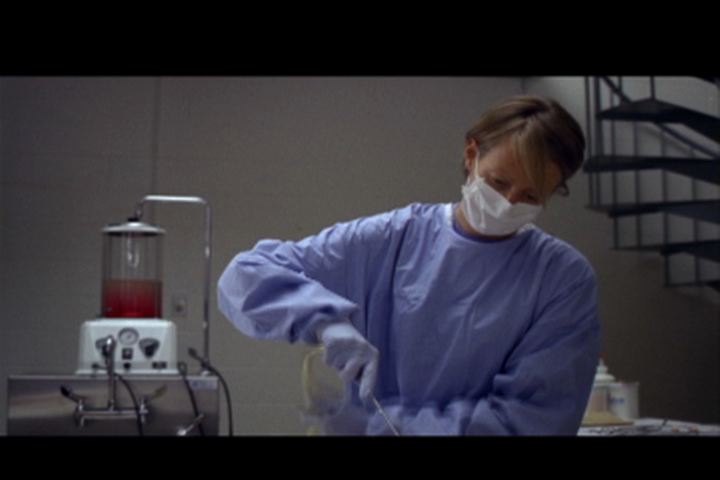
Thinking about Brenda Goldstein’s Hereafter begins with an absent body. The work consists of a 35-mm film loop portrait of a nameless woman preparing an unseen body for burial, presented alongside a slide projection composed of quotes from various people about the experience of death. Everything you see in the film is clinical, austere; the only element commanding a visceral response to the subject matter is a jar of red liquid, embalming fluid, visible on the right of the screen. The work constructs a composite representation of the idea of death, within which the only warm body present is that of the viewer.
Goldstein structures her installation so that one can view the film loop and the slide projection inde¬pendently. Complementing this schema is the work’s third element, its “soundtrack,” which is the ambi¬ent noise made by the slide and film projectors. Hereafter’s sombre topic might cause its audience to disregard this sound in the room; to hear but not hear it. Rather than using recorded audio to reinforce thoughts of death, nailing down that signifier, Goldstein instead allows the ambient sound to enhance one’s experience of the space. Like a mechanical version of sentient breathing, the sound made by the projectors is a reminder for the viewer, however subtle, of their own presence. In this context, the instal¬lation’s audibility also works as a reminder of one’s own mortality; one reason why viewers may be less inclined to “hear it.” As well, Goldstein’s use of sound points to other ideas, implicit to the installation and beyond its ostensible subject matter.
Hereafter has no single focal point because the artist’s intention is to create an immersive environ¬ment; one that, through use of shifting points of interest is, arguably, more actively constructed by the viewer than would be the case if it was presented as a film. Between the two types of presentation, seated film viewing or walk-in installation, there is only a fine distinction: it is debatable whether one or the other provides the more “immersive” experience. Differing means of creating that experience is more to the point.
One inescapable precedent for Hereafter is Stan Brakhage’s The Act of Seeing With One’s Own Eyes (1971). The film is shot in a morgue and documents a number of autopsies (the title is a literal transla¬tion of the Greek word, autopsia—to see for oneself). Brakhage’s immersion is more confrontational. By viewing the film, one is witness to an experience, that of seeing human bodies dissected, that few would actively seek out. Brakhage made the film as part of his larger project, the exploration of a number of themes that were central to avant-garde film at the time. Over his career, he made a slew of films in which various techniques of abstraction—such as variable focus, asynchronous sound, scratching and painting on the negative, and disjunctive editing—were used to create a poetics of perception. All of his works were predicated on the idea that the film material itself constituted a form of embodied perception and this is perhaps the reason Brakhage worked so hard to make its materiality evident. And if sight is an analogy for being, looking at the body as a starkly mortal entity gives this poetics its ultimate form of expression.
This digression into the world of 20th century avant-garde film is necessary because of what it tells us about the different set of assumptions guiding Goldstein’s work. For one, it gives us a clearer understand¬ing of the 21st century’s comparatively diminished faith in the visual. Hereafter’s visual component is diffused by the atmospherics of the text elements that accompany it. And it suggests that while intuitively a filmmaker like Brakhage understood the visual to be an aspect of embodied experience, Goldstein can make no such assumption. Her concern instead is to construct a different kind of body, one that is, among other things, a decidedly non-poetic being. In addition to the viewer in the room, the body Goldstein summons is the one that is typically elided by technologically mediated existence—especially because liberation from bodily constraints is the specific form of satisfaction mediation can offer. You could argue that locating the body is always the goal of the immersive artwork. It is why such works require an active viewer, one who can orchestrate an installation’s material synthesis simply by walking into it. (It is also the reason why the term “viewer” now reads as something of a misnomer; artworks today solicit a much more sophisticated kind of intelligence.) In the end, Hereafter is less about dead bodies than it is about living ones. The further we as a culture move into the everyday time and space travel of virtual technologies, the more we need to be reminded of who we are; sentient beings, limited and mortal after all.
—Rosemary Heather
This text was commissioned by Mercer Union Centre for Contemporary Art, Toronto in conjunction with the 23rd Images Festival, 1-10 April 2010.
More info about Brenda Goldstein can be found here.




 Rosemary Heather