Kent Monkman prepares to debut his largest painting yet

On the heels of his popular U of T Art Museum show, the Cree artist is unveiling a 12 x 24-ft history painting based on a treaty between the Dutch and the Iroquois

BY ROSEMARY HEATHER

Kent Monkman
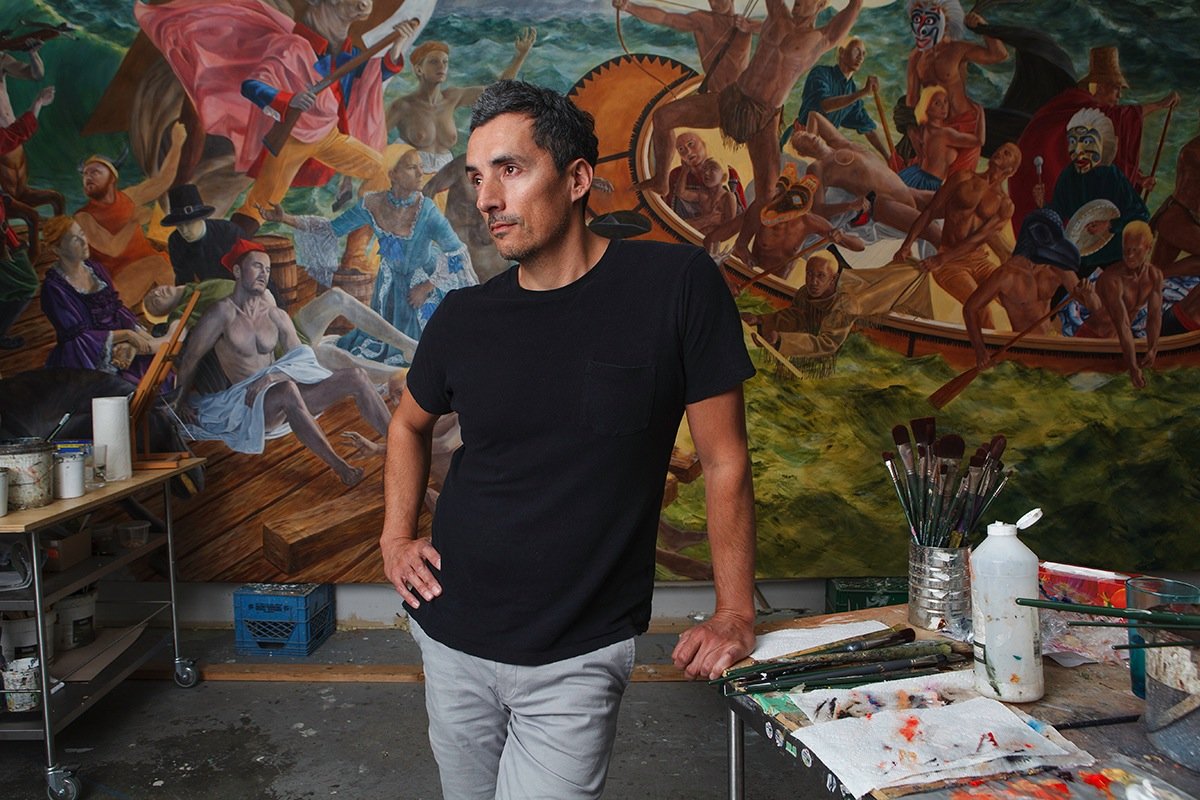
Kent Monkman in his studio – photo credit: Samuel Engleking

Kent Monkman’s show at U of T Art Museum earlier this year might have been Toronto’s most important art exhibition of 2017.

Hugely popular, Shame And Prejudice: A Story Of Resilience presented the artists’ work along with a selection of historical paintings and artefacts. A much-needed corrective to the Canada 150 celebrations, the exhibition addressed topics including treaty signings, First Nations’ reserves, residential schools and missing and murdered Indigenous women. Whatever the event’s organizers had in mind when planning the sesquicentennial, it probably wasn’t this.

Now Monkman is back with Two Ships. The monumental painting will be presented for two days – September 26 and 27 – as part of 360: Bridges at 6 Degrees Citizen Space, an event that asks what citizenship looks like in the 21st century. This series of discussions at the Art Gallery of Ontario will be livestreamed via four Toronto Public Library branches. Monkman’s talk happens September 26 from 3:30-5 pm, and his piece will be shown in Paris at the Canadian Cultural Centre’s inaugural exhibition in May 2018.

At 12 x 24 ft, this is the largest painting you’ve made. Tell me about it.

This project has been ongoing for almost three years. I wanted to do a very large history painting. The scale has a certain impact. The story I wanted to tell is based on a treaty between the Dutch and the Iroquois called the Two Row Wampum Treaty. It was a belt with two purple rows of beads made by the Iroquois to talk about a peace alliance — one for the European vessel and one for the Indigenous vessel and the idea was that they would travel a parallel course and not interfere with one another.

This painting is, of course, that moment of interference. I was inspired by Delacroix’s Christ On The Sea Of Galilee (1854). The parable here was that Christ was asleep and everyone was freaking out because they thought the boat they were in was going to sink. And he was blissfully asleep. In my painting, because of the collision of two cultures, these two vessels are about to collide and Miss Chief, my alter ego, is asleep in the boat. The idea is she is going to wake up and calm the storm.

With your show at U of T’s Art Museum – the room about the residential schools, for instance – I saw that and thought, I’ve never seen anything like this before.

Well, that was part of my work as I cycle through Western art history looking for all these gaps – there are huge gaps in the narrative and how the story of North America is told through a very European lens. The other stuff never really made it into the art canon because no one wanted to show it or to expose it. These chapters of Indigenous history – the removal of children, the rate of incarceration, the dispossession of Indigenous people from our land – those never made it into art history. They never made it into our school curriculums. I never set out to be an educator, but when I went into art history, all this stuff just came to the surface and I had to deal with it.

A large part of what I do in the art world is bring people over to my perspective because they are so used to the dominant narrative, which is a whitewash. The incidences where this story does exist in art history is minor. The story North America tells itself about its own history and mythology is flawed.

Do you think there are different rates of progress between Canada and the U.S. on these issues?

[Americans] are at least a generation behind in terms of their awareness. It’s like slipping back in time when you go across the border, depending where you are. That’s my perception. I feel that they are 20, 25 years behind. They have never had a major biennial, like the Sakahàn, of Indigenous work. They don’t have Indigenous curators working in institutions as contemporary curators. We do. And those are major battles that took generations to secure.

There is the National Museum of the American Indian in Washington, D.C., but that’s an ethnographic museum.

Exactly. That’s still how native people exist in the minds and imaginations of Americans, that they belong in the ethnological wing. Or the Indian Market. It’s either tourist art or they are ethnological specimens. That’s one of the biggest problems holding back Indigenous art from getting into the mainstream.

In Canada, the treaties haven’t been resolved. Is that the reason this history is not being dealt with?

Absolutely. It all goes back to the Indian Act and how the government has established a relationship with Indigenous people. It’s not nation-to-nation; we are wards of the state. We still have cards with numbers that identify us as wards of the state. This goes back to the signing of the treaties and the beginnings of colonial policies that began with incarcerating Indigenous people on reserves and then the institutionalization of Indigenous people through all these different policies.

This is why Indigenous people fill our prisons, because they were foster children. They were taken out with the Sixties Scoop and never had a chance. They never had a relationship with their parents or grandparents and they became institutionalized. They are in our prisons, they are in our foster care system. I could go on and on.

ORIGINALLY COMMISSIONED BY NOW MAGAZINE, SEPTEMBER 20, 2017 11:42 AM
https://nowtoronto.com/art-and-books/art/kent-monkman-debuts-largest-painting-yet/

art@nowtoronto.com | @rosemheather

Performance artist Dynasty Handbag is the opposite of correct behaviour

Dynasty_HandbagDynasty Handbag, photo: Charlie Gross

Los Angeles-based Jibz Cameron on straddling the worlds of art and comedy, parodying The Handmaid’s Tale and making TV moves with Jack Black

BY 

2017 is bananas. Nazis are back – and they are not afraid to cry on the internet. It’s a white supremacist man-baby thing, one given free reign by that Whiner-in-Chief currently residing in the Oval Office. If that’s real life, how is art supposed to compete?

Los Angeles-based Jibz Cameron, who performs under the name Dynasty Handbag, is one answer.

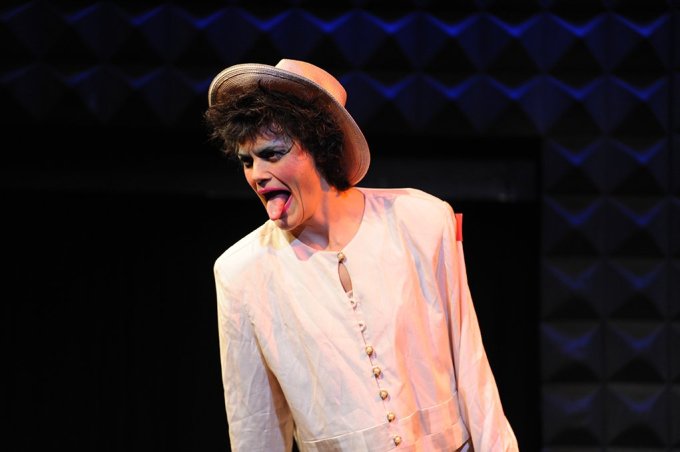
The queer performance artist and comedian’s videos and theatrical shows skirt the edges of what’s acceptable to the mainstream. Take her D-Bag’s Quick And Easy Makeup Tutorial For Life Under Fascism (2017), for instance. Smearing her eyes in a black “accent” she calls “doom, capitalism and white supremacy” she crosses the line from humour to discomfort. It’s a literal black eye that reflects our troubled times back to us.

Always with her work, each manic moment is redeemed by humour. In Vague (2016), the artist vamps’ guttural noises to strains of the Madonna hit with the similar name. As with her video that parodies Beyoncé’s vanity doc Life Is But A Dream (both 2013), Cameron offers welcome relief from the dominant culture’s dictates of perfection. Called by one smart critic “a send-up of the current social id,” Cameron’s act has attracted the attention of comedy heavyweights like Jack Black and Community creator Dan Harmon.

Though she is often referenced in the same breath as profane talents like John Waters or Amy Sedaris, she also recalls Karen Finley, the performance artist whose work sits at an intersection between art and theatre. Its not a perfect analogy. Cameron is madcap while Finley is more about unadulterated catharsis. Yet there is something to the comparison. Both show us how fraught political moments give us the artists we need.

NOW caught up with Cameron ahead of the Toronto debut of her latest show I, An Moron.

Your work straddles the worlds of performance art and comedy. Would you say you feel more at home in one than the other?

I don’t feel at home anywhere, really. It depends. Neither the typical straightforward comedy world nor the typical straightforward art world feel like a cozy blanket to me. But there are facets within those worlds where I think people are open and they kind of get that the two things are not mutually exclusive, and there is room for going in and out of those two contexts. Ultimately, they are just frameworks.

I guess one art world precedent is the performance artist, Karen Finley.

She’s not very funny [laughter].

There are lots of artists I identify with. A precedent for me would be Andy Kaufman. I am also really influenced by the early 80s female comedians, like Gilda Radner and Lily Tomlin. All that wacky stand-up. But it is just kind of more blended together in my presentation rather than sectioned off into specific characters.

Ah, your work is not skit-based?

But it can be. I don’t think that any of it is really limiting. What I’m doing actively is not trying to think about those things, and just do whatever I want. I just shot this thing the other day, a spoof of The Handmaid’s Tale – The Handbag’s Tale – and because I have this persona in place alreadyI have something to work off of, but its not like high art. Its like, really, really, lowbrow. Real low. [laughter]

You should tweet it at Margaret Atwood.

I will. I think she’ll love it. I actually really did love that book, and I like the show, too. It was really campy. But it often surprises me that people are thinking about, wondering, you know: what are you doing?

That’s what’s good about your work. That you are able to provoke the question: what is this? Its very refreshing. There’s an obvious way in which Trump is the context within which everything is happening right now. And you refer to that in your Makeup Tutorial For Life Under Fascism, but I also thought there is this other context. I just found out about “virtue signalling” do you know about that?

No, what is that?

It’s about political correctness. Like, everybody’s fiddling about correctness, and Rome is burning.

Oh right. Philosophy is for those with full bellies?

Yes, exactly. I feel your work responds to that as well, because its so the opposite of correct behaviour.

My work’s the opposite of correct behaviour?

Yes, I’d say so.

Well, if you say so. [laughter] The show I’m going to do in Toronto premiered at the Hammer Museum [in Los Angeles] in October last year. All that year I was writing it and I was really frustrated with North American white Liberals who are all talk no rock, or some rock but then the rock is like, so tied into capitalism – like, what kind of choices of gluten-free bread am I am going to buy and what company is the most moral? Choices we feel are moral and somehow making a difference, but what the fuck is actually going on? Nobody really knows. It’s hard not to be paranoid you are being led down some path that’s meant to distract you from some other terrible thing that’s happening.

Nobody knows what’s real and it is hard to grasp onto that, but I think what you’re doing is very real and its very effective for that reason. You are somehow channeling that or expressing that directly, which is a bit in short supply at the moment.

Well, thank you. I feel like I can express questions and outrage and naïveté. I know that I am naive. I just have feelings and I know where else to put them.

What’s next for you – and Dynasty Handbag?

Well, I’m trying to sell a television show right now with my writing partner Amanda Verwey. I’m having lots of meetings with enthusiastic, heterosexual, white gentlemen who nod and laugh a lot about how – well, they do say they will kill you with enthusiasm here – but I do have some really cool people that I am working with. Jack Black, who is just really awesome and a sweet guy that really loves art and wants to do fun projects. And also Dan Harmon, a producer and writer who has done a bunch of interesting stuff. He is an interesting guy who is in on the joke of the whole thing. And I am doing work on a new, live performance for the spring called Titanic that will premiere in New York. And, what else am I doing? Trying to finish all of Prime Suspect once again.

Oh, that’s a good show.

Yeah, I’m going to get through it for the sixth time. Some pretty big goals I’ve set up for myself.

I, AN MORON by Dynasty Handbag at DDL (209 Augusta) on August 24 at 9 pm. $12. torontomoron.bpt.me

art@nowtoronto.com | @rosemheather

This text commissioned for https://nowtoronto.com/art-and-books/art/dynasty-handbag-opposite-correct-behaviour/


The Crisis in Art

Warhol-Campbell_Soup-1-screenprint-1968
Andy Warhol, Campbell’s Soup Can, 1962

I like the idea that Twitter and Andy Warhol are equivalent expressions of their eras. Both incarnate their respective cultural moments with illuminating simplicity. Warhol called his studio The Factory, made artworks using industrial processes, and tried to be robotic in his utterances. What the artist implies is how 1960s consumer culture made mass identities, but with the appearance of uniqueness. Update that and you get Twitter as an aphorism machine and automaton of self-promotion. Twitter fulfills the vision Warhol foresaw of today’s fame industrial complex – as the art critic Jerry Saltz recently quipped: “In the future everyone will be famous to fifteen people.” Most important: Twitter embodies our present era in a manner Warhol himself wouldn’t recognize.

History works like that. Epochal change happens in a way we don’t fully understand. Tweets have no value without an audience to read and respond to them. This tells us the transition we are now going through is one from not human to machine so much as individual to collective, from client-server relationship to a peer-to-peer universe. Art today places a lot of emphasis on group initiative, but the effect is relatively weak when compared to the awesome power social media and the blockchain puts into the hands of the collectivity.

twitter

While the end result is not art, the culture the net creates suggests a new role for art that the institution has yet to come to terms with. It’s a crisis that the current vogue for artworks as an asset class helps to obscure. But no matter the collusion that will continue to prop that market up, the cultural tendency of actual significance in our time is happening elsewhere with profound long-term effect.

Rosemary Heather

This text originally commissioned by MISC Magazine – a journal of  strategic insight and foresight, FALL 2015.

Q&A Interviews: How to make a magazine in 2015

1.        Q&A is an online interview project that sells longform interviews as ebooks through Amazon and other online outlets. I used to be a magazine editor and this is what I see as a viable contemporary format for the magazine. It’s inside the network, as it were.

2.        Q&A is a magazine, but one that is formed by the characteristics of the context it’s presented within. This means that each individual interview will function on its own and as part of the broader Q&A project. The challenge for the project is to create a context of intelligibility for the idea “Q&A”, an understanding about what this combination of letters means within the context created. This is also a question of establishing a context of trust — trust that the product has a certain consistency and quality, which is what all branding aspires to.

3.        Strictly speaking, calling Q&A a magazine is a misnomer. Rather it is a product of the network. Describing the project in this way points to how Q&A gets activated by the interests of its readers. Internet giants’ Google and Amazon are central to how it works. Search and social media organize the Internet today and as such they create specific opportunities for how journalism can be practiced – specifically: 1) through the development of in-depth niche content; 2) for the interest of a non-local (global) audience; 3) with longterm relevance.

4.        Q&A takes this form in part due to an understanding that it is very hard to maintain a front page on the Internet. Huge resources are required to keep up with the 24/7 global demand for fresh content it enables. News organizations like the Guardian and the New York Times can manage it; organizations like the Gawker blog network or the Huffington Post take a different approach of producing a lot of content quickly, often on the backs of the major news networks by editorializing on news items they produce and inviting their readers to join in, to create extended online conversations.

5.        A lot of the content typical of the latter approach tends towards the prurient or sensational. So, as I like to say, a publisher on the Internet is either a farmer or a troll — the former cultivates an audience through considered development of content, and the latter conjures its audience into existence through one form of provocation or another, in the hope that it provokes a response. My approach is farming with a focus on what I like to think of as the developing culture of the 21st century. This includes interviews with contemporary artists, because they are naturally prognosticators about what it means to live in the present (the edge of the future,) as well as trends that are under-the-radar of broad cultural awareness. The blockchain and its applications (including Ethereum) and the Occupy movement and natural life extension are some examples.

6.        Q&A takes advantage of the unique power of the Internet to create a backcatalog of all kinds of content with a high degree of specificity, and distribute it widely. On the Internet any kind of niche at all can be catered to, and is. Q&A proposes to take advantage of this by producing in-depth interviews about topics that might not otherwise be covered. The niche is what I see as an emerging culture of time; i.e., those topics that do not necessarily have a mainstream audience yet, but still is of interest to specific constituencies.

7.        The phrase “conversational thinking,” provides a good explanation for my interest in the interview format. I got it from Clive Thompson’s book Smarter Than You Think (2013). Thinking happens in conversation that wouldn’t happen otherwise, and I like the way the interview format helps formalize this process. I believe the popularity of the Q&A format is part of the participatory tendency now at work in the culture at large, one that has been fostered by the Internet. It’s interesting to think that the web answers a pent-up demand for collaboration and the active production of knowledge by all kinds of people that, before it was broadly adapted to, apparently wasn’t well-understood.

Rosemary Heather

This text originally published at qqqandaaa.com on JUNE 29, 2015.

Interview: Allison Hrabluik on the Unscripted Magic of “The Splits”

SFU Gallery - Allison Hrabluik - "The Splits"
Allison Hrabluik, video still from “The Splits,” 2015. Image courtesy the artist.

Studying the human body in movement is a constant in Allison Hrabluik’s work. Starting first with hand-drawn animations, then making more abstract films derived from tracing figures on YouTube, the artist has most recently worked with real people to make her short film, The Splits (2015). The beguiling piece that results suggests another constant in the artist’s practice: an intuitive ability to use the things she works with — often random, dissimilar — to tell a story wrapped up in the artwork’s process.

With The Splits, Hrabluik constructs an unlikely portrait of everyday life in British Columbia by focusing on people performing a skill or hobby they are passionate about — from sausage-making to Afghan Hound-grooming. The desire to practice and get better at something, whatever it may be, connects the film’s subjects, and this includes Hrabluik and her facility for filmmaking. The artist told me she followed no strong rule about who would be included in the work. Instead, she found participants through an organic process, one that combined on-the-ground research with referrals from friends. She pulls it all together according to an intuitive logic both enigmatic and highly persuasive that makes clear the skill the artist brings to the project.

Hrabluik beguiles through the trickery of cinema. The work’s greater subject is the idiosyncratic space the film constructs and the role viewer perception plays in its making. A tightly focused camera frame makes us aware of the film’s synthetic space. Reinforcing this impression is the location where Hrabluik shot The Splits, a community center in Surrey, British Columbia. A typical setting for many of the activities the artist depicts — a tap dancing rehearsal, for instance — by using it to bring together a disparate range of such activities Hrabluik creates an enhanced but denaturalized context for her subjects. This approach is made clear from the film’s opening frames when the viewer receives partial pieces of information that become more intelligible as the film progresses. Sound from each scene carries over into the next, helping to establish the broader coherence of the work.

The Splits takes place within the white space of a rehearsal hall, and also in the world Hrabluik creates. This opens her work up onto a wider conversation about the use of art as a tool for scripting reality, a contemporary preoccupation that extends from the lowest forms of pop culture to the high art aspirations of literary autofiction. In her method of using real-world performance to capture unexpected, composite effects, Hrabluik’s film shares a lot in common with these tendencies. I spoke with the Vancouver-based Hrabluik this March about her artistic process, the logistics of filming The Splits, and where her practice might lead next. Following a presentation at Kassel Dokfest, in Kassel, Germany, the film is currently on view at SFU Art Gallery, Burnaby, BC, with an upcoming screening at Images Festival, Toronto.

You’ve described movement as being a unifying factor in your works, can you distill what’s of interest to you there?

Prior to making The Splits, I had been making narrative video works, and found that I didn’t know what kind of story to tell anymore. When it came time to write a new script, I could focus on almost anything, so how should I make a selection?

I was also reading a lot of fiction, and began to notice the similarities between many of the books on my shelf. They were wildly different in content, but similar in that they all describe how we manage, or don’t manage, the situations we find ourselves in. I wondered if this internal struggle could be distilled into something visually. Perhaps through the ways we physically move through the world. I began creating movement-based scripts as alternatives to narrative scripts, in an attempt to reveal a character instead of telling a story. To do this, I worked with a composer and a choreographer and began to trace films, looking for different ways to make things move.

You also made works by tracing videos found on YouTube — taking a video and choosing it for its movement. You mentioned this was the provenance for The Splits?

Yes. I was looking for videos to work with, and came across a group of young gymnasts online who record themselves performing in their living rooms and backyards, and post the videos to Youtube. The footage was strangely captivating but because they were teenagers I knew I couldn’t ethically use their images. So I started meeting with gymnasts and dancers here in Vancouver. I began videotaping them, planning to use the footage to trace their forms, but soon realized that altering the images wasn’t necessary. There was instead something in the connection between performers that I wanted to follow.

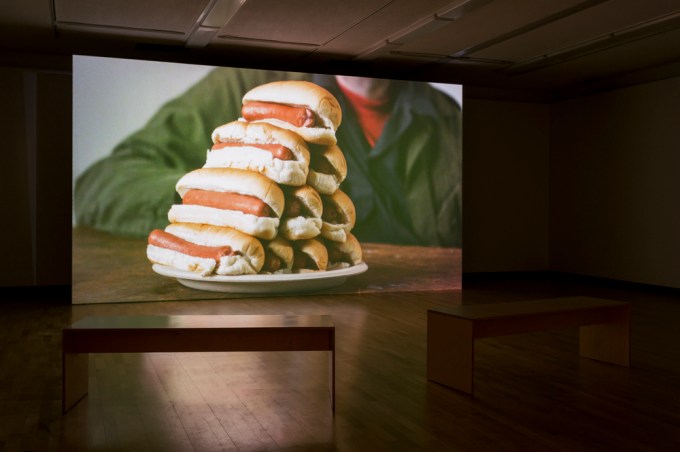
I contacted as many people as I could find who I thought moved in interesting ways. I started with gymnasts, a hula hooper, and weightlifters — athletic ways of moving. To round this out, I considered other ways of performing, like opera and burlesque, amateur music, and how we move everyday at work and with animals. I also incorporated elements of our lives that lean towards the grotesque — the salami makers and the hotdog eater. The absurd is linked to our everyday as much as the transcendent, which is often what we look for in physical excellence.

And you knew all the people?

I know a few of them. Barbe Atwell, the hula hooper is a friend, the tap dancers I saw tap dancing on Granville Island, and the dog trainers I found online through the Afghan Hound Society. Others, like the skippers, gymnasts, and weightlifters I contacted through their coaches, who put me in touch with people they thought might be interested. Often friends recommended people.

I began to notice that if there’s an action people do, there’s a team around it. For instance, I was thinking about skipping, fencing, competitive eating, dog training, birding, etc., and found communities for all of them, each with their own language, skill set, and measures of success. In this project, art and filmmaking became only one activity among many, and I enjoyed that opening up.

That brings me to another question. I noticed in the bibliography that accompanies your show that it includes the category Scripted. What’s the connection?

Melanie O’Brian, the director of SFU Galleries and the curator of the exhibition, asked me to compile a bibliography of books that formed my thinking around The Splits. She knew that literature is often a starting point for my work. Scripted is a section of the bibliography, and includes The Species of Spaces and Other Pieces (1974/1997) by Georges Perec, who works with writing constraints, and also the catalogue Yvonne Rainer: Space, Body, Language (2012). Rainer uses a lot of annotated scores to direct movement in her choreography.

Okay. Because that brings up a whole world of ideas that are relevant to the current moment. For instance, the idea of autofiction associated with the Norwegian writer, Karl Ove Knausgaard.

I’m not familiar with the term autofiction, but think I know what you mean. I read the first book of My Struggle (2012), and enjoyed it. Other books in the bibliography for the exhibition, like Marguerite Duras’s The Lover (1984/1985), bill bissett’s work, Elizabeth Smart’s By Grand Central Station I Sat Down and Wept (1945), I believe fall into that category. I’m also interested in nonfiction that has literary qualities, which for me begins to read in similar ways. Like Annie Dillard’s Pilgrim at Tinker Creek (1974), and Sharon Butala’s Perfection of the Morning (1994).

What some of these works share is a thinly-veiled allegory of self-love and self-destruction as two sides of the same coin. Sometimes describing this in a cool voice, other times with unapologetic effervescence. It’s the effervescence that spills into The Splits.

This makes me wonder about how scripted your works is?  Is it scripted?  

The selection of the cast was carefully arranged, as was the location of filming. We filmed at Sullivan Hall in Surrey, a very active community center. The events that happen at Sullivan Hall on a weekly basis are not far off from what happens in The Splits. The weeks before we filmed, the hall hosted a wedding, a bird sale, a rock and mineral show, an auto show, yoga lessons, and dog training evenings.

Creating the situation became the script. I trusted that once the cast and location were in place, something interesting would happen. During filming, I asked the performers to perform whatever they wanted. We filmed everything, and I made a lot of decisions during the editing process.

The framing is so important. When the film starts, it’s the tap dancers. Then it’s the hula hoop woman, but the way you frame it, there’s some degree of ambiguity. You are suggesting there is an equivalence between the frame and the stage, and that creates the space of the film. Were you always trying emphasize this tight framing when shooting?  

I was interested in the similarities between the different actions performed. The motion in the close-up scenes of the hula-hooper is echoed in the close ups of the gymnasts and weightlifter. By initially hiding the particular activity involved, I could focus on their shared qualities. In the end, it’s curious to know that it’s a hula hoop, a dumb bell, and balancing exercises that create such erotically-charged motion, but it’s not really about the hula hoop.

Right. I guess that’s what you give to the viewer is this puzzle to work out about what’s going on. Why are these things together and what connects them all? I think you can intuitively understand that it’s pretty open but I think you are also very aware of the frame.

I needed a frame, I did. I tried not to have one. I tried to film in everyone’s individual spaces and it didn’t work. So the hall and the stage and the close cropping become devices that connect what might otherwise be a random grouping of people, isolating and highlighting their actions. The neutrality of the hall is important. While it has the character of a space that is well used for performance and celebration, it also shares the neutral characteristics of an exhibition space, allowing us to focus on movement over setting.

Obviously you are able to work with these people because you have that sensitivity to what they need to feel comfortable, and to perform. It’s very naturalistic, that was another point I was going to make …

The process was comfortable, and this was important. I met with everyone individually before we filmed, to describe the project and answer questions. Once they arrived at the hall, we spent several hours filming each group. This gave them time to become comfortable in front of the camera. A feeling of naturalness also happens through editing. I searched through hours of footage to find moments where the performers were unguarded. Much of the scripting you asked about earlier happens there.

It’s not a documentary.

I think it intersects documentary and fiction. The performers are performing themselves, but the situation that brings them together is constructed. I’ll continue to explore this intersection with other subjects, leaving movement behind for a while.

Do you think about directing? Will you be making a more scripted film in the future?  

Yes, I’ll certainly experiment with a more scripted approach. That might involve writing scripts while leaving room for improvisation.

Rosemary Heather

This interview originally appeared in Momus, MARCH 29, 2016.

More information about Allison Hrabluik here.
 

Scott Treleaven finally shows in Toronto

cc_scott_treleaven_2017_placeholder
Scott Treleaven says he’s pursuing his interest in mystic abstraction in new works on paper at Cooper Cole.

You’d think a homegrown artist who’s hung out with Malcolm McLaren, Derek Jarman and Genesis P-Orridge and shown all over the world – including Paris and New York City – would’ve had a solo show in Toronto by now.

But Scott Treleaven is launching his first solo exhibition here this week.

He’s finally embracing what he calls “the increasingly rare human ecologies” of his readopted home.

“Toronto has totally unique integrations of different cultural, intellectual and creative communities. Anyone who’s lived here for a while knows how lucky we are,” he notes inside his studio.

Treleaven built his career aligning the subversive potential of mysticism and the occult with queer politics and art. The abstract artworks on paper in this exhibition are something of a departure for him, but he sees these luscious, deeply pigmented works as a natural extension of his interests, placing him in a tradition of mystic abstraction from Wassily Kandinsky to the rediscovered Hilma af Klint.

Treleaven’s bio is crammed with fascinating personal and professional encounters. There’s the meeting with McLaren in Paris, for example, or a big-name production company’s desire to make a mainstream feature based on his “queer pagan punk” zine/film The Salivation Army. That project foundered on the utter daftness of the film company’s vision, which sought to replace his gay teen protagonists with straight leads.

After taking a break from film studies at York, he moved to London in 1991, where he had a chance encounter with Jarman.

Treleaven’s filmography is very rich: Queercore: A Punk-u-mentary; Gold, a collaboration with British provocateur Genesis P-Orridge. But it was Jarman who urged him to focus more on visual art, a bold move that’s resulted in a very successful career.

After eight years living in Paris and New York with his partner, the painter Paul P., Treleaven is back in Toronto for what he believes will be an extended stay.

As to why he’s finally getting a solo exhibition here now, he thinks the city’s art scene has expanded its horizons in recent years, sparking a “vital, real-time dialogue that’s bringing artists-in-exile back into the fold.”

It’s a shift that reflects Canada’s changing, more engaged position in the world.


SHOWS WE’D LOVE TO SEE 
Some Toronto artists – former and current – have bigger audiences for their work elsewhere


Lorna Mills Mills works with the net and new media. The Whitney Museum recently purchased her multi-artist compendium Ways Of Something.

Karen Lofgren The OCAD-trained sculptor now works out of L.A.

Willy Le Maitre The Toronto-based intermedia artist exhibits with the Canada gallery in New York City.

Gareth Long Recently relocated to Toronto from London, the installation artist shows internationally.

Rosemary Heather


SCOTT TRELEAVEN at Cooper Cole (1134 Dupont), January 20 to February 18, 2017.

This text originally commissioned by NOW Magazine, JANUARY 18, 2017.

Nasty

This essay was written to accompany the exhibition of the same name. Details below.

Donald Trump deriding his electoral opponent as a “nasty woman” is hardly the biggest problem associated with the new American president. The insult delivered during the third presidential debate does, however, have relevance to the bizarre state of affairs that is the United States in 2017. The country is currently in the grip of a self-inflicted catastrophe. Chaos is not too strong a word for what is unfolding; who knows where its all heading? But just think what the cause is — the threat of a woman holding the country’s highest office. Reality TV host and fraud businessman Donald Trump was thought a better alternative than that.

jmurphy_cobra

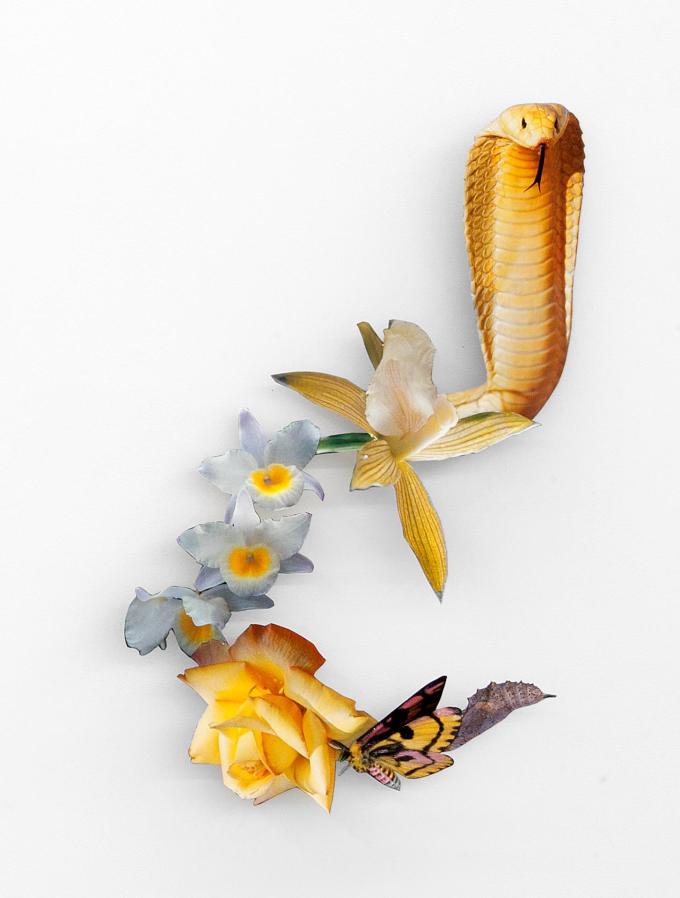
Jennifer Murphy, from collage series, 2016

Nasty personifies the idea of an embodied threat. On the occasion of Trump’s inauguration, the word takes on an added significance: as an emblem of resistance. Taking this challenge on, Nasty the exhibition is organized to coincide with the inauguration and the worldwide protests that are accompanying it. The idea of nasty connects with art in the latter’s embodied seductions — art is always in some sectors considered dangerous, in a tangible but hard-to-define way. We know from Plato that art is thought a program for deception; like misogyny, the social prejudice against it runs eons deep.  If artworks and women still engender a suspect reputation, what is the problem exactly?

nasty_shannon_2

Image: Shannon Bool (photogram) 2016

Going back to Hilary, the New York Times ran an illuminating opinion piece last November 5th, three days before the election. Titled, “The Men Feminists Left Behind,” the author Jill Filipovic talks about an America (and by extension all of the West) in which men have enjoyed a default dominance, forever. “It was mostly white men in charge and it was white male experiences against which all others found themselves contrasted and defined.” The clearest indication that this status quo might be undergoing change is — what else? — the resistance to it expressed by Donald Trump’s electoral success. Filipovic outlines the many advances women have made in the past decades — “For women, feminism is both remarkably successful and a work in progress” — and notes that “men haven’t gained nearly as much flexibility.” Accurately derided in Vanity Fair as “shallow and mediocre,” Trump as US President is living proof that men still rule, regardless of how ill-suited they may be for the job.

nasty_nadia_4

Nadia Belerique, from shelf series, 2016

Is the argument of this show then that artworks are like women? Clearly, yes. More specifically it proposes that both derive their power from a position of vulnerability. This position, however, produces in its turn an entire world of invention. Writing about Clinton’s loss to Trump in the election, the philosopher Rebecca Solnit notes: “power… is a male prerogative, which is to say that the set-up was not intended to include women.” If power is not “set up” for women to share in, they have to figure out other ways to get it. Faced with this reality, the appurtenances, so called, of the feminine are a way of owning it — if not power necessarily, then an equivalent force all its own.

An heightened relevance for feminist politics provides the context for this exhibition, but its not a political show. Nasty presents work by eight women artists, each one in some way investigating the visual culture of femininity. The types of practices on view are wide-ranging. Through surface collisions of ornamentation and draping, Shannon Bool evokes the figure of the feminine, as both historically specific and timeless. Stiletto heels, rendered as both support and staging ground, form the basis for Elizabeth Zvonar’s evocative collages. The power dynamics of looking take on new — gendered — meaning in Nadia Belerique’s shelf sculptures. Jennifer Murphy’s delicate sculptural collage works hint at the poisoned barbs that lie beneath the natural world’s seductions. Against an astringent blue background, the title Shady Lady (2010), suggests the gendered nature of Kristine Moran’s gestural abstractions. Aleesa Cohene’s 2009 video installation Like, Like discovers ulterior narratives for mass culture’s female icons. With Valerie Blass’s 2009 work Touche de bois, wood and jeggings are combined to be somehow confrontational. And finally, and hardly least, Kara Hamilton contributes further embodied aggressions with the beast-like, Tonka, a work she made in 2015.

Rosemary Heather

Nasty
Nadia Belerique, Valérie Blass, Shannon Bool, Aleesa Cohene, Kara Hamilton, Kristine Moran, Jennifer Murphy and Elizabeth Zvonar
January 21 – March 4, 2017
Daniel Faria Gallery
188 St Helens Avenue
Toronto ON, M6H 4A1
Canada
www.danielfariagallery.com

See also, Nasty Talk: Feminist Art In The Age Of Trump, a reprint of this text with a nice selection of images from the show, at Good Trouble Magazine.

Willy Le Maitre – title flight tiger compound returns

canada-nil-database-7_hfytahr

Canada, New York
May 6 – June 5, 2016

New arrangements in the drama of looking might be the mission statement for Willy Le Maitre’s lenticular photographs. The work is an update, in other words, on a well-established tradition in art — to upend accustomed habits of viewing, purely through formal means. Writing about the work, the critic Blake Gopnick talks about this tradition as one of visual “indeterminacy…one of the crucial bywords of modern art at least since the time of Cézanne and Picasso.”

Artworks considered indeterminate make special demands on the viewer. It’s a program for art, one for which Robert Hughes coined the phrase, the Shock of the New. The title of a 1980 TV series he wrote and hosted for the BBC, Hughes described a dynamic for artmaking that was essentially avant garde. Pushing forward, out ahead of the general public, modern artists work to broaden the intelligibility of contemporary experience, and this happens primarily in a visual key. As narrated by Hughes, each moment of innovation has historically specific circumstances — the Shock of the New is a migrating phenomenon. For instance, the visual disjunctions of Cubism are now familiar to the point of seeming decorative. In Le Maitre’s work, he uses lenticular images to revive this dynamic of dislocated (or fresh) looking in art. If the results are truly shocking, the question is what historical conditions could the work be said to express?

Used typically to make crude picture animations, lenticular technology dates from the post WW II period. Two or more images are animated when overlaid by a screen of finely ribbed plastic. Vision gets refracted one way or the other according to the angle of the ribs (and the angle of vision), each rib a lens that magnifies the strip of image that lies underneath it. Early uses of this novelty technique included badges for Dwight Eisenhower’s 1952 Presidential campaign (“I like Ike” alternating with a head shot of the candidate), or so-called Flicker Rings with pictures of Batman, or Curly from the Three Stooges, on them.

A less familiar term for this process is “Autostereo”. The name points to the technique’s origins in early experiments in optical illusion. The “auto” stereo innovation was a kind of improvement on the late 19th century technique of stereoscopy. When viewed with the aid of the eyeglass-like stereoscopic viewer, slightly different images seen side-by-side take on the illusion of 3D depth. Both vision technologies are approximations of the physiological process, designed to demonstrate a specific aspect of how vision works — that is, at the intersection of interior and exterior sight. The tangible artifice produced by a stereoscopic or lenticular image is in the end a slight entertainment, but one that helps highlight the role the mind plays in visual perception.

Internal vision has long been a preoccupation of Le Maitre’s. The artist posits stereoscopic effects as a model for what is seen by the mind’s eye. In the imperfection of the 3D illusion, Le Maitre finds an expanded realm for exploration, primarily by making films that combine digital and 3D technology. This extensive body of work characteristically uses digital effects to extend and distort 3D treatments of real world imagery. A phantasmagoric experience results, one that recognizably partakes of both artifice and the chimera of dreams. Freedom from the constraints of the material world is of course a capacity of the mind, and art often provides the best methods for making this capacity tangible.

auger_e4kehof_gfzfjcr

Film is typically described as a dream-like medium. Its invitation to sit in the dark and be off-duty somehow lends a legitimacy to even the most outlandish of speculative journeys it can fabricate — as a pastime, and as a form of experience. Always tasked with the job of convincing viewers of their plausibility, the same benefit of a doubt is less frequently extended to artworks. Arguably, this means Le Maitre’s lenticular works are a more risky proposition for the artist.

In his hands, lenticular technology becomes a tool of indeterminacy, with corresponding effects on the viewer. By combining photographs into a single picture frame, Le Maitre condenses the space-time continuum that each image implies. The collages he makes are deliberately disjunctive, their smashed perspectives rendered dynamic because of the way lenticular lens orchestrates viewer engagement.

What results is a destabilized position for the viewer. As Phil Grauer, of the New York gallery, Canada, observes: “You can’t conquer these works.” The space they construct is ambiguous without hope of resolution. Making vertiginous space inside the picture plane could be said to disrupt viewer expectations of coherence. From another perspective, what Le Maitre is doing is creating a more complex visual field for viewer apprehension. Beyond the capacity of the lenticular to create such an effect, what field of reference is the artist implying here? The quick answer would be “Pokemon Go”, the augmented reality that is now an expected component of everyday life. In a broader sense, it’s not hard to find other artworks that also traffic in a figure-ground confusion. What this suggests is that contemporary life conjures up not only a collapsed picture plane, but also one that is infinitely expanded. Le Maitre’s insight is to combine the two, his use of the constraint of the picture frame alerting us to the truth of this new reality.

Rosemary Heather

This text commissioned by Border Crossings Magazine Volume 35, Number 4, Issue No. 140

More information about Willy Le Maitre is available here.

Condo Living: An exhibition gets reprised after 30 years, revealing deep changes and some continuities in Toronto’s art scene

chromalives-install-06
Chroma Lives install image: stairs by Manden Murphy, Avocado Sprouter and Spoon for Return Baby Bird to Nest by Tammy McLennan, Book Stack andJumbo Playing Cards by Roula Partheniou, Spit Pits by Laurie Kang, Untitled Background 2 by Connor Crawford.

Visitor account by Rosemary Heather of ‘Chroma Lives’, Camrost Felcorp Yorkville Plaza Sales Centre, Toronto, 1-30 June 2016. Curated by Erin Alexa Freedman and Lili Huston-Heterich

The second time I visited Chroma Lives I sat on furniture that was part of the exhibition, happy to have escaped the blazing hot sun of the Toronto summer outside. Presented in a condo showroom, the exhibition was pleasantly air conditioned and accompanied by a treacly jazz soundtrack. There was no cake, and there had been at the vernissage, but I could live with that.

Curators Erin Alexa Freedman and Lili Huston-Herterich had assembled works by local artists and designers in one room in the sales centre. Devised in reference to Chromaliving, an earlier exhibition held in the same upscale Toronto neighborhood some thirty odd years before, Chroma Lives repeated its predecessors’ basic gesture of furnishing a retail space with artworks. The two shows however were on decidedly different scales: the former featuring 150 artists, and the latter just eighteen. This difference is one of a number of reasons Chroma Lives has a seemingly notational relationship to its past context. Another would be the more obvious explanation that, between now and then, historical circumstances have changed.

chromalives-install-04Chroma Lives install image: Heather Goodchild’s in the morning and in the evening, wool and burlap rug.

In the showroom, affixed in serif letters on the wall is the marketing slogan “Reside in a Modern Day Masterpiece.” The curators wisely chose to leave this feature intact. By giving credence to the hoary idea that artworks connote elegance, Chroma Lives made evident the narrow space of maneuver it was operating within. An agitated light fixture hanging in the centre of the room, animated to jerk constantly while making a crackling electric sound (Connor Crawford’s Light from a dilapidated interrogation room, 2016), was one of the few hints of disturbance amidst the otherwise placid facade of the show. Of course, closer inspection of the art on view revealed other signs of disruption, such as the wry humor of Oliver Husain’s phallic curtain tassels (Can we talk about the elegance in the room, 2016), for instance, or the subtle perversity of Laurie Kang’s seventeen aluminum-cast peach pits scattered across a silicone mat on the floor (Spit Pits, 2016). Many of the other works in the show were elegant takes on household items. Made by young designers who had responded to an open call, the show’s intermingling of art and design was for the general purpose of a mise-en-scene.

Throughout the exhibition, the curators used the showroom during off hours to conduct interviews with Chromaliving participants, from which they will produce a book and online archive about the project. This focus made Chroma Lives function like something of a portal into the past. A photo archive and catalogue provided documentation of the original exhibition. Presented in the vacated space of a bankrupt department store, Chromaliving was a maximalist endeavor. If that show’s contemporary incarnation presents mostly as decor, the latter exhibition was staged to serve an entirely different purview. Chromaliving aggressively positioned art and artists as values in and of themselves. In the documentation, one sees aesthetic excess that, among other things, might have pointed to a lack of infrastructure for the Toronto art scene of its day. If this art rawness is little in evidence today, this is perhaps an insight Chroma Lives helps to illuminate.

Toronto critic and curator Philip Monk has done important work chronicling the history of contemporary art in the city. His recently published Is Toronto Burning? : Three Years in the Making (and Unmaking) of the Toronto Art Scene (2016) is the catalogue for an exhibition that looked at the years 1977-1979. Monk positions this three-year period as foundational to the city’s current art scene. So called “artist-run” culture has always been strong in Canada, in part due to relatively lavish government largess. The galleries Mercer Union, Gallery TPW, and Gallery 44, so central to Toronto’s artist run culture today, were founded during that time, along with some of the city’s most influential artistic tendencies. Monk has written:

“In the midst of the economic and social crises of the 1970s, Toronto was pretty vacant—but out of these conditions its artists crafted something unique, sometimes taking the fiction of a scene for the subject of their art.”

If creating an art scene out of fiction sounds familiar that’s because it was the modus operandi of General Idea, the artist group who are Toronto’s most internationally celebrated art practitioners, along with Michael Snow. GI (as they are always referred to in Toronto) also participated in Chromaliving, arguably having been a progenitor of the DIY ethos that made the show possible. This legacy is still evident in certain threads of Toronto art practice — the queer, low-fi aesthetic of Peaches, Allyson Mitchell, FASTWÜRMS, or the late and dearly missed, Will Munro, for instance. The demand for such self-invention never goes away. In light of this, the Chroma Lives project has the feeling of an interlude: an occasion to contemplate past eras, and how Toronto as a location gets manifested in art today.

Chroma Lives features works by: Joshua Brolly, Connor Crawford, Laura Dawe, Mike Goldby, Heather Goodchild, Oliver Husain, Tim Jocelyn, Laurie Kang, Jeremy Laing, Brittany MacDougall, Tammy McClennan, Pasha Moezzi, Manden Murphy, Roula Partheniou, Shakeel Rehemtulla & Dynasty, Wanze Song, Kristian Spreen, and Brad Tinmouth.

Text commissioned by If I Can’t Dance, I Don’t Want to be Part of Your Revolution, summer 2016.

On Art and Populism: Mohammad Salemy on the New Centre for Research & Practice


 The online school bridges the gap between legacy institutions and new knowledge production

03/02 2016 One reason I like the New Centre for Research & Practice is the way it constructs itself out of tools made available by the internet. Implicitly, even the school’s chosen moniker, the New Centre, suggests what potential gets realized through the use of this context. A school in pragmatic terms, the project is also an embedded reflection on what kind of capacity the network creates. Registered in the State of Michigan (under the category of a Licensed Proprietary School) the non-profit offers graduate-level certificates, along with a range of related on and off-line activities. Started in the Fall of 2014, the New Centre has quickly established itself as a presence, in part due to pent up demand brick and mortar institutions have been slow to meet. However, in this conversation the curator and artist, Mohammad Salemy, one of the school’s three co-founders, makes clear their mission is not oppositional but supplementary to educational resources provided by traditional institutions. With a big shout out to Google docs, the web app Mohammad and I used to conduct this discussion over the last two weeks.

Rosemary Heather (RH): Can you talk about the origins of this project?

Mohammad Salemy (MS): The New Centre was established due to a common interest amongst its founders — myself, Jason Adams and Tony Yanick — in philosophy and theory, in particular their contemporary and emerging forms. We wanted to see how these new approaches could be put to work in a variety of disciplines, with a special emphasis on the arts, technology, and politics. We shared a desire for new intellectual spaces, and new forms of research and development in these new areas of thought. We first focused on online seminars. These are taught face-to-face via Google Hangouts, for video conferencing, and Google Classroom, a platform for maintaining classroom environments. Later on, we opened a new focus on research and publishing, including ten different research groups on the areas of accelerationism, the anthropocene, new art, new music, postcapitalism, and poststatism. Our approach is to identify groundbreaking research agendas and bring together the people central to their development with students and scholars seeking to take their work in new directions. Our publishing platform &&& (tripleampresand.org) publishes the results and disseminates other works by The New Centre community.

RH: Since the Kunsthalle Wien planned their Political Populism exhibition late in 2014, the tendency has only become more pronounced, in Europe and the US. We could say the solution populist politicians offer to a perceived crisis of legitimacy is dubious, but it’s an authentic channeling of discontent nonetheless. Can I draw an analogy here? Can the New Centre for Research & Practice be said to be similarly providing an alternative to an academic establishment perceived to be at an impasse?

MS: If anything, our collective operations at The New Centre can be said to represent a form of academic populism. This can only be accurate if we redefine our understanding of the notions of pop and popular. We are popular to the extent that the increasingly youthful face of our academic world — for instance, the average age of those attending PhD programs has dropped dramatically in the last two decades — demands forms of knowledge that are in tune with the contemporary world, not just politically but also in terms of epistemology. We organize seminars, events and activities that bring new thinkers, scholars and artists to a global audience using available web technologies as the Centre’s physical and institutional platforms. Given the popularity of everything digital and networked these days, and of social media in particular, we are also popular because we operate out of this virtual space rather than depend on traditional educational infrastructure like a campus, studios, etc. However, unlike the movements associated with para academia, we see ourselves as a fluid space which surrounds and extends, rather than opposes, the capabilities of traditional academic institutions. Our objective is to legitimize newer forms of knowledge through our collaborative work with universities, colleges, and other physical institutions like galleries and museums. We think these institutions, despite their material and political limitations still provide an irreplaceable set of tools and valuable networks for the advancement of new discourses that are yet to be canonized. Most of our members and students are already connected to universities and other institutions as professors, graduate students, researchers or artists. They come to us because they find our services a necessary complement to what they otherwise pursue in their own work.

RH: It seems accurate to call The New Centre a decentralized initiative. On your website, you talk about “accelerating academia” and “ecologizing knowledge.” Both concepts can be described as capacities of the network. What effects do you see resulting from the project specifically due to the platform you are working from?

thenewcentre.org

MS: Not only are we more decentralized than other educational platforms, but we are also intent on becoming even more decentralized as we grow. First of all myself and my cofounders, Jason and Tony, are geographically dispersed, often residing in different parts of the world. For the longest time, until Machines that Matter our collaborative conference with e-flux in New York (December 2014), we had not even met in person and had done everything via the internet, from registering The New Centre as a school in Michigan to setting up various service accounts with government and private entities. In regards to accelerating academia and ecologizing knowledge, the key is in having an ear for what is emerging from inside and outside of academia, and shortening the feedback loop through which the works of the younger generation of researchers and graduates become validated and available to others who are pursuing higher level education. On the practical level, we see the school lending a hand to those who might have remained outside the academic gates by upgrading their knowledge and skills and helping them enter the academic world faster. What we mean by ecologizing knowledge is a networked process in which the seminars, syllabuses and assignments will find new ramifications outside of the classroom. To facilitate this, we try to connect our educational services to other activities inside and outside The New Centre. This is a process through which not only a new knowledge but also a new environment for its reception and evaluation is constructed, basically through networks established via the interactions between the wider internet and the institution.

RH: “Shaping the future” is one of the stated goals of the school. Is this in respect of an ideal of progressive politics? What set of political ideas frame The New Centre project?

MS: Jason and Tony come from other trajectories, and also we tend to have both overlapping and diverging point of views in relation to politics. Perhaps what unites our political horizon is the faith we have in the collective human capacity for self improvement via human and non-human technologies, both on the singular and collective levels. For myself, the political dimension of The New Centre is encapsulated in a term I have been using lately: “epistopolitics.” As far as political economy is concerned, an accelerationist project like The New Centre can never be merely political, but can perhaps be epistopolitical. In my opinion, political emancipation can only be possible as a result of an intense epistemological revolution that transforms the entire social fabric, including the outlook of the capitalist class, and a complete revamping of the structures and processes that constitute contemporary liberal democracies. Epistopolitics describes the entanglement of politics with the theory of knowledge and vice versa, which instead of restating Foucault’s position on the relationship between knowledge and power (i.e., knowledge is political) shows how truth, or more precisely the production of knowledge, can only be emancipatory if the trajectory of its politics is also emancipatory. This means an emancipatory political project will be doomed to fail if it remains untouched by a transformation of the existing theories of knowledge. Epistopolitics is the ultimate politics, which consists of producing a knowledge that uses both the critical (negative) and constructive (positive) forms of looking at the world to secure qualitative gains in the general production of knowledge towards collective emancipation.

RH: British political philosopher John Gray said recently that our best thinking today is happening in mainstream culture, not the academy. He cited as an example the way certain TV series (Breaking Bad, for instance) are able to dramatize ethical contradictions. I agree; it’s hard not to notice the many ways that mainstream culture is progressive. How do you then position a project like The New Centre, with its commitment to advanced political and philosophical thinking? Is the model of the avant-garde relevant?

MS: It is impossible to define a contemporary ontology for an avant-garde carved out of its history and actuality from the 20th century. If we forgo ontology and instead identify an avant-garde based on its process and function, then I think it is possible to talk about The New Centre as an avant-garde project. The difference is that in the traditional definition of the term, innovation and radicality is articulated through the 20th century metaphor of war and confrontation that imagines the avant-garde in the front line of political and cultural battles. For us, if there is any avant-garde, it must be found as isolated and dispersed elements and entities within the larger universe of social, artistic, political and scientific fields and institutions. The New Centre can claim this mantle by being both the agent of cohesion, bringing these elements together, and vehicles for navigation, using networked resources to move the whole operation, and not just its front rows, forward.

RH: How do you reconcile the work you do at the The New Centre with your work as a curator and practicing artist?

MS: Even in the strictest definition of the term “curatorial,” the work of a curator already includes the creation of public education programs in relation to other activities of the museum or gallery, like exhibitions. In my case, the collaboration with Jason and Tony began as a result of working together on the Incredible Machines conference, which was a curatorial initiative I undertook in 2013–14 culminating in a part real/part virtual gathering of thinkers, scholars and artists around the themes of computation and cybernetics. Respectively, our work at The New Centre is at least partially — if not completely — curatorial. It takes curatorial skills to compose a virtual institution of learning out of digital bits and parts that are generated on different platforms. So much of managing our virtual institution has to do with maintaining its virtual interface on a regular basis, like an ongoing exhibition of interdisciplinary work with parts being operational separately but also together as a whole. If at the end of the day the function of a good exhibition or another kind of curatorial project is to bring people together and generate questions, conversations — and possibly plans of action — around a theme or concern, I think one can see how what we do at The New Centre overlaps with the activities of any rigorous curatorial team.

It’s also interesting to talk about my practice as an artist, which itself is a cross between curatorial and conceptual practices. In recent years my work has involved taking large data sets extracted from technological platforms like Google, social media, or archived live television broadcasts, and using them to create novel and critical forms of cybernetics involving humans and machines. In this way, I see an overlap between working as an artist, a curator or a programmer at The New Centre.

http://thenewcentre.org/


Mohammad Salemy is an independent NYC/Vancouver-based critic and curator from Iran. He has curated exhibitions at the Koerner Gallery and AMS Gallery at the University of British Columbia, as well as the Satellite Gallery and Dadabase. He co-curated Faces exhibition at the Morris and Helen Belkin Art Gallery. In 2014, Salemy organized the Incredible Machines conference in Vancouver. Salemy holds a masters degree in Critical and Curatorial Studies from the University of British Columbia.

This is one of ten posts written to accompany the Kunsthalle Wien’s Political Populism exhibition (November 11, 2015 – February 2, 2016).