Sobey Art Award winner Ursula Johnson spreads her wings

The Mi’kmaw artist talks about her big prize win, moose fencing and how she became a butterfly

Photo: Rita Taylor/Banff Centre For The Arts
Ursula Johnson, Sobey Award Winner 2017/Photo: Rita Taylor/Banff Centre

Mi’kmaw artist Ursula Johnson has won this year’s $50,000 Sobey Art Award. It’s a well-deserved win in a strong year for the national art prize, which focuses on artists under 40.

It marked the first time a nominee from the Atlantic region has prevailed. At the ceremony last week, Johnson first addressed the crowd in Mi’kmaq before switching to English because “nobody can understand me but my Mom,” she said.

The speech reflected her artistic approach: opening up traditional practices so they have contemporary relevance.

A member of Cape Breton’s Eskasoni First Nation, the 37-year-old’s art encompasses installation and performance, often incorporating skills learned from her elders, like basket weaving.

Sobey Award Winner Ursula Johnson
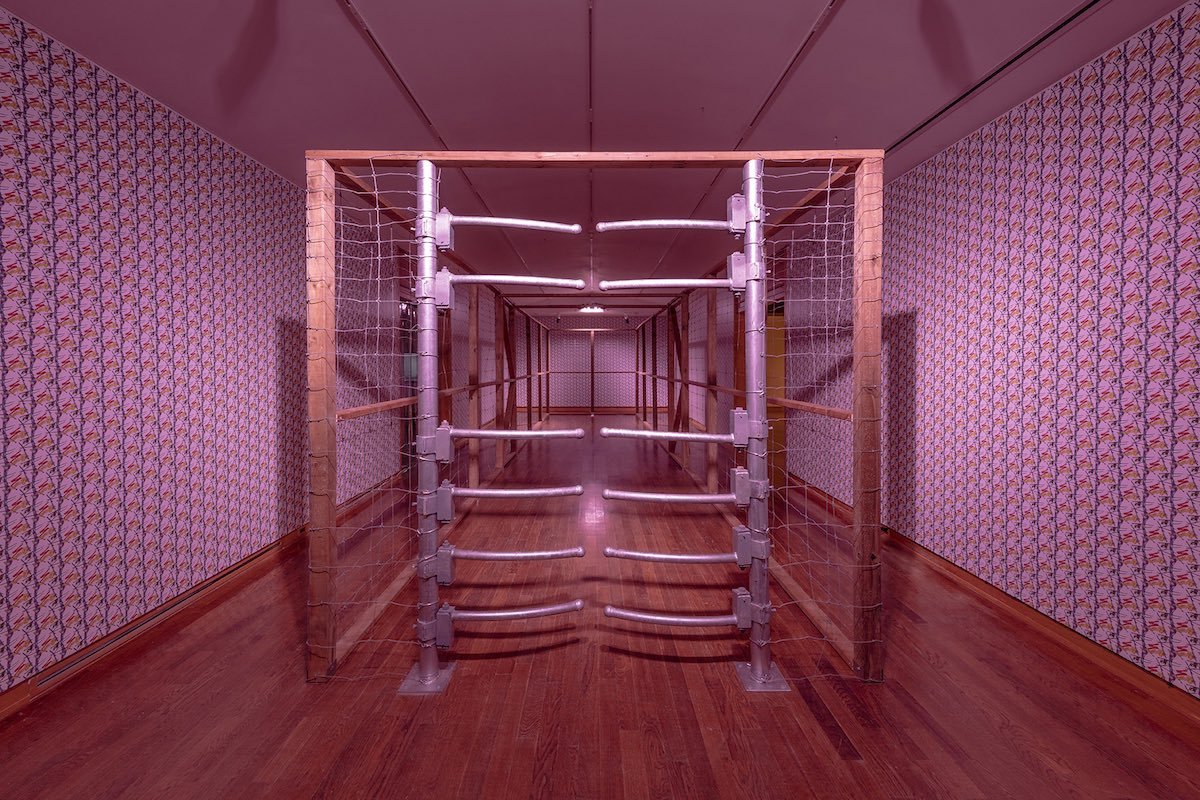
Ursula Johnson’s installation Moose Fence           Photo: Toni Hafkenscheid

Johnson’s installation at the Sobey Art Award exhibition at U of T’s Art Museum is Moose Fence, based on fencing used to prevent animals from straying into traffic. NOW spoke with Johnson about the piece and her wider practice.

Congratulations on the win! How does it feel?

Thank you! I am kind of vibrating with excitement. I can’t believe it.

For any artist who wins this type of prize it must be a shock. It’s so separate
from what you do to win this kind of prize.

Yes. It seems more like what an athlete does – training for competition. Artists are creating things with materials or mediums to try to communicate what’s in our minds. There is no [finish] line.

I really love Moose Fence. Could you talk about it?

I’ve wanted to make Moose Fence for years now, but I needed the right space, one with an intersecting gallery to disrupt movement of people so the work could convey the idea I was interested in. This type of fence is very familiar for people in Eastern Canada. It has an ominous feel because it represents a dangerous situation for animals – specifically ungulates or animals with hoofed feet. I wanted to create that feeling for humans. I want visitors to think about these barriers we create between us and nature.

Visitors can choose to go inside the cage or not – nobody wants to be inside a cage, and neither do moose. So it points out that we have this power over animals.

Absolutely. I wanted to create a situation where people couldn’t tell at first – if they entered the cage – that there was a way out. If they are not familiar with this type of undulate gate, they don’t know it’s a one-way gate. There’s a moment of panic maybe before they realize there are also doors on the side. This introduces something that features a lot in my practice. You might ask someone to help – you collaborate.

This project also connects to your basket weaving performances. There’s one where you weave a basket so by the end you are enclosed by it. This implies you are only a part of the tradition you are working within.

My family are basket weavers. Once I started to explore this, it led me down a whole different path, being able to spend time with the elders in my community and my great grandmother and following them around with video cameras. I learned some important life lessons by asking them things like, “How does this relate to conservation practices and sustainability?”

The first time I did [the basket weaving performance] I was in art school, and I had the punk rock hair and piercings in my face. I thought, “I’m going to do something really on the edge,” and I went to ask my great grandmother if it would be okay. She laughed hysterically and said, “That’s going to be a really big basket!”

It was at an Indigenous art festival in Halifax at Dalhousie [University]. I worked for three days and struggled with it horribly. At one point, I looked up at people on a balcony who were looking down on me – these Maliseet First Nations women who were basically laughing at me. I felt so humbled and went up to them and said, “I have no idea what I’m doing. I really need some help.” They helped me and that was an important lesson. So many people engaged in this beautiful process and that propelled the entire way that I work now.

How did you get out of the basket in the end?

I fell onto the floor and lay there for a bit. Then I crawled out the bottom. I thought, “Oh, I’ve emerged from my cultural cocoon. I’m no longer a larva – I’m a butterfly now.”

BY ROSEMARY HEATHER
NOW MAGAZINE OCTOBER 31, 2017

https://nowtoronto.com/art-and-books/art/ursula-johnson-interview-sobey-art-award/

More about the 2017 Sobey Prize here.

More information about Ursula Johnson here.

In Visible Colours – Rosemary Heather In Conversation With Zainub Verjee

A groundbreaking film and video festival made for and by women of colour in late 1980s Vancouver stands as an important precedent for the return of identity politics

Still from Tracey Moffatt’s Nice Coloured Girls (1987), which made its Canadian premiere at InVisible Colours. Courtesy Roslyn Oxley9 Gallery, Sydney.

The personal trajectory of Zainub Verjee over the past four decades intersects with cultural moments that continue to resonate.

Born in Kenya and educated in the UK, Verjee arrived in Canada in the 1970s to study economics at Simon Fraser University. A close collaborator with Ken Lum in the early years of Vancouver’s photoconceptualism movement, and with Sara Diamond on a history of women’s labour in British Columbia, Verjee also helped build the international profile of the Western Front throughout the 1990s. Her policy work on the BC Arts Board in the early 1990s helped produce the province’s Arts Council Act, leading to the formation of the BC Arts Council, and she later worked on early digital initiatives at the Canada Council for the Arts and the Department of Canadian Heritage.

As a practicing artist in the 1980s and ’90s, Verjee was included in national and international group exhibitions, including “New Canadian Video” at the Museum of Modern Art in New York in 1994; “TransCulture,” a satellite exhibition at the Venice Biennale in 1995; “Traversing Territory, Part II: Road Movies in a Post-Colonial Landscape,” curated by Judith Mastai for the Portland Institute of Contemporary Art in 1997; and “Tracing Cultures III,” curated by Karen Henry and installed at the Ismaili Jamatkhana and Centre in Burnaby in 1997. (“A first when contemporary art was shown in a mosque in Canada,” says Verjee.)

One of the defining legacies in Verjee’s career is In Visible Colours (IVC), an international festival in Vancouver dedicated to film and video by women of colour that she co-founded, with Lorraine Chan, in 1989. A landmark event of its time, IVC assembled works by then-emerging artists such as Tracey Moffatt, Gurinder Chadha, Alanis Obomsawin, Merata Mita and Mona Hatoum. IVC and the issues it foregrounded is one reason why, from Verjee’s perspective, the identity politics of today is in large part a return to a conversation that started in the 1980s.

Rosemary Heather: It’s been almost 30 years since you staged In Visible Colours, with more than 100 films and videos by artists from 28 countries and 75 international delegates in attendance. The event focused on global issues around diversity and representation. What do you think has changed in the intervening time? Have we seen any progress?

Zainub Verjee: In Visible Colours emerged amid contestations on nation building and the making of a global neoliberal order, as much as the social and political upheavals of the late 1970s and ’80s that foregrounded race, gender and the politics of cultural difference.

IVC was primarily about the contested history of the modernist aesthetic and modernism in the visual arts and the making of the contemporary condition—as a historical marker—for the decolonized world. It asked: Who was defining this marker?

To reduce that conversation to diversity and representation can undermine the deeper issues of contested art histories and the politics of aesthetics. The reality today is that embedding oneself into such a discourse is still a massive challenge for people of colour, particularly women.

RH: So IVC was essentially informed by that era’s worldwide push for decolonialization, but with a stronger emphasis on discourse, correct?

ZV: IVC was made, not found; it was historically produced and was historically productive. Post-war decolonization led to a global societal upheaval.

There were transatlantic responses in the art world: In New York, for example, the Museum of Modern Art’s controversial “Primitivism in 20th Century Art: Affinity of the Tribal and the Modern,” in 1984, can be read in context of the ascendancy of two generations of Black artists (this includes South Asians) in the UK in the early 1980s. Their contrasting relationship to modernism, and opposition to anticolonial and postcolonial politics, resulted in the making of the Black British Arts movement.

In Canada, the 1951 Massey Report frames this nation-building project, and despite its multiple flaws—primarily its Eurocentric orientation— remains well entrenched today. The failure of the 1970 Royal Commission on the Status of Women led to a flurry of counter-events with the emergence of second-wave feminism. Race also became a major element in this collective endeavour and shook the cultural institutional apparatus. IVC was a forerunner of these phenomena.

RH: You worked with cultural theorist Stuart Hall, who was a key inspiration for Black British Arts—the radical political art movement founded in the UK in 1982 and inspired by anti-racist discourse and feminist critique. How did Black British Arts influence IVC?

ZV: Black as a label in Britain encompassed a broad range of non-European ethnic minority populations. Since I was from London and hooked into that scene, I closely followed Lubaina Himid’s set of three exhibitions beginning in 1983 and culminating with “The Thin Black Line” at the Institute for Contemporary Arts in 1985. Another important one was the one-off Third Eye festival of Third World cinema held in London and Birmingham in 1983. Together they addressed Black invisibility in the art world and engaged with the sociopolitical and aesthetic issues of the time.

Over that decade, artists and thinkers such as Hall, Sonia Boyce, Hanif Kureishi, Kobena Mercer and Rasheed Araeen, and institutions like the Black Audio Film Collective, Sankofa and Third Text, were other major influences. They informed me about the agency I had as a person of colour and how I could use that position to intervene on the racialized gender issues of cultural production and institutional discourse that had been unleashed by globalization and a new neoliberal order.

RH: Was this conversation also happening in Vancouver at the time?

ZV: Indeed. For instance, from the 1970s onwards, Chilean women in the exile community established themselves in Vancouver. Their activism against the Pinochet dictatorship influenced multiple sites: Simon Fraser University, artist scenes and centres, literary circles and left movements. Pinochet was, after all, the poster boy of the neoliberal regime!

In 1987, I started working at Women in Focus Society (WIF), a feminist, arts and media centre devoted to women’s cultural production in film, video and the visual arts in Vancouver. I recall the WIF exhibition “Mujer, arte y periferia” [Women, art and periphery], in 1987, raising complex questions about the gestures of Chilean women under dictatorship as well as the “placement” of women’s art.

It was within these larger contexts that I noticed there were no works by women of colour in WIF’s distribution collection. This overwhelming absence of the voice of women of colour in the Canadian context led to the first conversations that ultimately took the form of IVC.

RH:
 This sense of tumult at the end of the 1980s produced other exhibitions that were equally influential to the direction of IVC. Can you talk about that?

ZV: The two-year period leading to IVC in 1989 became coterminous with other exhibitions of equal critical import.

In Paris, in response to the colonial ethnography of MoMA’s “Primitivism” exhibition, Jean-Hubert Martin curated “Magiciens de la Terre,” presenting works by more than 100 Western and non-Western artists from 50 countries. In London, Araeen’s “The Other Story” invoked multiple modernities. And in Ottawa, Gerald McMaster’s “In the Shadow of the Sun” framed Indigenous contemporary expression without any apology, offering a definitive moment in the contemporary art history of Canada.

This post is adapted from an article in the Fall 2017 issue of Canadian Art.

Kent Monkman prepares to debut his largest painting yet

On the heels of his popular U of T Art Museum show, the Cree artist is unveiling a 12 x 24-ft history painting based on a treaty between the Dutch and the Iroquois

BY ROSEMARY HEATHER

Kent Monkman
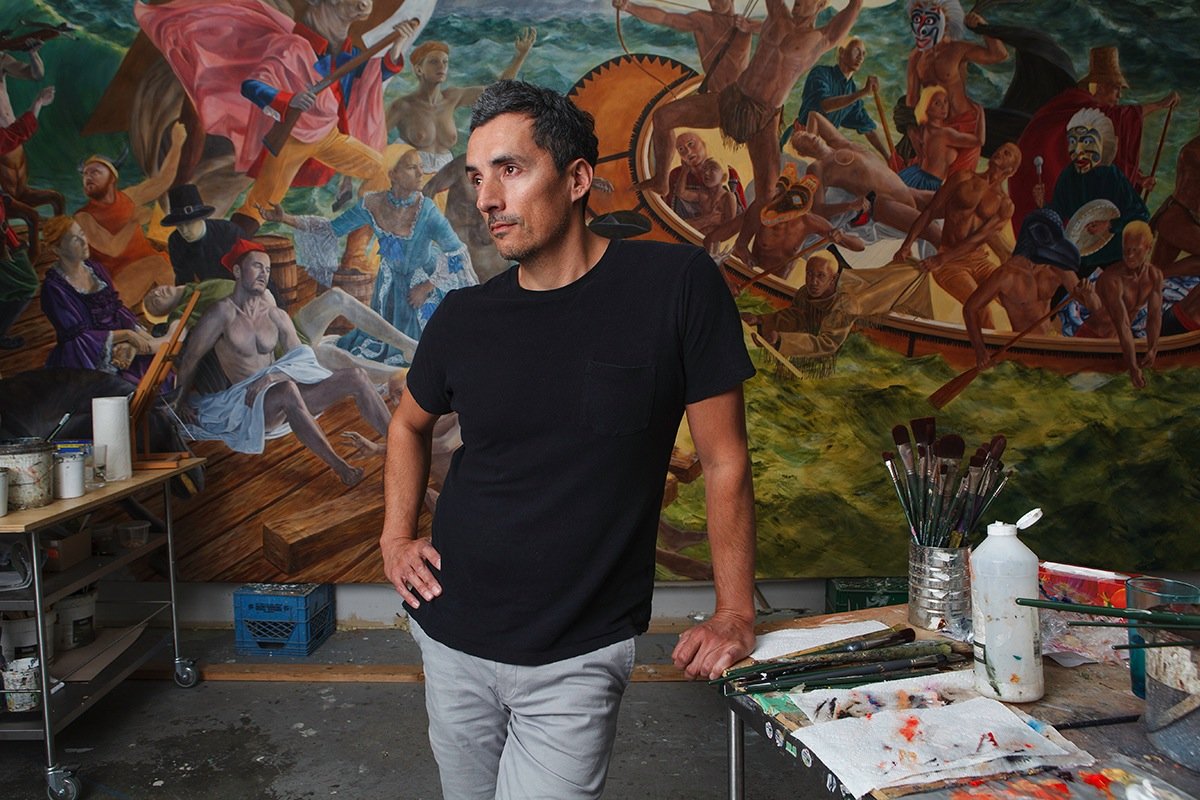
Kent Monkman in his studio – photo credit: Samuel Engleking

Kent Monkman’s show at U of T Art Museum earlier this year might have been Toronto’s most important art exhibition of 2017.

Hugely popular, Shame And Prejudice: A Story Of Resilience presented the artists’ work along with a selection of historical paintings and artefacts. A much-needed corrective to the Canada 150 celebrations, the exhibition addressed topics including treaty signings, First Nations’ reserves, residential schools and missing and murdered Indigenous women. Whatever the event’s organizers had in mind when planning the sesquicentennial, it probably wasn’t this.

Now Monkman is back with Two Ships. The monumental painting will be presented for two days – September 26 and 27 – as part of 360: Bridges at 6 Degrees Citizen Space, an event that asks what citizenship looks like in the 21st century. This series of discussions at the Art Gallery of Ontario will be livestreamed via four Toronto Public Library branches. Monkman’s talk happens September 26 from 3:30-5 pm, and his piece will be shown in Paris at the Canadian Cultural Centre’s inaugural exhibition in May 2018.

At 12 x 24 ft, this is the largest painting you’ve made. Tell me about it.

This project has been ongoing for almost three years. I wanted to do a very large history painting. The scale has a certain impact. The story I wanted to tell is based on a treaty between the Dutch and the Iroquois called the Two Row Wampum Treaty. It was a belt with two purple rows of beads made by the Iroquois to talk about a peace alliance — one for the European vessel and one for the Indigenous vessel and the idea was that they would travel a parallel course and not interfere with one another.

This painting is, of course, that moment of interference. I was inspired by Delacroix’s Christ On The Sea Of Galilee (1854). The parable here was that Christ was asleep and everyone was freaking out because they thought the boat they were in was going to sink. And he was blissfully asleep. In my painting, because of the collision of two cultures, these two vessels are about to collide and Miss Chief, my alter ego, is asleep in the boat. The idea is she is going to wake up and calm the storm.

With your show at U of T’s Art Museum – the room about the residential schools, for instance – I saw that and thought, I’ve never seen anything like this before.

Well, that was part of my work as I cycle through Western art history looking for all these gaps – there are huge gaps in the narrative and how the story of North America is told through a very European lens. The other stuff never really made it into the art canon because no one wanted to show it or to expose it. These chapters of Indigenous history – the removal of children, the rate of incarceration, the dispossession of Indigenous people from our land – those never made it into art history. They never made it into our school curriculums. I never set out to be an educator, but when I went into art history, all this stuff just came to the surface and I had to deal with it.

A large part of what I do in the art world is bring people over to my perspective because they are so used to the dominant narrative, which is a whitewash. The incidences where this story does exist in art history is minor. The story North America tells itself about its own history and mythology is flawed.

Do you think there are different rates of progress between Canada and the U.S. on these issues?

[Americans] are at least a generation behind in terms of their awareness. It’s like slipping back in time when you go across the border, depending where you are. That’s my perception. I feel that they are 20, 25 years behind. They have never had a major biennial, like the Sakahàn, of Indigenous work. They don’t have Indigenous curators working in institutions as contemporary curators. We do. And those are major battles that took generations to secure.

There is the National Museum of the American Indian in Washington, D.C., but that’s an ethnographic museum.

Exactly. That’s still how native people exist in the minds and imaginations of Americans, that they belong in the ethnological wing. Or the Indian Market. It’s either tourist art or they are ethnological specimens. That’s one of the biggest problems holding back Indigenous art from getting into the mainstream.

In Canada, the treaties haven’t been resolved. Is that the reason this history is not being dealt with?

Absolutely. It all goes back to the Indian Act and how the government has established a relationship with Indigenous people. It’s not nation-to-nation; we are wards of the state. We still have cards with numbers that identify us as wards of the state. This goes back to the signing of the treaties and the beginnings of colonial policies that began with incarcerating Indigenous people on reserves and then the institutionalization of Indigenous people through all these different policies.

This is why Indigenous people fill our prisons, because they were foster children. They were taken out with the Sixties Scoop and never had a chance. They never had a relationship with their parents or grandparents and they became institutionalized. They are in our prisons, they are in our foster care system. I could go on and on.

ORIGINALLY COMMISSIONED BY NOW MAGAZINE, SEPTEMBER 20, 2017 11:42 AM
https://nowtoronto.com/art-and-books/art/kent-monkman-debuts-largest-painting-yet/

art@nowtoronto.com | @rosemheather

Performance artist Dynasty Handbag is the opposite of correct behaviour

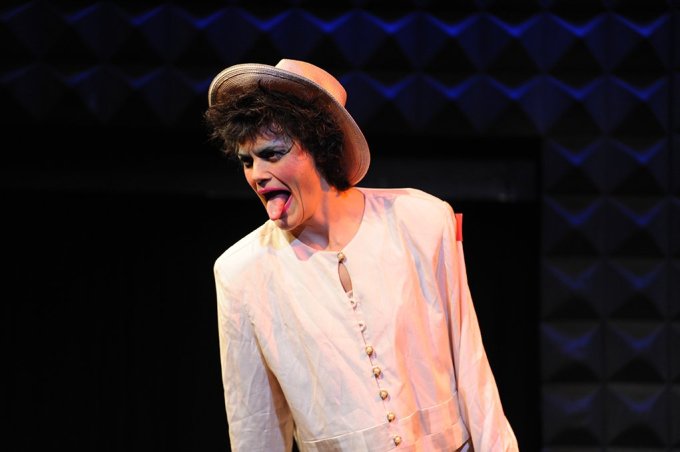
Dynasty_HandbagDynasty Handbag, photo: Charlie Gross

Los Angeles-based Jibz Cameron on straddling the worlds of art and comedy, parodying The Handmaid’s Tale and making TV moves with Jack Black

BY 

2017 is bananas. Nazis are back – and they are not afraid to cry on the internet. It’s a white supremacist man-baby thing, one given free reign by that Whiner-in-Chief currently residing in the Oval Office. If that’s real life, how is art supposed to compete?

Los Angeles-based Jibz Cameron, who performs under the name Dynasty Handbag, is one answer.

The queer performance artist and comedian’s videos and theatrical shows skirt the edges of what’s acceptable to the mainstream. Take her D-Bag’s Quick And Easy Makeup Tutorial For Life Under Fascism (2017), for instance. Smearing her eyes in a black “accent” she calls “doom, capitalism and white supremacy” she crosses the line from humour to discomfort. It’s a literal black eye that reflects our troubled times back to us.

Always with her work, each manic moment is redeemed by humour. In Vague (2016), the artist vamps’ guttural noises to strains of the Madonna hit with the similar name. As with her video that parodies Beyoncé’s vanity doc Life Is But A Dream (both 2013), Cameron offers welcome relief from the dominant culture’s dictates of perfection. Called by one smart critic “a send-up of the current social id,” Cameron’s act has attracted the attention of comedy heavyweights like Jack Black and Community creator Dan Harmon.

Though she is often referenced in the same breath as profane talents like John Waters or Amy Sedaris, she also recalls Karen Finley, the performance artist whose work sits at an intersection between art and theatre. Its not a perfect analogy. Cameron is madcap while Finley is more about unadulterated catharsis. Yet there is something to the comparison. Both show us how fraught political moments give us the artists we need.

NOW caught up with Cameron ahead of the Toronto debut of her latest show I, An Moron.

Your work straddles the worlds of performance art and comedy. Would you say you feel more at home in one than the other?

I don’t feel at home anywhere, really. It depends. Neither the typical straightforward comedy world nor the typical straightforward art world feel like a cozy blanket to me. But there are facets within those worlds where I think people are open and they kind of get that the two things are not mutually exclusive, and there is room for going in and out of those two contexts. Ultimately, they are just frameworks.

I guess one art world precedent is the performance artist, Karen Finley.

She’s not very funny [laughter].

There are lots of artists I identify with. A precedent for me would be Andy Kaufman. I am also really influenced by the early 80s female comedians, like Gilda Radner and Lily Tomlin. All that wacky stand-up. But it is just kind of more blended together in my presentation rather than sectioned off into specific characters.

Ah, your work is not skit-based?

But it can be. I don’t think that any of it is really limiting. What I’m doing actively is not trying to think about those things, and just do whatever I want. I just shot this thing the other day, a spoof of The Handmaid’s Tale – The Handbag’s Tale – and because I have this persona in place alreadyI have something to work off of, but its not like high art. Its like, really, really, lowbrow. Real low. [laughter]

You should tweet it at Margaret Atwood.

I will. I think she’ll love it. I actually really did love that book, and I like the show, too. It was really campy. But it often surprises me that people are thinking about, wondering, you know: what are you doing?

That’s what’s good about your work. That you are able to provoke the question: what is this? Its very refreshing. There’s an obvious way in which Trump is the context within which everything is happening right now. And you refer to that in your Makeup Tutorial For Life Under Fascism, but I also thought there is this other context. I just found out about “virtue signalling” do you know about that?

No, what is that?

It’s about political correctness. Like, everybody’s fiddling about correctness, and Rome is burning.

Oh right. Philosophy is for those with full bellies?

Yes, exactly. I feel your work responds to that as well, because its so the opposite of correct behaviour.

My work’s the opposite of correct behaviour?

Yes, I’d say so.

Well, if you say so. [laughter] The show I’m going to do in Toronto premiered at the Hammer Museum [in Los Angeles] in October last year. All that year I was writing it and I was really frustrated with North American white Liberals who are all talk no rock, or some rock but then the rock is like, so tied into capitalism – like, what kind of choices of gluten-free bread am I am going to buy and what company is the most moral? Choices we feel are moral and somehow making a difference, but what the fuck is actually going on? Nobody really knows. It’s hard not to be paranoid you are being led down some path that’s meant to distract you from some other terrible thing that’s happening.

Nobody knows what’s real and it is hard to grasp onto that, but I think what you’re doing is very real and its very effective for that reason. You are somehow channeling that or expressing that directly, which is a bit in short supply at the moment.

Well, thank you. I feel like I can express questions and outrage and naïveté. I know that I am naive. I just have feelings and I know where else to put them.

What’s next for you – and Dynasty Handbag?

Well, I’m trying to sell a television show right now with my writing partner Amanda Verwey. I’m having lots of meetings with enthusiastic, heterosexual, white gentlemen who nod and laugh a lot about how – well, they do say they will kill you with enthusiasm here – but I do have some really cool people that I am working with. Jack Black, who is just really awesome and a sweet guy that really loves art and wants to do fun projects. And also Dan Harmon, a producer and writer who has done a bunch of interesting stuff. He is an interesting guy who is in on the joke of the whole thing. And I am doing work on a new, live performance for the spring called Titanic that will premiere in New York. And, what else am I doing? Trying to finish all of Prime Suspect once again.

Oh, that’s a good show.

Yeah, I’m going to get through it for the sixth time. Some pretty big goals I’ve set up for myself.

I, AN MORON by Dynasty Handbag at DDL (209 Augusta) on August 24 at 9 pm. $12. torontomoron.bpt.me

art@nowtoronto.com | @rosemheather

This text commissioned for https://nowtoronto.com/art-and-books/art/dynasty-handbag-opposite-correct-behaviour/


Q&A Interviews: How to make a magazine in 2015

1.        Q&A is an online interview project that sells longform interviews as ebooks through Amazon and other online outlets. I used to be a magazine editor and this is what I see as a viable contemporary format for the magazine. It’s inside the network, as it were.

2.        Q&A is a magazine, but one that is formed by the characteristics of the context it’s presented within. This means that each individual interview will function on its own and as part of the broader Q&A project. The challenge for the project is to create a context of intelligibility for the idea “Q&A”, an understanding about what this combination of letters means within the context created. This is also a question of establishing a context of trust — trust that the product has a certain consistency and quality, which is what all branding aspires to.

3.        Strictly speaking, calling Q&A a magazine is a misnomer. Rather it is a product of the network. Describing the project in this way points to how Q&A gets activated by the interests of its readers. Internet giants’ Google and Amazon are central to how it works. Search and social media organize the Internet today and as such they create specific opportunities for how journalism can be practiced – specifically: 1) through the development of in-depth niche content; 2) for the interest of a non-local (global) audience; 3) with longterm relevance.

4.        Q&A takes this form in part due to an understanding that it is very hard to maintain a front page on the Internet. Huge resources are required to keep up with the 24/7 global demand for fresh content it enables. News organizations like the Guardian and the New York Times can manage it; organizations like the Gawker blog network or the Huffington Post take a different approach of producing a lot of content quickly, often on the backs of the major news networks by editorializing on news items they produce and inviting their readers to join in, to create extended online conversations.

5.        A lot of the content typical of the latter approach tends towards the prurient or sensational. So, as I like to say, a publisher on the Internet is either a farmer or a troll — the former cultivates an audience through considered development of content, and the latter conjures its audience into existence through one form of provocation or another, in the hope that it provokes a response. My approach is farming with a focus on what I like to think of as the developing culture of the 21st century. This includes interviews with contemporary artists, because they are naturally prognosticators about what it means to live in the present (the edge of the future,) as well as trends that are under-the-radar of broad cultural awareness. The blockchain and its applications (including Ethereum) and the Occupy movement and natural life extension are some examples.

6.        Q&A takes advantage of the unique power of the Internet to create a backcatalog of all kinds of content with a high degree of specificity, and distribute it widely. On the Internet any kind of niche at all can be catered to, and is. Q&A proposes to take advantage of this by producing in-depth interviews about topics that might not otherwise be covered. The niche is what I see as an emerging culture of time; i.e., those topics that do not necessarily have a mainstream audience yet, but still is of interest to specific constituencies.

7.        The phrase “conversational thinking,” provides a good explanation for my interest in the interview format. I got it from Clive Thompson’s book Smarter Than You Think (2013). Thinking happens in conversation that wouldn’t happen otherwise, and I like the way the interview format helps formalize this process. I believe the popularity of the Q&A format is part of the participatory tendency now at work in the culture at large, one that has been fostered by the Internet. It’s interesting to think that the web answers a pent-up demand for collaboration and the active production of knowledge by all kinds of people that, before it was broadly adapted to, apparently wasn’t well-understood.

Rosemary Heather

This text originally published at qqqandaaa.com on JUNE 29, 2015.

Interview: Allison Hrabluik on the Unscripted Magic of “The Splits”

SFU Gallery - Allison Hrabluik - "The Splits"
Allison Hrabluik, video still from “The Splits,” 2015. Image courtesy the artist.

Studying the human body in movement is a constant in Allison Hrabluik’s work. Starting first with hand-drawn animations, then making more abstract films derived from tracing figures on YouTube, the artist has most recently worked with real people to make her short film, The Splits (2015). The beguiling piece that results suggests another constant in the artist’s practice: an intuitive ability to use the things she works with — often random, dissimilar — to tell a story wrapped up in the artwork’s process.

With The Splits, Hrabluik constructs an unlikely portrait of everyday life in British Columbia by focusing on people performing a skill or hobby they are passionate about — from sausage-making to Afghan Hound-grooming. The desire to practice and get better at something, whatever it may be, connects the film’s subjects, and this includes Hrabluik and her facility for filmmaking. The artist told me she followed no strong rule about who would be included in the work. Instead, she found participants through an organic process, one that combined on-the-ground research with referrals from friends. She pulls it all together according to an intuitive logic both enigmatic and highly persuasive that makes clear the skill the artist brings to the project.

Hrabluik beguiles through the trickery of cinema. The work’s greater subject is the idiosyncratic space the film constructs and the role viewer perception plays in its making. A tightly focused camera frame makes us aware of the film’s synthetic space. Reinforcing this impression is the location where Hrabluik shot The Splits, a community center in Surrey, British Columbia. A typical setting for many of the activities the artist depicts — a tap dancing rehearsal, for instance — by using it to bring together a disparate range of such activities Hrabluik creates an enhanced but denaturalized context for her subjects. This approach is made clear from the film’s opening frames when the viewer receives partial pieces of information that become more intelligible as the film progresses. Sound from each scene carries over into the next, helping to establish the broader coherence of the work.

The Splits takes place within the white space of a rehearsal hall, and also in the world Hrabluik creates. This opens her work up onto a wider conversation about the use of art as a tool for scripting reality, a contemporary preoccupation that extends from the lowest forms of pop culture to the high art aspirations of literary autofiction. In her method of using real-world performance to capture unexpected, composite effects, Hrabluik’s film shares a lot in common with these tendencies. I spoke with the Vancouver-based Hrabluik this March about her artistic process, the logistics of filming The Splits, and where her practice might lead next. Following a presentation at Kassel Dokfest, in Kassel, Germany, the film is currently on view at SFU Art Gallery, Burnaby, BC, with an upcoming screening at Images Festival, Toronto.

You’ve described movement as being a unifying factor in your works, can you distill what’s of interest to you there?

Prior to making The Splits, I had been making narrative video works, and found that I didn’t know what kind of story to tell anymore. When it came time to write a new script, I could focus on almost anything, so how should I make a selection?

I was also reading a lot of fiction, and began to notice the similarities between many of the books on my shelf. They were wildly different in content, but similar in that they all describe how we manage, or don’t manage, the situations we find ourselves in. I wondered if this internal struggle could be distilled into something visually. Perhaps through the ways we physically move through the world. I began creating movement-based scripts as alternatives to narrative scripts, in an attempt to reveal a character instead of telling a story. To do this, I worked with a composer and a choreographer and began to trace films, looking for different ways to make things move.

You also made works by tracing videos found on YouTube — taking a video and choosing it for its movement. You mentioned this was the provenance for The Splits?

Yes. I was looking for videos to work with, and came across a group of young gymnasts online who record themselves performing in their living rooms and backyards, and post the videos to Youtube. The footage was strangely captivating but because they were teenagers I knew I couldn’t ethically use their images. So I started meeting with gymnasts and dancers here in Vancouver. I began videotaping them, planning to use the footage to trace their forms, but soon realized that altering the images wasn’t necessary. There was instead something in the connection between performers that I wanted to follow.

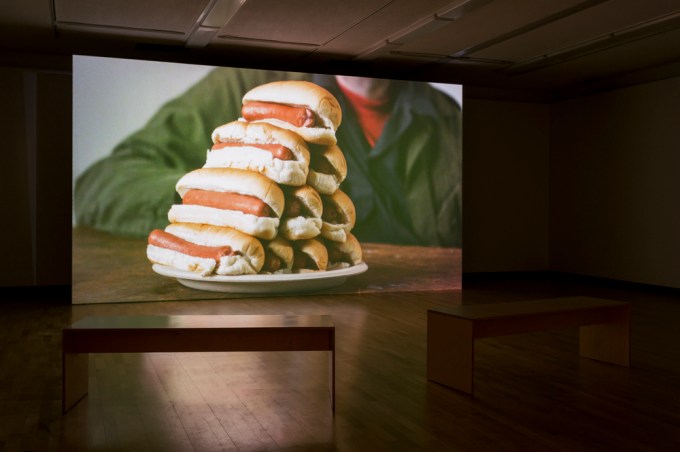
I contacted as many people as I could find who I thought moved in interesting ways. I started with gymnasts, a hula hooper, and weightlifters — athletic ways of moving. To round this out, I considered other ways of performing, like opera and burlesque, amateur music, and how we move everyday at work and with animals. I also incorporated elements of our lives that lean towards the grotesque — the salami makers and the hotdog eater. The absurd is linked to our everyday as much as the transcendent, which is often what we look for in physical excellence.

And you knew all the people?

I know a few of them. Barbe Atwell, the hula hooper is a friend, the tap dancers I saw tap dancing on Granville Island, and the dog trainers I found online through the Afghan Hound Society. Others, like the skippers, gymnasts, and weightlifters I contacted through their coaches, who put me in touch with people they thought might be interested. Often friends recommended people.

I began to notice that if there’s an action people do, there’s a team around it. For instance, I was thinking about skipping, fencing, competitive eating, dog training, birding, etc., and found communities for all of them, each with their own language, skill set, and measures of success. In this project, art and filmmaking became only one activity among many, and I enjoyed that opening up.

That brings me to another question. I noticed in the bibliography that accompanies your show that it includes the category Scripted. What’s the connection?

Melanie O’Brian, the director of SFU Galleries and the curator of the exhibition, asked me to compile a bibliography of books that formed my thinking around The Splits. She knew that literature is often a starting point for my work. Scripted is a section of the bibliography, and includes The Species of Spaces and Other Pieces (1974/1997) by Georges Perec, who works with writing constraints, and also the catalogue Yvonne Rainer: Space, Body, Language (2012). Rainer uses a lot of annotated scores to direct movement in her choreography.

Okay. Because that brings up a whole world of ideas that are relevant to the current moment. For instance, the idea of autofiction associated with the Norwegian writer, Karl Ove Knausgaard.

I’m not familiar with the term autofiction, but think I know what you mean. I read the first book of My Struggle (2012), and enjoyed it. Other books in the bibliography for the exhibition, like Marguerite Duras’s The Lover (1984/1985), bill bissett’s work, Elizabeth Smart’s By Grand Central Station I Sat Down and Wept (1945), I believe fall into that category. I’m also interested in nonfiction that has literary qualities, which for me begins to read in similar ways. Like Annie Dillard’s Pilgrim at Tinker Creek (1974), and Sharon Butala’s Perfection of the Morning (1994).

What some of these works share is a thinly-veiled allegory of self-love and self-destruction as two sides of the same coin. Sometimes describing this in a cool voice, other times with unapologetic effervescence. It’s the effervescence that spills into The Splits.

This makes me wonder about how scripted your works is?  Is it scripted?  

The selection of the cast was carefully arranged, as was the location of filming. We filmed at Sullivan Hall in Surrey, a very active community center. The events that happen at Sullivan Hall on a weekly basis are not far off from what happens in The Splits. The weeks before we filmed, the hall hosted a wedding, a bird sale, a rock and mineral show, an auto show, yoga lessons, and dog training evenings.

Creating the situation became the script. I trusted that once the cast and location were in place, something interesting would happen. During filming, I asked the performers to perform whatever they wanted. We filmed everything, and I made a lot of decisions during the editing process.

The framing is so important. When the film starts, it’s the tap dancers. Then it’s the hula hoop woman, but the way you frame it, there’s some degree of ambiguity. You are suggesting there is an equivalence between the frame and the stage, and that creates the space of the film. Were you always trying emphasize this tight framing when shooting?  

I was interested in the similarities between the different actions performed. The motion in the close-up scenes of the hula-hooper is echoed in the close ups of the gymnasts and weightlifter. By initially hiding the particular activity involved, I could focus on their shared qualities. In the end, it’s curious to know that it’s a hula hoop, a dumb bell, and balancing exercises that create such erotically-charged motion, but it’s not really about the hula hoop.

Right. I guess that’s what you give to the viewer is this puzzle to work out about what’s going on. Why are these things together and what connects them all? I think you can intuitively understand that it’s pretty open but I think you are also very aware of the frame.

I needed a frame, I did. I tried not to have one. I tried to film in everyone’s individual spaces and it didn’t work. So the hall and the stage and the close cropping become devices that connect what might otherwise be a random grouping of people, isolating and highlighting their actions. The neutrality of the hall is important. While it has the character of a space that is well used for performance and celebration, it also shares the neutral characteristics of an exhibition space, allowing us to focus on movement over setting.

Obviously you are able to work with these people because you have that sensitivity to what they need to feel comfortable, and to perform. It’s very naturalistic, that was another point I was going to make …

The process was comfortable, and this was important. I met with everyone individually before we filmed, to describe the project and answer questions. Once they arrived at the hall, we spent several hours filming each group. This gave them time to become comfortable in front of the camera. A feeling of naturalness also happens through editing. I searched through hours of footage to find moments where the performers were unguarded. Much of the scripting you asked about earlier happens there.

It’s not a documentary.

I think it intersects documentary and fiction. The performers are performing themselves, but the situation that brings them together is constructed. I’ll continue to explore this intersection with other subjects, leaving movement behind for a while.

Do you think about directing? Will you be making a more scripted film in the future?  

Yes, I’ll certainly experiment with a more scripted approach. That might involve writing scripts while leaving room for improvisation.

Rosemary Heather

This interview originally appeared in Momus, MARCH 29, 2016.

More information about Allison Hrabluik here.

 

On Art and Populism: Mohammad Salemy on the New Centre for Research & Practice


 The online school bridges the gap between legacy institutions and new knowledge production

03/02 2016 One reason I like the New Centre for Research & Practice is the way it constructs itself out of tools made available by the internet. Implicitly, even the school’s chosen moniker, the New Centre, suggests what potential gets realized through the use of this context. A school in pragmatic terms, the project is also an embedded reflection on what kind of capacity the network creates. Registered in the State of Michigan (under the category of a Licensed Proprietary School) the non-profit offers graduate-level certificates, along with a range of related on and off-line activities. Started in the Fall of 2014, the New Centre has quickly established itself as a presence, in part due to pent up demand brick and mortar institutions have been slow to meet. However, in this conversation the curator and artist, Mohammad Salemy, one of the school’s three co-founders, makes clear their mission is not oppositional but supplementary to educational resources provided by traditional institutions. With a big shout out to Google docs, the web app Mohammad and I used to conduct this discussion over the last two weeks.

Rosemary Heather (RH): Can you talk about the origins of this project?

Mohammad Salemy (MS): The New Centre was established due to a common interest amongst its founders — myself, Jason Adams and Tony Yanick — in philosophy and theory, in particular their contemporary and emerging forms. We wanted to see how these new approaches could be put to work in a variety of disciplines, with a special emphasis on the arts, technology, and politics. We shared a desire for new intellectual spaces, and new forms of research and development in these new areas of thought. We first focused on online seminars. These are taught face-to-face via Google Hangouts, for video conferencing, and Google Classroom, a platform for maintaining classroom environments. Later on, we opened a new focus on research and publishing, including ten different research groups on the areas of accelerationism, the anthropocene, new art, new music, postcapitalism, and poststatism. Our approach is to identify groundbreaking research agendas and bring together the people central to their development with students and scholars seeking to take their work in new directions. Our publishing platform &&& (tripleampresand.org) publishes the results and disseminates other works by The New Centre community.

RH: Since the Kunsthalle Wien planned their Political Populism exhibition late in 2014, the tendency has only become more pronounced, in Europe and the US. We could say the solution populist politicians offer to a perceived crisis of legitimacy is dubious, but it’s an authentic channeling of discontent nonetheless. Can I draw an analogy here? Can the New Centre for Research & Practice be said to be similarly providing an alternative to an academic establishment perceived to be at an impasse?

MS: If anything, our collective operations at The New Centre can be said to represent a form of academic populism. This can only be accurate if we redefine our understanding of the notions of pop and popular. We are popular to the extent that the increasingly youthful face of our academic world — for instance, the average age of those attending PhD programs has dropped dramatically in the last two decades — demands forms of knowledge that are in tune with the contemporary world, not just politically but also in terms of epistemology. We organize seminars, events and activities that bring new thinkers, scholars and artists to a global audience using available web technologies as the Centre’s physical and institutional platforms. Given the popularity of everything digital and networked these days, and of social media in particular, we are also popular because we operate out of this virtual space rather than depend on traditional educational infrastructure like a campus, studios, etc. However, unlike the movements associated with para academia, we see ourselves as a fluid space which surrounds and extends, rather than opposes, the capabilities of traditional academic institutions. Our objective is to legitimize newer forms of knowledge through our collaborative work with universities, colleges, and other physical institutions like galleries and museums. We think these institutions, despite their material and political limitations still provide an irreplaceable set of tools and valuable networks for the advancement of new discourses that are yet to be canonized. Most of our members and students are already connected to universities and other institutions as professors, graduate students, researchers or artists. They come to us because they find our services a necessary complement to what they otherwise pursue in their own work.

RH: It seems accurate to call The New Centre a decentralized initiative. On your website, you talk about “accelerating academia” and “ecologizing knowledge.” Both concepts can be described as capacities of the network. What effects do you see resulting from the project specifically due to the platform you are working from?

thenewcentre.org

MS: Not only are we more decentralized than other educational platforms, but we are also intent on becoming even more decentralized as we grow. First of all myself and my cofounders, Jason and Tony, are geographically dispersed, often residing in different parts of the world. For the longest time, until Machines that Matter our collaborative conference with e-flux in New York (December 2014), we had not even met in person and had done everything via the internet, from registering The New Centre as a school in Michigan to setting up various service accounts with government and private entities. In regards to accelerating academia and ecologizing knowledge, the key is in having an ear for what is emerging from inside and outside of academia, and shortening the feedback loop through which the works of the younger generation of researchers and graduates become validated and available to others who are pursuing higher level education. On the practical level, we see the school lending a hand to those who might have remained outside the academic gates by upgrading their knowledge and skills and helping them enter the academic world faster. What we mean by ecologizing knowledge is a networked process in which the seminars, syllabuses and assignments will find new ramifications outside of the classroom. To facilitate this, we try to connect our educational services to other activities inside and outside The New Centre. This is a process through which not only a new knowledge but also a new environment for its reception and evaluation is constructed, basically through networks established via the interactions between the wider internet and the institution.

RH: “Shaping the future” is one of the stated goals of the school. Is this in respect of an ideal of progressive politics? What set of political ideas frame The New Centre project?

MS: Jason and Tony come from other trajectories, and also we tend to have both overlapping and diverging point of views in relation to politics. Perhaps what unites our political horizon is the faith we have in the collective human capacity for self improvement via human and non-human technologies, both on the singular and collective levels. For myself, the political dimension of The New Centre is encapsulated in a term I have been using lately: “epistopolitics.” As far as political economy is concerned, an accelerationist project like The New Centre can never be merely political, but can perhaps be epistopolitical. In my opinion, political emancipation can only be possible as a result of an intense epistemological revolution that transforms the entire social fabric, including the outlook of the capitalist class, and a complete revamping of the structures and processes that constitute contemporary liberal democracies. Epistopolitics describes the entanglement of politics with the theory of knowledge and vice versa, which instead of restating Foucault’s position on the relationship between knowledge and power (i.e., knowledge is political) shows how truth, or more precisely the production of knowledge, can only be emancipatory if the trajectory of its politics is also emancipatory. This means an emancipatory political project will be doomed to fail if it remains untouched by a transformation of the existing theories of knowledge. Epistopolitics is the ultimate politics, which consists of producing a knowledge that uses both the critical (negative) and constructive (positive) forms of looking at the world to secure qualitative gains in the general production of knowledge towards collective emancipation.

RH: British political philosopher John Gray said recently that our best thinking today is happening in mainstream culture, not the academy. He cited as an example the way certain TV series (Breaking Bad, for instance) are able to dramatize ethical contradictions. I agree; it’s hard not to notice the many ways that mainstream culture is progressive. How do you then position a project like The New Centre, with its commitment to advanced political and philosophical thinking? Is the model of the avant-garde relevant?

MS: It is impossible to define a contemporary ontology for an avant-garde carved out of its history and actuality from the 20th century. If we forgo ontology and instead identify an avant-garde based on its process and function, then I think it is possible to talk about The New Centre as an avant-garde project. The difference is that in the traditional definition of the term, innovation and radicality is articulated through the 20th century metaphor of war and confrontation that imagines the avant-garde in the front line of political and cultural battles. For us, if there is any avant-garde, it must be found as isolated and dispersed elements and entities within the larger universe of social, artistic, political and scientific fields and institutions. The New Centre can claim this mantle by being both the agent of cohesion, bringing these elements together, and vehicles for navigation, using networked resources to move the whole operation, and not just its front rows, forward.

RH: How do you reconcile the work you do at the The New Centre with your work as a curator and practicing artist?

MS: Even in the strictest definition of the term “curatorial,” the work of a curator already includes the creation of public education programs in relation to other activities of the museum or gallery, like exhibitions. In my case, the collaboration with Jason and Tony began as a result of working together on the Incredible Machines conference, which was a curatorial initiative I undertook in 2013–14 culminating in a part real/part virtual gathering of thinkers, scholars and artists around the themes of computation and cybernetics. Respectively, our work at The New Centre is at least partially — if not completely — curatorial. It takes curatorial skills to compose a virtual institution of learning out of digital bits and parts that are generated on different platforms. So much of managing our virtual institution has to do with maintaining its virtual interface on a regular basis, like an ongoing exhibition of interdisciplinary work with parts being operational separately but also together as a whole. If at the end of the day the function of a good exhibition or another kind of curatorial project is to bring people together and generate questions, conversations — and possibly plans of action — around a theme or concern, I think one can see how what we do at The New Centre overlaps with the activities of any rigorous curatorial team.

It’s also interesting to talk about my practice as an artist, which itself is a cross between curatorial and conceptual practices. In recent years my work has involved taking large data sets extracted from technological platforms like Google, social media, or archived live television broadcasts, and using them to create novel and critical forms of cybernetics involving humans and machines. In this way, I see an overlap between working as an artist, a curator or a programmer at The New Centre.

http://thenewcentre.org/


Mohammad Salemy is an independent NYC/Vancouver-based critic and curator from Iran. He has curated exhibitions at the Koerner Gallery and AMS Gallery at the University of British Columbia, as well as the Satellite Gallery and Dadabase. He co-curated Faces exhibition at the Morris and Helen Belkin Art Gallery. In 2014, Salemy organized the Incredible Machines conference in Vancouver. Salemy holds a masters degree in Critical and Curatorial Studies from the University of British Columbia.

This is one of ten posts written to accompany the Kunsthalle Wien’s Political Populism exhibition (November 11, 2015 – February 2, 2016).

On Art and Populism: The Next Universal – An Interview with Laboria Cuboniks

tumblr_npt43s29fa1tl4z6so2_r1_1280

11/12 2015 With the publication of their Xenofeminist manifesto this spring, the anonymous feminist collective Laboria Cuboniks sets the terms for a massively ambitious project. Their goal is to synthesize a new universalism, one that overrides the still-dominant paradigm that derives from the western white-male. Their collectively-authored text, subtitled A Politics for Alienation, is just a first step in a multi-faceted critique that will draw from the various strands of their respective disciplines. While building on the accomplishments of identity-based politics of the last century, the collective argue that the historical moment for this type of analysis has passed. Before reading the manifesto, the urgency of Laboria Cubonik’s program was not clear to me, but it now seems obvious. I look forward to the book they are now working to produce. We spoke through the medium of Google Docs over the past couple of weeks.

I am always interested in origin stories. I realize this approach is a bit contrary to what I understand the Laboria Cuboniks enterprise to be, but…where did you guys meet?

LC: We met up at the Navigation as Emancipation summer school during the summer in 2014 at the Haus der Kulturen der Welt, in Berlin. It was organised by Armen Avanessian, Peter Wolfendale and Reza Negarestani. It was basically a two-week program for those interested in pursuing what has been deemed “neo-rationalist” philosophy. (The term “neo-rationalist” sounds a bit harsh, but it basically concerns new understandings of reason and its function for an age of complexity). What bonded us was the fact that many of us had experienced animosity for avowing things like reason, science, technology and/or mathematics — having been accused of “bowing to the patriarchy” for working with and alongside such perspectives, and we all felt a collective need to denaturalize such disciplines from a de jure masculine grip — that the white-male dominated histories of those disciplines does not mean that their future is bound to the same fate.

That experience became your identity then. So how does Laboria Cuboniks now speak in public? On the web only or also IRL?

LC: Our name is actually an anagram of the Nicolas Bourbaki group of mathematicians from the 20th Century, who advocated for abstract and generic approaches to the field — so there is some definite kinship with their pursuits. We’re (currently) six people from different disciplines spread out across three continents right now. But our identity is not so important. More important for us is to begin developing conceptual tools under the umbrella of xenofeminism — a feminism arguing for abstraction, cognitive augmentation in the face of complexity, and a politics able to think an intersectional or “relative” universalism as a gluing operation after decades of identity politics that emphasize particularisms.

So much to unpack here! The Xenofeminism Manifesto gives a thorough articulation of these ideas. I guess what I am trying to do is first look at the context through which you are speaking as a way to articulate those ideas but in a different way. I understand the Laboria Cuboniks identity is not so important, but I am interested in the way it allows you to speak as one voice. Xeno means “other” (as in xenophobia) so this other voice you are adopting is one made possible by internet, is that correct?

LC: There’s no doubt that without the internet we couldn’t work together, being as spread out as we are (although time zones are a problem — just ask our Australian member who joins in video chats at ungodly hours!) This “other” — or “alien” voice as we’d prefer — that came through the manifesto was a pretty arduous process. But it was also quite interesting to work between horizontal and vertical modes of collaboration, moving between diffuse and top-down editorial authoring. The manifesto for us is a foundational document implicitly mapping out a program of work. It needed a unified voice to articulate these perspectives in a cohesive way. That said, we’ll continually rework our formal approach with each project. The book we’re developing, for example, will take on another strategy altogether as a “forking” of the manifesto. We’ll each prepare contributions in our various areas of competence, elaborating critical points that have been raised since the release of the text, potentially with other authors included as well. It will be a curious exercise. On some issues there isn’t a consensus amongst us, so those tensions will be more visible and hopefully help demonstrate a commitment to “impurity” we believe is necessary to address anything on the level of the social. One cannot get very profound in the manifesto form, so we’re very conscious of the fact that many passages should in fact be proper essays in their own right. We want to start pushing the concepts as tools for reappropriation, similar to the function of something like Git-Hub where coders can build off existing projects, orienting or augmenting them in new directions.

I think these tensions are evident on the level of form, in the sheer density of the text. Its got forward propulsion at the cost of elaboration on the many different avenues of inquiry it proposes. Forking seems like the necessary next step. At the same time, the format of the manifesto and the Laboria Cuboniks identity are what make it possible to articulate such an encompassing set of concerns. Again, in the interest of getting you to spell things out, what is the unifying factor here? To quote from the Xenofeminist Manifesto, does “embracing alienation” as a position and “the synthetic potential of a groundless universalism” properly express it?

LC: You’ve basically nailed it — in the (positively) generic sense. What unites us are several fundamental commitments: the first being an affirmation of alienation as a necessary, cognitive and pragmatic “state” to be mobilised for any substantial change to take place at the scale of the normative. The perspectives that arise from “alien” encounters could mitigate against the way the familiar obstructs the effects of new knowledge. Alienation can never be a “total” thing — it expresses a relation between things/people/activities — so any talk that we are “totally alienated” is rubbish. Such a statement disavows this definitive relationality! One of our main issues is the ossification of norms as facts — when plastic norms become naturalised as a truth of biology, physiology, ecology — or even certain economic orders. In order to disentangle the two, we require a state of “alienation” from those inhibiting normative modes, to construct new ones that operate as a collective horizon for navigating the desire of what we do want as a social body. This generative alienation is a means for thinking through the social, technological, economic, ethical and sexual ramifications of new knowledge(s) — rather than falling trap of alternativeless naturalization. We embrace the power of plastic norms as a counter-hegemonic project, provided they are seized as plastic — that is, subject to re-invention. We can’t simply advocate for a politics celebrating the margin anymore, we require a thinking and pragmatics at a scale of the so-called “total” (and therefore naturalized) global scale of the neo-liberal modus operandi. This scale, in our view, can only be navigated and put to other functions when we can properly think the planetary complexity of 21st Century life — a scale that requires thinking from the nano-second to the geological, which is surely an alien proposition given unaided human phenomenology or intellection.

Can you expand on how you are using the term “plastic” is this connected to “the synthetic potential of a groundless universalism”? I still need that notion clarified.

LC: Definitely. What we discuss as “plastic” most certainly has to do with how a universalism for the 21st century needs to function. What taints the notion of universalism is (quite rightly) it’s Modernist legacy, where we have seen the deployment of “universalism” as: a) a schematic top-down plan, where every difference is subsumed into its over-arching form; and b) as a particularity that is falsely inflated as a universal model — a specifically white Euro-Male “point” or perspective is projected as a dominant mode of orientation globally. On the latter point, we suggest this is no universalism at all. It’s a bloated, disproportionate particularity that has delivered to us global structures of colonialism and capitalism. This is an illogical universalism, a falsely conceived and implemented abuse of the term that does not live up to the potential of its name.

As an important and useful response to this violent (false) universalism, we have seen the development of fields like post-colonial theory, identity politics, queer theory and strands of feminism that highlight marginalized perspectives and voices lost to Modernity’s “inflationary” modes of operation. Addressing critical issues like the “site” or context “from where one speaks” has been a collective effort to emphasize the importance of particularities and give necessary attention to unheard voices and unmapped positions (in art, we saw these tendencies manifest in site specific practices, for example). After decades of such theorizing, though, this almost exclusive focus on particularities has lost sight of the global neoliberal hegemony we are all forced to live by. Calling for a reworking of the concept “universal” should not be taken as a side-swipe against those invaluable theoretical contributions mentioned earlier. It is to face up to their inherent limits in the face of the hegemonic core that has only increased in dominance, and whose scale is gargantuan. It would be a failure to not properly acknowledge those limits and overestimate the usefulness of certain theoretical frameworks, just as Levi Bryant has pointed out how Lacanian psychoanalysis does not offer sufficient tools to adequately examine something like climate change, for example.

Our project is a counter-hegemonic one, which definitively means taking on issues of scale (not only politics understood in its’ local, on-the-ground, phenomenological form) and reformatting what we mean by “universalism”. This is similar to when Rosi Braidotti calls for a feminism unsatisfied by the margins that instead seeks to occupy the centre. To us this signifies a feminism willing to construct what that centre — a normative proposition — could be. This new universalism still requires much thought, to go against the “false” variant we have already been subject to historically. For this universal to live up to its name means not to do away with the important work that’s been done on particularisms, but instead turn our focus to the engineering of a kind of abstract “glue”, in order to plot out coherent relations between particularities — or “solidarities”, in a way. Part of our approach to this concept of universalism is drawn from mathematics, wherein Fernando Zalamea (calling on the work of Alexander Grothendieck) has written about “relative universals” and has begun working with these ideas within a social framework. Now clearly, we are not suggesting an achievement in mathematics can be readily mapped on to the social. But what we can make use of is a functional concept of a bottom-up universal — including the ability to move back and forth between local and global scales. Because this universal is an implicit (bottom-up) and not explicit (top-down) variant, its field of reference is not fixed in stone, but is constituted by the relations it constructs. While we have much more thinking to do on this topic, one thing is clear — if we are going to gain any sort of political and cognitive traction against the almost total subsumption of life to neo-liberalism, we require strategies at a proportionate scale, able to face up to our complex plight — an urgent plight yielding increasingly to (climatic, social, and economic) injustice. It is not sufficient to be against our situation in the negative, but rather to focus our thought towards the affirmative construction of a post-catastrophic world we want.

The position you have mapped out is clear and compelling, and it provides useful insight into a global situation that might otherwise be experienced as an impasse. I am curious to know more about the “conceptual tools” you are planning to develop under the umbrella of xenofeminism. Can you say more about this next step in the project?

The next steps will more distinctly reflect our poly-disciplinary backgrounds — each member delving into the ramifications the manifesto has had upon our thinking since its release (including the myriad of external reactions that it generated — both positive and negative). Having each been infected by alien fields of knowledge in the process of intensively working together, our imminent horizon will be to integrate this conceptual contagion to our respective fields of practice.

http://laboriacuboniks.net/

This is one of ten posts made to accompany the Kunsthalle Wien’s Political Populism exhibition (November 11, 2015 – February 2, 2016).

Rosemary Heather is a freelance writer based in Toronto and Editor-in-Chief of Q&A, an information retail project focusing on interviews.

Kelly Richardson Talks Sci-Fi Futures, Life On Mars And Mariner 9

Kelly Richardson Mariner 9 2012 Installation view Courtesy of the artist and Birch Libralato / photo Colin Davison

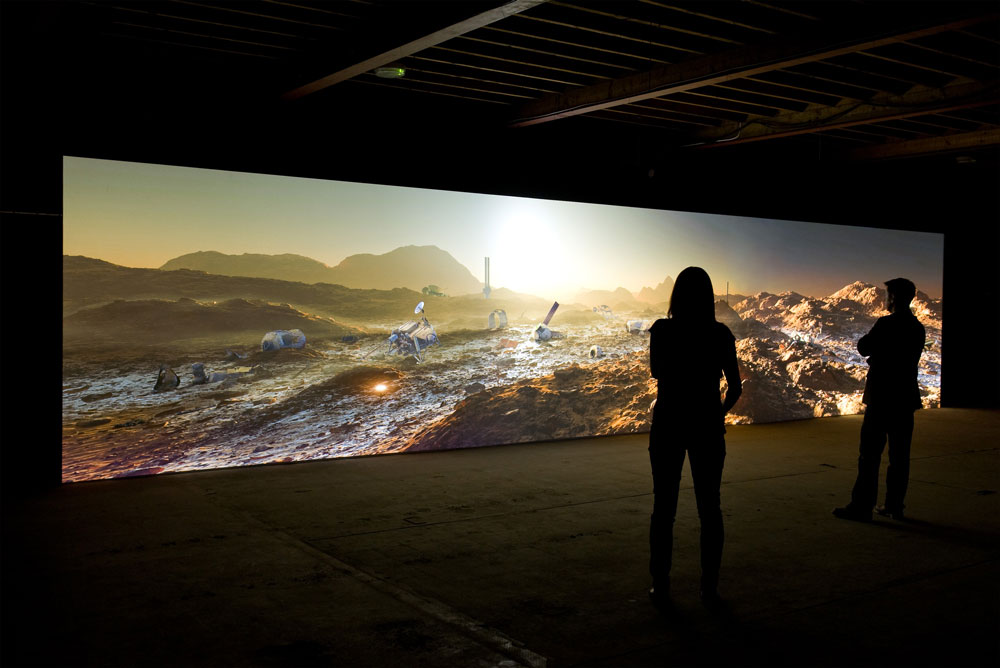
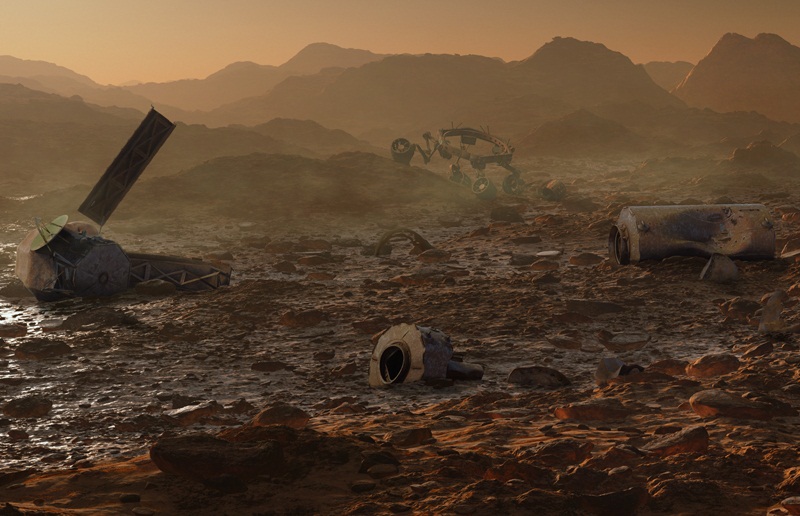
As part of the Future Projections program at this year’s Toronto International Film Festival, UK-based Canadian artist Kelly Richardson brought a scaled-down version of her amazing new work Mariner 9 to the Royal Ontario Museum. A panoramic video installation, Mariner 9 presents a detailed portrait of the surface of Mars as it might be seen in the future—littered with space junk, but still apparently uninhabited.

Commissioned by Tyneside Cinema in Newcastle, the TIFF installation offered North Americans a foretaste of the touring mid-career survey of Richardson’s work (also organized in the UK) that will arrive at Buffalo’s Albright-Knox Art Gallery in February 2013 and, in smaller form, at Vancouver’s Contemporary Art Gallery in 2014. This survey promises to be an event in itself, with eight rooms at the Albright-Knox to be taken over by her work. In this email interview, Richardson talks about the origins of Mariner 9, our fascination with life on Mars, and what that might mean for the future of life on Earth.

Rosemary Heather: There was an almost unnerving coincidence at seeing Mariner 9 in Toronto at the same time that NASA’s Curiosity was exploring Mars. It makes your project seem more real, almost as if you are doing the advance work—mapping the mental territory—for this new era in space exploration. Care to comment?

Kelly Richardson: The idea for Mariner 9 did come about before I became fully aware of when Curiosity would embark on its mission to the red planet. The opportunity I was given to develop the work was during a residency as part of Tyneside Cinema’s Pixel Palace program. The timing was perfect for the commission to be presented in parallel with the Mars mission.

Because of the unique problems the piece introduced, I spent the majority of time during my two-month residency researching and developing the various approaches I could take to produce the work so that, by the end of it, I would be ready for production to begin. Interestingly, by this point—the end of the residency and the beginning of the creation of Mariner 9—Curiosity had departed for Mars.

As we had planned to launch its UK exhibition within days of NASA’s anticipated landing, roughly eight months later, the work was produced entirely during the time it took for Curiosity to leave our planet and arrive on Mars: simultaneous missions. Mariner 9 premiered in the UK three days before NASA’s landing, and given that I had included Curiosity in the work itself, I was obviously thrilled when it landed successfully.

RH: One goal you’ve said you have for the work is to produce an immersive experience for your audience, which the installation delivers when presented at full scale, as it will be for your show at the Albright-Knox. Is it correct to say this effect in part derives from the authentic look you were able to give the piece? Can you also say something about the kind of research you had to do to achieve this look?

KR: I’d say the convincing Martian landscape certainly contributes to the immersive quality of the work. I wanted people to feel as if they could step onto Mars and I did overhear a number people in the UK telling one another that that’s exactly how it felt.

This is the first piece I have done that was entirely digitally produced. Usually I begin by filming existing locations, which I then alter digitally to create the work. However, as I couldn’t film on Mars I had to take a different approach.

I discovered that NASA knows exactly how Mars is constructed and that it had made this data available to the public, which could then be brought into a 3-D program to faithfully create the lay of the land. Using images of the surface of Mars taken from various rovers as a reference, I could then texture my digital version by creating similar rocks, sand, etc., to produce a photorealistic terrain. So that’s exactly what I endeavoured to do—and of course, it wasn’t nearly as straightforward as I’ve made it sound here.

I put a great deal of research into actual missions that had gone to the planet to recreate digitally the graveyard of partially functioning and corroding remains from various spacecraft you see in the work. And as it is a “futurescape” several centuries from now, I also researched current thinking about what future rovers may look like.

Lastly, I wanted the scene to be set during a dust storm, which is one of the most difficult effects to achieve in 3-D. Research aside, the skill set required for the whole of this work was huge. In the film industry, it would have required a large team of people. Two of us (my partner Mark Jobe and I) worked on the project full-time for 10 months. We basically started from scratch, as we had to learn several new programs and methods of working to achieve the desired look.

RH: I love the way, even when describing the project, you convey a sense of why it is so compelling to you—the recent Mars exploration adding extra urgency. I am wondering about the sound. You took great pains to include details that give the piece visual verisimilitude; is this true also of the soundtrack? I recently saw Christian Marclay’s The Clock and noticed how the sound from one segment will often carry on over top of subsequent clips, providing an element of continuity (along with the timepieces) to the artist’s otherwise disparate selection of movies. Can something analogous be said about Mariner 9? Is the soundtrack what makes it truly immersive?

Kelly Richardson Mariner 9 2012 Installation view Courtesy of the artist and Birch Libralato / photo Colin Davison

KR: I’d say it’s equal parts visual to audio that makes the work immersive. The installation, at 43 feet by 9 feet, takes up far more than your immediate and peripheral fields of view. In fact, it’s so large that you really can’t take in the whole of the piece without physically moving around it.

In England, it was common to see people sitting in front of one area for a good while, and then relocating to another area for an equally long time. Holly Hughes, who is curating my mid-career survey at the Albright-Knox, also noted that when you walk around the work, the light changes as it would in front of a physical landscape and many people have noted how three-dimensional it looks, without the use of 3-D technology.

The sound does play a huge part in the immersive quality of Mariner 9, though. During my research I discovered that we don’t actually know what Mars sounds like. All attempts to record audio on Mars have failed so it’s mere speculation at this point as to how it would behave on the planet.

In lieu of this information, I created a soundtrack which, again, attempts to convince the viewer that they’re there, providing the tools for a suspension of disbelief. It is 5.1 surround sound, made up of a dust storm swirling around the room; faint, strange, rhythmic sounds; and mechanical sounds associated with the movement of spacecraft. The nature of the sound also reflects the function of the visual, which is both hypnotic and strangely beautiful, but equally unsettling.

RH: Finally, I guess the biggest question is, Why Mars? Aside from the current focus of American space exploration, are there other reasons this project took Mars as its subject?

KR: Over the last few years, I’ve been increasingly interested in the way science fiction allows us to experience what life might be like in the coming century. Scientists and futurologists can speculate on what the future might look like, but artists are capable of visualising those futures, making them tangible. If hindsight is always 20/20, experiencing these potential futures offers us a window through which we can view our present time and the direction we are headed in with some measure of clarity.

Mariner 9 presents Mars as littered with the rusting remains from various missions to the planet. Despite its suggested abandoned state, several of the spacecraft continue to partially function, doing their job to look for signs of life, and possibly transmitting the data back to no one.

That search for life—to know that we’re not alone in the universe—is fascinating on many levels, but it’s also a beautiful, endearing endeavour, particularly for us as a species. We are destroying much of life as we know it, literally consuming our planet, at a truly alarming rate. I’m interested in that contradiction at this critical time in history when current predictions for our future are not just unsettling, but terrifying.

By Rosemary Heather

This text was originally posted at canadianart.ca

More info about Kelly Richardson can be found here.

Kelly Richardson is represented by Birch Libralato.


Geoffrey Farmer Discusses His Documenta Hit

Installation view at Neue Galerie, Kassel.
Geoffrey Farmer, Leaves of Grass, 2012. Installation view at Neue Galerie, Kassel. Courtesy the artist and Catriona Jeffries. Commissioned and co-produced by dOCUMENTA (13) / photo Anders Sune Berg

Neue Galerie, Kassel June 9 to September 16, 2012
By Rosemary Heather

Geoffrey Farmer’s Leaves of Grass is one of the big hits of dOCUMENTA (13). Toronto critic Rosemary Heather caught up with the Vancouver artist by email to ask about the inspirations, processes and resonances behind the astonishing work—which, as Farmer noted, ended up surprising even himself.

Rosemary Heather: There’s quite a story behind the making of Leaves of Grass. The work features a great number of figures cut out from the pages of Life magazine that have been mounted on dried-grass sticks. Someone told me there were 30,000 figures, but you have amended that, saying it’s closer to 16,000, which is still a huge number. Can you tell me a bit of the backstory here?

Geoffrey Farmer: The collection of Life magazines came from the Morris/Trasov Archive. They (Michael Morris and Vincent Trasov) knew that I had been working with image collections, and about three years ago they asked if I might be interested in it. There were approximately 900 magazines in the collection, spanning five decades, from 1935 to 1985. In the beginning, Life was a weekly; in 1978, it became a monthly. So we had a lot of magazines from the 30s, 40s and 50s. We had fragments—a few pages—from 1935, and then complete copies after that. This includes the first issue that had Time co-founder Henry Luce as publisher; he bought it in 1936 and changed it to a photojournalistic format. The last issue we had, from 1985, was on AIDS.

In Kassel, the work is displayed on the second floor of the Neue Galerie in the loggia, which is a long, sculptural corridor with huge arched windows overlooking the park. The view brought to mind the miniaturization of the world. I was already thinking about how photography has a tendency to make sculpture, and I liked this in relationship with the loggia. The piece is in chronological order and is displayed on a 124-foot table, which is viewable from both sides. There are 16,000 figures, and each figure has two sides. Although the image arrangements may appear chaotic, I took great care in their placement.

During my studio visit with dOCUMENTA (13)’s curator, Carolyn Christov-Bakargiev, we talked about Paul Klee’s drawing Angelus Novus and Walter Benjamin’s essay “On The Concept of History.” I showed her a film made in 1961 by Arthur Lipsett, Very Nice Very Nice. In it, he uses images from Life, as well as found film footage and sound clips, all montaged together. It contained a quality I wanted to find for the piece. I mentioned to Carolyn that he committed suicide a few weeks before his birthday in 1986. She was curious as to what was happening in the world around the date of his death. So we were looking at timelines, and I began to think about chronology as a composition.

It was a gruelling project, but I wanted to be transformed by the experience. In the last few months, we had about 90 volunteers helping us. We had quotas to keep. We worked in shifts. There was a small group of us who, in the end, I think, were working 20-hour days. I was amazed at the generosity of everyone working on the piece. It was a communal experience. A lot of conversation happens when you are sitting together working around a table. If someone didn’t agree with the image selection or strongly felt an image should be included, they would hold the image up for a vote. We had meals together, a fantastic cook and friend came in to make lunches and dinners. I wasn’t expecting the piece to grow in the way that it did.

There is another story, though, that I want to mention because I think it relates in a broader sense.

When I was very young, my teacher asked us each to bring a leaf to class. She then got us to place the leaf on a piece of paper. Above the paper was a metal screen stretched over a wooden frame. She lowered the frame, and then she gave us a toothbrush dipped in gouache paint to rub on the screen. When I rubbed the toothbrush over the screen, it sent out a fine spray of paint over the leaf and the paper. Then she lifted the screen, and then lifted the leaf off of the paper. Even though she was holding the leaf in her hand, it still appeared on the paper. This deeply shocked me.

When I first saw William Fox Talbot’s early leaf-photo experiments, I recognized them as being linked to this early experience. When I read Roland Barthes’ Camera Lucida, I also had this recognition. Absence existing simultaneously within presence.

RH: Your anecdote brings to mind a certain uncanny quality the work has. When the figures are cut out from the magazine and brought together again in the amalgamated form, the first thing you notice is the discrepancy in scale between them. This suggests their lost context (the scale that naturalizes each figure within its photo) and makes apparent the essential strangeness of the photographic format, which you evoke in your answer above. So is the work just an expression of a relationship you have always had with photographs, or is something else going on?

GF: I think there are many things that are going on in this piece and I hope people get a sense of that. In one of the last issues of Life, I found a small image of Susan Sontag’s book On Photography. It is about one centimetre by one centimetre. It appears at the very end of the piece, next to a tiny Lady Diana. I think, in some ways, the piece is dedicated to Sontag and to her writing. Not to say there is a warning there, but perhaps there is.

RH: So ideas about the work proliferate in the same way the figures seem to…this suggests why knowing their exact number is not important. There are enough of them to push the mind into the territory of something not previously experienced. Was this a goal you had in mind? Or did you set out to do one thing and in the end discover you had accomplished something else?

GF: I am not really conceptual. I don’t think up a concept and then execute it. I learn through discovery and from direct contact with the material I am using. Even though the work might emanate out of an idea or interest and may have a horizon, I don’t really know exactly what I am doing.

For example, the title partially came from the fact that I was using grass, in a literal way, to mount the images onto, but also because I was looking at Walt Whitman’s use of writing cut-ups to make the poems for his book Leaves of Grass. He spoke about wanting to write a modern portrait of the United States, and I thought that the piece could be looked at as a kind of portrait. I also liked that the first Documenta was in 1955 as part of a horticultural show, and that it occurred on the 100-year anniversary of the publishing of Leaves of Grass. There was a special article in Life on Whitman in 1955, with pictures of his grave that are now in the piece. I also liked that the term “leaves” can refer to the pages of a book and to grass—to something without much value. I thought this related to the form of a magazine.

I didn’t really consider what the effect of looking at so many images would have on me. At certain points in the project, I had a hard time sleeping. When I closed my eyes all I could see were images. I was going through 30 magazines every morning to make selections. And then we would see them again for cutting, again for the gluing, again for the sorting and then again for arranging.

I knew from the beginning that it was important the figures be placed in chronological order, and that their arrangement was important. It hadn’t occurred to me that it would be a strange kind of history lesson. It was like a slow-motion flip-book.

It wasn’t until we had finished making the work that I realized the piece is very much about factory life. Factory farming, the war factory, the death factory, the automobile factory, the Hollywood factory, the personality factory…. History emerging out of a factory. In the end, it takes on the appearance of a conveyor belt.

I was asked to pick a song that the viewer could then download as part of a dOCUMENTA (13) phone app. I chose Over The Rainbow as sung by Judy Garland in the movie The Wizard of Oz. American soldiers used to play it in Germany as a kind of anthem at the end of the war. In the movie, it is a hopeful song, but when listening to it and looking at the piece, it has another effect, making the piece, and history, feel like a very strange dream.

This interview was commissioned by http://www.canadianart.ca 

More information about Documenta 13 can be found here

More information about Geoffrey Farmer can be found here