Condo Living: An exhibition gets reprised after 30 years, revealing deep changes and some continuities in Toronto’s art scene

chromalives-install-06
Chroma Lives install image: stairs by Manden Murphy, Avocado Sprouter and Spoon for Return Baby Bird to Nest by Tammy McLennan, Book Stack andJumbo Playing Cards by Roula Partheniou, Spit Pits by Laurie Kang, Untitled Background 2 by Connor Crawford.

Visitor account by Rosemary Heather of ‘Chroma Lives’, Camrost Felcorp Yorkville Plaza Sales Centre, Toronto, 1-30 June 2016. Curated by Erin Alexa Freedman and Lili Huston-Heterich

The second time I visited Chroma Lives I sat on furniture that was part of the exhibition, happy to have escaped the blazing hot sun of the Toronto summer outside. Presented in a condo showroom, the exhibition was pleasantly air conditioned and accompanied by a treacly jazz soundtrack. There was no cake, and there had been at the vernissage, but I could live with that.

Curators Erin Alexa Freedman and Lili Huston-Herterich had assembled works by local artists and designers in one room in the sales centre. Devised in reference to Chromaliving, an earlier exhibition held in the same upscale Toronto neighborhood some thirty odd years before, Chroma Lives repeated its predecessors’ basic gesture of furnishing a retail space with artworks. The two shows however were on decidedly different scales: the former featuring 150 artists, and the latter just eighteen. This difference is one of a number of reasons Chroma Lives has a seemingly notational relationship to its past context. Another would be the more obvious explanation that, between now and then, historical circumstances have changed.
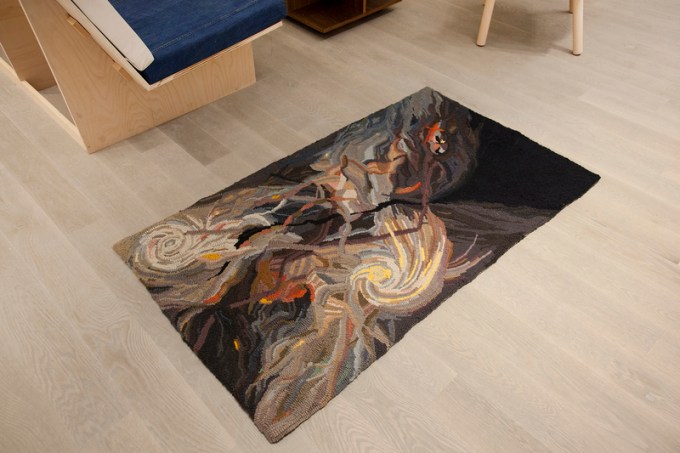
chromalives-install-04Chroma Lives install image: Heather Goodchild’s in the morning and in the evening, wool and burlap rug.

In the showroom, affixed in serif letters on the wall is the marketing slogan “Reside in a Modern Day Masterpiece.” The curators wisely chose to leave this feature intact. By giving credence to the hoary idea that artworks connote elegance, Chroma Lives made evident the narrow space of maneuver it was operating within. An agitated light fixture hanging in the centre of the room, animated to jerk constantly while making a crackling electric sound (Connor Crawford’s Light from a dilapidated interrogation room, 2016), was one of the few hints of disturbance amidst the otherwise placid facade of the show. Of course, closer inspection of the art on view revealed other signs of disruption, such as the wry humor of Oliver Husain’s phallic curtain tassels (Can we talk about the elegance in the room, 2016), for instance, or the subtle perversity of Laurie Kang’s seventeen aluminum-cast peach pits scattered across a silicone mat on the floor (Spit Pits, 2016). Many of the other works in the show were elegant takes on household items. Made by young designers who had responded to an open call, the show’s intermingling of art and design was for the general purpose of a mise-en-scene.

Throughout the exhibition, the curators used the showroom during off hours to conduct interviews with Chromaliving participants, from which they will produce a book and online archive about the project. This focus made Chroma Lives function like something of a portal into the past. A photo archive and catalogue provided documentation of the original exhibition. Presented in the vacated space of a bankrupt department store, Chromaliving was a maximalist endeavor. If that show’s contemporary incarnation presents mostly as decor, the latter exhibition was staged to serve an entirely different purview. Chromaliving aggressively positioned art and artists as values in and of themselves. In the documentation, one sees aesthetic excess that, among other things, might have pointed to a lack of infrastructure for the Toronto art scene of its day. If this art rawness is little in evidence today, this is perhaps an insight Chroma Lives helps to illuminate.

Toronto critic and curator Philip Monk has done important work chronicling the history of contemporary art in the city. His recently published Is Toronto Burning? : Three Years in the Making (and Unmaking) of the Toronto Art Scene (2016) is the catalogue for an exhibition that looked at the years 1977-1979. Monk positions this three-year period as foundational to the city’s current art scene. So called “artist-run” culture has always been strong in Canada, in part due to relatively lavish government largess. The galleries Mercer Union, Gallery TPW, and Gallery 44, so central to Toronto’s artist run culture today, were founded during that time, along with some of the city’s most influential artistic tendencies. Monk has written:

“In the midst of the economic and social crises of the 1970s, Toronto was pretty vacant—but out of these conditions its artists crafted something unique, sometimes taking the fiction of a scene for the subject of their art.”

If creating an art scene out of fiction sounds familiar that’s because it was the modus operandi of General Idea, the artist group who are Toronto’s most internationally celebrated art practitioners, along with Michael Snow. GI (as they are always referred to in Toronto) also participated in Chromaliving, arguably having been a progenitor of the DIY ethos that made the show possible. This legacy is still evident in certain threads of Toronto art practice — the queer, low-fi aesthetic of Peaches, Allyson Mitchell, FASTWÜRMS, or the late and dearly missed, Will Munro, for instance. The demand for such self-invention never goes away. In light of this, the Chroma Lives project has the feeling of an interlude: an occasion to contemplate past eras, and how Toronto as a location gets manifested in art today.

Chroma Lives features works by: Joshua Brolly, Connor Crawford, Laura Dawe, Mike Goldby, Heather Goodchild, Oliver Husain, Tim Jocelyn, Laurie Kang, Jeremy Laing, Brittany MacDougall, Tammy McClennan, Pasha Moezzi, Manden Murphy, Roula Partheniou, Shakeel Rehemtulla & Dynasty, Wanze Song, Kristian Spreen, and Brad Tinmouth.

Text commissioned by If I Can’t Dance, I Don’t Want to be Part of Your Revolution, summer 2016.

On Art and Populism: A Massively Distributed Mass Collaboration Platform

Tony_Judt_20651
Tony Judt

Who shapes culture today? We do! Sort of.

After World War Two governments retreated from politics…There was a feeling, partly a consequence of Fascism, that you couldn’t trust mass opinion any more… Steadily from the 1950s onwards the influence of the street, of the media, newspapers, public opinion, of ideology, was pushed further and further away from the actual decision-making processes.

Talking about the need for a progressive politics today, Judt also sheds light on our current experience of epochal disjunction:

We can’t come together on the basis of 19th or 20th-century ideas of inevitable progress or the natural historical progression from capitalism to socialism or whatever. We can’t believe in that anymore. And anyway, it can’t do the work for us. We need to rediscover our own language of politics.1

Judt suggests the problem is a reliance on a vocabulary and set of concepts that haven’t kept pace with historical developments. We seem to be lacking the fullness of understanding that is implied in the notion of a paradigm shift. Additionally, a type of futurism, that of cataclysmic change, abounds in daily life. The most obvious example is the drastic alteration of business models and accustomed ways of earning a living, seemingly overnight. This is an experience shared by many, who adapt out of necessity and according to the conceptual framework, so defining of our era, known as technologically led innovation and disruptive change.

9780007525591
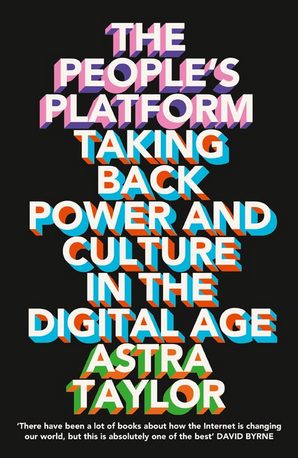
The People’s Platform: Taking Back Power and Culture in the Digital Age

Still, my impression is that we imperfectly comprehend the implications of the change being wrought upon us. One reason for this might be how the internet defines the contours of public life today. In The People’s Platform: Taking Back Power and Culture in the Digital Age, a book about how the corporate power consolidations of the internet undermine its utopian rhetoric, Astra Taylor writes,

We need to rethink how power operates in a post-broadcast era. It was easy, under the old media-model to point the finger at television executives and newspaper editors (and even book publishers) and the way they shaped the cultural and social landscape from on high.2

What strikes me are the spatial metaphors used here. Creating an insider/outsider dynamic are the easy-to-identify culprits for the discontents of mainstream culture that Taylor alludes to — TV executives pandering to an imagined lowest common denominator; newspaper editors who cater to the interests of their advertisers; the list could go on. Also the idea that decision-makers worked from on high, a citadel well protected from less sanctioned creative actors. Taylor paints a picture of a culture that was broadcasted to its public, operating within a landscape that was, first of all, possible to survey, and second, possible to shape according to business and other interests.

What’s different now is the changed topography of culture created by the internet. It’s a mass-collaborative project, one that’s difficult to see in a certain sense because of the way its users are so fully enmeshed in the process of its production. This especially is true of social media, whose users are its very essence, but is also a basic characteristic of the platform, which facilitates in general an ongoing dialogue — one that is equal parts frivolous, vituperative and highly informative — that accompanies virtually everything that appears on the internet.

Of course, as Taylor cautions, while the online conversation (thirty odd years and counting) has been fun it’s characterized by certain naivety. Her basic point is that, sure, the internet is kind of utopian, but you can believe this only by ignoring how perfectly intact it leaves basic power structures and accelerates wealth inequality, while enabling a decline in personal privacy, commercialization of the commons, and increased surveillance by a quasi-totalitarian state. Accordingly, more thinking is in order. Specifically, about what generalized notions we can take from the enmeshed production of culture that is now a daily habit for a billion or more people.


1) Tony Judt and Kristina Božič, “The Way Things Are and How They Might Be,” London Review of Books Vol. 32 No. 6 25 March 2010

2) Astra Taylor, The People’s Platform: Taking Back Power and Culture in the Digital Age (Toronto: Random House, 2014) 9.

This is one of ten posts written to accompany the Kunsthalle Wien’s Political Populism exhibition (November 11, 2015 – February 2, 2016).

Rosemary Heather is a freelance writer based in Toronto and Editor-in-Chief of Q&A, an information retail project focusing on interviews.

On Art and Populism: The Next Universal – An Interview with Laboria Cuboniks

tumblr_npt43s29fa1tl4z6so2_r1_1280

11/12 2015 With the publication of their Xenofeminist manifesto this spring, the anonymous feminist collective Laboria Cuboniks sets the terms for a massively ambitious project. Their goal is to synthesize a new universalism, one that overrides the still-dominant paradigm that derives from the western white-male. Their collectively-authored text, subtitled A Politics for Alienation, is just a first step in a multi-faceted critique that will draw from the various strands of their respective disciplines. While building on the accomplishments of identity-based politics of the last century, the collective argue that the historical moment for this type of analysis has passed. Before reading the manifesto, the urgency of Laboria Cubonik’s program was not clear to me, but it now seems obvious. I look forward to the book they are now working to produce. We spoke through the medium of Google Docs over the past couple of weeks.

I am always interested in origin stories. I realize this approach is a bit contrary to what I understand the Laboria Cuboniks enterprise to be, but…where did you guys meet?

LC: We met up at the Navigation as Emancipation summer school during the summer in 2014 at the Haus der Kulturen der Welt, in Berlin. It was organised by Armen Avanessian, Peter Wolfendale and Reza Negarestani. It was basically a two-week program for those interested in pursuing what has been deemed “neo-rationalist” philosophy. (The term “neo-rationalist” sounds a bit harsh, but it basically concerns new understandings of reason and its function for an age of complexity). What bonded us was the fact that many of us had experienced animosity for avowing things like reason, science, technology and/or mathematics — having been accused of “bowing to the patriarchy” for working with and alongside such perspectives, and we all felt a collective need to denaturalize such disciplines from a de jure masculine grip — that the white-male dominated histories of those disciplines does not mean that their future is bound to the same fate.

That experience became your identity then. So how does Laboria Cuboniks now speak in public? On the web only or also IRL?

LC: Our name is actually an anagram of the Nicolas Bourbaki group of mathematicians from the 20th Century, who advocated for abstract and generic approaches to the field — so there is some definite kinship with their pursuits. We’re (currently) six people from different disciplines spread out across three continents right now. But our identity is not so important. More important for us is to begin developing conceptual tools under the umbrella of xenofeminism — a feminism arguing for abstraction, cognitive augmentation in the face of complexity, and a politics able to think an intersectional or “relative” universalism as a gluing operation after decades of identity politics that emphasize particularisms.

So much to unpack here! The Xenofeminism Manifesto gives a thorough articulation of these ideas. I guess what I am trying to do is first look at the context through which you are speaking as a way to articulate those ideas but in a different way. I understand the Laboria Cuboniks identity is not so important, but I am interested in the way it allows you to speak as one voice. Xeno means “other” (as in xenophobia) so this other voice you are adopting is one made possible by internet, is that correct?

LC: There’s no doubt that without the internet we couldn’t work together, being as spread out as we are (although time zones are a problem — just ask our Australian member who joins in video chats at ungodly hours!) This “other” — or “alien” voice as we’d prefer — that came through the manifesto was a pretty arduous process. But it was also quite interesting to work between horizontal and vertical modes of collaboration, moving between diffuse and top-down editorial authoring. The manifesto for us is a foundational document implicitly mapping out a program of work. It needed a unified voice to articulate these perspectives in a cohesive way. That said, we’ll continually rework our formal approach with each project. The book we’re developing, for example, will take on another strategy altogether as a “forking” of the manifesto. We’ll each prepare contributions in our various areas of competence, elaborating critical points that have been raised since the release of the text, potentially with other authors included as well. It will be a curious exercise. On some issues there isn’t a consensus amongst us, so those tensions will be more visible and hopefully help demonstrate a commitment to “impurity” we believe is necessary to address anything on the level of the social. One cannot get very profound in the manifesto form, so we’re very conscious of the fact that many passages should in fact be proper essays in their own right. We want to start pushing the concepts as tools for reappropriation, similar to the function of something like Git-Hub where coders can build off existing projects, orienting or augmenting them in new directions.

I think these tensions are evident on the level of form, in the sheer density of the text. Its got forward propulsion at the cost of elaboration on the many different avenues of inquiry it proposes. Forking seems like the necessary next step. At the same time, the format of the manifesto and the Laboria Cuboniks identity are what make it possible to articulate such an encompassing set of concerns. Again, in the interest of getting you to spell things out, what is the unifying factor here? To quote from the Xenofeminist Manifesto, does “embracing alienation” as a position and “the synthetic potential of a groundless universalism” properly express it?

LC: You’ve basically nailed it — in the (positively) generic sense. What unites us are several fundamental commitments: the first being an affirmation of alienation as a necessary, cognitive and pragmatic “state” to be mobilised for any substantial change to take place at the scale of the normative. The perspectives that arise from “alien” encounters could mitigate against the way the familiar obstructs the effects of new knowledge. Alienation can never be a “total” thing — it expresses a relation between things/people/activities — so any talk that we are “totally alienated” is rubbish. Such a statement disavows this definitive relationality! One of our main issues is the ossification of norms as facts — when plastic norms become naturalised as a truth of biology, physiology, ecology — or even certain economic orders. In order to disentangle the two, we require a state of “alienation” from those inhibiting normative modes, to construct new ones that operate as a collective horizon for navigating the desire of what we do want as a social body. This generative alienation is a means for thinking through the social, technological, economic, ethical and sexual ramifications of new knowledge(s) — rather than falling trap of alternativeless naturalization. We embrace the power of plastic norms as a counter-hegemonic project, provided they are seized as plastic — that is, subject to re-invention. We can’t simply advocate for a politics celebrating the margin anymore, we require a thinking and pragmatics at a scale of the so-called “total” (and therefore naturalized) global scale of the neo-liberal modus operandi. This scale, in our view, can only be navigated and put to other functions when we can properly think the planetary complexity of 21st Century life — a scale that requires thinking from the nano-second to the geological, which is surely an alien proposition given unaided human phenomenology or intellection.

Can you expand on how you are using the term “plastic” is this connected to “the synthetic potential of a groundless universalism”? I still need that notion clarified.

LC: Definitely. What we discuss as “plastic” most certainly has to do with how a universalism for the 21st century needs to function. What taints the notion of universalism is (quite rightly) it’s Modernist legacy, where we have seen the deployment of “universalism” as: a) a schematic top-down plan, where every difference is subsumed into its over-arching form; and b) as a particularity that is falsely inflated as a universal model — a specifically white Euro-Male “point” or perspective is projected as a dominant mode of orientation globally. On the latter point, we suggest this is no universalism at all. It’s a bloated, disproportionate particularity that has delivered to us global structures of colonialism and capitalism. This is an illogical universalism, a falsely conceived and implemented abuse of the term that does not live up to the potential of its name.

As an important and useful response to this violent (false) universalism, we have seen the development of fields like post-colonial theory, identity politics, queer theory and strands of feminism that highlight marginalized perspectives and voices lost to Modernity’s “inflationary” modes of operation. Addressing critical issues like the “site” or context “from where one speaks” has been a collective effort to emphasize the importance of particularities and give necessary attention to unheard voices and unmapped positions (in art, we saw these tendencies manifest in site specific practices, for example). After decades of such theorizing, though, this almost exclusive focus on particularities has lost sight of the global neoliberal hegemony we are all forced to live by. Calling for a reworking of the concept “universal” should not be taken as a side-swipe against those invaluable theoretical contributions mentioned earlier. It is to face up to their inherent limits in the face of the hegemonic core that has only increased in dominance, and whose scale is gargantuan. It would be a failure to not properly acknowledge those limits and overestimate the usefulness of certain theoretical frameworks, just as Levi Bryant has pointed out how Lacanian psychoanalysis does not offer sufficient tools to adequately examine something like climate change, for example.

Our project is a counter-hegemonic one, which definitively means taking on issues of scale (not only politics understood in its’ local, on-the-ground, phenomenological form) and reformatting what we mean by “universalism”. This is similar to when Rosi Braidotti calls for a feminism unsatisfied by the margins that instead seeks to occupy the centre. To us this signifies a feminism willing to construct what that centre — a normative proposition — could be. This new universalism still requires much thought, to go against the “false” variant we have already been subject to historically. For this universal to live up to its name means not to do away with the important work that’s been done on particularisms, but instead turn our focus to the engineering of a kind of abstract “glue”, in order to plot out coherent relations between particularities — or “solidarities”, in a way. Part of our approach to this concept of universalism is drawn from mathematics, wherein Fernando Zalamea (calling on the work of Alexander Grothendieck) has written about “relative universals” and has begun working with these ideas within a social framework. Now clearly, we are not suggesting an achievement in mathematics can be readily mapped on to the social. But what we can make use of is a functional concept of a bottom-up universal — including the ability to move back and forth between local and global scales. Because this universal is an implicit (bottom-up) and not explicit (top-down) variant, its field of reference is not fixed in stone, but is constituted by the relations it constructs. While we have much more thinking to do on this topic, one thing is clear — if we are going to gain any sort of political and cognitive traction against the almost total subsumption of life to neo-liberalism, we require strategies at a proportionate scale, able to face up to our complex plight — an urgent plight yielding increasingly to (climatic, social, and economic) injustice. It is not sufficient to be against our situation in the negative, but rather to focus our thought towards the affirmative construction of a post-catastrophic world we want.

The position you have mapped out is clear and compelling, and it provides useful insight into a global situation that might otherwise be experienced as an impasse. I am curious to know more about the “conceptual tools” you are planning to develop under the umbrella of xenofeminism. Can you say more about this next step in the project?

The next steps will more distinctly reflect our poly-disciplinary backgrounds — each member delving into the ramifications the manifesto has had upon our thinking since its release (including the myriad of external reactions that it generated — both positive and negative). Having each been infected by alien fields of knowledge in the process of intensively working together, our imminent horizon will be to integrate this conceptual contagion to our respective fields of practice.

http://laboriacuboniks.net/

This is one of ten posts made to accompany the Kunsthalle Wien’s Political Populism exhibition (November 11, 2015 – February 2, 2016).

Rosemary Heather is a freelance writer based in Toronto and Editor-in-Chief of Q&A, an information retail project focusing on interviews.

On Art and Populism: The Unpopularity of Art

Donald_Trump_August_19,_2015_(cropped)Donald Trump

13/10 2015 One of the discarded ideas I had for the title of this blog, which looks at the topic of political populism as it relates to art, was “Plebiscite.” Populism and plebiscites share the idea that the people are sovereign. Commendable on the face of it, the ideal of direct democracy has limited practical application. The expression of popular opinion that a plebiscite allows risks being too immediate (too emotional, too self-interested) and therefore risks failing to protect the broader public interest. Looked at from this perspective, it’s easy to see why the phenomenon of political populism, whether an impulse arising from the right or left, will always be regarded with mistrust. By seeking out alternatives to established political parties and actors, the populist impulse presumes to appoint the fringe candidate or party as its direct representative. However effective an expression of popular discontent, this bypassing of mainstream political avenues would seem to carry the risk of steering the polity into uncharted territory.

Art is a product of its history and institutions, and by this measure, Kunsthalle Wien’s Political Populism project is motivated mostly by the need to see its own values preserved. Tendencies on today’s horizon suggest these values are under threat: migration as a crisis, and nationalism as an exclusionary phenomenon, the demagogic tendencies of some political parties, and the unpredictability of democratic power — in the words of Chantal Mouffe, populism has the potential to create “a terrain…for the emergence of collective identities whose nature is inimical to democratic treatment.”1 The openDemocracy website notes that the perception of political populism’s current omnipresence derives in part from the newness of this development in Europe, where “historically populism has been a marginal phenomenon…unlike in the Americas (North and South).”2

Tensions within Europe may be one reason for the rise of political populism on the continent, but wider forces are driving the phenomenon. Arguably, the semi-legitimisation of populist political alternatives is a symptom of a larger transition being undergone in the West. In part, this can be attributed to the way digital technology remaps the landscape of the public commons, to good and bad effect. Digital diffuses power across its network, bringing with it new standards of transparency and accountability in public life. At the same time, digital infrastructure enables asymmetric power advantage. The web is an amplification tool, with a wide reach disproportionate to the resources required to have such an effect.

51GSL1h8gdL._SL300_

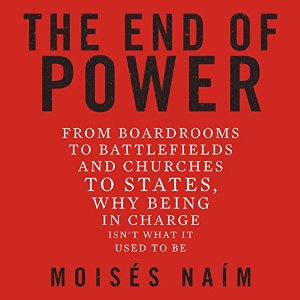
In his book The End of Power (2013), Moisés Naím argues we are now in an era where power is both more constrained and more anarchic. Although a useful observation about 21st century’s new dynamic of power redistribution, it’s a thesis that fails to acknowledge a bigger and apparently entrenched problem. Today’s transnational economies and the global class of the 1% subjugates the nation state, such as recently happened in Greece, and erodes the tax base — with ruinous effect to the social fabric. Writing from the UK, George Monbiot states “Our political system protects and enriches a fantastically wealthy elite, much of whose money is, as a result of their interesting tax and transfer arrangements, in effect stolen from poorer countries, and poorer citizens of their own countries.”3

And this is rather the case everywhere. Globally, art organizations find themselves embattled. Operating according to a business model that includes public money, they get characterized as being undeserving of tax revenues. The political pressure to justify this largesse results in the education and outreach programs of today’s contemporary art institutions — not in itself a bad thing. Regardless, at its base the practice of contemporary art is not a popular endeavor. Artists work within a context that will be most intelligible to an audience educated about its traditions and precepts. While representing a shared inheritance art can reasonably be perceived as only speaking to the few. Of course this shouldn’t matter. Public money benefits everyone in one way or another, including an encompassing range of initiatives within the private sector. However, the tradition of the public sphere that includes art carries within it many of the common values — like free speech and critical enquiry — that could be considered a threat to the global elite’s highly successful project of public funding cuts for the poor and middle classes and wealth accumulation for the rich.

George Packer notes that populism is a volatile tendency that “flourishes in periods… like our own, when large numbers of citizens…feel that the game is rigged against them.” It’s a truth that explains the ascendance in the United States of Donald Trump, a billionaire demagogue who connects with his audience because he is an independent with no association with institutions rightfully perceived to be corrupt by the general populace. That Trump continues to have a strong lead amongst Republican candidates for Presidential nominee, despite his noxious (and farcical) political ideas (deporting millions of undocumented immigrants; building a wall between the US and Mexico) suggests the degree to which the traditional options are discredited.

If contemporary art can be said to represent a set of values, it’s important to identify what they are and how artworks are understood to embody them. This is the first of an ongoing series of blog posts that will lead up to and accompany Kunsthalle Wien’s Political Populism exhibition and On Art and Populism symposium. The blog proposes to look at what these values are, why they are worth protecting, and what historical circumstances are currently at work to undermine them, as articulated through reference to art and its institutions.

1) Chantal Mouffe, “Right-Wing Populism: The Mistakes of the Moralistic Response”, The Populism Reader (Berlin: Sternberg Press, 2005) 63-68.

2) Cas Mudde, “Populism in Europe: a primer”, openDemocracy, 12 May 2015 https://www.opendemocracy.net/can-europe-make-it/cas-mudde/populism-in-europe-primer

3) George Monbiot, “To us, it’s an obscure shift of tax law. To the City, it’s the heist of the century,” The Guardian, 7 February 2011 https://www.theguardian.com/commentisfree/2011/feb/07/tax-city-heist-of-century

This is one of ten posts written to accompany the Kunsthalle Wien’s Political Populism exhibition (November 11, 2015 – February 2, 2016).

Rosemary Heather is a freelance writer based in Toronto and Editor-in-Chief of Q&A, an information retail project focusing on interviews.

7th Berlin Biennale, April 27–July 1, 2012, Berlin

Image

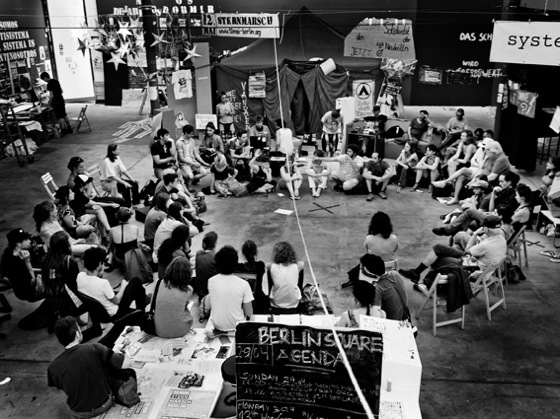
OWS at the Berlin Biennial, 2012. Photo by Marcin Kalinski. 

Much reviled, widely derided, the 7th Berlin Biennale (BB7) achieved its aims regardless. The biennale curator, Polish artist Artur Žmijewski, proposed art as a problem and activism as the solution and in the process created the circumstances for reconsideration of both. In keeping with his tendency to be a provocateur and bully, Žmijewski (creator of, among other works, the highly discomfiting video 80064 (2004) in which he persuades a Holocaust survivor to have his faded Auschwitz tattoo redone) poses this question with a brutal hauteur. He titled his curatorial essay “7th Berlin Biennale for Contemporary Politics” and made a show at the BB7 press conference of declaring his antipathy to art.

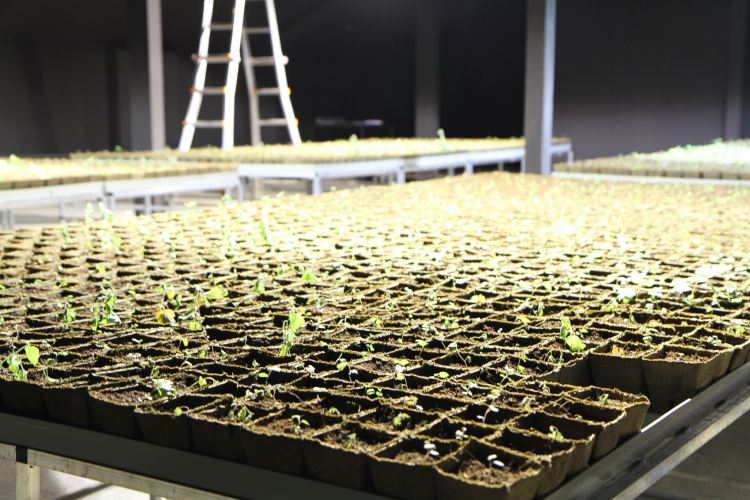
Banishing much of what contemporary art audiences expect to see at an event like this, Žmijewski and his co-curators replaced it with works, often by nonartists, that were unambiguously political in intent. At the Kunst-Werke (KW), the event’s primary venue, the walls were hung with banners and painted with the murals and stencils of street art made by various artists and activist groups. On the level of sheer visuality, the exhibition suffered from too narrowly defining what political art looks like. In this sense, the BB7 was guilty of the oft-repeated critique that overtly political art risks addressing merely the known enemy. Along with street art, the KW presented a number of works that shared in common a taste for devising small problems—little moral dilemmas—for the visitor. In an installation by Jonas Staal related to his New World Summit, an “alternative parliament” event organized during the Biennial, a passageway was hung with the flags of the various participating insurgent groups, positioned low to the ground and close together, creating a kind of gauntlet to be run to get to the other side.  Teresa Margolles’ stack of giveaway posters featured gory images of one year of drug war murders in Juárez as they had appeared on the front page of one of the city’s tabloids. Also free to take home were Łukasz Surowiec’s replanted seedlings that had originally taken root in the ground around the Auschwitz-Birkenau concentration camp. Of most consequence perhaps, Khaled Jarrar invited the biennale audience to stamp their passports with the seal of the nonexistent State of Palestine. Take up this offer and you would have joined an international community in solidarity with the Palestinian people, a gesture that under certain circumstances—attempting to enter Israel, for instance—could mean the loss of rights you otherwise take for granted. At center stage within this mise-en-scene of political theater, on the main floor of the KW were representatives of the Occupy movement itself. Imported from New York, members of Occupy Wall Street, along with Spain’s M15 and Russia’s Pussy Riot, among others, had set up camp for the duration of the exhibition. The consensus in Berlin seemed to be that moving indoors somehow neutralized the movement; more than one person told me the BB7 was “occupying” the Occupiers (clever!). Who made this rule, so widely agreed upon, that activists have to be cold and wet as opposed to warm and dry to be effective?img_4875

Lukas Surowiec’s Berlin- Birkenau Berlin Biennale 2012

Activists at the venue, who were busy painting signs for an action they would undertake later that day in support of the Deutsche Guggenheim’s nonunionized workers,  reported being happy to have a base in Berlin from which to expand their operations. “You never know where it’s going to blow up,” one of them told me. Where it will not blow up—and we can be certain of this—is inside the walls of an art institution conducting business as usual. This is of course Žmijewski’s point. The tactics of the Occupy activists and their cohort might be a little crude, their handmade signs a little embarrassing, but at least the time frame they are working in is “now.” The alternative is the deferred time frame of the avant-garde that tends to structure art world thinking about political ideas. As Žmijewski notes, the “label of ‘bad art’ is frequently deployed, as if by targeting the form, one needs not be concerned about the message.”  Whether he believes as he claims that the biennale takes part in “transformative social processes,” Žmijewski performs the service of helping us subject to scrutiny claims to political efficacy made on both sides of the argument. When confronted with the vernacular style of political protest arrayed throughout the KW, all I could think of was how feeble the tools are that we have at hand to combat the power of the financial elite, precipitators of financial crises for which they, to a person, remain not held accountable. Žmijewski’s exhibition provokes profound questions about how we experience history—by definition it is understood in retrospect, even when vast sectors of the population suffer from its machinations. It is for this reason that I felt genuinely moved by the 7th Berlin Biennale and the generosity it displayed toward political activism, which will carry on regardless, whether or not the art world continues to give it attention.

By Rosemary Heather

This text was originally published in Art Papers

More info about the 7th Berlin Biennale here

Kelly Richardson Talks Sci-Fi Futures, Life On Mars And Mariner 9

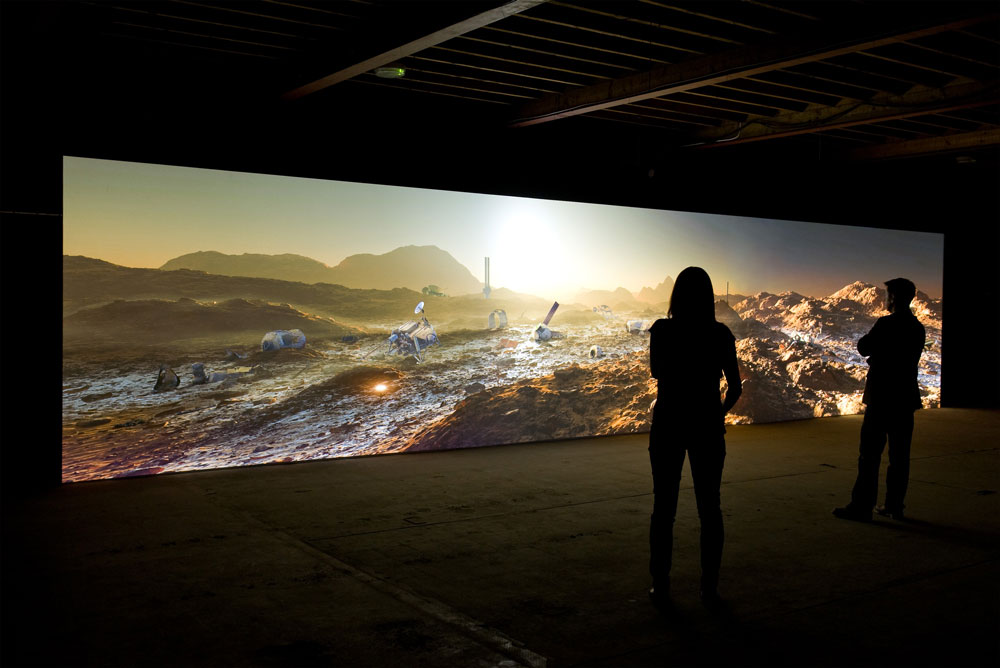
Kelly Richardson Mariner 9 2012 Installation view Courtesy of the artist and Birch Libralato / photo Colin Davison

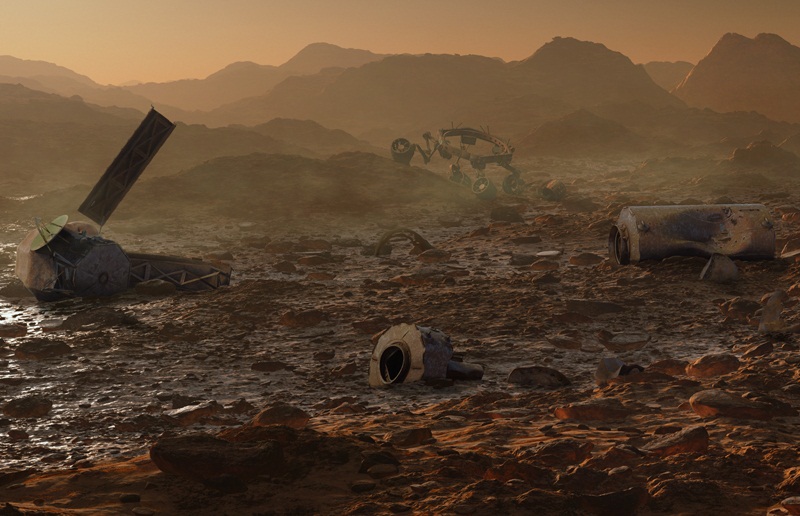
As part of the Future Projections program at this year’s Toronto International Film Festival, UK-based Canadian artist Kelly Richardson brought a scaled-down version of her amazing new work Mariner 9 to the Royal Ontario Museum. A panoramic video installation, Mariner 9 presents a detailed portrait of the surface of Mars as it might be seen in the future—littered with space junk, but still apparently uninhabited.

Commissioned by Tyneside Cinema in Newcastle, the TIFF installation offered North Americans a foretaste of the touring mid-career survey of Richardson’s work (also organized in the UK) that will arrive at Buffalo’s Albright-Knox Art Gallery in February 2013 and, in smaller form, at Vancouver’s Contemporary Art Gallery in 2014. This survey promises to be an event in itself, with eight rooms at the Albright-Knox to be taken over by her work. In this email interview, Richardson talks about the origins of Mariner 9, our fascination with life on Mars, and what that might mean for the future of life on Earth.

Rosemary Heather: There was an almost unnerving coincidence at seeing Mariner 9 in Toronto at the same time that NASA’s Curiosity was exploring Mars. It makes your project seem more real, almost as if you are doing the advance work—mapping the mental territory—for this new era in space exploration. Care to comment?

Kelly Richardson: The idea for Mariner 9 did come about before I became fully aware of when Curiosity would embark on its mission to the red planet. The opportunity I was given to develop the work was during a residency as part of Tyneside Cinema’s Pixel Palace program. The timing was perfect for the commission to be presented in parallel with the Mars mission.

Because of the unique problems the piece introduced, I spent the majority of time during my two-month residency researching and developing the various approaches I could take to produce the work so that, by the end of it, I would be ready for production to begin. Interestingly, by this point—the end of the residency and the beginning of the creation of Mariner 9—Curiosity had departed for Mars.

As we had planned to launch its UK exhibition within days of NASA’s anticipated landing, roughly eight months later, the work was produced entirely during the time it took for Curiosity to leave our planet and arrive on Mars: simultaneous missions. Mariner 9 premiered in the UK three days before NASA’s landing, and given that I had included Curiosity in the work itself, I was obviously thrilled when it landed successfully.

RH: One goal you’ve said you have for the work is to produce an immersive experience for your audience, which the installation delivers when presented at full scale, as it will be for your show at the Albright-Knox. Is it correct to say this effect in part derives from the authentic look you were able to give the piece? Can you also say something about the kind of research you had to do to achieve this look?

KR: I’d say the convincing Martian landscape certainly contributes to the immersive quality of the work. I wanted people to feel as if they could step onto Mars and I did overhear a number people in the UK telling one another that that’s exactly how it felt.

This is the first piece I have done that was entirely digitally produced. Usually I begin by filming existing locations, which I then alter digitally to create the work. However, as I couldn’t film on Mars I had to take a different approach.

I discovered that NASA knows exactly how Mars is constructed and that it had made this data available to the public, which could then be brought into a 3-D program to faithfully create the lay of the land. Using images of the surface of Mars taken from various rovers as a reference, I could then texture my digital version by creating similar rocks, sand, etc., to produce a photorealistic terrain. So that’s exactly what I endeavoured to do—and of course, it wasn’t nearly as straightforward as I’ve made it sound here.

I put a great deal of research into actual missions that had gone to the planet to recreate digitally the graveyard of partially functioning and corroding remains from various spacecraft you see in the work. And as it is a “futurescape” several centuries from now, I also researched current thinking about what future rovers may look like.

Lastly, I wanted the scene to be set during a dust storm, which is one of the most difficult effects to achieve in 3-D. Research aside, the skill set required for the whole of this work was huge. In the film industry, it would have required a large team of people. Two of us (my partner Mark Jobe and I) worked on the project full-time for 10 months. We basically started from scratch, as we had to learn several new programs and methods of working to achieve the desired look.

RH: I love the way, even when describing the project, you convey a sense of why it is so compelling to you—the recent Mars exploration adding extra urgency. I am wondering about the sound. You took great pains to include details that give the piece visual verisimilitude; is this true also of the soundtrack? I recently saw Christian Marclay’s The Clock and noticed how the sound from one segment will often carry on over top of subsequent clips, providing an element of continuity (along with the timepieces) to the artist’s otherwise disparate selection of movies. Can something analogous be said about Mariner 9? Is the soundtrack what makes it truly immersive?

Kelly Richardson Mariner 9 2012 Installation view Courtesy of the artist and Birch Libralato / photo Colin Davison

KR: I’d say it’s equal parts visual to audio that makes the work immersive. The installation, at 43 feet by 9 feet, takes up far more than your immediate and peripheral fields of view. In fact, it’s so large that you really can’t take in the whole of the piece without physically moving around it.

In England, it was common to see people sitting in front of one area for a good while, and then relocating to another area for an equally long time. Holly Hughes, who is curating my mid-career survey at the Albright-Knox, also noted that when you walk around the work, the light changes as it would in front of a physical landscape and many people have noted how three-dimensional it looks, without the use of 3-D technology.

The sound does play a huge part in the immersive quality of Mariner 9, though. During my research I discovered that we don’t actually know what Mars sounds like. All attempts to record audio on Mars have failed so it’s mere speculation at this point as to how it would behave on the planet.

In lieu of this information, I created a soundtrack which, again, attempts to convince the viewer that they’re there, providing the tools for a suspension of disbelief. It is 5.1 surround sound, made up of a dust storm swirling around the room; faint, strange, rhythmic sounds; and mechanical sounds associated with the movement of spacecraft. The nature of the sound also reflects the function of the visual, which is both hypnotic and strangely beautiful, but equally unsettling.

RH: Finally, I guess the biggest question is, Why Mars? Aside from the current focus of American space exploration, are there other reasons this project took Mars as its subject?

KR: Over the last few years, I’ve been increasingly interested in the way science fiction allows us to experience what life might be like in the coming century. Scientists and futurologists can speculate on what the future might look like, but artists are capable of visualising those futures, making them tangible. If hindsight is always 20/20, experiencing these potential futures offers us a window through which we can view our present time and the direction we are headed in with some measure of clarity.

Mariner 9 presents Mars as littered with the rusting remains from various missions to the planet. Despite its suggested abandoned state, several of the spacecraft continue to partially function, doing their job to look for signs of life, and possibly transmitting the data back to no one.

That search for life—to know that we’re not alone in the universe—is fascinating on many levels, but it’s also a beautiful, endearing endeavour, particularly for us as a species. We are destroying much of life as we know it, literally consuming our planet, at a truly alarming rate. I’m interested in that contradiction at this critical time in history when current predictions for our future are not just unsettling, but terrifying.

By Rosemary Heather

This text was originally posted at canadianart.ca

More info about Kelly Richardson can be found here.

Kelly Richardson is represented by Birch Libralato.


Brad Phillips, Literature And The Art Of Autobiography

Brad Phillips’s preferred meeting place in Vancouver is Reno’s Restaurant at Broadway and Main. “It’s quiet there, and we will be able to talk,” he says.

In the condo-choked gloss of Canada’s most beautiful city, Reno’s offers a step away from the fray. Albeit of a dying breed, Reno’s is the type of diner you can find pretty much anywhere on the continent. In keeping with Phillips’s practice as an artist, it’s situated at a studied remove from current trends.

As Christopher Brayshaw, the Vancouver critic, photographer and co-founder of CSA Space, remarked to me, an artist concerned with appearing hip would never reference John Cheever. But Phillips does (Unknown Painting, 2005), and Cheever provides a revealing clue to understanding the appeal of Phillips’s art. A paragon of WASP experience in the mid-20th-century US and the writer of matchless tales of suburbia, Cheever created fiction whose power lies in intimations of dark undercurrents that run through domestic life. Phillips makes art with a similar effect. He is an artist who takes photographs and makes paintings in a photorealist style (meaning photorealism is less a goal than a by-product of his practice, but more on that later). Like refractions of light through a crystal, his work creates surface tensions with what’s left unsaid.

A Toronto native, Phillips moved to Vancouver in 2002. Like Cheever, whose relationship to pop culture is at this point etiolated at best, Phillips makes work that appears to have little in common with his city’s dominant art practices. Photography is central to his work, but he uses the medium more as a tool than as a mechanism deployed to reflect back on the genres photography creates. This is not to say Phillips’s work lacks an international audience. Represented by the Zurich gallery Groeflin Maag until it closed in 2010, Phillips is an artist arguably appreciated more outside his home country than within. His work has been purchased by some noteworthy collectors: Toronto financier and philanthropist W. Bruce C. Bailey was an early supporter.

Brad_Phillips_Patricia_Highsmith
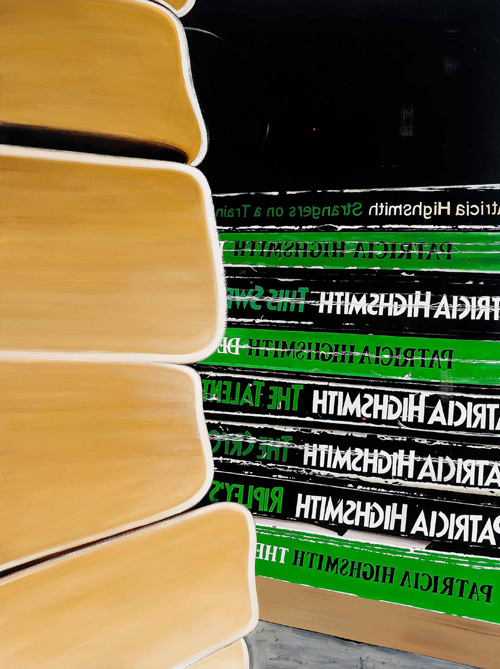
Brad Phillips, One Month of Reading in the Mirror (2007)

It is possible Phillips’s work flies beyond the sightlines of full art-world appreciation in Canada because he makes art in a fashion that is deceptively straightforward. His work is plainspoken in a way that is perhaps more intelligible to the European eye. Phillips hews a vernacular style that constructs a world from the materials at hand, as evidenced by his habit of making paintings about books he has read. One Month of Reading in the Mirror (2007), for instance, presents a stack of books by the writer Patricia Highsmith, their spines cracked from use. Not surprisingly, Phillips, a maker of paintings, gives his literary references a surface form. He presents books to be judged by their covers, so to speak. For an exegesis of their references, viewers will need to look elsewhere—including to other works made by the artist.

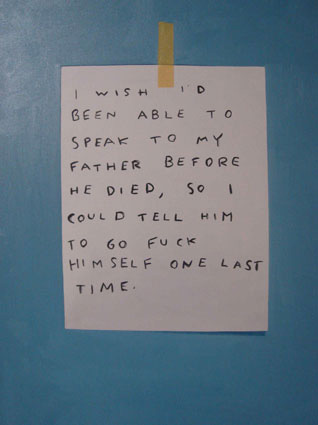
The implied deferral of significance between works is the method by which Phillips constructs an edifice of meaning through his practice as a whole, his titling of a work being a pointed element within the piece’s overall composition. This is especially true because his work is always figurative with a focus on the still life (Sentimental Monochrome, 2009) or landscape (Summer of Whatever, 2003), and he has made many paintings in which the signifying element is reduced down to a declarative text. The work Richard Prince (2009), for instance, is a painting of a piece of paper taped to a wall, with a note scribbled on it that reads like a one-liner from Prince’s own Joke series (1986–ongoing): “I wish I’d been able to speak to my father before he died, so I could tell him to go fuck himself one last time.”

Brad Phillips, Richard Prince, Oil Painting, 2007

The punch line hits its mark, but it gets a laugh that’s more queasy than funny. Richard Prince poses questions about which components of Phillips’s work are autobiographical, as the reference made to the work of the American artist seems less a clever homage than a discreet form of self-revelation. Similar conclusions can be inferred from the text painting Doctor Shopping (2010), which features a tightly framed list of doctors’ names on a black background. The slight angle given to the list of names and the shadowing in the lower right-hand corner subtly position the viewer, and more explicitly the artist (Phillips is tall), as if perusing the list within the lobby of a medical building.

Brayshaw notes that Phillips’s painting technique is “faux naive”; the artist’s photorealist style risks the appearance of simplicity. Close inspection of the canvas reveals great painterly skill, but it is a technique deployed as a means to an end. Phillips avails himself of a dry finish when applying paint to the surface of the canvas. It is an effort made in firm disavowal of the drama of the brushstroke, and also a way for the artist to maintain a fidelity to his pictorial goals.

“There are no happy accidents in the making of my work. I know exactly what the painting is going to be when I start, and that’s how it looks when I finish. In between, nothing happens except execution,” Phillips says. In a similar fashion, he uses titles to banish ambiguity, all the better to summon full engagement with his works’ melancholic ambience.

In making his works, Phillips uses a camera, but he reports that he mostly knows what image he wants before he takes a photo. While he sometimes exhibits the photographs he takes, they mostly become the bases for his paintings. At each step in the process, Phillips excerpts and revises. Every component in his repertoire—whether paintbrush or camera—is only a tool to facilitate his exceptional talent for pictorial composition. One Month of Reading in the Mirror presents what we assume is a gathering of books read, but this record from the artist’s life is angled, as if seen in a mirror. In this way, Phillips constructs a metaphor for self-reflection: we are what we read, so to speak. Another work, Major Depressive Episode (2011), features a chain lock on a door in close-up. The focus on this detail, combined with the work’s title, is almost cinematic in effect, its impact deriving in part from an implied honesty about the artist’s circumstances.

Rather than being painterly or expressive, Phillips makes artworks in the service of narrative. He has a story to tell, and each painting is not so much a chapter as a sentence in its overall composition. A Modern Painters review of the artist’s exhibition at London’s Residence Gallery last year notes that Phillips focuses on details as if “he had zoomed in until his eyes reached the satisfying flatness of the written word.” Literature finds an equivalency in the clarity and flatness of Phillips’s skill with pictorial denotation.

Phillips’s use of a realist style and his dry application of paint give his work a certain verisimilitude. In the words of John Cheever: “Verisimilitude is…a technique one exploits in order to assure the reader of the truthfulness of what he’s being told.… Of course, verisimilitude is also a lie.”

Phillips uses visual art as a means of self-portraiture. He authors certain truths about himself through the fiction of painting. In the midst of the current ethos of Internet and reality TV–based self-disclosure, his modus operandi strikes one as almost old-fashioned. As Vancouver writer Kevin Chong notes in conversation, Phillips’s work is self-revelatory, but not in the style of the up-to-the-minute Facebook status update. Making paintings is, after all, hardly the quickest way to get your message across. The same could be said of the presentation of art exhibitions. Art occasions slowness and contemplation, which, as the American artist Kerry Tribe has noted, is a proposition that is a “tiny bit radical” when considered in relation to the value today’s culture places on instantaneous content transmission.

Phillips concedes that in recent years his work has become more directly autobiographical. The Victoria-based fiction writer and critic Lee Henderson notes in an email that Phillips’s earlier work tended to favour what Henderson calls “goth girls [Untitled, 2001] and other midnight imagery: a van parked in a vacant parking lot in front of a black sky [The Last Party, 2002], a silhouette of a forest at night and so on.” The imagery, Henderson says, was in keeping with “a young man’s experience.”

Today, Phillips’s work is both subtler and more polished. Perhaps not coincidentally, he matches advances in his painting skill with the recognition of the value of his life as subject matter. His directness of expression, however elliptical, is a measure of his confidence as a maker of artworks, an assuredness that belies the self-recriminating eye with which he often seems to regard himself.

Phillips admits that this new tendency to make works that refer more directly to his own experience leaves him feeling exposed, though he has found that his audiences recognize the vulnerability he risks and respond accordingly. When he cites influences, other artists hardly figure, although he does count himself a fan of Hans-Peter Feldmann, Joan Mitchell and Edwin Dickinson. Phillips says his influences come more from the traditions of literary fiction. In particular, he says the confessional poetry of writers like Robert Lowell, Elizabeth Bishop, Anne Sexton and Sylvia Plath has had a huge impact on his work. “They made such beautiful prose out of their lives and I realized I could do that in painting,” he tells me.

In keeping with the efflorescence of cultural innovations during the 1950s and 1960s, the confessional poets discovered fresh territory to explore in their work by freeing themselves from the constraints of propriety that had governed poetic expression up to that time. Free verse went hand in hand with the revelation of personal intimacies that were sometimes considered shameful. Phillips likewise uses his work to intimate personal difficulties. They can be as commonplace as insomnia, in Twice a Day or Insomnia (2010), or as bleak as those suggested by Deadbeat Dad (2007), one of a series of works the artist has made of the back of a framed photograph—paintings that pack an emotional punch disproportionate to the bare facts of what they depict.

Brad Phillips, Deadbeat Dad, Oil painting, 2007

Phillips’s admiration for the work of the confessional poets is, like much else in his practice, a kind of throwback. Viewed in the light of today’s ultra-confessional culture, this connection suggests that Phillips has found a permission set by their example—permission for art to be the vehicle for the imparting of intimacies that gain a life beyond the moment.

By Rosemary Heather

This text appears in the Fall 2012 Issue of Canadian Art.

More info about Brad Phillips can be found here.

Brad Phillips is represented by the Monte Clark Gallery.

Kevin Rodgers: Contingency Problem

Kevin Rodgers
Poster from Kevin Rodgers, OUT OF ORDER, 2012 McIntosh Gallery in London, ON.

In a 1972 text that takes the Watergate scandal as its stepping off point, Hannah Arendt writes:

The deliberate falsehood deals with contingent facts; that is, with matters that carry no truth within themselves, no necessity to be as they are…

It’s hard to think of a better analogy for contemporary art practice, or at least a certain tendency within it. Watergate may be far from the concerns of contemporary art but the manipulation of contingent facts is often the way art gets practiced today.

The characterization of art as a species of lying is long standing. The idea dates back to Plato. As a bulwark against the temporal nature of existence (which changes and ultimately expires) and the non-omniscient perspective of human beings, Plato posited another reality, one that was more real than the one mere mortals’ experience. It’s a schema that takes solace in the possibility of transcending the imperfectness and contingency of everyday life.

For Plato artworks were non-ideal, mere approximations of their referents, if potentially seductive regardless. Today art trades in a subtle variant on this idea of art’s essential deception. Dispensing with the framework of the meta-physic, contingency is no longer a problem. Instead it represents the opportunity every artist engages with. With each instance of reception meaning crystallizes anew, which is why such a high value is placed on the actual encounter with the artwork.

However, encountering an artwork provides no guarantee that meaning will derive from it. In the best scenario, contemporary art aims for a kind of freedom enjoyed by the spectator in the contingent moment of understanding. But it’s not a freedom easily won, and the reason for this is directly connected to the way art intermingles with falsehood.

Kevin Rodgers, OUT OF ORDER
Installation, Kevin Rodgers, OUT OF ORDER, 2012 McIntosh Gallery in London, ON.

In a certain type of art practice things are made to stand in for other things. This type of practice makes literal the idea that appearances are deceptive. The art encounter that results will require viewers to hunt for the meaning of the facts presented to them. A mental operation will be required that is often tough because exceedingly subtle. Back to Arendt:

“deception [is] so very easy up to a point…it never comes into conflict with reason because things could have indeed been as the liar maintains they were…”

Artworks similarly never come into conflict with reason. If a work defies logic it simply isn’t successful. It fails the demand that it be in some way interpretable.

The best works of art are open-ended and susceptible to multiple interpretations. The onus placed on the viewer in this transaction accounts for the dissatisfaction about art often expressed by contemporary art audiences. Arendt gets at this idea when she says “factual truths are never compellingly true.” And the demand placed on the viewer is perhaps never greater, and meaning is never more elusive, than when artists present an assemblage of facts, things standing in for other things, with only minimal clues about how to grasp their intention.

How do we access the meaning an artwork implies except through the hard surface of the facts presented? In the end, there is only this surface, a set of appearances held in tension with one another and, implicitly, held in tension with what isn’t there. The clues and lack of clues work together to create a kind of surface coherence, the edits or cuts becoming as important, as you will come to understand, as what is left in its stead.

Rosemary Heather

Commissioned on the occasion of the show, this text appears on the poster give away that accompanied Kevin Rodgers, OUT OF ORDER, McIntosh Gallery in London, ON, 19 July to August 11, 2012. The exhibition was the culmination of the artist’s PhD research at The University of Western Ontario.

More information about Kevin Rodgers work can be found here.

Knowledge Held in Suspense: A Conversation with Kerry Tribe

There Will Be _______
Kerry Tribe, There Will Be _______, 2012, Installation view, Courtesy the Power Plant / photo Toni Hafkenscheid

Toronto-based writer Rosemary Heather spoke to Los Angeles-based artist Kerry Tribe during her solo exhibition Speak, Memory at The Power Plant (24 March – 3 June 2012).

This excerpt is part of a longer conversation, most of which took place in a taxi on the way to the Toronto airport. Heather notes, “Setting out to do this interview, I devised a theory of how to understand Tribe’s work. As often happens, however, our conversation overtook any hope I had of getting Tribe to commit to a particular hypothesis about her art practice – it defies easy encapsulation. This made talking to Tribe about her work much like the experience of engaging with it: the process is an end in itself.”

ROSEMARY HEATHER: One way that I thought of talking about your work is through the lens of Here & Elsewhere (2002). You remade a piece by Jean-Luc Godard, in which he interviews children by asking them metaphysical questions. Can I locate that as a framework for your work as a whole?

KERRY TRIBE: The idea of remaking something?

RH: Yes.

KT: I don’t know if I would think of it as remaking so much as returning. At UCLA when I was a graduate student I organized a series of screenings — a 24-hour unofficial film festival — because I discovered a little pocket of money in the graduate program that allowed me to rent some titles.

I had never seen Godard’s television series France/Tour/Détour/Deux/Enfants (1977) and a friend recommended it, so I screened it. I just screened the first two episodes. I was really struck by what happened when this big father of avant-garde film and video (who was a Maoist and tough and rigorous and making images that were often difficult to look at) set out to interrogate this little girl and little boy about heavy political and philosophical issues. The little girl’s responses, which were down-to-earth and sometimes confused, were totally compelling to me. What was it about the presence of this little girl? There’s one point in the video where her face appears — her name is Camille Virolleaud — and over it is the word “Verité” in big letters. And I thought: There’s something accurate about that. We all want to identify with this simple, you might say, Cartesian subject position that says: Yes I know. I’m here. I only exist once. I walk through my life. I understand things or I don’t, even if we know better. I mean, even if feminism, psychoanalysis and critiques of capitalism tell us that this simple belief in one’s own self-identity, agency and autonomy is inadequate, it’s nevertheless compelling. I wasn’t so much interested in specifically remaking that Godard video, or in pointing directly back to it but rather in trying to see what would happen if some of those questions were asked again. At one point, Godard asked Camille about her room. It’s very bright and it’s clean, and who cleans her room? (I’m paraphrasing.) And she says something like either her mother or the housekeeper does it. And he asks, Well who pays your mother to do this? And she thinks probably nobody does. Do you think maybe The State should pay her? And, Is The State a man? Or a woman? And so on. It’s great stuff.

And these are questions that continue to be urgent. And yet in the end, it didn’t seem viable to do that in 2002. When I tried to work the explicitly political questions into the script it just fell flat. It was actually dreadful.

RH: Can you elaborate? What does your piece look like? Read the full interview here.

This interview was commissioned by the Power Plant, Toronto. A longer version will be forthcoming.

More info about Kerry Tribe can be found here.

Image Chain Reaction

Flip
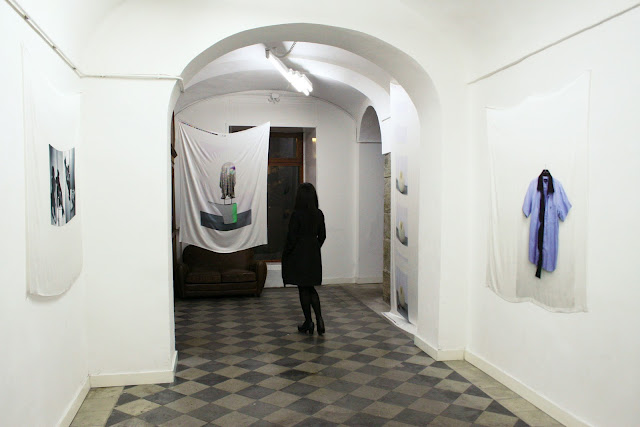
Flip Project Space, How to Make a Delicious Tea, ARTISSIMA LIDO, 2011, Eloise Hawser. Martin Soto Climent. Patrick Tuttofuoco. Per-Oskar Leu

We understand what kind of knowledge the photographic image makes available to us. We know about its status as copy, and the technologies that produce it. We intuitively know that an image isn’t real precisely because it is reproducible. So why try to make all of this visible?

Flip’s How to Make a Delicious Tea has an answer to this question, or more correctly, offers a sophisticated articulation of the circumstances that provoke it. A predominate feature of contemporary experience is the dynamic of image proliferation. Like the light of the sun, images may now elucidate the world in such an all encompassing manner that they defy our ability to see them with any clarity. Flip finds a way to embody this dynamic through an ongoing collaborative process. Working with a group of artists, they produce a composite artwork. How to Make a Delicious Tea creates a material analogy for the image and the way today it is more process than singular entity.

Located nowhere in particular How to Make a Delicious Tea exists as versions of itself that take shape according to the context within which it touches down. Working with pre-existing artworks, the project turns them in to images that are printed onto silk for display as an art exhibition.

If every image now exists as a process, this is because images now exist as expressions of the network that circulates them. Reproducibility and connectivity turn the image into endless versions of itself, a veritable chain of impressions with slight variation. Flip uses silk to perform a kind of transubstantiation, one that enacts a mordant commentary on the many potential layers of a photograph’s insubstantiality.

Somewhat intimate, almost embarrassing to the touch, silk could be said exceed the boundaries of its materiality. It is substance with a suggestion of vaporousness at its edge. Similarly, the best artworks slip beneath the boundaries of attempts to define them.  And photographing artworks will always exacerbate the problem, in the guise of saying something definitive. Combining these elements, Flip creates an analogy for the essential contextlessness of digital image reproduction. Silk is used here is not so much like the printed page as the fathomless space of the internet.

How to Make a Delicious Tea makes silk into a self-reflexive medium. Silk transforms mere image, so divisible, back into indivisible luxury object. As a material, silk will distort the image reproduced on it. It drapes with specificity, and so undermines the original’s reproducibility as copy.  It’s a kind of triumph, to halt the infinite slippage of the digital. But the respite is only momentary. Photographed, the artworks start to circulate again.

Rosemary Heather

The text was commissioned to accompany Flip Project Space’s How to Make a Delicious Tea II by Art Metropole

More info about Flip Project Space can be found here.