Meat dress manifesto: On the contemporary irrelevance of contemporary art

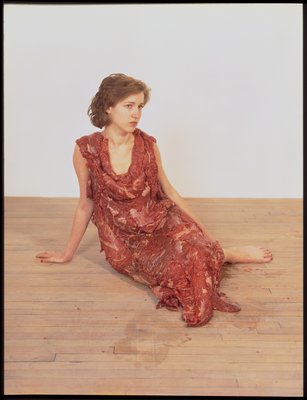
Jan Sterbak, Meat Dress 1987
Jan Sterbak, Vanitas: Flesh Dress for an Albino Anorectic, 1987

By Rosemary Heather

I happened to find myself in Grande Prairie, Alberta. I had never heard of the city before. In Canada most urban life hugs the border with the United States. Canadians commonly refer to this border by its latitude: the 49th parallel. Grande Prairie sits just north of the 55th parallel. If you were driving from Montana, it would take over 12 hours to get there. Call me ignorant of geography. I didn’t know Canada had cities that far North.

I live in Toronto and it cares little about what happens in Grande Prairie; the centre of Canada’s media universe, news emanating out from here barely mentions the place. For the people of Grande Prairie, I’m sure the feeling is mutual. After all, Grande Prairie is booming. In part due to the dirty economics of the Tar Sands, Alberta is an exceedingly prosperous province.

Driving the streets of Grande Prairie, you can draw a map of Globalisms’ franchising coordinates. Starbucks is one outlet we are happy to find. Good coffee is progress, says my companion. Context is everything. In the absence of better coffee, Starbucks is good. Like the prow of a ship breaking ice, Starbucks opens up new markets for capitalism while setting better standards for coffee taste. This is the progress we like, one that caters to our urbanite selves. We can thank the Tar Sands for this, along with its disastrous environmental effects. History is always experienced as a lived contradiction.

At lunch, I read a BBC story on my phone about Lady Gaga. How does she do it? Various experts weigh in on the Gaga phenomenon. Like Starbucks, I don’t doubt that Lady Gaga is popular in Grande Prairie. Shuttling through stations on the car radio I hear Bad Romance and then Classic Rock. I want to understand the changing landscape of mainstream culture. In Grande Prairie, I find myself in the changed landscape itself. To me, it looks like a city that has popped up overnight, the spores of Globalism taking root in the form of big box stores. Seeing duplicates of chains I know from elsewhere makes Grande Prairie a place I both can and can not recognize. Thriving, it still seems to barely exist. It is simulacral, to use that old word.

At Starbucks I had picked up a flyer for a local historical society. This is what culture is in Grande Prairie, I think: Lady Gaga and historically-accurate reconstructed log cabins. Grande Prairie upends what I thought I knew about the world. Globalism redraws the map of the globe, and Gaga looms large on this horizon.

At the 2010 MTV Music Video Awards, Gaga wore a meat dress. Thinking about this, I make the assumption it augurs something new. Not the meat dress itself – that is an artwork made by Jana Sterbeck in 1987 – but the meat dress as an object of mainstream consumption. Claiming to be an artist, Gaga uses the shock tactics of the avant-garde, but not to any avant-garde end. As John Ashbery wrote in 1968, “the artist who wants to experiment [today]…is now at the centre of a cheering crowd. Gaga serves a structural purpose, not unlike that of Starbucks coffee.

Writing about the Pepsi Corporation in the New Yorker, John Seabrook notes that Pepsi products have a dual nature. Every bag of Doritos offers flavour combinations that are the same every time, fused with something more abstract. As Seabrook says, “PepsiCo grafts taste with desire.” The same could be said for any contemporary brand. In Gaga’s case, she embodies the culture social media makes. Gaga is the best example of its aspirational narrative: self-transformation is just a costume change away. This is why the music she makes can be merely adequate.

Art and pop culture are like languages. The parts of speech remain the same, while meaning is generated through the logic of substitution. If history’s substitutions always move from tragedy to farce, Gaga is definitely the farce. She wore the meat dress for the purposes of a photo op, nothing more. It was but a salvo in the arsenal of costumes changes she uses to keep her publicity machine churning. When Jana Sterbeck put the meat dress in an art gallery its point was decay. Not an irony for which Gaga can spare the time.

To claim pop cultural novelty is new is merely to betray my own biases. I am naive like every Liberal Arts student. Study of the modernist canon defines the scope of my formal education. Figuratively, modernism is reducible to clean lines and white spaces; pure abstraction and an absence of embellishment at one time signified a break from the past. It’s a legacy that lives on in the white cube of contemporary art today. And seeing the world from inside the white cube nurtures certain assumptions about what’s important.

Lady Gaga
Lady Gaga, Meat Dress, Designed by Franc Fernandez and styled by Nicola Formichetti, 2010

The problem modernism always had with kitsch is that it is not remarkable to be a fan – and fans are what popular culture creates. Today, it is unremarkable to be on Facebook; most people participate in the new culture the digital era creates. At the same time, Facebook is not merely the contemporary version of an older form. Facebook, like the internet, is genuinely new, in the way that collage and television once were. This suggests is that nowadays it is more notable to be on Facebook than it is to have an interest in modernism and contemporary art. In the popularity of Lady Gaga and Facebook and Starbucks, we find the cultural formats of the modern era’s irrelevance. Viewed from the perspective of Grand Prairie, Alberta, this becomes clear to me. Not the literal phenomenon of modernism’s end but rather the loss of its importance as a way to understand our culture.

Thanks to Ann Dean for her comments on this text.

This text was commissioned by Animate Projects’ for their Digitalis series of film commissions, which premiered at the London South Bank, December 2011.

The Digitalis catalogue can be downloaded here.

The Fox: Yam Lau, Oskar Hüber, Yam Lau, Sophie Nys and Kevin Rodgers

Oskar Hüber, moon video
Oskar Hüber, Gute Nacht!, cardboard box, video (2011)

Curated by Kevin Rodgers

Artmaking is always in some way an arena for subtle thought experiments. If everyday certainties fall away and audiences are left to re-think what they thought they knew, the experiment is a success. It is a commitment to the activity of thought, as opposed to its ossification in “knowledge”, which drives artist Kevin Rodgers’ curation of the Fox.

Setting the stage for the performance of thought, Rodgers’ quotes Hannah Arendt from her book, The Life of the Mind (1978), who warns not to “mistake the need to think with the urge to know.” Thinking, Rodgers’ notes, can be bottomless. The art gallery provides an apt metaphor for concept of a bottomless space; or in Arendtian terms, an interval in time between past and future. Rodger’s curation fulfills this ambition, primarily by being more enigmatic, and more successfully so, than your average art exhibition.

The figures of Arendt and her one time lover, Martin Heidegger, frame the exhibition. Giants of 20th century thought, their romantic liaison stands in contrast to key aspects of their respective philosophical positions. Heidegger, the eponymous fox, pulled the thread of his thinking through the holes provided by the meaning of certain words, such as ‘being’, which are central to the edifice of language. Parsing meaning into ever greater depths of subtlety led the German philosopher, in Arendt’s view, into a trap that suggests reasons why he could disavow culpability for his association with National Socialism.

Today Arendt’s thought enjoys ruddy health, in part due to her glamorous theorization of the public sphere as a realm of authentic living. In the exhibition, Rodgers’ presents the two figures in poster format. A scaled-up portrait of Heidegger is hung close to the ceiling so that he casts a dour gaze down onto the exhibition. As in his philosophical writing, Heidegger exists as a remote presence. For its companion piece, the artist prints a poster of Arendt’s parable about a fox in his lair, who is happily cunning but probably amoral as a result. Thinking about the trap of your own presuppositions offers a potential for release from it, by mere dint of thinking about it. By the same token, historical figures presented in visual form can only stand at the threshold of the ideas they represent. Onus for elaboration of those ideas is a job for the viewer.

The idea of an interval is given literal form by Yam Lau’s A-fold-in-two, in memory of Gordon Lebredt (2011). Lau’s work is a reprise of a collaboration he made with Lebredt, who died of cancer earlier this year, for the now defunct Toronto space Cold City Gallery in 1997. Originally accompanying Lebredt’s series of architectural interventions at Cold City, Lau here presents two off-white metallic slabs hung high up on the wall across the room from each other. Both slabs are bent at a right angle at one end, so they slant out from the wall. Implying sight lines that slice the room in two, at the same time Lau’s work brackets’ the gallery inside the legacy of contemporary art’s rhetoric of forms.

German artist, Oskar Hüber, takes a different approach to the encapsulation of space. Gute Nacht! (2011) presents a luscious, tightly-framed, video of the moon turning on its access that is hidden at the bottom of a cardboard box. By virtue of this simple spatial manoeuvre, a whole world is contained for the benefit of our mastery. Looking down at the work, however, also has the effect of relativizing our own place on the planet. Like David Bowie says, “It’s lonely out in space.” Hüber creates an effective portrait of the limits of our world.

Belgian Sophie Nys’ presents a large-scale reproduction of the cover of Heidegger’s Die Kunst und der Raum (1969) that hangs from the ceiling, and a video shot in the German countryside that features a still photograph of the philosopher and standing in front of his summer hut. Without delving into the content of the book, its title alone, which translates as Art and Space, makes for a nice précis of the exhibition as a whole: art plus life equals the steps we take to negotiate the interval between them.

In his book about photography, Camera Lucida (1980), Roland Barthes formulates the concept of the punctum. Derived from the Latin word for wound, punctum can mean the tiny opening the eye has for the tear duct. In Barthes’ terms, it means the part of the photograph that punctures you, bringing on unexpected emotional associations that may be unrelated to the meaning of the picture as a whole. Although not a show about photography, The Fox has a punctum in it; specifically, a rustic toilet seat once used by Heidegger that Nys’ reportedly spirited away from the philosopher’s summer retreat in the Black Forest.

Making reference to the punctum to talk about artworks is to misapply Barthes’ concept. And yet to say I am pierced by the presence of this particular toilet seat in the show is accurate. Like a pebble thrown into a pond, the implications ripple outwards. For one, it invites unwelcome thoughts about the German philosopher’s ass and its related functions. Elevating the discussion a bit, the toilet seat also prompts thoughts about real things and their relationship to art. The toilet seat is a real thing and yet its effect depends on the story that comes with it. Nys’ piece is a powerful example of the type of experience the art gallery is uniquely capable of creating. An interval in Arendt’s sense of the term, it offers the viewer a chance to participate in a thought experiment of the truest kind.

The Fox was presented at G Gallery, Toronto, July 14 – August 20, 2011. This text appears in Border Crossings #120

More info about Yam Lau can be found here.

More info about Kevin Rodgers can be found here.

More info about Sophie Nys can be found here.

Maura Doyle: Dear Universe

Maura Doyle, Bones, 2006, porcelain, unlimited edition, sizes vary

Ever the rigorous practitioner, Maura Doyle made sure to try the new ‘Unidentified’ flavour of Doritos’ tortilla chip when it was debuted recently by Frito Lay. Deciding they taste like a “ketchup taco”, she imparts this information at the end of a letter she has written to the Universe. Giant in size, like everything in this show, the letter asks after the fate of her DNA sample, which the artist had previously entrusted to a rocket ship.

Querying the Universe on any manner of topic provides a good analogy for art making. In both cases you can ask questions and propose a solutions, but without any hope of definitive reply.  Doyle’s practice benefits from a non-didactic approach to questions about our relationship with nature. Her work helps clarify its human component. As she once reminded us: “Sticks [are] made from dead people”. What we understand about nature is a reflection of what we understand about ourselves.

For her show at the Paul Petro Gallery, Doyle presented beautifully wrought bones made of unglazed porcelain. Made in a generalized likeness of the femur, the bones are an end (of a life) product that also make a sly commentary on the redundancy of sculpture. Elaborating on this point is a giant Tim Horton’s coffee cup, slightly damaged and ‘tossed’ on the floor. In a previous project, the artist proposed using a helicopter to drop thousands of empty chip bags into Toronto’s Sky Dome. A funny take on the idea of recycling, the work suggests the city’s premier sports stadium can double as a waste bin.

Seeing the landscape – natural and man-made – as a gigantic found sculpture is one way to overcome our alienated relationship to it. In Doyle’s practice we find a reason for the increasing interest contemporary art practice takes in the world outside itself. Like her notes to the Universe, scaled-up to help them get noticed, Doyle suggests that finding reconciliation with the world we’ve got begins with giving value (and sending notes of appreciation!) to all of its elements.

This text originally appeared in Hunter and Cook #6. Maura Doyle’s show Dear Universe was presented at Paul Petro Contemporary Art in 2010.

More info about Maura Doyle can be found here. Doyle’s Dear Universe (2008) giant letter to the universe can be purchased at Art Metropole.

The Real and How to Find It – An Interview with Ken Lum by Rosemary Heather

RH: Why is the Real so popular as a genre, though?

KL: Why is the Real so popular?

RH: In art, on TV, in popular culture…

KL: I have a theory on that. Our culture that has moved towards a fetish of the everyday, a fetish of drawing attention to yourself as an individual. It’s a trend towards an ultra narcissism, and the emphasis on the individual comes at the exclusion of being able to formulate a critique on a societal level, because it’s only about the individual, and that’s a problem.

I highlight the above quote from my 2011 interview with Ken Lum, because it so accurately identifies a contributing factor of the insurgent politics of the West in 2017 (Trump; Brexit). As if to underline this point, Lum’s analysis of the “fetish of the individual” is also the essential argument Adam Curtis makes in Hypernormalization, his 2016 BBC documentary. The interview is now available for purchase as an ebook on Amazon for .99 cents (click on the link below). The publication also includes, To Say or Not to Say, an essay Lum wrote in 2008 that we discuss in the interview. Both interview and essay showcase the incredible trenchancy of Lum’s thought, and his ability to translate his thinking into artworks – as relevant today as ever.

The Lum publication is part of a larger project, which either repackages existing interviews I have done as ebooks, or releases new interviews – by myself and others – all under the imprint, Q&A. A short blog post I wrote about the thinking that informs the Q&A project can be read here: How to Make a Magazine in 2015. Its a statement of purpose that attempts to think through the changed conditions of publishing in the 21st century – ideas I hope to expand on in the coming months.

Rosemary Heather


Instant Coffee – The Party’s Over by Rosemary Heather

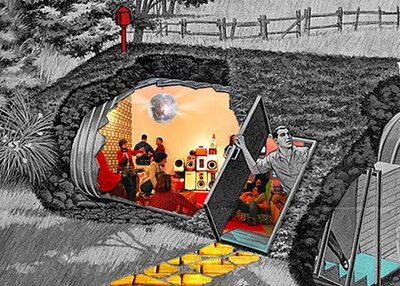
Instant Coffee, Disco Fallout Shelter, 2009, Concept collage

“For both Manet and Baudelaire, can their invention of powerful models of modernist practice be separated from the seductive and nauseating image the capitalist city seemed to be constructing for itself?” [1]

                                                                                                Thomas Crow

At first, I couldn’t understand why Instant Coffee would deep-six itself into a Fallout Shelter. Their motivations for doing this seemed rather obscure to me. Weren’t bomb shelters a thing of the past? The millenialism of the gesture a little late?

A garden today more readily evokes narratives of sustainability. Whatever the state of contemporary geo-politics, there is hardly a nuclear winter on humanity’s horizon.

When I asked IC’s Jenifer Papararo about this she averredthe tale told here was a happy one, it may be “a dark fairytale…but, we are together, even under fallout.”

Ah, survival. So IC sees its future to be much like its past.  Improbably succeeding, setting the agenda. Outwitting and outlasting and the competition. Still here. Ha.

And if the terminus point imagined seems a bit grim, well, artworks are never only about the artists that make them. Implicit to Instant Coffee’s Fallout Shelter project is a larger narrative about the fate of all utopias.

………..

Now clearer that my first impression had been too literal, I remembered that I had always kind of misunderstood what IC was trying to do. And I was not alone in this.

Severed from work done in a specific medium, the zone of representation is a tricky substance from which to hone an art practice. This is especially true if you hardly bother to—or deliberately avoid—differentiating what you do from representation’s more mundane existence as the language of commerce.

Perhaps, too, because of the collective’s proven ability to anticipate the forms of their ongoing relevance which is on pace with wider art world trends, but may be a little in advance of their audience, the Instant Coffee project has always been somewhat misunderstood.

Throwing parties will do that to your reputation; enjoyment, for some reason, is one of the more hypocritical realms of human experience.

………..

The art show as party was the original format of IC-engineered inclusivity. In the collective’s own words, creating event-based exhibitions was a way to “renegotiate…traditional exhibition structures”.  In the process, they jettisoned outmoded medium-specific hierarchies of the more traditional exhibition venues.

Self-reflexive about their own role as facilitators of art experiences, IC recognized the important part that brand identity could play to formalize the collective as a framework of possibility. Cannily adopting the language of globalism, IC staked its territory as a “service-oriented artist collective.”

The claim is funny in itself.   Self-aware and proactive, it lives up to the ideal of truth in advertising, yet partakes of the peculiarly Canadian preoccupation with being nice and non-threatening.

……

To embrace a plurality of practices means to embrace the plurality of artists responsible for them. And at the point of this connective tissue, we find the core Instant Coffee ethic. Not only were collective members party people, they were people people too.

So, for instance, in early incarnations, Instant Coffee’s parties and their predecessors — Jin’s Banana House and the Money House — used the device of the slide show to provide an easy format of participation for all invited, artists and non-artists alike.

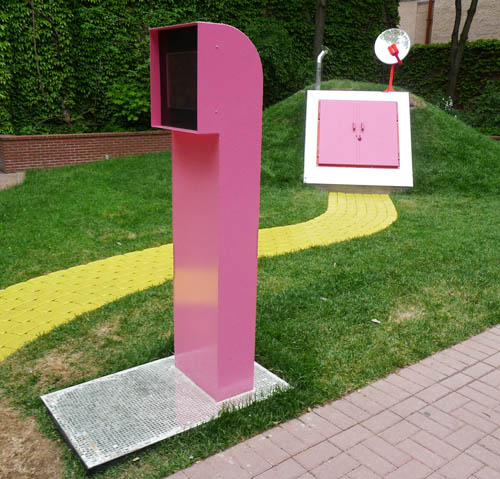
Instant Coffee, Disco Fallout Shelter, Toronto Sculpture Garden, 2009

A practical approach to curating contemporary art, Instant Coffee’s democratizing strategy was also a way to contend with the difficulty of assigning value to artworks. This is a problem, one of positively diluvial proportions, that follows in the wake of post-minimalism.

Increasingly, when de-skilled and neo-conceptual, the possible in contemporary practice has become difficult to differentiate from the necessary.

IC’s brand-defining rhetoric energetically addressed this predicament. Starting with their name, Instant Coffee (i.e., the ersatz version), the collective declared itself a non-arbiter of value. Taste, they contended, distracted “from the fundamental reasons for ingesting either the real thing or its substitute.”

The above excerpt from IC’s manifesto—which has served as the collective’s credo throughout their career—suggests that artworks are a medium of social interaction, and in some cases a mere pretext for it; an idea which has subsequently played out in the contemporary art world at large.

In Instant Coffee terms, the figure of ‘the party’ was the refuge—and the metaphor, perhaps—for the demotion of the curatorial role. To explain the circumstances they saw themselves operating within, the collective chose an ironic voice…

Instant Coffee. No Better Than You… Instant Coffee: it doesn’t have to be good to be meaningful…

…creating a ground ripe for misapprehension; but that, too, was part of the act. Those observers who took the IC party for the main event were missing the point.

Because inventing an art scene that accommodated and gave validity to the activity of your peers was a kind of utopia – symptomatic, maybe, and expressive of a wider condition — but a utopia nonetheless.

………

It is possible to characterize ICs commitment to inclusion as a practice of extreme courtesy, an idea that is fully in keeping with the collective’s ethos. Which is why their Toronto Sculpture Garden project is a departure in more ways than one.

With the inception of the Instant Coffee Disco Fallout Shelter, the question arises as to who now is being served? For the outside observer, a look into the sculpture’s video kiosk reveals the collective to be inside the shelter hanging out; business, for them, as usual.

But six people living cramped together in an underground space what kind of paradise is this?

By choosing to sequester only IC’s immediate members, and by making an artwork out of that decision, it is as if the collective has devolved into real personalities.  They have become the artwork.  It is a hard won conclusion to this story—or at least this chapter of it.  The IC Disco Fallout Shelter probably has always been IC’s inevitable destination.


[1] Thomas Crow, Modern Art in the Common Culture, Yale University Press, New Haven and London (1996) p. 3.

This text was written to accompany Instant Coffee’s commission for the Toronto Sculpture Garden in 2009.

The Whitney Biennial 2004 by Rosemary Heather

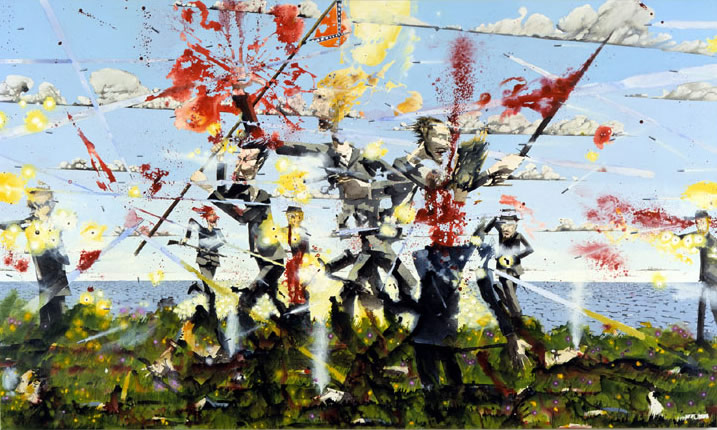
Barnaby Furnas, Hamburger Hill
Barnaby Furnas, Hamburger Hill, 2002, Urethane on linen, 182.9 x 304.8cm

Everyone seems to like this years Biennial. It’s an unusual state of affairs. Typically, the Whitney’s biannual attempt to assess the current state of American art pleases few beyond those artists lucky enough to appear in it. The 1993 Biennial was dismissed as strident and one-dimensional due to its emphasis on identity politics. The 2000 Biennial, complied by six curators, was thought to be weakened by its attempt to be regionally representative.

For anyone who has a stake in the art business, it is fair game to assess the assessment. This means that even if you do not see it, you get the gist. Talk about the Biennial is like a public servce broadcast regarding the show’s curatorial errors and omissions.  As such, the Whitney, like Documenta or the Venice Biennial, provides a heightened example of how opinion is formed in the artworld: from person-to-person, mouth-to-mouth.

The Whitney and audience satisfaction rarely coincide, so its worth asking what the consensus tells about the current cultural moment. Like this year’s Oscars, in which most of the awards went to a single film – the Lord of the Rings, a movie which maybe not uncoincidentally is about a tribe working to rid the world of evil forces – it suggests a not-entirely concious closing of the ranks. It may be a good year for art, and filmmakers from New Zealand, but its proving to be a particularly bad one for the United States.

If this edition’s curators’ have come up with a persuasive account of, as the Village Voice’s Jerry Saltz says, “what the now looks like in art”, its persuasion resides in the consistency of the artistic sensibility on view. The predominant impression given is of an aesthetic engagement with the state of vulnerability, as if the pressure of exterior events had produced an array of delicate art objects in reaction.

Barnaby Furnas’ painting ‘Hamburger Hill’ portrays soldiers in battle, its title referring to the fierce 10 day fight to capture the Dong Ap Bia hill in Vietnam. Both formally and figuratively the paiting edges into abstraction. On first look, the soldiers appare to be of a more distant vintage – maybe the American civil war? – the superimposition of events broadening the theme of the work to war in general. The dynamic of the painting’s moment in time, the sheer brutality of combat, is rendered with surprising fineness. Heads are blown apart in mid-air, the carnage depicted in angular visual harmony, bullets rendered as lines of paint slicing through the air. The effect is the spectacle of war reconciled with the medium of paint, the two-dimensionality of the image made explicit.

The artfulness of Furnas’ work is in keeping with the tone of the exhibition. It is less about war than it is about painting. As the New Yorker’s Peter Schjeldhal noted, everything in the show adheres to the gravitational pull of painting and drawing, the median being line-rendered figuration, as it directs looking and in the delineation of what is to be looked at.

This figurative impulse is evident in a number of the film and video installations. Aida Ruilova’s untitled video work, creates a Gothic ambience through momentary vignettes of actors gesticulating for the camera. Playing out on five monitors that surround the viewer, the scenes alternate absurdist instances of thespian drama. Sounds are made but few words are spoken, the repetition of fragments being reminiscent of Bruce Nauman and in their formal dissolution, the films of Jack Smith. Working within the idiom of filmic collage, in their brevity, the videos aspire to the staus of pictures. , albeit pictures with the fraught psychological content that is implied by their durational tension.

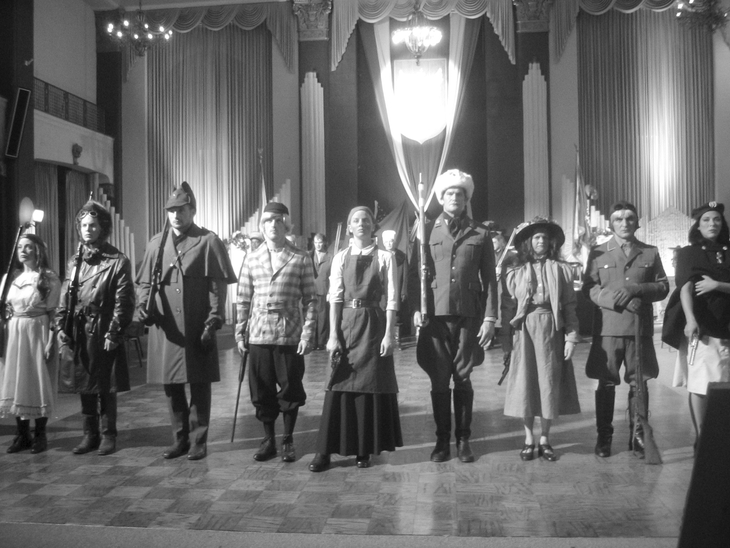
Catherine Sullivan, Ice Floes of Franz Joseph Land
Catherine Sullivan, Ice Floes of Franz Joseph Land, 5-channel film installation 27 min 37 sec, B/W, Sound, 2003

Mining similar territory but with added granduer, is Catherine Sullivan’s film installation, Ice Floes of Franz Joseph Land (2003), which using actors in period-ish dress, portrays a shortform pageant of 20th century European political turmoil. Referencing the traditions of avant-garde film and theatre, the multiple screen presentation evokes the mass upheavals and visceral hysteria brought on by the two world wars.  In contrast to Ruilova’s work, pictorial collage is not in the edits but rather the actors antic stylizations, silent film being a tableau upon which to etch ghostly signs of the past remembered.

In that it is a theatre piece made abstract, Sullivan’s work partakes of the formalizing tendency that pervades this Biennial. As a picture of the zeitgiest, what it tells us is that the art instituion currently favors its traditions of craft, formal ingenuity and hence connoisseurship. What is absent is the conceptualist-pop-minimalist paradigm. For the time being it appears, from the perspective of the influential the American urban centres, art is not obliged to be about politics, the social world, or its own status as object of commodity exchange. Those are subjects better left it seems to less poltically tenuous times. In place of art’s historically important role as mouthpeice or agitator, or vehicle of reflective thought, the 2004 Biennial promotes the value of art as a medium of tactile visual pleasure. As an agenda, it grants artists an autonomy they already had as craftpersons of the articulate visual imagination.

This text originally appeared in BorderCrossings, Volume 23#2 (#90)

Aernout Mik at The Power Plant, Toronto by Rosemary Heather

Aernout Mik, Reversal Room (2001)

Because of their historical significance, the events of September 11th appear to exist in a timeframe of deferred comprehension. It is as if what is required – a god-like point of view – is distinctly unavailable. In light of September 11th, the work of Aernout Mik seems unnervingly relevant. It is hard to imagine artworks that could better encapsulate the historical moment. Constructing a hybrid form of video-installation/sculpture, Mik’s works offer a proto-realist immersion in events that are profoundly ungodly in their perspective.


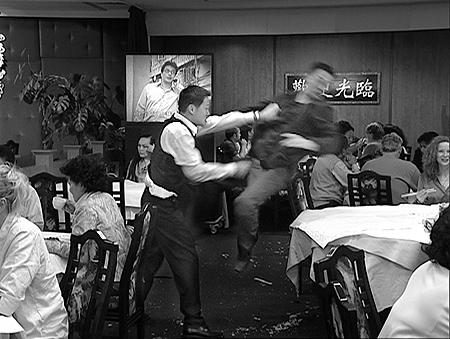
In ‘Reversal Room’ (2001) the artist creates a vaguely plausible Chinese restaurant scenario that one would hope never to be a part of. Portrayed from multiple perspectives, on 5 different screens, a scene of diners eating unravels into inexplicable – if low-grade – violence. Patrons appear little disturbed as three men shove one another, a table is overturned, and then righted again. The video-loop format ensures that this scene is repeated ad infinitum. Through the multiple perspectives represented, Mik violates the convention of representation that allows the viewer to master what they see by placing them at the apex of a singular perspective. The other diners’ implacability contributes to the feeling of unease, a confusion confounded by the work’s sculptural components. Viewers’ enter the piece via a path composed of low-level walls of height equal to the video projections, which are installed on the floor. To emphasize that the space of each video is equal to the space of the viewer, two glass-enclosed rooms abut the projections, one containing a chair, the other a door that goes nowhere. By creating a tension between the sculptural flow of the installation – which surrounds the viewer – and the stasis the videos’ portray, the artist replicates in abstract form the envelope of an incomprehensible reality.


A lack of dialogue or even ambient noise further distances the viewer from the expectation of understanding. The overall effect is that of a curiously mesmerizing kind of estrangement. The work is convincing to the extent that one feels a part of the action. You are, in effect, inside the scene – in a restaurant – and can accept your place within it in the same way that you accept what you don’t know about the lives of the people who surround you. The work absorbs your attention within the problem of what you cannot understand, until you hit a limit of interest and switch back to feelings of indifference. Few works of art so accurately mirror the degree and limits of viewer engagement, a fact that curiously contributes to the work’s credibility. One explanation for this is found in the process the artist uses to create each piece. In a talk he gave at the Power Plant, Mik discussed how his working method strives to create the semblance of the real within the parameters of artifice. Each scene begins when non-actors are given minimal direction within ambiguous scenarios. Real dynamics develop out of play aggression as the individuals become absorbed by the actions they are asked to repeat and the situation takes on a life of its own, regardless of the absurdity of its premise – Mik reports that the scenes tend to fall apart of their own accord after about 50 minutes.


Mik works within the conventions of cinematic realism because it has the capacity to create a reality adjacent to that of the viewer. Within those conventions, he contrives to torment the cinematic moment; in the scenes portrayed, things occur and yet fail to progress. As the 20th century techniques of collage and montage have demonstrated, viewers are more than able to assimilate discontinuous and disjunctive elements to a greater meaning, synthesized within the picture plane or filmic space. Mik’s innovation is to situate elements that are irreconcilable to one another within the scene itself. Periodically, ‘Reversal Room’, itself reverses, changing into a scene of people working in the kitchen of a restaurant, the videos now slowly rotating in a counter-clockwise direction. The situation would be unremarkable but for the presence within it of other people, drinking coffee or sleeping on available shelf space. While most just hang around, some of them follow behind the staff as they work in a somewhat disruptive matter. Their actions as useless as the employees are purposeful; those working take no notice of these literal parasites. Hence what we see seems fragmented against itself, as if two realities were on view, joined together but opposite, reconcilable only in a world beyond sense.


Mik’s artworks succeed because he creates situations that are undecidable rather than implausible.  Plausibility in fact helps the installations overcome the need for explanation as meaning moves from the particular to the general; the present lived as an abstract reality divorced from any awareness of its larger significance.


This text originally appeared in BorderCrossings Volume 21#1 (#81).


The 2006 Sonambiente Festival of Hearing and Seeing, Berlin

Bernard Leitner, Kaskade (2006)

By Rosemary Heather

Shown at a number of locations in Berlin, The Sonambient Festival of Hearing and Seeing took place within the wider context of the 2006 World Cup. This was a circumstance that found its most tangible expression at the Brandenbrug Gate branch of the Akademie der Kunst. Situated next to the Gate, on the Pariser Platz, the Akademie also happened to be at the start of the so-called ‘fan mile’. Running along the tree-lined boulevard that connects the Gate to the city’s Victory Column, the fan mile saw audiences of up to 700,000 people congregate to watch live football broadcasts on giant TV screens and bleachers temporarily erected for the occasion.

Two basic assumptions framed the event. The first is that sound art is somehow intrinsically populist. Acknowledging that it sat at the doorstep of an uncommonly powerful global event, the Akademie offered fans the ‘Public Viewing World Cup Sound Art Lounge’, which bracketed screenings of each game with various sound art events, most of them themed DJ evenings. Presumably the idea was to offer fans a gateway to the appreciation of other types of sound-based phenomena. The second more interesting premise is that the festival would in effect provide the context to enable an experience of the city of Berlin as “an actual work of sound art.” By stating its desire to make a connection between “urban experience and sound experience”, the festival organizers reveal a preference for cultural sounds, as opposed to those found in nature – if one can put it like that? It is a distinction made if only for the purposes of shedding light on a deeper bias: that is, in favour of the synthetic character of urban sound experience and its innate connection to spectacle.

The idea that sound based art may lead on to thoughts about spectacle proves useful when considering the artworks presented by the event. It suggests criteria for evaluating the work that is otherwise lacking in the catchall category of sound art. This is especially true because, as a mode of art making that is about aural experience but is not music, sound art has long operated as a subgenre of modernist art practice. Dedicated to experimentation with volume and the spatial, durational and physical effects of sound, it falls within the larger modernist project of finding ways to give tangible expression to a medium’s formal properties.

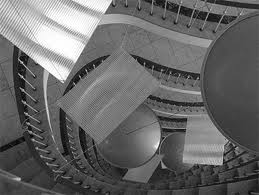
Much of the work presented by Sonambinete adhered to this proto-modernist formula. Austrian artist Bernard Leitner’s Kaskade (2006), a sound installation in a kidney-shaped stairwell, provided one of the more stellar examples of this type of practice. Six tweeter-fitted parabolic bowls mounted in the 12-story stairwell created cascading effects of sound that changed according to where one was standing. As with the best of these types of experiments, the aural effects had tangible physical and almost visible correlates to create a physically embodied experience of the architectural space. However, most of the artworks in this mode presented by Sonambiente were far less compelling, if only because this type of experimentation seems irrelevant to those aspects of contemporary experience that the best sound-based art can offer a critical perspective on.

A large portion of the show was devoted to works of sculpture with a sound component, and this had the inadvertent effect of exposing the weakness of sound art as a category. For what may be good examples of audio art can also be just middling examples of artworks generally. Belgian artist Kris Vleeschouwer’s Glassworks, a+b (2005), consists of 10,000 glass bottles sitting on a mechanized industrial shelving unit. Connected by an ADSL line to five glass-recycling containers around Berlin, the shelving moves every time someone throws a bottle away, displacing the bottles in the gallery so that they smash to the floor. Although breaking glass always brings with it some residual excitement, the work never quite escapes the banality of its conceptual framework: people recycle and accidents happen, whether casually connected or incidental, both are unremarkable occurrences in everyday life.

Like Vleeschouwer’s piece, the German Robert Jacobsen’s Skulpturelles Theater Nr. 4 (2006) easily falls within the genre of kinetic sculpture. A drum and large symbol are balanced on either ends of a microphone stand that hang’s from the ceiling by a single chain. A small fan next to the symbol causes the sculpture to spin languidly but with enough velocity to activate a drumstick attached to its other end. Although there is a nice economy of materials used, and a kind of semantic equivalence between elements achieved, the sculpture is of a type that could have been made any time in the last 50 years. The historical particularities that gave kinetic pioneer Jean Tinguely’s work its playful and bracing relevance belong to his time; as mechanical devices are themselves an almost outmoded format of our interface with the world, art about machines are also look as if they are speaking to us from another era.

Opera for a Small Room, Janet Cardiff and George Bures Miller, 2005

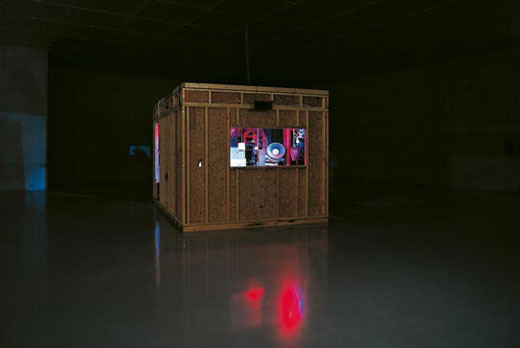
Addressing the disjunction in timeframes that are always a part of the historical condition is Opera for a Small Room (2005) by the Canadians’ Janet Cardiff and George Bures Miller. Viewers look through the windows of to-scale built cabin into an interior filled from top to bottom with old fashioned record players, 24 antique speakers and almost 2000 long playing record albums. Over the course of 20 minutes, a scenario plays out. Animatronic activation of the record players, and light and audio elements evoke a tale about the opera-obsessed individual who retreats to this cabin to play music and reflect on his life. A voice distorted as if speaking through a megaphone, and dreamy as if lost in thought, provides the basic elements of a narrative. Orchestral and pop music, arias from operas, and ambient sound effects such as the thunderous noise from a passing train are layered together to create a fully immersive art experience. So persuasive is the mise-en-scene of this work that one has to stop and remind oneself that what they are watching is happening but is not actually there; no one sits in this cabin playing records. Existing in the imagination in some melancholy Canadian back wood, far from the urban milieu that creates opera and even history, the work sat in fact in an art gallery in Berlin. The Sonambiente festival provided no better example of our susceptibility to the seductions of virtual experience. Perhaps it was the work’s dislocation of locales and implied historical timeframes (record albums are a thing of the past) that helped to make tangible the synthetic nature of the world it creates. The artists had no need to avail themselves of futuristic metaphors to make visible the fantastic virtual character of the reality that comprises much of contemporary experience. Instead they made use of a slight historical time lag to give sharp focus onto the world of the present. Creating an awareness about not the content of that experience but the form that enables its expression is what made this work most relevant to the spectacle of the World Cup that was occurring all around it. In such a large and varied event as Sonambiente 2006, it might seem odd to say that one work more than all the others fully met the event’s ambitions to provide a critical context for a sports event with an unprecedented media reach, but this would only be to point out just how elusive critical reflection on the present can be.

This text originally appeared in The Senses and Society Vol 2, Issue 1.

The 2006 Gwangju and Singapore Biennales by Rosemary Heather

Jun Nguyen-Hatsushiba, Memorial Project Waterfield: The Story of the Stars, 2006

It is not surprising that an artwork could suggest a metaphor for the global explosion of biennales. Korean-American Michael Joo’s prize winning work Bodhi Obfuscatus (Space-Baby) (2005) at the 2006 Gwanju Biennial is a case in point. A gold-painted Buddhist statue sits in a darkened room surrounded by a latticed grid of webcams; surrounding this, mirrors and flat screen TVs mounted on poles refract and reflect the images relayed by the tiny cameras’, but what the viewer sees is indistinct. Fragmented views of the statue’s face glow with the sickly green hue typical of real time images when transmitted on the Internet. If Joo makes the somewhat obvious point that the web redefines our experience of time and place, he also encapsulates an idea about the biennale phenomenon: cultural translations are often murky but the mechanisms of their transmission remain the lingua franca of globalism today.

This is true of modern communications technologies and the biennial format, use of the former sometimes being the best way to standardized an artwork in the international style. There is a kind of depersonalized universalism inherent to professionalised art practice that allows for the expression of local concerns. As in Joo’s work, the meeting of East and West, and past and present, was a central focus of the Gwanju Biennale. This was also true of its counterpart in Singapore; which by cross-promotional design had opened just prior to Gwanju, and which put forward a set of interests that were overall perhaps less coherent but more interesting for their relevance to the Asia-Pacific region.

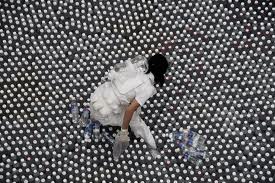
If Gwanju was the stronger exhibition, it also was the more conventional, although this impression may simply be a reflection of its site. All the works in Gwanju were shown in one huge multileveled venue, whereasSingaporeused multiple locations, many of them places of worship, giving a greater sense that the show was knit into the fabric of the city. Gwanju also presented a higher proportion of artists known on the international circuit. The Incidental Self II (2006) by the collaborative duo Elmgreen and Dragset featured hundreds of small framed photographs all in some way referring to the gay lifestyle. Tepid and banal, this commissioned work was also presumably not intended for jaded Western eyes as its primary audience. The Italian Monica Bonvicini offered What Does Your Wife/Girlfriend think of your Rough Dry Hands? an ongoing project consisting of a questionnaire the artist has been conducting with construction workers in various cities and languages since 1999. Presenting the hand-scribbled answers in rows papered along a corridor, the work looks at preconceptions about gender. Like that of Elmgreen and Dragset, it has a domestic scale that is appropriate to its sociological conceit; inadvertently, however, this exposes the slightness of Western preoccupations – and specifically identity politics – when compared to the weight of issues informing works by their colleagues in the East. Chen Cheieh-Jen’s spectacular and disturbing Lingchi: Echoes of a Historical Photograph (2002) is a multi-screen reconstruction of an archival photo from the early 1900s. Using the techniques of cinema and the actual photograph it elaborates a scenario of extreme cruelty: execution by mutilation. The rhetorical devices of film mean that you infer the violence more than you see it. Balancing the aestheticisation of the act with its analysis, the artist provokes a range of questions, not least the intrinsic connection between visual representation and power. On an outdoor walkway between the two sides of the Biennale building, viewers of Jun Nguyen-Hatsushiba’s Memorial Project Waterfield: The Story of the Stars (2005-2006) look down one level onto a field of 26,000 empty water bottles. Working in this area, which is likened by the artist to a “prison courtyard”, white clad performers drink water from tanks strapped to their backs and then release it when they can into the plastic bottles. Their urine becomes the paint of the picture plane, the bottles being slowly accumulated and arranged into the yellow stars of the Vietnamese flag. The performers looking like nothing so much as labourers in a rice field, the artist suggests that the colonial struggles of his country continue: the containers of their body fluids bear the labels of the bottled-water brands Aquafina and Desani, subsidiaries of Pepsi Co. and Coca Cola, respectively.

Bani Abidi, Shan Pipe Band Learns Star-Spangled Banner, 2004

Artworks inSingapore’s first Biennale also focus on a globalism that beats a path to your door. As with Nguyen-Hatsushiba’s work, global economic forces are identified with their most notorious ambassador; America’s influence is as large as the resentment it appears to inspire. In the large screen projection, The White House (2005), the Korean artist Joonho Jeon digitally animates an image of himself whitewashing out the windows of 2100 Pennsylvania Avenueas it appears on the back of the US 20 dollar bill. Like the strain of anti-Americanism running through both exhibitions, what the current US administration doesn’t know may be hurting them. In Shan Pipe Band Learns Star-Spangled Banner (2004), the Pakistani artist Bani Abidi tells melancholy a story on two screens. On one, the eponymous brass pipe band struggles to master the American anthem; on the other, one of their members gets dressed into a uniform with the red tunic and gold epaulettes of the country’s colonial past. The Chinese artist, Jianhua Liu powerfully expands on this theme to the point that it becomes not a specific but a universal indictment. Exhibited in a former Methodist Church, Dream (2005-2006) is a large-scale sculptural installation. Broken ceramic casts of consumer goods ­– such as computer keyboards, light bulbs, guns and toy airplanes – litter the floor in thousands of pieces. Seen from the perspective of a raised viewing platform, the fragments cohere into the image of a space shuttle – an elegant and harrowing expression of the idea of the catastrophe that is modernity itself.

Singapore is a city-state which is famous for its unusually high degree of social controls (e.g.: the no chewing gum edict, like decriminalized marijuana you can use it but its sale is against the law). It was a situation of unknown restrictions, against which the Biennale’s curators played a fascinating game of low-grade political provocation. Swedish duo Bigert and Bergstrom’s video work, The Last Supper (2005) looks at the American tradition of serving condemned men a last meal of their choice. A rather facile news-magazine type documentary, the work nonetheless made the ironic cruelties of the custom tangible. It also served to highlight the tensions inherent to the ambitions ofSingapore’s Biennale. A peacefully multicultural society,Singaporeis also known for its somewhat relaxed attitude to the death penalty. In this context, The Last Supper took on an added resonance, foregrounding other possible views on the topic than the one the country practices as a cultural norm.  Although showing the work did not exactly constitute an incident of political dissent, its toleration shows how artworks can help to expand the realm of thought. Even if this toleration was in the name of what was speculated to be one of the Biennale’s larger goals, to create the impression of the liberal environment in advance of a conference of the IMF, its knock-on effects are still positive.

This text was originally published in C Magazine, #92.

Of Mice and Men: the 4th Berlin Biennial for Contemporary Art

Paul McCarthy, Bang Bang Room, 1992

The 4th Berlin Biennial presents art about death, decrepit sculptures and rancid dreams. Tacitly it poses the question: “Is this a world you would want to live in?” And gives the answer: “Too bad, because you already do.” Or as the title of one of the works in the exhibition so aptly puts it: “I cannot forward or rewind this state of being, this aged resign…” (mixed media installation by Sebastien Hammwohner, Dani Jakob and Gabriel Vormstien, 2004) Charged with the task of putting a gloss on contemporary art practice, international art expositions rarely risk making a statement as strong as this – or at least rarely one that is so pessimistic.

Curated by Maurizio Cattelan, Massimiliano Gioni and Ali Subotnik, who are also responsible for the various initiatives of the Wrong Gallery, the Biennial lived up to the trio’s reputation for defying expectations, but true to form, not in the way they were expected to do so. Other Wrong Gallery projects include a Manhattan exhibition venue of the same name that consists only of a street front space confined to the dimensions of its doorframe, and a 1:6 scale replica of the same that is available for purchase. Like the work of Cattelan himself, the Wrong Gallery’s modus operandi is to tweak conventions within the well-established confines of contemporary art practice. And indeed the 4th Berlin Biennial started out in this mode. Expanding the Biennial’s boundaries in the year leading up to the event, the three conducted bi-weekly interviews with artists in the Berlin listings magazine Zitty, put together a photocopied tome called Checkpoint Charley of unauthorized reproductions of all 700 artists they met with who were not included in the Biennial, and in September 2005, began presenting a series of exhibitions, using guest curators, in a space they called The Gagosian Gallery. Since the real Gagosian Gallery is well known and exists elsewhere, and the art world being the small ecosphere that it is, everyone could experience the fun of being in on the “joke.”

These projects did much to raise the profile of the event and the Biennial benefited greatly from its most inspired innovation: the presentation of the entire exhibition on a single street, Augustrasse, in the centre of the former East. Home to the KW, or Kunst-Werke Institute for Contemporary Art, the major non-collecting contemporary art venue in the city, Augustrasse also has a preponderance of one of the most distinctive features of Berlin, disused buildings. Spaces richly evocative of the city’s complex and troubled history were put to powerful use by the curators. Naming the Biennial Of Mice and Men, after the Steinbeck novel (the phrase is taken from a poem by Robert Burns) signals a narrative intent for the exhibition: like the street of Augustrasse, it has a beginning and an end – and it tells, however tangentially, a story. Similarly, the art presented in the show is for the most part figurative. The use of the street and the in some cases almost derelict sites and were clearly intended to compound this impression. The romance of seeing promenading crowds on opening night combined with cold wet March weather to reinforce the overriding tone of much of the work in the show, which was dark and gloomy; by forcing its audience to move between venues on the street, the curator’s created a fitting metaphor for the exhibition’s worldview: a biennial about prevailing conditions.

More than one person I spoke with commented that the show’s narrative emphasis had its most obvious manifestation in the curators’ preference for so-called “mannequin art,” of which there seemed to be a lot. Mannequins, dolls and marionettes, defenseless as they are, lend themselves to abject statements, perhaps because of the ease with which they are dismembered, or otherwise abused. The Glaswegian artist Kathy Wilkes’ mixed media installation, Non Verbal (2005) provides a good example of this tendency. In the centre of a selection of disparate scattered objects, a black manikin stands mid stride, her face obscured by a small rectangular painting that is attached to it. The canvas is smeared by a few disconsolate brush strokes of color, its placement where the sculpture’s face should be turning it into the very image of angry inarticulateness. Wilkes’ work is redolent of self-reproach, suggesting that in the 21st Century painters and sculptors of the human figure move in dicey territory.

If this is an ulterior thesis of the exhibition, it is one that the artists, in effect, wrest back from the curators. For the context in this Biennial, especially for those works presented in the Former Jewish School for Girls, is problematically dominant. Distrust of the figure could be considered a theme in the work of American sculptor Rachel Harrison, but it’s a distrust leavened by humour. Harrison refracts sculpture through its contemporary practice as installation, bringing the figure back into the work through the use of pop cultural references. But shown in the Girls’ school, with its peeling paint, dust and faded graffiti, her trademark sculpture’s combining pink insulation foam, plywood and figurative elements – in this case a typewriter – gets dragged down into the firmament of the venue’s pathos-laden ambience.

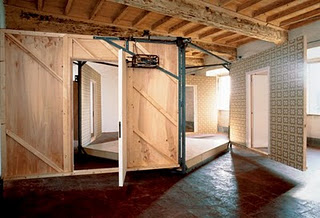
Other works in this venue fair better, if to the perhaps questionable end of creating a macabre atmosphere. Markus Schinwald’s Otto (2004), for instance, is a life-sized Marionette that sits slumped in a chair. Guy wires are visible but Otto (get it?) doesn’t work. Similarly mawkish, if haunting, is the late Polish artist, Tadeusz Kantor’s The boy in the bench (1983), in which a life-sized child doll sits at a 19th century wooden school desk. More interesting and genuinely unsettling is Bulgarian artist Pravdoliub Ivanov’s Territories (1995/2003) a mud encrusted series of flags running along a hallway on a the school’s first floor, or the Russian Viktor Alimpiev’s Summer Lightings (2004) a video consisting of tight shots of young school girls enigmatically drumming their fingers on their desks, intercut with distant glimpses of summer lightning. Most spectacular in this setting is Paul McCarthy’s Bang Bang Room (1992). Flush with a platform, the four mechanized wallpapered walls of a room, each with its own door incessantly opening and banging shut, lever out to constantly make and unmake a room. The action of the walls is slow enough that viewers can safely step on and off of the platform, but the effect of the work is manic and unsettling just the same, much like the Biennial itself.

 This article was originally published in Border Crossings #98 June 2006