Knowledge Held in Suspense: A Conversation with Kerry Tribe

There Will Be _______
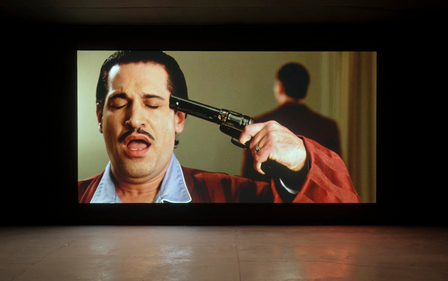
Kerry Tribe, There Will Be _______, 2012, Installation view, Courtesy the Power Plant / photo Toni Hafkenscheid

Toronto-based writer Rosemary Heather spoke to Los Angeles-based artist Kerry Tribe during her solo exhibition Speak, Memory at The Power Plant (24 March – 3 June 2012).

This excerpt is part of a longer conversation, most of which took place in a taxi on the way to the Toronto airport. Heather notes, “Setting out to do this interview, I devised a theory of how to understand Tribe’s work. As often happens, however, our conversation overtook any hope I had of getting Tribe to commit to a particular hypothesis about her art practice – it defies easy encapsulation. This made talking to Tribe about her work much like the experience of engaging with it: the process is an end in itself.”

ROSEMARY HEATHER: One way that I thought of talking about your work is through the lens of Here & Elsewhere (2002). You remade a piece by Jean-Luc Godard, in which he interviews children by asking them metaphysical questions. Can I locate that as a framework for your work as a whole?

KERRY TRIBE: The idea of remaking something?

RH: Yes.

KT: I don’t know if I would think of it as remaking so much as returning. At UCLA when I was a graduate student I organized a series of screenings — a 24-hour unofficial film festival — because I discovered a little pocket of money in the graduate program that allowed me to rent some titles.

I had never seen Godard’s television series France/Tour/Détour/Deux/Enfants (1977) and a friend recommended it, so I screened it. I just screened the first two episodes. I was really struck by what happened when this big father of avant-garde film and video (who was a Maoist and tough and rigorous and making images that were often difficult to look at) set out to interrogate this little girl and little boy about heavy political and philosophical issues. The little girl’s responses, which were down-to-earth and sometimes confused, were totally compelling to me. What was it about the presence of this little girl? There’s one point in the video where her face appears — her name is Camille Virolleaud — and over it is the word “Verité” in big letters. And I thought: There’s something accurate about that. We all want to identify with this simple, you might say, Cartesian subject position that says: Yes I know. I’m here. I only exist once. I walk through my life. I understand things or I don’t, even if we know better. I mean, even if feminism, psychoanalysis and critiques of capitalism tell us that this simple belief in one’s own self-identity, agency and autonomy is inadequate, it’s nevertheless compelling. I wasn’t so much interested in specifically remaking that Godard video, or in pointing directly back to it but rather in trying to see what would happen if some of those questions were asked again. At one point, Godard asked Camille about her room. It’s very bright and it’s clean, and who cleans her room? (I’m paraphrasing.) And she says something like either her mother or the housekeeper does it. And he asks, Well who pays your mother to do this? And she thinks probably nobody does. Do you think maybe The State should pay her? And, Is The State a man? Or a woman? And so on. It’s great stuff.

And these are questions that continue to be urgent. And yet in the end, it didn’t seem viable to do that in 2002. When I tried to work the explicitly political questions into the script it just fell flat. It was actually dreadful.

RH: Can you elaborate? What does your piece look like? Read the full interview here.

This interview was commissioned by the Power Plant, Toronto. A longer version will be forthcoming.

More info about Kerry Tribe can be found here.
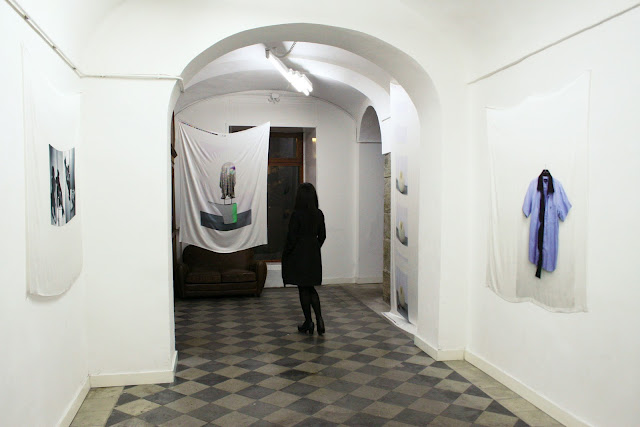
Image Chain Reaction

Flip
Flip Project Space, How to Make a Delicious Tea, ARTISSIMA LIDO, 2011, Eloise Hawser. Martin Soto Climent. Patrick Tuttofuoco. Per-Oskar Leu

We understand what kind of knowledge the photographic image makes available to us. We know about its status as copy, and the technologies that produce it. We intuitively know that an image isn’t real precisely because it is reproducible. So why try to make all of this visible?

Flip’s How to Make a Delicious Tea has an answer to this question, or more correctly, offers a sophisticated articulation of the circumstances that provoke it. A predominate feature of contemporary experience is the dynamic of image proliferation. Like the light of the sun, images may now elucidate the world in such an all encompassing manner that they defy our ability to see them with any clarity. Flip finds a way to embody this dynamic through an ongoing collaborative process. Working with a group of artists, they produce a composite artwork. How to Make a Delicious Tea creates a material analogy for the image and the way today it is more process than singular entity.

Located nowhere in particular How to Make a Delicious Tea exists as versions of itself that take shape according to the context within which it touches down. Working with pre-existing artworks, the project turns them in to images that are printed onto silk for display as an art exhibition.

If every image now exists as a process, this is because images now exist as expressions of the network that circulates them. Reproducibility and connectivity turn the image into endless versions of itself, a veritable chain of impressions with slight variation. Flip uses silk to perform a kind of transubstantiation, one that enacts a mordant commentary on the many potential layers of a photograph’s insubstantiality.

Somewhat intimate, almost embarrassing to the touch, silk could be said exceed the boundaries of its materiality. It is substance with a suggestion of vaporousness at its edge. Similarly, the best artworks slip beneath the boundaries of attempts to define them.  And photographing artworks will always exacerbate the problem, in the guise of saying something definitive. Combining these elements, Flip creates an analogy for the essential contextlessness of digital image reproduction. Silk is used here is not so much like the printed page as the fathomless space of the internet.

How to Make a Delicious Tea makes silk into a self-reflexive medium. Silk transforms mere image, so divisible, back into indivisible luxury object. As a material, silk will distort the image reproduced on it. It drapes with specificity, and so undermines the original’s reproducibility as copy.  It’s a kind of triumph, to halt the infinite slippage of the digital. But the respite is only momentary. Photographed, the artworks start to circulate again.

Rosemary Heather

The text was commissioned to accompany Flip Project Space’s How to Make a Delicious Tea II by Art Metropole

More info about Flip Project Space can be found here.

Annie MacDonell: Sunset Cinema

Annie MacDonell, vaudeville models
Annie MacDonell, Shea's Hippodrome, (1914), cardboard diorama, 20 x 20 x 30 in., from the series 'Vaudeville Interiors'

Recent history tells us that the experience cinema offers is excessive. The belief that it is necessary to go to a theatre to see a film is already a thing of the past. Cinema was an industrial innovation. Based on an economy of scale, the commercial premise of the business is that each member of its audience possesses a quotient of popular taste that the industry can replicate and nurture in each new film it devises. The basic assumption of the format used to be that this mass psyche could be unlocked by a film’s presentation in a setting of anonymous camaraderie; in other words, the belief was that people would want to watch movies together in the dark. But these conditions now appear to be unnecessary, or so the popularity of sub-par viewing formats like YouTube and iPod movies would seem to suggest.

In her exhibition, The Castle and other works, Annie MacDonell looks at this history from the perspective of today, a moment when cinema is being eclipsed by newer formats of entertainment. Giving depth to this view, her show looks beyond film to its origins in Vaudeville. Consisting of remnants from this past, MacDonnell’s exhibition offers insights into the wider cultural demands embodied by these continuities, suggesting that the need for diversion, for a parallel realm of spectral distraction, exceeds any of the formats invented for its possibility. It is this need’s ability to conjure up the means of its realization, if not an explanation of its source that MacDonnell’s show evokes..

In The Castle (2006) a sculpture of a chandelier sits on the floor of the gallery as if it had recently crashed there, or, in more grandiose terms, had somehow fallen to earth. A non-functioning replica, the chandelier illuminates nothing except protocols of ornamentation to which we are no longer accustomed. Ornamentation was, however, once thought of as an important aspect of the movie experience; film theatres were after all referred to as “palaces.” This connects the chandelier to MacDonnell’s Untitled Vaudeville Models (2006), which MacDonnell built in collaboration with Rob Shostak. They consist of three scale models of Vaudeville theatres in Toronto, all of which date from the turn of the 20th century. That Vaudeville theatres tended to be turned into cinemas, which are themselves now on the wane, points to the larger theme of the show. The condition of spectatorship was once located in spaces built specifically for the purpose, but it is less and less dependent on physical circumstance.

In The Castle (2006) a portly man in a video projection is seen falling through space. He stumbles down the stairs and then the action is magically reversed. The cycle repeats. By looping the video, the artist arrives at a kind of perpetual slapstick. The artist abstracts the base humor of Vaudeville, its broad physical comedy, to evoke the idea of entertainment itself. The man’s appearance reinforces this impression. Middle-aged and out of shape, his mustachioed visage evokes an archetype: not a leading man or captain of industry but rather an avuncular figure of fun, like Stan Laurel or Fatty Arbuckle, familiar from the early days of the entertainment industry. A likely inhabitant of both smoking jacket and smoking lounges, he evokes the pathos of manhood past its prime, still the beneficiary of male privilege but some years beyond the ability to make meaningful use of its powers.

Art exhibitions tend to consist of discrete objects ¬– whether of the thing itself or of some form of its representation – presented in meaningful combination. The custom is for exhibitions to occur in a definite space, or make reference to that space, which is known as “the context.” The placement into this context of any artwork that takes the form of a real entity (as opposed to an abstraction of such) should be understood as having been removed from the circulation of utilitarian items for a reason. In the same way that the art gallery is more than just a space for the exhibition of objects, the artwork is both a thing in itself and what it represents. The artwork in itself refers to every possible realization of the idea of art, especially those that have already occurred; and the entity it represents refers to the wider world of meaning from which it derives.

Although susceptible to many definitions, the artwork’s ability to incorporate within itself multiple dimensions of significance means that it always in some sense functions as a synechdoche: the work of art or the art installation is always the part standing for the whole. Writing about literature, the critic Terry Eagleton discusses how the reader of a literary work “unconsciously supplies information which is needed to make sense of it.” “All literature is understated” Eagleton notes, “even at its most luridly melodramatic.” The same could be said for art. MacDonell’s show makes use of the synechdochic power of the artwork, and also makes an exhibition that is about this synechdochic power. The artist doubles the synechdochic resonances of her show in the sense that it is about just how little it is that we need from the real world in order for us to imaginatively exist in the spectral realm, and for that realm to fulfill the wish that we could exist there.

If early cinema took the basic elements of Vaudeville as its starting point, this is in part because film’s illusionistic qualities were so well suited to the art form’s vulgar comedy of physical mishap. The idea that someone can fall without getting hurt, the basic fact that the moving image finds its origins in release from the consequences of the physical, suggests a number of things: that entertainment is strangely predicated on the misfortune of others, and, more broadly, that the cinema fulfils a wish that the physical world could be more benign than it is. This connects MacDonell’s fallen chandelier and tumbling man to another work in the show, Sunset Signature Lounge (2006). Housed inside a small freestanding cabinet with room enough for only one viewer at a time, the work features a slide-projected image of a sunset as seen from the 96th floor of the Chicago’s John Hancock tower. One of the tallest buildings in the U.S., a centerpiece in a city famed for its architecture, the building’s Signature Lounge provides Chicago’s citizens with a cocktail hour ritual. The image was shot at twilight in the lounge, a bar that features floor-to-ceiling plate glass windows. Looking at the phosphorescent and warm transitional hues of the sun as it sinks below the horizon offers the best accentuation of this, as it fuses the experience of the sunset with its image. It is, as MacDonell comments, “an intensely American experience, ” the impact of which is such that the lounge patrons often break into applause upon viewing the sun’s final curtain, so to speak. It is as if each floor of the John Hancock tower was only the premise for the next one, and this continues upwards until the building was tall enough to create the perfect platform for the viewing of each day’s end., The floor-to-ceiling plate glass windows were installed to more perfectly frame the experience, transforming it all into a two-dimensional picture of itself. Finding that cinematic desire lurks even in aspects of the built environment, the artist points out just how eager we are as a culture to step off into the virtual.

MacDonell designed the installation so that the sound of applause, which is preceded by a soundtrack of ambient noise and soft chatter, subtly permeates the exhibition as a whole. If not actually creating an immersive experience for the viewer, the sound in the exhibition points to the aural aspect of spectacle; its aim is to be thoroughly persuasive. To undercut this, and to indicate that what she is offering is not spectacle per se but the means for a critical reflection on its powers, the artist positions the slide projector outside the cabinet, which itself is left unfinished, and leaves the work’s speakers, amplifiers, and their connecting cables and electrical wires exposed on its top.

The artist’s suggestion about how easily natural phenomena are incorporated into an overall cultural preference for spectacle connects to the show’s wider idea that our culture is constantly looking for the means to make our reality into something that is more free of consequences and more under our control than it is or ever could be. This idea applies especially to how we participate in spectacle today, which because of the Internet and portable digital devices extends far beyond the physical space of the movie theatre. This suggests that it’s not the cinema that is excessive but only the cultural desire for its pleasures. If this fact is more apparent than ever, being able to recognize it still tell us little about what it means. Full participants in this virtual onslaught, cinema and other forms of spectacle have only a weak ability to reflect on the phenomenon. Artworks, on the other hand, exist to be reflective, and in the process can reveal an entirely new dimension to, for instance, the fun Vaudeville finds in misfortune.

Rosemary Heather 10.15.06

This text was commissioned by Gallery TPW to accompany Annie MacDonell: The Castle and Other Works, October 26-November 26, 2006.

More information about Annie MacDonell can be found here, here and here.

Brenda Goldstein’s Hereafter

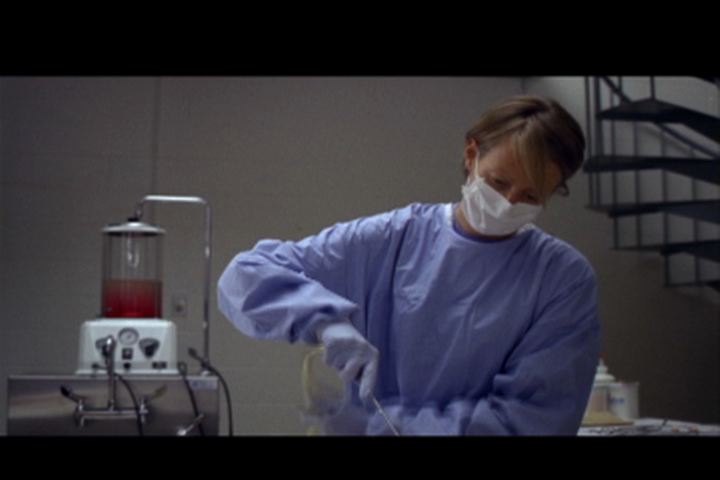
Brenda Goldstein, Hereafter, 2010, 35mm film installation
Brenda Goldstein, Hereafter, 2010, 35mm film installation, looping 35 mm film, sandblasted plexiglass, slide projector.

Thinking about Brenda Goldstein’s Hereafter begins with an absent body. The work consists of a 35-mm film loop portrait of a nameless woman preparing an unseen body for burial, presented alongside a slide projection composed of quotes from various people about the experience of death. Everything you see in the film is clinical, austere; the only element commanding a visceral response to the subject matter is a jar of red liquid, embalming fluid, visible on the right of the screen. The work constructs a composite representation of the idea of death, within which the only warm body present is that of the viewer.

Goldstein structures her installation so that one can view the film loop and the slide projection inde¬pendently. Complementing this schema is the work’s third element, its “soundtrack,” which is the ambi¬ent noise made by the slide and film projectors. Hereafter’s sombre topic might cause its audience to disregard this sound in the room; to hear but not hear it. Rather than using recorded audio to reinforce thoughts of death, nailing down that signifier, Goldstein instead allows the ambient sound to enhance one’s experience of the space. Like a mechanical version of sentient breathing, the sound made by the projectors is a reminder for the viewer, however subtle, of their own presence. In this context, the instal¬lation’s audibility also works as a reminder of one’s own mortality; one reason why viewers may be less inclined to “hear it.” As well, Goldstein’s use of sound points to other ideas, implicit to the installation and beyond its ostensible subject matter.

Hereafter has no single focal point because the artist’s intention is to create an immersive environ¬ment; one that, through use of shifting points of interest is, arguably, more actively constructed by the viewer than would be the case if it was presented as a film. Between the two types of presentation, seated film viewing or walk-in installation, there is only a fine distinction: it is debatable whether one or the other provides the more “immersive” experience. Differing means of creating that experience is more to the point.

One inescapable precedent for Hereafter is Stan Brakhage’s The Act of Seeing With One’s Own Eyes (1971). The film is shot in a morgue and documents a number of autopsies (the title is a literal transla¬tion of the Greek word, autopsia—to see for oneself). Brakhage’s immersion is more confrontational. By viewing the film, one is witness to an experience, that of seeing human bodies dissected, that few would actively seek out. Brakhage made the film as part of his larger project, the exploration of a number of themes that were central to avant-garde film at the time. Over his career, he made a slew of films in which various techniques of abstraction—such as variable focus, asynchronous sound, scratching and painting on the negative, and disjunctive editing—were used to create a poetics of perception. All of his works were predicated on the idea that the film material itself constituted a form of embodied perception and this is perhaps the reason Brakhage worked so hard to make its materiality evident. And if sight is an analogy for being, looking at the body as a starkly mortal entity gives this poetics its ultimate form of expression.

This digression into the world of 20th century avant-garde film is necessary because of what it tells us about the different set of assumptions guiding Goldstein’s work. For one, it gives us a clearer understand¬ing of the 21st century’s comparatively diminished faith in the visual. Hereafter’s visual component is diffused by the atmospherics of the text elements that accompany it. And it suggests that while intuitively a filmmaker like Brakhage understood the visual to be an aspect of embodied experience, Goldstein can make no such assumption. Her concern instead is to construct a different kind of body, one that is, among other things, a decidedly non-poetic being. In addition to the viewer in the room, the body Goldstein summons is the one that is typically elided by technologically mediated existence—especially because liberation from bodily constraints is the specific form of satisfaction mediation can offer. You could argue that locating the body is always the goal of the immersive artwork. It is why such works require an active viewer, one who can orchestrate an installation’s material synthesis simply by walking into it. (It is also the reason why the term “viewer” now reads as something of a misnomer; artworks today solicit a much more sophisticated kind of intelligence.) In the end, Hereafter is less about dead bodies than it is about living ones. The further we as a culture move into the everyday time and space travel of virtual technologies, the more we need to be reminded of who we are; sentient beings, limited and mortal after all.

—Rosemary Heather

This text was commissioned by Mercer Union Centre for Contemporary Art, Toronto in conjunction with the 23rd Images Festival, 1-10 April 2010.

More info about Brenda Goldstein can be found here.

Meat dress manifesto: On the contemporary irrelevance of contemporary art

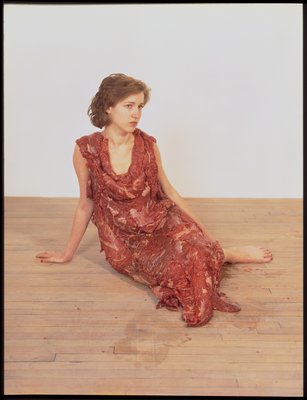
Jan Sterbak, Meat Dress 1987
Jan Sterbak, Vanitas: Flesh Dress for an Albino Anorectic, 1987

By Rosemary Heather

I happened to find myself in Grande Prairie, Alberta. I had never heard of the city before. In Canada most urban life hugs the border with the United States. Canadians commonly refer to this border by its latitude: the 49th parallel. Grande Prairie sits just north of the 55th parallel. If you were driving from Montana, it would take over 12 hours to get there. Call me ignorant of geography. I didn’t know Canada had cities that far North.

I live in Toronto and it cares little about what happens in Grande Prairie; the centre of Canada’s media universe, news emanating out from here barely mentions the place. For the people of Grande Prairie, I’m sure the feeling is mutual. After all, Grande Prairie is booming. In part due to the dirty economics of the Tar Sands, Alberta is an exceedingly prosperous province.

Driving the streets of Grande Prairie, you can draw a map of Globalisms’ franchising coordinates. Starbucks is one outlet we are happy to find. Good coffee is progress, says my companion. Context is everything. In the absence of better coffee, Starbucks is good. Like the prow of a ship breaking ice, Starbucks opens up new markets for capitalism while setting better standards for coffee taste. This is the progress we like, one that caters to our urbanite selves. We can thank the Tar Sands for this, along with its disastrous environmental effects. History is always experienced as a lived contradiction.

At lunch, I read a BBC story on my phone about Lady Gaga. How does she do it? Various experts weigh in on the Gaga phenomenon. Like Starbucks, I don’t doubt that Lady Gaga is popular in Grande Prairie. Shuttling through stations on the car radio I hear Bad Romance and then Classic Rock. I want to understand the changing landscape of mainstream culture. In Grande Prairie, I find myself in the changed landscape itself. To me, it looks like a city that has popped up overnight, the spores of Globalism taking root in the form of big box stores. Seeing duplicates of chains I know from elsewhere makes Grande Prairie a place I both can and can not recognize. Thriving, it still seems to barely exist. It is simulacral, to use that old word.

At Starbucks I had picked up a flyer for a local historical society. This is what culture is in Grande Prairie, I think: Lady Gaga and historically-accurate reconstructed log cabins. Grande Prairie upends what I thought I knew about the world. Globalism redraws the map of the globe, and Gaga looms large on this horizon.

At the 2010 MTV Music Video Awards, Gaga wore a meat dress. Thinking about this, I make the assumption it augurs something new. Not the meat dress itself – that is an artwork made by Jana Sterbeck in 1987 – but the meat dress as an object of mainstream consumption. Claiming to be an artist, Gaga uses the shock tactics of the avant-garde, but not to any avant-garde end. As John Ashbery wrote in 1968, “the artist who wants to experiment [today]…is now at the centre of a cheering crowd. Gaga serves a structural purpose, not unlike that of Starbucks coffee.

Writing about the Pepsi Corporation in the New Yorker, John Seabrook notes that Pepsi products have a dual nature. Every bag of Doritos offers flavour combinations that are the same every time, fused with something more abstract. As Seabrook says, “PepsiCo grafts taste with desire.” The same could be said for any contemporary brand. In Gaga’s case, she embodies the culture social media makes. Gaga is the best example of its aspirational narrative: self-transformation is just a costume change away. This is why the music she makes can be merely adequate.

Art and pop culture are like languages. The parts of speech remain the same, while meaning is generated through the logic of substitution. If history’s substitutions always move from tragedy to farce, Gaga is definitely the farce. She wore the meat dress for the purposes of a photo op, nothing more. It was but a salvo in the arsenal of costumes changes she uses to keep her publicity machine churning. When Jana Sterbeck put the meat dress in an art gallery its point was decay. Not an irony for which Gaga can spare the time.

To claim pop cultural novelty is new is merely to betray my own biases. I am naive like every Liberal Arts student. Study of the modernist canon defines the scope of my formal education. Figuratively, modernism is reducible to clean lines and white spaces; pure abstraction and an absence of embellishment at one time signified a break from the past. It’s a legacy that lives on in the white cube of contemporary art today. And seeing the world from inside the white cube nurtures certain assumptions about what’s important.

Lady Gaga
Lady Gaga, Meat Dress, Designed by Franc Fernandez and styled by Nicola Formichetti, 2010

The problem modernism always had with kitsch is that it is not remarkable to be a fan – and fans are what popular culture creates. Today, it is unremarkable to be on Facebook; most people participate in the new culture the digital era creates. At the same time, Facebook is not merely the contemporary version of an older form. Facebook, like the internet, is genuinely new, in the way that collage and television once were. This suggests is that nowadays it is more notable to be on Facebook than it is to have an interest in modernism and contemporary art. In the popularity of Lady Gaga and Facebook and Starbucks, we find the cultural formats of the modern era’s irrelevance. Viewed from the perspective of Grand Prairie, Alberta, this becomes clear to me. Not the literal phenomenon of modernism’s end but rather the loss of its importance as a way to understand our culture.

Thanks to Ann Dean for her comments on this text.

This text was commissioned by Animate Projects’ for their Digitalis series of film commissions, which premiered at the London South Bank, December 2011.

The Digitalis catalogue can be downloaded here.

The Fox: Yam Lau, Oskar Hüber, Yam Lau, Sophie Nys and Kevin Rodgers

Oskar Hüber, moon video
Oskar Hüber, Gute Nacht!, cardboard box, video (2011)

Curated by Kevin Rodgers

Artmaking is always in some way an arena for subtle thought experiments. If everyday certainties fall away and audiences are left to re-think what they thought they knew, the experiment is a success. It is a commitment to the activity of thought, as opposed to its ossification in “knowledge”, which drives artist Kevin Rodgers’ curation of the Fox.

Setting the stage for the performance of thought, Rodgers’ quotes Hannah Arendt from her book, The Life of the Mind (1978), who warns not to “mistake the need to think with the urge to know.” Thinking, Rodgers’ notes, can be bottomless. The art gallery provides an apt metaphor for concept of a bottomless space; or in Arendtian terms, an interval in time between past and future. Rodger’s curation fulfills this ambition, primarily by being more enigmatic, and more successfully so, than your average art exhibition.

The figures of Arendt and her one time lover, Martin Heidegger, frame the exhibition. Giants of 20th century thought, their romantic liaison stands in contrast to key aspects of their respective philosophical positions. Heidegger, the eponymous fox, pulled the thread of his thinking through the holes provided by the meaning of certain words, such as ‘being’, which are central to the edifice of language. Parsing meaning into ever greater depths of subtlety led the German philosopher, in Arendt’s view, into a trap that suggests reasons why he could disavow culpability for his association with National Socialism.

Today Arendt’s thought enjoys ruddy health, in part due to her glamorous theorization of the public sphere as a realm of authentic living. In the exhibition, Rodgers’ presents the two figures in poster format. A scaled-up portrait of Heidegger is hung close to the ceiling so that he casts a dour gaze down onto the exhibition. As in his philosophical writing, Heidegger exists as a remote presence. For its companion piece, the artist prints a poster of Arendt’s parable about a fox in his lair, who is happily cunning but probably amoral as a result. Thinking about the trap of your own presuppositions offers a potential for release from it, by mere dint of thinking about it. By the same token, historical figures presented in visual form can only stand at the threshold of the ideas they represent. Onus for elaboration of those ideas is a job for the viewer.

The idea of an interval is given literal form by Yam Lau’s A-fold-in-two, in memory of Gordon Lebredt (2011). Lau’s work is a reprise of a collaboration he made with Lebredt, who died of cancer earlier this year, for the now defunct Toronto space Cold City Gallery in 1997. Originally accompanying Lebredt’s series of architectural interventions at Cold City, Lau here presents two off-white metallic slabs hung high up on the wall across the room from each other. Both slabs are bent at a right angle at one end, so they slant out from the wall. Implying sight lines that slice the room in two, at the same time Lau’s work brackets’ the gallery inside the legacy of contemporary art’s rhetoric of forms.

German artist, Oskar Hüber, takes a different approach to the encapsulation of space. Gute Nacht! (2011) presents a luscious, tightly-framed, video of the moon turning on its access that is hidden at the bottom of a cardboard box. By virtue of this simple spatial manoeuvre, a whole world is contained for the benefit of our mastery. Looking down at the work, however, also has the effect of relativizing our own place on the planet. Like David Bowie says, “It’s lonely out in space.” Hüber creates an effective portrait of the limits of our world.

Belgian Sophie Nys’ presents a large-scale reproduction of the cover of Heidegger’s Die Kunst und der Raum (1969) that hangs from the ceiling, and a video shot in the German countryside that features a still photograph of the philosopher and standing in front of his summer hut. Without delving into the content of the book, its title alone, which translates as Art and Space, makes for a nice précis of the exhibition as a whole: art plus life equals the steps we take to negotiate the interval between them.

In his book about photography, Camera Lucida (1980), Roland Barthes formulates the concept of the punctum. Derived from the Latin word for wound, punctum can mean the tiny opening the eye has for the tear duct. In Barthes’ terms, it means the part of the photograph that punctures you, bringing on unexpected emotional associations that may be unrelated to the meaning of the picture as a whole. Although not a show about photography, The Fox has a punctum in it; specifically, a rustic toilet seat once used by Heidegger that Nys’ reportedly spirited away from the philosopher’s summer retreat in the Black Forest.

Making reference to the punctum to talk about artworks is to misapply Barthes’ concept. And yet to say I am pierced by the presence of this particular toilet seat in the show is accurate. Like a pebble thrown into a pond, the implications ripple outwards. For one, it invites unwelcome thoughts about the German philosopher’s ass and its related functions. Elevating the discussion a bit, the toilet seat also prompts thoughts about real things and their relationship to art. The toilet seat is a real thing and yet its effect depends on the story that comes with it. Nys’ piece is a powerful example of the type of experience the art gallery is uniquely capable of creating. An interval in Arendt’s sense of the term, it offers the viewer a chance to participate in a thought experiment of the truest kind.

The Fox was presented at G Gallery, Toronto, July 14 – August 20, 2011. This text appears in Border Crossings #120

More info about Yam Lau can be found here.

More info about Kevin Rodgers can be found here.

More info about Sophie Nys can be found here.

Maura Doyle: Dear Universe

Maura Doyle, Bones, 2006, porcelain, unlimited edition, sizes vary

Ever the rigorous practitioner, Maura Doyle made sure to try the new ‘Unidentified’ flavour of Doritos’ tortilla chip when it was debuted recently by Frito Lay. Deciding they taste like a “ketchup taco”, she imparts this information at the end of a letter she has written to the Universe. Giant in size, like everything in this show, the letter asks after the fate of her DNA sample, which the artist had previously entrusted to a rocket ship.

Querying the Universe on any manner of topic provides a good analogy for art making. In both cases you can ask questions and propose a solutions, but without any hope of definitive reply.  Doyle’s practice benefits from a non-didactic approach to questions about our relationship with nature. Her work helps clarify its human component. As she once reminded us: “Sticks [are] made from dead people”. What we understand about nature is a reflection of what we understand about ourselves.

For her show at the Paul Petro Gallery, Doyle presented beautifully wrought bones made of unglazed porcelain. Made in a generalized likeness of the femur, the bones are an end (of a life) product that also make a sly commentary on the redundancy of sculpture. Elaborating on this point is a giant Tim Horton’s coffee cup, slightly damaged and ‘tossed’ on the floor. In a previous project, the artist proposed using a helicopter to drop thousands of empty chip bags into Toronto’s Sky Dome. A funny take on the idea of recycling, the work suggests the city’s premier sports stadium can double as a waste bin.

Seeing the landscape – natural and man-made – as a gigantic found sculpture is one way to overcome our alienated relationship to it. In Doyle’s practice we find a reason for the increasing interest contemporary art practice takes in the world outside itself. Like her notes to the Universe, scaled-up to help them get noticed, Doyle suggests that finding reconciliation with the world we’ve got begins with giving value (and sending notes of appreciation!) to all of its elements.

This text originally appeared in Hunter and Cook #6. Maura Doyle’s show Dear Universe was presented at Paul Petro Contemporary Art in 2010.

More info about Maura Doyle can be found here. Doyle’s Dear Universe (2008) giant letter to the universe can be purchased at Art Metropole.

The Real and How to Find It – An Interview with Ken Lum by Rosemary Heather

RH: Why is the Real so popular as a genre, though?

KL: Why is the Real so popular?

RH: In art, on TV, in popular culture…

KL: I have a theory on that. Our culture that has moved towards a fetish of the everyday, a fetish of drawing attention to yourself as an individual. It’s a trend towards an ultra narcissism, and the emphasis on the individual comes at the exclusion of being able to formulate a critique on a societal level, because it’s only about the individual, and that’s a problem.

I highlight the above quote from my 2011 interview with Ken Lum, because it so accurately identifies a contributing factor of the insurgent politics of the West in 2017 (Trump; Brexit). As if to underline this point, Lum’s analysis of the “fetish of the individual” is also the essential argument Adam Curtis makes in Hypernormalization, his 2016 BBC documentary. The interview is now available for purchase as an ebook on Amazon for .99 cents (click on the link below). The publication also includes, To Say or Not to Say, an essay Lum wrote in 2008 that we discuss in the interview. Both interview and essay showcase the incredible trenchancy of Lum’s thought, and his ability to translate his thinking into artworks – as relevant today as ever.

The Lum publication is part of a larger project, which either repackages existing interviews I have done as ebooks, or releases new interviews – by myself and others – all under the imprint, Q&A. A short blog post I wrote about the thinking that informs the Q&A project can be read here: How to Make a Magazine in 2015. Its a statement of purpose that attempts to think through the changed conditions of publishing in the 21st century – ideas I hope to expand on in the coming months.

Rosemary Heather


Instant Coffee – The Party’s Over by Rosemary Heather

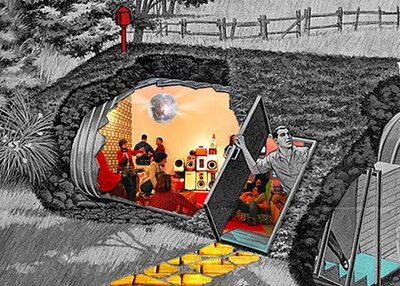
Instant Coffee, Disco Fallout Shelter, 2009, Concept collage

“For both Manet and Baudelaire, can their invention of powerful models of modernist practice be separated from the seductive and nauseating image the capitalist city seemed to be constructing for itself?” [1]

                                                                                                Thomas Crow

At first, I couldn’t understand why Instant Coffee would deep-six itself into a Fallout Shelter. Their motivations for doing this seemed rather obscure to me. Weren’t bomb shelters a thing of the past? The millenialism of the gesture a little late?

A garden today more readily evokes narratives of sustainability. Whatever the state of contemporary geo-politics, there is hardly a nuclear winter on humanity’s horizon.

When I asked IC’s Jenifer Papararo about this she averredthe tale told here was a happy one, it may be “a dark fairytale…but, we are together, even under fallout.”

Ah, survival. So IC sees its future to be much like its past.  Improbably succeeding, setting the agenda. Outwitting and outlasting and the competition. Still here. Ha.

And if the terminus point imagined seems a bit grim, well, artworks are never only about the artists that make them. Implicit to Instant Coffee’s Fallout Shelter project is a larger narrative about the fate of all utopias.

………..

Now clearer that my first impression had been too literal, I remembered that I had always kind of misunderstood what IC was trying to do. And I was not alone in this.

Severed from work done in a specific medium, the zone of representation is a tricky substance from which to hone an art practice. This is especially true if you hardly bother to—or deliberately avoid—differentiating what you do from representation’s more mundane existence as the language of commerce.

Perhaps, too, because of the collective’s proven ability to anticipate the forms of their ongoing relevance which is on pace with wider art world trends, but may be a little in advance of their audience, the Instant Coffee project has always been somewhat misunderstood.

Throwing parties will do that to your reputation; enjoyment, for some reason, is one of the more hypocritical realms of human experience.

………..

The art show as party was the original format of IC-engineered inclusivity. In the collective’s own words, creating event-based exhibitions was a way to “renegotiate…traditional exhibition structures”.  In the process, they jettisoned outmoded medium-specific hierarchies of the more traditional exhibition venues.

Self-reflexive about their own role as facilitators of art experiences, IC recognized the important part that brand identity could play to formalize the collective as a framework of possibility. Cannily adopting the language of globalism, IC staked its territory as a “service-oriented artist collective.”

The claim is funny in itself.   Self-aware and proactive, it lives up to the ideal of truth in advertising, yet partakes of the peculiarly Canadian preoccupation with being nice and non-threatening.

……

To embrace a plurality of practices means to embrace the plurality of artists responsible for them. And at the point of this connective tissue, we find the core Instant Coffee ethic. Not only were collective members party people, they were people people too.

So, for instance, in early incarnations, Instant Coffee’s parties and their predecessors — Jin’s Banana House and the Money House — used the device of the slide show to provide an easy format of participation for all invited, artists and non-artists alike.

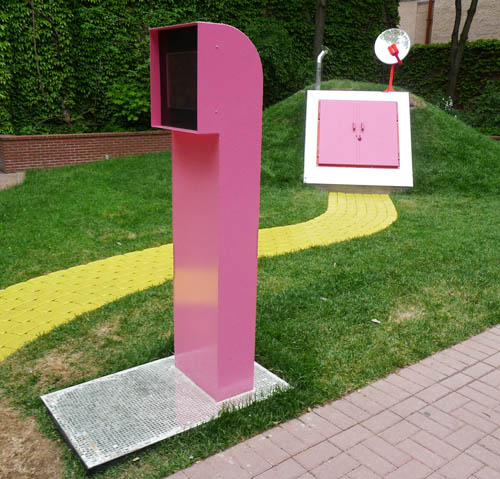
Instant Coffee, Disco Fallout Shelter, Toronto Sculpture Garden, 2009

A practical approach to curating contemporary art, Instant Coffee’s democratizing strategy was also a way to contend with the difficulty of assigning value to artworks. This is a problem, one of positively diluvial proportions, that follows in the wake of post-minimalism.

Increasingly, when de-skilled and neo-conceptual, the possible in contemporary practice has become difficult to differentiate from the necessary.

IC’s brand-defining rhetoric energetically addressed this predicament. Starting with their name, Instant Coffee (i.e., the ersatz version), the collective declared itself a non-arbiter of value. Taste, they contended, distracted “from the fundamental reasons for ingesting either the real thing or its substitute.”

The above excerpt from IC’s manifesto—which has served as the collective’s credo throughout their career—suggests that artworks are a medium of social interaction, and in some cases a mere pretext for it; an idea which has subsequently played out in the contemporary art world at large.

In Instant Coffee terms, the figure of ‘the party’ was the refuge—and the metaphor, perhaps—for the demotion of the curatorial role. To explain the circumstances they saw themselves operating within, the collective chose an ironic voice…

Instant Coffee. No Better Than You… Instant Coffee: it doesn’t have to be good to be meaningful…

…creating a ground ripe for misapprehension; but that, too, was part of the act. Those observers who took the IC party for the main event were missing the point.

Because inventing an art scene that accommodated and gave validity to the activity of your peers was a kind of utopia – symptomatic, maybe, and expressive of a wider condition — but a utopia nonetheless.

………

It is possible to characterize ICs commitment to inclusion as a practice of extreme courtesy, an idea that is fully in keeping with the collective’s ethos. Which is why their Toronto Sculpture Garden project is a departure in more ways than one.

With the inception of the Instant Coffee Disco Fallout Shelter, the question arises as to who now is being served? For the outside observer, a look into the sculpture’s video kiosk reveals the collective to be inside the shelter hanging out; business, for them, as usual.

But six people living cramped together in an underground space what kind of paradise is this?

By choosing to sequester only IC’s immediate members, and by making an artwork out of that decision, it is as if the collective has devolved into real personalities.  They have become the artwork.  It is a hard won conclusion to this story—or at least this chapter of it.  The IC Disco Fallout Shelter probably has always been IC’s inevitable destination.


[1] Thomas Crow, Modern Art in the Common Culture, Yale University Press, New Haven and London (1996) p. 3.

This text was written to accompany Instant Coffee’s commission for the Toronto Sculpture Garden in 2009.

The Whitney Biennial 2004 by Rosemary Heather

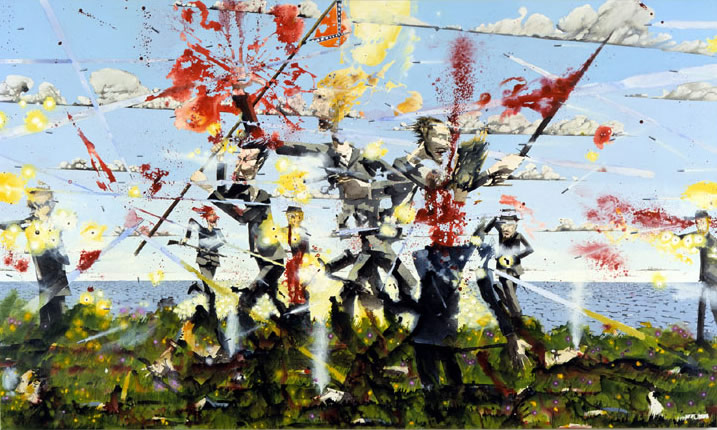
Barnaby Furnas, Hamburger Hill
Barnaby Furnas, Hamburger Hill, 2002, Urethane on linen, 182.9 x 304.8cm

Everyone seems to like this years Biennial. It’s an unusual state of affairs. Typically, the Whitney’s biannual attempt to assess the current state of American art pleases few beyond those artists lucky enough to appear in it. The 1993 Biennial was dismissed as strident and one-dimensional due to its emphasis on identity politics. The 2000 Biennial, complied by six curators, was thought to be weakened by its attempt to be regionally representative.

For anyone who has a stake in the art business, it is fair game to assess the assessment. This means that even if you do not see it, you get the gist. Talk about the Biennial is like a public servce broadcast regarding the show’s curatorial errors and omissions.  As such, the Whitney, like Documenta or the Venice Biennial, provides a heightened example of how opinion is formed in the artworld: from person-to-person, mouth-to-mouth.

The Whitney and audience satisfaction rarely coincide, so its worth asking what the consensus tells about the current cultural moment. Like this year’s Oscars, in which most of the awards went to a single film – the Lord of the Rings, a movie which maybe not uncoincidentally is about a tribe working to rid the world of evil forces – it suggests a not-entirely concious closing of the ranks. It may be a good year for art, and filmmakers from New Zealand, but its proving to be a particularly bad one for the United States.

If this edition’s curators’ have come up with a persuasive account of, as the Village Voice’s Jerry Saltz says, “what the now looks like in art”, its persuasion resides in the consistency of the artistic sensibility on view. The predominant impression given is of an aesthetic engagement with the state of vulnerability, as if the pressure of exterior events had produced an array of delicate art objects in reaction.

Barnaby Furnas’ painting ‘Hamburger Hill’ portrays soldiers in battle, its title referring to the fierce 10 day fight to capture the Dong Ap Bia hill in Vietnam. Both formally and figuratively the paiting edges into abstraction. On first look, the soldiers appare to be of a more distant vintage – maybe the American civil war? – the superimposition of events broadening the theme of the work to war in general. The dynamic of the painting’s moment in time, the sheer brutality of combat, is rendered with surprising fineness. Heads are blown apart in mid-air, the carnage depicted in angular visual harmony, bullets rendered as lines of paint slicing through the air. The effect is the spectacle of war reconciled with the medium of paint, the two-dimensionality of the image made explicit.

The artfulness of Furnas’ work is in keeping with the tone of the exhibition. It is less about war than it is about painting. As the New Yorker’s Peter Schjeldhal noted, everything in the show adheres to the gravitational pull of painting and drawing, the median being line-rendered figuration, as it directs looking and in the delineation of what is to be looked at.

This figurative impulse is evident in a number of the film and video installations. Aida Ruilova’s untitled video work, creates a Gothic ambience through momentary vignettes of actors gesticulating for the camera. Playing out on five monitors that surround the viewer, the scenes alternate absurdist instances of thespian drama. Sounds are made but few words are spoken, the repetition of fragments being reminiscent of Bruce Nauman and in their formal dissolution, the films of Jack Smith. Working within the idiom of filmic collage, in their brevity, the videos aspire to the staus of pictures. , albeit pictures with the fraught psychological content that is implied by their durational tension.

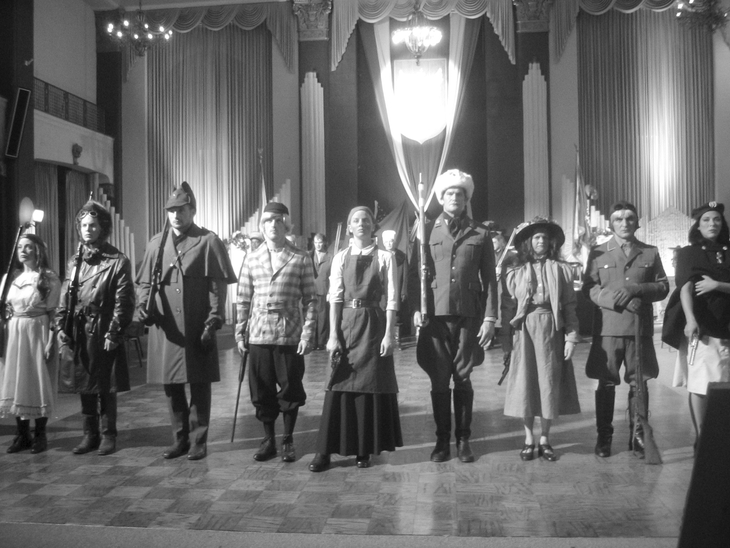
Catherine Sullivan, Ice Floes of Franz Joseph Land
Catherine Sullivan, Ice Floes of Franz Joseph Land, 5-channel film installation 27 min 37 sec, B/W, Sound, 2003

Mining similar territory but with added granduer, is Catherine Sullivan’s film installation, Ice Floes of Franz Joseph Land (2003), which using actors in period-ish dress, portrays a shortform pageant of 20th century European political turmoil. Referencing the traditions of avant-garde film and theatre, the multiple screen presentation evokes the mass upheavals and visceral hysteria brought on by the two world wars.  In contrast to Ruilova’s work, pictorial collage is not in the edits but rather the actors antic stylizations, silent film being a tableau upon which to etch ghostly signs of the past remembered.

In that it is a theatre piece made abstract, Sullivan’s work partakes of the formalizing tendency that pervades this Biennial. As a picture of the zeitgiest, what it tells us is that the art instituion currently favors its traditions of craft, formal ingenuity and hence connoisseurship. What is absent is the conceptualist-pop-minimalist paradigm. For the time being it appears, from the perspective of the influential the American urban centres, art is not obliged to be about politics, the social world, or its own status as object of commodity exchange. Those are subjects better left it seems to less poltically tenuous times. In place of art’s historically important role as mouthpeice or agitator, or vehicle of reflective thought, the 2004 Biennial promotes the value of art as a medium of tactile visual pleasure. As an agenda, it grants artists an autonomy they already had as craftpersons of the articulate visual imagination.

This text originally appeared in BorderCrossings, Volume 23#2 (#90)