Michael Lewis

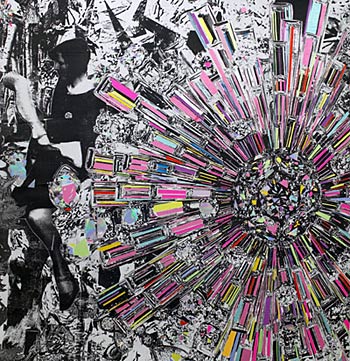
‘We All Lie Together’, oil on canvas, 49" x 49.5" (2007)
I’ve never forgotten what an artist friend once told me. Making paintings is an exceptionally weird thing to do. Applying paint to a flat surface, constructing the illusion of space in two dimensions: What could be the motive for this?

Among the legion of painters devoted to figuration, Michael Lewis maps out a distinct place. In his large-scale works, the dimensions of painting become the constricted space of everyday urban existence: the hotel hallways, office buildings and banquet halls. Windowless rooms contain faceless people, all of them suffering from some nameless torpor. Primarily a painter of interior spaces, Lewis frequently includes potted plants in his pictures to provide a (somewhat cynical) reminder of natural life. When Lewis does paint the outside world, his landscapes look suitably alien.

Sometimes the torpor in Lewis’s work is depicted. In ‘We All Lie Together’ (2007), a group of people lie on the floor. More often, torpor is just an ambience pervading the work. The artist uses a tepid palette of blue and green to serve psychological ends. There is no air in these rooms. Often the paintings are tinged with an undercoat of red, giving them an eerie vitality. The subtle reddish glow suggests a painterly corollary for disquiet.

Lewis used to be a bike courier and he told me this may be the reason why the mise en scene of his imagination always ends up looking like the lobby of an office building. In his paintings, people are busy but it’s hard to say what exactly they are doing. Allegories of office job deadness, bomb shelter anomie or consumer culture conformity all spring to mind.

More to the point perhaps is the claim Lewis makes in his paintings that his medium conveys meaning. His work recalls a quote of Rene Magritte, who described painting as “the art of putting colors side by side in such a way that their real aspect is effaced.”1 In Magritte’s view, a successful painting achieved just that, a kind of poetic coherence, one that “dispenses with any symbolic significance.” Lewis’s work achieves this coherence. His paintings give an impression of profundity; numerous potential readings could result. Our willingness to invest in the work’s reality is connected to the artist’s motives when making it. In the end, however, all readings hit up against the limit of what Lewis’ works actually articulate: the artist’s skill at painting.

1. Frasnay, Daniel. The Artist’s World. “Magritte.” New York: The Viking Press, 1969. pp. 99-107

By Rosemary Heather

This text originally appeared in Hunter and Cook, Issue 09
Michael Lewis is represented by the Meredith Keith Gallery.
Michael Lewis’ website is here.

Miles Collyer

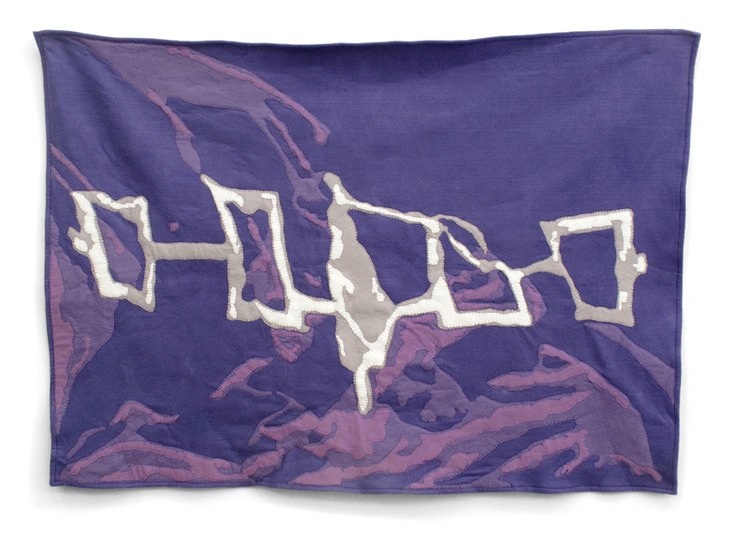
Miles Collyer, Hamas, felt and thread (2007)

Miles Collyer makes felt flags based on images he finds online. Few works of art convey ideas about the world we live in so effectively. Today, a flag could stand for the frivolity of a regatta, or the half-serious declaration of micro-nationhood. Collyer chooses to focus instead on symbols of political conflict; flags that express the statehood aspirations of disenfranchised groups. In the single video he showed at Toronto’s G Gallery, Collyer painted a pennant black and animated it, making the felt triangle appear menacing. It was the only flag that flew in the show, and it clearly announced what territory Collyer wants to claim as his native ground.

We live in a world where images condense territories, which is also a good definition of the Internet. Recreating found images as life-sized replicas in felt, Collyer takes particular interest in the distortions that data transmission brings. Working from digital files, Collyer matches the crudity of pixelation with his chosen material’s lack of finesse. With meticulous care, he sews chunky, abstract artworks. The ripples of a flag that once flapped in the wind are given form as a layered, two-dimensional object. The result is eerie: the flag’s distortions lack detail, and thus take on the contours of a topographical map. Subjected to a multi-step process of translation, Collyer’s works continue to convey a message about their origins. The effect is an uncanny one, which brings to mind the Surrealists’ belief that they could find beauty and truth in a flea market.

Collyer trained as a photographer, and this work is ultimately an investigation into the power of the photographic image. In a previous series of photographs, Collyer confronted this issue directly. He took portraits of himself wearing a variety of coloured knit balaclavas he had found in thrift stores. Even when styled as a fashion statement, the balaclava speaks the language of political insurgency. The images Collyer made cannot escape this implication; they draw resonance from the idiom of 21st-century terrorism.

Miles Collyer, Haudenosaunee, felt and thread (2007)

With his flag series, Collyer looks at the politics of the image from a different angle. The innocuousness of felt neutralizes the political flag, and yet its message remains undiluted. This is not because his audience knows much about the political struggles of, say, the people, whose flag Collyer has used as source material. Rather, it is because the picture frame flattens and condenses information into form. Flag symbolism is cultural expression at its most basic or, dare I say, primitive; this is why Collyer can create soft, distorted versions of the real thing and still find that they pack a powerful, atavistic punch.

By Rosemary Heather

This text originally appeared in the Spring 2011 issue of Canadian Art.
You can find more info about Miles Collyer here.

Keith Jarret: The Köln Concert (1975)

Keith Jarret, The Köln concert, 1975

If you want to make a German laugh, tell them you have been listening to Keith Jarret’s The Köln Concert (1975). This very pretty recording of the artist’s live solo piano improvisation in Cologne is one of the biggest selling jazz albums of all time. The laughter will be out of slight embarrassment for you. Not because of the unadulterated pleasure this album offers the listener, although somehow that is embarassing too, but because it was at one time a cultural behemoth that has few referent points in the present. The Köln Concert is my musical guilty pleasure, because listening to it always makes me cry.

Like few other albums, the Köln Concert holds special significance for me. At certain times in my life I have become fixated on it, listening to it repeatedly. I have this relationship with only two other records, Neil Young’s After the Gold Rush, and Substance, the Joy Division singles compilation. Each elicits from me a specific brand of melancholy, one that risks being ‘worn out’ through overindulgence. And just as easily as these private episodes begin they will be over, the music to be forgotten for sometimes years on end.

If the virtuosity of Jarret’s improvisations is in some sense his music’s content, I suspect that at one time in Germany the Köln Concert represented a welcome freedom from the past. Today, however, it can sound more like solipsism, a self-absorption of the man into the realms of his exceptional musical technique. Like the New Age spirituality with which The Köln Concert shares a 70s provenance, Jarret’s music works hard to free itself of its inheritances, which makes it ecumenical at best; at its worst it sounds dangerously like musical kitsch.

For the jazz enthusiast, I am sure there is nothing embarrassing about liking Keith Jarret. But save for the work of Thelonious Monk –who no coincidence is also a virtuosic pianist– I don’t listen to jazz. I came to the record through Nanni Moretti’s 1993 film Caro Diario (Dear Diary). In it, music from The Köln Concert accompanies a sequence where the camera follows the director on his moped, riding through the scraggy outskirts of Rome on a late summer day. Arriving at the site where Passolini was murdered, the camera gazes through a wire fence. Marking the spot is a weathered concrete sculpture, and beyond it lays a disused overgrown football field. Overall, the effect is devastating. Jarret’s music redeems the desolation of the landscape, at the same time as the film sequence brings out the tragic dimension of its beauty. I am not alone in feeling this way; I originally went to see Caro Diario because a friend told me it made her cry, which in art is a high recommendation. Today you can watch the clip on YouTube. Most of the comments are in Italian, but a certain gentlemen, dariobr83, echoes this emotion when he says, “every time I watch it I feel shattered…”

Rosemary Heather

This text was commissioned for Song-Ming Ang’s Book of Guilty Pleasures, a collection of 100 contributions from different artists, curators, musicians, and writers on their aural guilty pleasures, co-edited with Kim Cascone. It can be purchased here.

Collage: The Shock of the Newspaper

"I think photomontages function like dreams," says Kirstine Roepstorff.
Kirstine Roepstorff, Pink, 2004, Courtesy Galleri Christina Wilson

In his famous text Collage, written in 1959, Clement Greenberg talks about the “shock value” of the technique. Somewhat shocking in itself, the remark harkens back to a time when mere artistic innovation could have the power to be troubling. Little did Greenberg suspect that the alarm was justified. By introducing fragments from the outside world to the surface of the painting – real things like bits of newspaper, or oil cloth – Cubist period Picasso and Braque helped to predict the demise of old world aesthetic standards, a protracted process that art continues to undergo to this day.

An avant gardist himself in his critical practice, Greenberg was contemptuous of the then commonplace idea that the extraneous elements used by the Cubists represented the necessary corrective of “reality” in the face of the growing abstractness of Analytical Cubism.” Scoffing at the suggestion that things glued onto a painting’s surface were any more “real” than those depicted within the picture plane, he went to all but extraordinary lengths to prove why this might be true, and invented a theory of modernism in the process.

At the time, Greenberg’s argument that the cubist technique of “depicting flatness” – a painterly method of self-cancelling 3D illusionism – represented the salvation of the medium did have some persuasive value. In the 1950s, the class divide between high and low regimes of taste was readily apparent. It was a cultural climate that gave credence to one of the American critic’s more outlandish ideas: the notion that medium-specificity adhered to rigorously enough could make painting immune to the influence of the wider culture. But as with any self-regarding elite, whether persons or art practices, an insularity practiced to this extreme is in itself a kind of death knell.

What I am referring to here is not of course that perennially popular– and maybe finally over – conversation about the Death of Painting, but rather the connected event of the death of necessary skill or technique in art practice.

This was the future that was augured by collage. After all, when Braque stuck, as Greenberg says, “a very un-cubist graphic depiction of a tack with a cast shadow” onto his 1910 painting Still Life with Violin and Pitcher, he was not only placing it there as a reminder of the medium’s illusionistic past, he had also discovered an entirely new category for the practice of art, one that would go on to almost swallow the discipline whole: the readymade.

Although Duchamp’s innovation in this respect was roughly contemporaneous – and it was the French artist who made the possibility explicit – the Cubist choice of the still life as the genre best suited to their radical form of artistic experimentation looks, from the perspective of today, like nothing so much as the readymade’s foreshadowing.

Contrary to Greenberg’s argument, so elegantly rendered, about continuity of the aesthetic ideals that his version of modernism ensured, collage represented the first puncture hole in the visual arts’ commitment to the principles of classical culture. The moment of deflation that is collage, the implications of which Greenberg tried so hard to resist, was nothing so much as the noise of real life rushing in. Listen for it now and you can still hear the whooshing sound.

By Rosemary Heather

This text was commissioned for Fleur du Mal, 2007 (Daddy III. A project of Peres Projects, Berlin). Guest edited by Kirstine Roepstorff, Fleur du Mal can be purchased here.

Daniel Cockburn’s You Are Here


Daniel Cockburn

A bemused and slightly anxious film, Daniel Cockburn’s first feature You Are Here(2010) is a perfectly concocted expression of everything we don’t understand about our new century.

Fitting for a movie that features the viewer in its starring role – the “you” of the title – a central character in Daniel Cockburn’s You Are Here (2010) is the aggregate entity ‘Alan’. The film creates Alan by layering in quick succession, shots of different men and women performing – or failing to perform – a series of small actions. Cockburn uses this device to displace the viewer identification that typically drives a film’s narrative. Meanwhile, a voice muses about the fragile nature of identity. “Are you the same person before and after putting something down and picking it up again?

The 2010 Toronto International Film Festival (TIFF)

The Autobiography of Nicolae Ceausescu, Andrei Ujica (2010)
The 2010 edition of the Toronto International Film Festival (TIFF) seemed particularly hysterical. Toronto crowds have proved reliable predictors of future box office success – Slumdog Millionaire (2008) was rescued from straight-to-DVD obscurity at TIFF, and Precious (2009) was an audience favourite here before becoming an Oscar contender. It’s a track record that contributes to the sense that TIFF has arrived, it now being considered second in importance only to Cannes in terms of industry weight. Burnishing this image is the glamorous new TIFF Bell Lightbox, home to the festival and the branding of its corporate sponsor Bell, the hated pretty much by everyone Canadian telephone conglomerate. Not that we live in an age where anyone cares about this kind of thing. One of the main venues for TIFF screenings was a big commercial movie complex that is mystifyingly (to me at least) branded with the name of a bank. Regardless, the Lightbox is a glorious addition to the city’s art ecosystem, a reassuring sign that, better late than never, Toronto has caught on to the prestige and economic power that culture can bring to a city.

Cathy Busby/Garry Neill Kennedy

Cathy Busby, NEW!, 2006 Latex and oil on canvas, 4/8 30.6 x 40.5 cm
Signs Taken for Wonders is the title of a book of literary criticism by Franco Moretti, but it also serves as a good description of what unites the practices of Cathy Busby and Garry Neill Kennedy. Both artists combine found objects with abstraction, working to expose the socio-political content of cultural forms. The methods they use are at complementary cross-purposes: Busby strives to elevate ephemeral materials to the status of art, while Kennedy contrives to contaminate the histories of minimalism and abstraction with news of the everyday.

Eli Langer

Eli Langer, Shadow Shift, 2007

Eli Langer

Paul Petro Gallery, Toronto, July 13th – Aug 11th, 2007

By Rosemary Heather

Many people were struck by the confounding elegance of Eli Langer’s latest exhibition in Toronto. Like much contemporary art, you could ‘get it’ in an instant – but what you ‘got’, that was less certain.

A powerful florescent light eliminating all shadow enhanced the dazzling white ground of a painting hanging in the gallery’s window vitrine. Floating against this whiteness were a couple of insouciant washes of oil paint in purple and blue, the lines intersecting in the work’s upper right hand corner to make a 45 degree angle.

That this work has been described as both “Zen-like” and “baroque” gives an indication of the freshness of ground that the artist marks out with this exhibition.

In a media environment that thrives on monotony, shock, and repetition (this is what celebrities are for!) it is exceedingly difficult to create a visual frisson of the new. Much worthy art founders on exactly this rock of seeming overly familiar. Langer’s work in this show has the opposite effect; the artist combines familiar elements to free us from tired habits of looking.

A case in point is a sculpture leaning against the gallery’s back wall in the shape of a large but skinny black ‘x’. Attached to the axis where the two intersecting pieces of wood meet is a small black and white photograph. In it two women stand with their backs to the camera. Doubling the vista they contemplate is the vanishing point conjured by the ‘x’. Like the show as a whole, the work makes for a simple and yet highly sophisticated configuration of the problems of representation.

Across the room a companion piece leans against the wall. Titled, ‘Rum De Dum’ (2007), it features a tightly cropped photo of a woman’s face affixed to the top of a slender black piece of wood. Because the girl in the photo floats above the viewer’s head and touches the floor, the work enacts a literal disembodiment.

Langer speaks about these sculptures as “props,” as a way to position the image. They also serve a related function, as a means to reduce the referential power of the images. This is a canny double maneuver, pushing the show towards abstraction, but keeping it anchored in the real.

The two other paintings in the show echo the window piece’s minimal sensualism. It is the artist’s lightness of touch and assured aesthetic intelligence that allows for his extravagant use of pastels and wash. It is weirdly risky to create works that are this ethereal and pretty.

Although the people in the photos are key figures in Langer’s life, his work here is decidedly non-biographical. Like the disembodied girl’s face, small in scale, dreamy and distant, the artist seems to be pointing his audience in a direction away from humankind’s destructive self-absorption. Of a piece with the whole installation, the girl in ‘Rum De Dum’ is anonymous, just a part of nature. Her subjectivity, like the artist’s is in the work itself.

In this show, Langer uses modest means to deliver euphoric effects. In his return to the fine sensitivity of fine art ­–a practice long developed by the artist–he presages a massive cultural shift that seems all but imminent.

http://www.paulpetro.com/

Steve Mann

Professor Steve Mann photographed wearing the EyeTap digital eye glass in Toronto Monday Dec. 22, 2003. (Aaron Harris/Canadian Press)

Steve Mann – Prior Art: Art of Record for Personal Safety

Curated by Kathleen Pirrie-Adams
July 5-28, 2001,
Gallery TPW, Toronto

By Rosemary Heather

Wearable computing was in the past an ideal of the future we now live in. If we used to dream of building robots, a more likely scenario today is that we will become robots ourselves. A professor of Computer engineering at the University of Toronto, Steve Mann has been pursuing the dream of wearable computing for over twenty years. At the Gallery TPW in Toronto, Mann displayed the artifacts of the sci-fi reality that is his daily life.

Since 1980 he has on a full-time basis worn an evolving prototype that combines a computer screen attached to a pair of sunglasses with video, audio and data links to the Internet. The continuous data-stream that results, which was for two years, from 1994-1996, continuously available for anyone to view on the web, is one part of a complex project that underpins his development of prosthetic computing with socio-political critique.

Although Mann’s inventions may have the potential improve the life of the blind or people with Alzheimer’s, the show at TPW chose to focus on his work’s more theatrical edge. This includes a performative investigation into the surveillant nature of contemporary society.

Living your life as a full-time cyborg has certain repercussions. Unlike the institutional surveillance network, Mann has no interest in being covert. Although less so than it used to be, his gear is bulky, conspicuous, the better to drag into the light of public consciousness operations that would prefer to remain un-remarked  on. At issue here is our otherwise tacit acceptance of private interests right to document our daily behaviors. By practicing his own form of counter-surveillance, Mann gives content, albeit from reverse view, to what otherwise exists as a shadowy realm of potential data that we know exists but never see. In its most radical implication, the project posits technology as the vehicle of an augmented subjectivity, a not inconceivable reality where computers interact not only with the world at large but also our own consciousness. The ideal Mann is celebrating is really one of degree. We already interact with computers in such a way that they augment our experience of the world. Mann places himself on the far edge of techno-fetishism by welcoming a human fusion with computers that is truly invasive.

The same could be said of Mann‘s chosen approach to these issues. In its current state, his personal computing get-up is intimidating, turning personal encounters into confrontations. Mann casts himself as a foot soldier in some kind of cyber-war, perpetrating a personal surveillance-oppression on unwitting victims. On view at TPW is one such encounter with a clerk from the Motor Vehicles Department. The resulting imagery is silent but fully communicative of a certain pathos.  The clerk looks cowed, almost scared, Mann having removed the human element from the interaction. Part of his routine is to ask the clerk in question if he is being filmed, Mann winning the point by, in effect, asserting control over the situation. Implied here is a future where personal interests prevail, proto-militarized like the gated communities of today. Mann contends he does this in the name of “personal safety”,  but it belies a vision that is ultimately dystopic. He exposes issues of great relevance to the contemporary world, but in the end his practice only manages to replicate the system that is the ostensible object of his critique.

The 50th Thessaloniki International Film Festival

Karpo Godina, Litany of Happy People (1969-71)
Changing notions of what now constitutes ‘mainstream culture’ mean that ideas such as ‘underground’, ‘avant-garde’ or ‘oppositional’, are also in flux. The particularly thorough approach that Bourikas brings to the presentation of avant-garde film allows us to, as he says, “extract the context’” which, in the 20th century, gave the ethos of art experimentation such vitality.

TIFF’s Serbian Kino Clubs screenings, for instance, revive to memory the role that filmmakers in (then) Yugoslavia played in the international conversation about avant-garde film. A legacy of Tito’s program for ‘popular technological education’, the true origins of the Kino Clubs are in avant-garde notions about the revolutionary potential of film technology itself.