11 art exhibitions to be excited about in 2019

Look out for the Toronto Biennial of Art and exhibitions featuring work by Brian Jungen, Chantal Akerman, Carrie Mae Weems and Daniel Arsham
Untitled, a 2017 photograph by Carrie Mae Weems.
Courtesy of the artist and Jack Shainman Gallery, New York


If last year is anything to go by, 2019 promises more social media exodus and a world slightly less obsessed with connected devices. Art galleries offer a good alternative. Instead of the light emitting from the mobile or computer screen, light therapy as art is on offer. And come September, Toronto gets the art biennial it has long been waiting for, featuring local and international artists at venues adjacent to Lake Ontario.

VAJIKO CHACHKHIANI: THEY KEPT SHADOWS QUIET

Scrap Metal Gallery, October 11, 2018-March 30, 2019

The first solo show in North America by the young Georgian artist is the most ambitious exhibition staged to date by this private gallery. It features a number of works, including a specially built “inverted” immigration checkpoints. Using two way mirrors in reverse direction, visitors can surveil the occupants of the booths, which are manned by actors every Saturday from 1-4 pm for the duration of the show.

SANAZ MAZINANI: LIGHT TIMES

Stephen Bulger Gallery, January 12-February 23

Known for her large-scale mosaic works embedded with political content, Mazinani returns to her hometown for this back-to-basics study of photography. Camera-less photos (i.e., light exposed to photosensitive paper) form the basis of this show – but Mazinani’s larger agenda is revealing the manipulations, framing and cropping that create photographic “truth.”

TRUE TO THE EYES: THE HOWARD AND CAROLE TANENBAUM PHOTOGRAPHY COLLECTION

Ryerson Image Centre, January 23-April 7

A presentation of over 200 works from the Toronto philanthropists’ private collection. The sheer range and eclecticism of the photos on view – including Brassaï, vernacular works, Diane Arbus and Edward Burtynsky – offers insight into how genres within the medium have evolved. A useful point of reference for photography’s expanded digital life today.

Inverse Squares Yellow on Black, an abstract painting by Swedish-born artist Jaan Poldaas.
Photo: Toni Hafkenscheid / Courtesy Birch Contemporary and estate of Jaan Poldaas


JAAN POLDAAS: A COLOURFUL LIFE

Birch Contemporary, February 7-March 2

This is a memorial exhibition for the Swedish-born Toronto-based artist who died in October. Poldaas made vibrant, hard-edged abstract paintings, working within set rules he imposed on his practice such as using primary colours and the colour grey in differing shades. This framework allowed him to discover constant variation in composition throughout his career.

APOLONIJA ŠUŠTERŠIČ:
LIGHT THERAPY &
CHANTAL AKERMAN

MOCA, November 28-April 30/ MOCA, February 14-April 14 

Here are two good reasons to visit MOCA’s new location. Slovenian artist Šušteršič presents a light therapy room as part of the museum’s interest in exploring the role galleries play in supporting well-being. Visitors who become MOCA members can also book it for private sessions. Filmmaker Akerman, who died in 2015, was one of Europe’s foremost auteurs of the last 50 years. While many of her films have screened in Toronto, MOCA is hosting the first museum presentation of her installation work.

CARRIE MAE WEEMS: HEAVE

Art Museum at University of Toronto, CONTACT Photography Festival and three public sites, May 3-July 13

Part of this year’s Contact Photography Festival, this show marks the first solo exhibition in Canada by this important African-American artist. Weems is known for her photo-based installations that incorporate film, daguerreotypes, textiles and period-specific dress. Her tableaux reflect on how power functions in society, in part by making viewers aware of the constructed nature of photography.

Brian Jungen’s Warrior 1 sculpture from 2017 is made from Nike Air Jordans and leather.
Photo: Jason Wyche / Courtesy of the artist and Casey Kaplan, New York

BRIAN JUNGEN

Art Gallery of Ontario, June 20-August 25

A solo exhibition by the celebrated West Coast artist touches down at the AGO this summer. Jungen is known for remaking everyday items, like Nike shoes or plastic lawn chairs, into powerful sculptural works. The artist’s always inventive refashionings often reference his Indigenous heritage. His use of mass-produced materials also critiques the conventions of museum display and the value of the objects collected therein.

KATE NEWBY

Cooper Cole Gallery, September TBA

The New Zealand-born artist’s debut solo show will feature beguiling works that are part sculpture, part installation. Working with ceramics, bricks, glass and found materials like pebbles and other detritus, she often uses the floor and other overlooked parts of the gallery to subtly shift visitor experience – as well as the concept of what can be art.

TORONTO BIENNIAL OF ART

Various venues on Lake Ontario, opens September 21

Biennials are the lingua franca of the international art world and Toronto is long overdue to host its own. This 90-day event is helmed by Candice Hopkins and Tairone Bastien, two smart, experienced curators who have announced a theme focused on the history embedded in the city’s waterfront – the site of settlement, trade and Indigenous histories. Featured artists include Althea Thauberger, Shezad Dawood and Syrus Marcus Ware.

NUIT BLANCHE

Various venues, October 5

The city’s all-night public art event again includes venues in Scarborough and adds first-time locations Fort York and the Garrison Common. Nathan Phillips Square will host an installation by Daniel Arsham. Few details are available, but given he works with meta-architecture firm Snarkitecture, it’s a good bet the New York artist’s piece will be big and involve the colour white. The deadline for artists to submit proposals for the Open Call section is February 4. 11 art exhibitions to be excited about in 2019

NOW Magazine: 11 art exhibitions to be excited about in 2019
@rosemheather 

The 10 best art shows of 2018

Historical legacies and Toronto’s changing landscape were major themes in galleries and in public art works this year

BY ROSEMARY HEATHER

DECEMBER 3, 2018
Ibrahim Mahama’s Radical Histories, 2012-2018 wrapped City Hall in jute fabric during Nuit Blanche. Photo: Cheol Joon Baek


Toronto is growing by the square metre, with buildings popping up everywhere. The city’s art scene is also changing and, in some cases, responding.

In 2018, all-night art event Nuit Blanche extended to Scarborough and Don Mills. Fighting condo glut, artists are building spaces in overlooked corners and raising voices against the threat of Toronto becoming homogenized for the rich.

Thinking about the urban landscape is second nature in a profession in which space is a core element. That’s one reason arts organizations here and across Canada are drawing attention to the contested status of the land beneath our feet. Land acknowledgments of First Nations territorial rights preceding art events have become common. This year saw Canadian art galleries cited internationally for changing the terms under which Indigenous art is exhibited. At the same time, one of the city’s leading curators, the AGO’s Wanda Nanibush, started a conversation to get arts professionals to better understand how to do it right.

With this attention to historical legacy, and commitment to reasoned dialogue, the art world increasingly feels like a realm more thoughtful and separate from wider public spheres. Artist-led dialogue contrasts strikingly with conniving public figures like Premier Doug Ford, who emulate the worst tendencies of our U.S. neighbours. Toronto artists are fighting back in the best way they know how. By making art and putting on shows – some of it explicitly in protest.

1. Ibrahim Mahama, Radical Histories, 2012-2018, Nathan Phillips Square (September 29)

For Nuit Blanche, the Ghanaian artist transformed the pedestal ramp of City Hall by wrapping it in a patchwork curtain of jute fabric that had previously been used in trade of cocoa, coffee and charcoal. A thrilling, instantly readable monument to labour, colonialism and the hard truths of commerce.

2. The Work Of Wind: Air, Land, Sea, Blackwood Gallery, Mississauga (September 14-23)

This massive art project in Mississauga’s Southdown Industrial Area featured 13 outdoor installations that visitors could tour using a specially commissioned MiWay bus. Many of the works captured the event’s theme of stewardship in the face of environmental crisis, while remaining playful. A show highlight was Tomás Saraceno’s giant walk-in air balloon made from thousands of plastic bags.

3. Rebecca Belmore: Facing The Monumental, Art Gallery of Ontario (July 12-October 21)

For those who saw Belmore’s excellent 2014 show at the Justina M. Barnicke Gallery, her AGO exhibition was a revelation. This show featured a different but equally compelling range of works. Her monumental stack of shopping carts packed with fresh clay offered a concise statement about Indigenous dispossession. Just one of many works on view that combined critique of social and power structures with strong emotional impact.Expand

GTA’s billboard in Trinity-Bellwoods Park proposed legislation to curb house flipping and make the city more affordable. Photo:Courtesy of Gentrification Tax Action (GTA

4. GTA, Gentrification Tax, Trinity Bellwoods Park (February 25); Public Studio (June 1-July 30)

GTA stands for Gentrification Tax Action, an ad hoc artist group who – in different combinations of people – have made activist art since the 90s. Via a temporary billboard installation in Trinity Bellwoods Park and poster project, GTA proposed a practical solution to Toronto’s gentrification problem: a tax on real estate speculation, with the money redirected to affordable housing. Their work added much-needed nuance to the conversation around the city’s affordable housing crisis.

5. Shannon Bool, Bomb. Shell., Daniel Faria Gallery (November 1-January 12)

Canada produces a lot of strong artists. Bool is a contender for one of the best. Her stunning photo collages and tapestries in this show combine the work of modernist giants like Le Corbusier with vintage postcards of nude Algerian women, whom the architect also made sketches of in his off hours. A deft exposé of Orientalism and the darker underpinnings of modernism.

6. Shelley Niro, Ryerson Image Centre (April 28-August 5)

This was a welcome survey show for the 2017 Scotiabank Photography Award winner. Niro is skilled at bringing humour to dark subject matter like the decimation of her Indigenous ancestors by white settlers in Canada. The preference for comedy and a light touch on view in this exhibition made clear her connection to the sophisticated craft-based work of artists like General Idea and Allyson Mitchell.

7. Believe, Museum of Contemporary Art (September 22-January 6)

Attendees at the MOCA’s inaugural exhibition at its new home in the Lower Junction Triangle were probably as curious about the building – five floors in all – as they were the art. This show is multifaceted and sprawling, with textile works sitting next to a playable and wildly decorated pinball machine, adjacent to sculptures and video works. A total experience of art and space, its highlights include works by Dineo Seshee Bopape, Tuan Andrew Nguyen and Rajni Perera.

8. I continue to shape, Art Museum, University of Toronto (September 5-December 8)

This group show features mostly First Nations artists taking a non-didactic approach to settler and Indigenous histories. By combining traditional First Nations and contemporary art vocabularies – see Nicholas Galanin’s re-carving of a traditional native mask – the artists bring viewers into a fresh dialogue with the subject matter. In a show of great works, Joseph Tisiga’s paintings using Archie comic characters as stand-ins for white obliviousness are standouts.

9. Yoko Ono: The Riverbed, Gardiner Museum (February 22 to June 3)

How calming it was to visit the white environ Yoko Ono created in her three-part, ceramic-based installation. Ono was part of the first wave of artists making interactive (or instructional) artworks in the late 60s and 70s, and this recent work confirms her preeminence. Made with the help of museum visitors – who reassembled broken china and threaded twine into a room-sized spider web – and probably for that reason, the installations evoked the timeless mark-making of artists like Cy Twombly.

10. Diagrams Of Power, Onsite Gallery at OCAD University (July 11-September 30)

This exhibition articulates the forms power takes in the 21st century through works that highlight how today’s geopolitics are networked. We understand we live in a networked world and yet it remains intangible in important ways. The research-based works in this exhibition, such as Bureau d’études’ mappings of what they call “the World Government,” create a visual lexicon for grasping ideas society has yet to fully grapple with.

https://nowtoronto.com/culture/art-and-design/the-10-best-art-shows-of-2018/

@rosemheather


Toronto artists are gathering images for anti-Ford protests

The Artists Projection Protest Project is taking steps to align with labour unions, teachers and health care providers in Ontario

BY ROSEMARY HEATHER, OCTOBER 31, 2018

Anti-Ford Art Protest
Illustrator Gary Taxali contributed this image to a projection protest in Queen’s Park on October 24.

Resistance to Premier Doug Ford is just getting started. That’s the view of artist Kelly McCray, who staged a protest on a chilly Wednesday night last week in Queen’s Park.

Along with artist Ian MacLeod, McCray and a small group of supporters used a construction hoarding as a backdrop and projected a series of images onto a makeshift screen.  Thirty artists – including high-profile local talents like Shary Boyle, Suzy Lake, Jon Sasaki and Gary Taxali – made work for the Artists Projection Protest Project.

McCray says the Ford era recalls the 90s when Mike Harris was Ontario’s premier. The Conservative leader implemented a series of budget cuts in the name of smaller government and deficit reduction. Among the most controversial was the amalgamation of Toronto and five boroughs into a megacity.

Fiercely opposed at the time, the move is reminiscent of Ford’s reduction of seats on city council from 47 to 25. Both were supposedly undertaken to create “efficiencies” by shifting power from elected officials to admin staff – not a smaller government so much as one less democratic by design.

“We’ve already been through this,” says McCray, who adds that tactics like the rolling one-day anti-Harris strikes, Days Of Action, now seem relevant again. “We should have taken measures back then to protect our city.”

As the anti-Ford movement gathers steam, he and MacLeod are among artists thinking about how to respond.

Included at the protest, Lyla Rye’s close-cropped black-and-white image of a women’s face with the word “SHAME” superimposed on it pointed to a number of recent issues: Ford’s opposition to the carbon tax, and/or his scrapping of the progressive sex-ed curriculum.

Illustrator Taxali, known internationally for a signature style that riffs on 20th-century newsprint ads – think pulp comic figures and the Ben-Day dots of the four-colour printing process – contributed an image of a broken heart bisected by a silhouette of the CN Tower. The work’s subtle power gradually sunk in over the course of the night. Who wouldn’t be sad given the pointless destruction Ford has inflicted during his short time in office?

McCray and MacLeod are in the midst of finding other opportunities to stage the project. They are reaching out to labour unions, with the plan to align with any forthcoming protests. They are also open to working with teachers and health care providers around the province.

There is an important difference between the Harris years and today: the internet. The pair plan to add their images and others they collect to an image bank for use at future protests and to be circulated on social media.

Like many things today, protest will happen on the web as much as it does IRL; the contemporary model for political action is necessarily two-pronged. By holding events on the ground, the Artists Projection Protest Project continues the history of vibrant street protest. On the day of the protest, there was a demo on the south side of Queen’s Park against Ford’s move to freeze the minimum wage at $14 per hour. The location of the projections in the north end of the park was also close to where to an Indigenous protest encampment had been set up for a number of weeks during the summer.

Of course, circulating images through Facebook and other social media platforms will create greater exposure for the project. However, so far the right has made better use of meme culture than the left. A meme as innocuous as the cartoon Pepe the Frog is now considered a hate symbol by the anti-bigotry ADL (Anti-Defamation League) because of the ways it was circulated online by right-wing extremists.

How the left can use images to galvanize online support remains an open question. As the writer and podcaster Anna Khachiyan pointed out in a recent NOW article, using internet platforms for protest has troubling implications. As a society, we have barely come to terms with how sites like Facebook and Twitter double as mechanisms for surveillance. Furthermore, activity on these platforms might be free but at the cost of a fait accompli donation to the tech giants who profit from data mining. That reality must be considered when answering the question: how do artists protest today?

For McCray and his cohort, creating images for protest is a good first step. It’s a way to workshop even bigger gestures that capture the imagination and bring people together.

“There are a number of ways to get the message out,” says McCray, “but our focus will always be on artist images.”

art@nowtoronto.com | @rosemheather

https://nowtoronto.com/culture/art-and-design/toronto-artists-doug-ford-protests/

Why Trump is able to neutralize #Resistance art

Ahead of her Art Toronto talk, critic and podcaster Anna Khachiyan suggests that artistic dissenters should focus on platforms like Facebook and Instagram

BY ROSEMARY HEATHER OCTOBER 23, 2018


Trump, Resistance, Protest, Art
Barbara Kruger’s Prump Tutin magazine cover, part of New York Magazine’s My New York public art project. Photo: Anna Khachiyan


If the art world needs a contrarian, Anna Khachiyan can oblige.

Along with Dasha Nekrasova, Khachiyan co-hosts the podcast Red Scare. The New York duo’s weekly,  often provocative, look at cultural news already has healthy base of Patreon supporters since launching in March. Part of the so-called Dirtbag Left, Khachiyan and Nekrasova are caustically skeptical about the niceties of mainstream liberal thought.

In balancing an indulgance in bad taste and being reactionaries, the Red Scare duo sometimes risks sounding like an internet troll act. But as a writer, Khachiyan is a too-rare voice in a world that’s voguish for art best understood through moral positioning. Her recent essay Art Won’t Save Us tackles why so much political “resistance” art aimed at U.S. President Donald Trump is ineffectual, and argues what’s needed is more critical thinking around the power big tech companies have over our lives.

In town on Friday to speak at Art Toronto, Khachiyan chatted with NOW over email last week.

Your essay is a series of propositions that ends with a stunning observation, one I haven’t seen anyone else make. But before we get to that, I want to ask: You dismiss political art like Barbara Kruger’s PRUMP/TUTIN poster as “vapid sloganeering.” But, to state the obvious, isn’t that what artists do: work with visual elements?

It goes without saying that artists primarily work in a visual language. But there’s a difference between understanding something in aesthetic terms and insisting on its moral significance. The sense you get with all this anti-Trump political #resistance art is that it’s aggressively propagandistic yet bizarrely phoned-in.

What’s especially bad-faith about the propagandizing is that it’s not in service of some political agenda, but rather personal consolation and mutual flattery – not so much anti-Trump as pro-themselves. These people are so scandalized by Trump’s persona precisely because they’re so removed from Trump’s policies. On a more basic level, the aesthetics are just so corny as to be embarrassing for everyone involved. The art world has lost sight of the fact that artists are under no moral obligation to be role models, which is what made them such compelling interpreters of reality in the first place.

I disagree on the aesthetics being corny. I’d say Kruger’s work is more classic protest style. Art gets part of its power from finding new relevance for visual formats. But I agree that artists who want to be role models are misunderstanding their role. In your essay you write that art needs mass appeal to have political force. What are you thinking exactly? TV has mass appeal, art typically does not.

I’m thinking more of the Soviet mode of socialist realism. The Soviets came the closest to successfully engineering the total collapse of art and life. But it came at a cost: the tyranny of an enforced style. Interestingly, in America today you also have the presence of an aesthetic and ideological monoculture, though the difference is that it’s not so much enforced from the top down as self-enforced.

The claim that I made in that essay – that the Trump administration is the first properly capitalist realist “regime”– is crucial to the degree that it has been able to successfully absorb and neutralize artistic dissent. Trump parodies himself so well that any form of protest art, whether earnest or satirical, falls flat. That’s why that classic protest style you mention looks so ill-suited to the current context, and is also why mainstream TV political comedy like Saturday Night Live or The Daily Show are equally cringeworthy.

Your comparison of the received wisdoms of today’s art milieu with Soviet realism is useful. As I mentioned, your essay offers another powerful insight: a reluctance in art circles to grapple with “the systemic dangers lurking… in the digital networks… governing our everyday existence.” You’re right. Platforms such as Facebook, Instagram and Twitter should be a focus of art’s political talk and action, but they aren’t. Any thoughts on why?

Well, for starters, it’s a daunting proposition – not only from the standpoint of our willing participation in these networks, but also in the sense that the language we use to understand them is unwieldy and not agreed-upon. That is, before anyone can launch a systemic critique, let alone a concerted action, we first have to author the theory around it. “Platform capitalism,” for instance, as a particularly aggressive exponent of neo-liberal orthodoxy, is for the most part uncharted territory.

If you really want to psychoanalyze it, there’s also the question of the art world’s collective guilt. As I’ve said before, these [artists] are the people who are least likely to be meaningfully affected by any of Trump’s policies, so they’ve re-routed all of their energies into performatively grandstanding over his persona. But a politics that privileges affect and sensibility over society’s common interests will always be toothless. The art world’s power players, at least subconsciously, know this about themselves. They know their unwillingness to part with their power, however narrowly defined, is precisely what makes them so powerless, so they’ve overcompensated in the opposite direction.

art@nowtoronto.com | @rosemheather

https://nowtoronto.com/culture/art-and-design/anna-khachiyan-trump-resistance-art/?fbclid=IwAR2jH4_RfpkPCNt1l7MuhpORmMxyom7300t4WF9_DXH_jsXtnn6KtZiFDnw

Ten must-see shows at Nuit Blanche 2018

This year, the all-night art festival expands to Scarborough and takes over the Ontario Science Centre for the first time

BY ROSEMARY HEATHER, SEPTEMBER 25, 2018

Nathan Phillips Square isn’t the only game in town during Nuit Blanche now that the art event is expanding to Scarborough. Photo: Cheol Joon Baek


NUIT BLANCHE all over town, Saturday (September 29), sundown to sunrise. Free. nbto.com.


The city as art museum – that’s the basic premise of annual all-night art event Nuit Blanche. Now in its 13th year, and no longer with a big bank title sponsor, Nuit Blanche continues to thrive. This year it’s happening in the wake of the new MOCA’s debut in the Junction, an important milestone for the city’s art scene. Arguably, by showing a broad range of temporary art installations in free yearly events, Nuit Blanche helped create the overflow crowds that enjoyed MOCA’s free opening weekend.

For the first time, Saturday’s event will see a portion of its festivities happening in Scarborough, including a series of artist installations on the Scarborough RT Line (up until October 8). Going city-wide is an excellent way to diversify the ethos of bringing art to the people. This Nuit Blanche is creating the better megacity that Toronto needs right now. Here are 10 must-see exhibitions.

1. PRESERVED – GAYLE CHONG KWAN
City Hall, 100 Queen West

As past editions have proved, making use of City Hall’s underground parking garage adds to the power of the artworks seen there. This UK artist is presenting large-scale photo installations that combine collaged images of early immigrant communities in Toronto, London and New York, “preserved” using the sculptural element of salt.

2. INTERNATIONAL DUMPLING FESTIVAL – KEN LUM
60 Queen West (at James)

Vancouver’s Ken Lum is one of Canada’s best artists. Now decamped to Philadelphia for a prime academic appointment, Lum is creating a night market focusing on dumplings. A range of dumpling cuisines typical of Toronto will be available to buy, each stall also featuring a banner made by Lum in his signature declamatory style.

3. MIRRORS OF BABEL – EL SEED, JAVID JAH, SHALAK ATTACK, TABBAN SOLEIMANI, PLANTA MUSICA, MEDIAH
Yonge-Dundas Square, 1 Dundas East; Line 3 Scarborough (Kennedy Station, Lawrence East Station, Ellesmere Station, Midland Station and Scarborough Centre Station); Scarborough Centre (290 Borough Drive)

The French Tunisian artist eL Seed is known for his spectacular large-scale works that blend graffiti with Arabic calligraphy. For Nuit Blanche, the artist presents murals in Toronto and Scarborough, bookending the work of five local street artists that occupy one station each along the RT line that connects the two locations of the murals.

4. WITHIN – REACHING INTELLIGENT SOULS EVERYWHERE (RISE)
STYLL, Scarborough Civic Centre (loading dock), 150 Borough

A youth-led organization, RISE hosts a popular open mic session on Monday evenings, the largest such event in Toronto. Their special Nuit Blanche edition combines a night-long poetry slam and series of performances with the debut screening of the eponymous documentary film – telling the stories of Scarborough’s communities.

5. STEAM-POWERED STORIES
Ontario Science Centre, 770 Don Mills

For its first Nuit Blanche, the Ontario Science Centre goes all out with activities that include First Nations storytelling, a Nuit Bazaar food market – courtesy the Thorncliffe Park Women’s Collective – and an interactive installation about the immigrant experience by artist Zahra Salek and Yaw Tony. Free shuttles will get you there (and to the Aga Khan Museum) from the ROM.

Daniel Iregui’s two-channel installation FORWARD (2015).

6. DANIEL IREGUI – FORWARD / SMJILK – PASSAGE
OCAD University, 100 McCaul; and the Bata Shoe Museum, 327 Bloor West

Two passage-based installations at different sites. Montreal artist Daniel Iregui’s work invites visitors to walk through an endless tunnel composed of sound and light. The Mississauga-based smjilk similarly uses light and mirrors to create a transformative pathway for visitors at the Bata Museum.

7. MODERNISM ON THE GANGES: RAGHUBIR SINGH PHOTOGRAPHS/#METOO & THE ARTS/THE HOUSE THAT WHITENESS BUILT – DIVYA MEHRA AND AMY FUNG
Royal Ontario Museum, 100 Queen’s Park

A chance to do your own Night At The Museum. On view are the ROMs current exhibitions – about Singh, and a show that considers his work in the context of #MeToo accusations against him. The evening also sees debut performances of a collaboration between Fung and Mehra (a writer and artist respectively) that brings an intersectional focus to the iconic Anne Of Green Gables story.

8. ONE SKY – MATT RUSSO AND SYSTEM SOUNDS
Dunlap Institute for Astronomy and Astrophysics, University of Toronto, 50 St. George

Even if the skies are not clear come Nuit Blanche evening, audiences will be able to hear this project. Astrophysicist Russo is also a musician and collaborates with his SYSTEM Sounds collective to translate the intensity of the stars (brightness and colour) into volume and pitch.

9. STAR MOON WATER STONE – ENSEMBLE JENG YI
Church of the Redeemer, 162 Bloor West

An all-night shamanistic performance by this Korean performing arts company and their friends from the Korean and Japanese performance-art worlds. A combination of theatre, music, drumming and dance evoke traditional Korean rituals of thanksgiving, asking the spirits for their blessings in advance of the coming winter months.

10. GHOST SCHOOL – ST. JOSEPH’S COLLEGE SCHOOL
74 Wellesley West

A member of the Toronto Catholic School system, St. Joe’s is using the occasion of Nuit Blanche to reflect on its history. Images of the school as it existed in its earliest form will be projected onto its former site across the street: the buildings of the MacDonald Block, sleek examples of a late-1960s modernist style.

For more on Nuit Blanche 2018, check out our interview with Lego sculptor Ekow Nimako here.

art@nowtoronto.com | @rosemheather

The best Toronto art shows in fall 2018

Including MOCA’s grand reopening, Nuit Blanche in Scarborough and a monumental light installation at the Bentway

Amy Kazymerchyk (left), Chandra Melting Tallow, Jeneen Frei Njootli, Gabrielle L’Hirondelle Hill and Tania Willard’s film Coney Island Baby runs to November 3 at Gallery TPW. Photo Courtesy of Amy Kazymerchyk and Aaron Leon.

BY 

SEPTEMBER 17, 2018

One reason art is good for you: generally, you need to walk around to see it. Do it with a friend, adding conversation to the mix, and you have a program for healthy cogitation.

This fall, the ambitious art lover can get a lot of walking done. Toronto’s arts organizations have a slew of events and exhibitions planned. Some of these take place outdoors as temporary installations. Others are launching new art venues, kicking off fresh prospects for the city’s scene. Below is a list of upcoming events to get excited about – and plan a day’s outing or two.

WILL KWAN, A PARK FOR ALL
At Don River Valley Park Art Program, Lower Don Trail
Summer 2018-Summer 2023

Part of an ongoing series of art commissions for the Don Valley Park, Kwan wrote a text piece that has been writ large on a retaining wall of the Don River. A five-year-long installation, the work reflects on the way public space is defined by the imperfect coexistence of its members.

SARAH MUNRO AND JOSI SMIT, A VIEW TO A ROOM
At Zalucky Contemporary (3044 Dundas West)
September 8-October 6

Munro presents collage works that use photos of the dwellings occupied by Belgian surrealist René Magritte (a Canadian, Munro lives in Belgium). Complementing this is an installation by Toronto’s Smit, evoking the armature of home decor.

GORDON PARKS, THE FLÁVIO STORY
At Ryerson Image Centre (33 Gould)
September 12-December 9

This show is about a 1961 Life Magazine exposé that changed the life of a 12-year-old boy from a Rio de Janeiro favela. African-American Parks was a pioneer of photojournalism. He went on to direct Hollywood films, including Shaft.

BETSABEÉ ROMERO, BRAIDED ROOTS/TRENZANDO RAÍCES
At Art Gallery of York University (4700 Keele)
September 13-December 3

Mexican artist Romero developed this sculptural installation at the AGYU after a number of visits to Toronto. It’s result of a series of workshops she did with the Mississaugas of the New Credit First Nation, along with research into Canadian mining practices abroad.

JENEEN FREI NJOOTLI, GABRIELLE L’HIRONDELLE HILL, CHANDRA MELTING TALLOW AND TANIA WILLARD, CONEY ISLAND BABY
At Gallery TPW (170 St Helens)
September 13-November 3

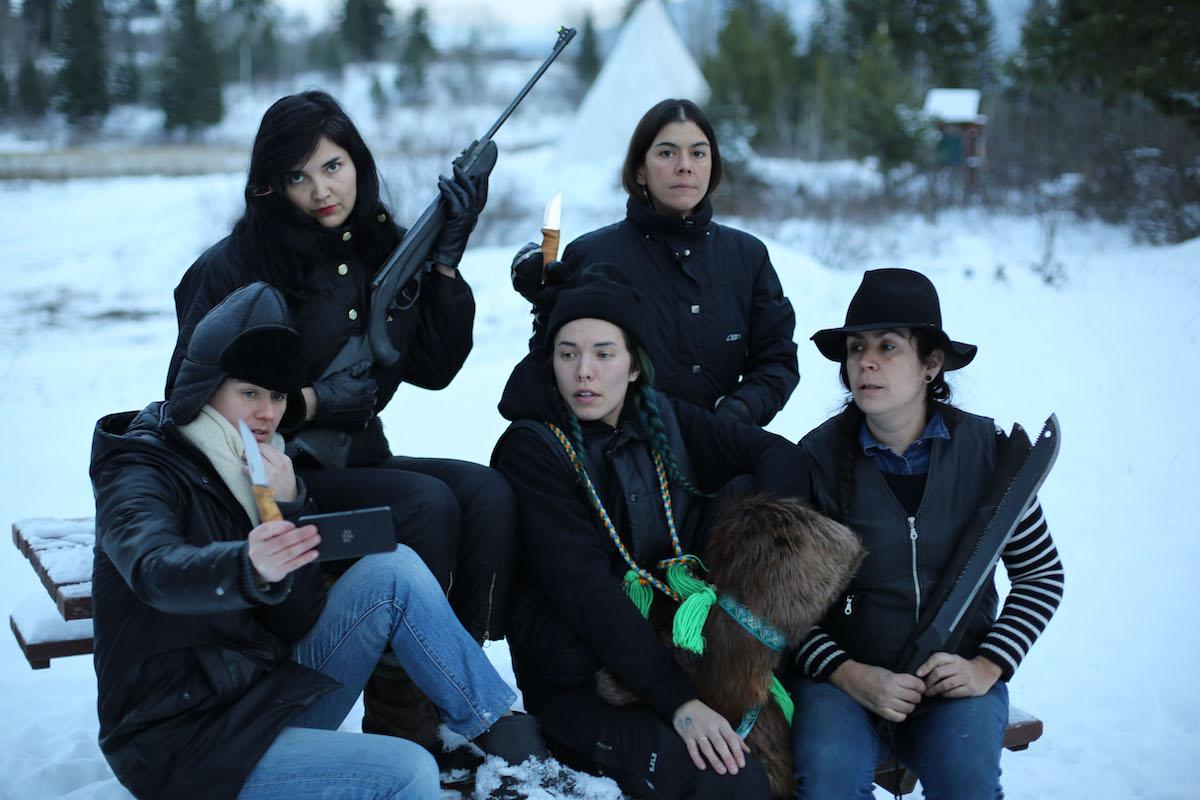
Shot on the territory of the Secwépemc Nation in B.C.’s interior, Coney Island Baby is a collectively authored film, made by four women. Focusing on skills that are often the responsibility of women in Indigenous communities, like the snaring of rabbits, the show also features sculptural installations by two of the artists.

THROUGH LINES
At Koffler Gallery (180 Shaw)
September 13-November 25

A show about “redaction” suggests the long history of political censorship; as an artistic method, however, redaction is essentially collage. As the works in this group show demonstrate, the technique provides endless scope for artists to cut and recombine materials – to bracing effect. Includes Lise Beaudry, Nadia Myre, and Michèle Pearson Clarke.

MUSEUM OF CONTEMPORARY ART, INTERNATIONAL GRAND OPENING WEEKEND
At 158 Sterling
September 22-23

The title says it all. With its move to a new location in the Lower Junction, Toronto’s MOCA is announcing the scale of its ambitions. Its inaugural exhibition, Believe, features celebrated artists like Barbara Kruger, Rajni Perera, Ange Loft and Jeremy Shaw, among others. Occupying five stories in a former aluminum factory, the show is free all weekend.

STYLL AT NUIT BLANCHE
At Scarborough Town Centre and Scarborough Civic Centre
September 29

This year, Toronto’s all-night art event includes Scarborough as a location. All projects on view in STYLL – including performances, soundscapes and projections – were made by Scarborough-based artists, or are the result of collaborations between artists and community members or groups. Artists include Hiba Abdallah (also included in the MOCA show), Reaching Intelligent Souls Everywhere (RISE), Ekow Nimako and Director X.

DAAN ROOSEGAARDE, WATERLICHT
At The Bentway (250 Fort York)
October 12-14

The Bentway presents the Canadian debut of this monumental light work by the acclaimed Dutch artist. Made from LEDs and special projection lenses, it’s part of a series of art-based installations called If, But, What If? running through November under the Gardiner. A range of public programs will accompany it.

JANET MORTON AND MORLEY SHAYUK
At Paul Petro Contemporary Art (980 Queen West)
November 16-December 22

These two solo shows help celebrate the gallery’s 25th anniversary. Morton is known for her knitted works, sometimes at building scale; Shayuk makes fine abstract paintings that often incorporate sculptural elements.

art@nowtoronto.com | @rosemheather

https://nowtoronto.com/culture/art-and-design/best-toronto-art-shows-fall-2018/

How indie art spaces are surviving gentrification in Toronto

Courtesy of Akin Collective
Akin co-director Michael Vickers leads a free seasonal public gallery crawl. Photo: Courtesy of Akin Collective.


From garages and shipping containers to members’ clubs, art galleries are finding creative ways to carve out space in the city


BY 

SEPTEMBER 4, 2018

Artists see possibilities that mere mortals tend to overlook. This is especially true when it comes to finding the space needed for making and showing their work. In today’s real estate market, affordable rental properties are increasingly scarce. As densification increases in Toronto’s urban areas, gentrification now obeys its own logic, one in which everything looks like a condo tower just waiting to be retrofitted.

Long known as first adapters of derelict sites, artists seem less central to the gentrification process than before. Instead, they are devising new ways to carve out the space they need. What follows is a list of tactics used by artists working independently in the city – a place that of course belongs as much as much to them as it does to fat cat developers.

AKIN

The Akin collective now boasts a 10-year track record of creating affordable space for artists. This includes a new partnership with the about-to -launch Museum of Contemporary Art (MOCA) that will provide studios for over 30 art professionals. The entire Akin enterprise, which includes a range of art-based programs, is funded through studio rentals – currently, about 30,000 square feet in seven locations across the city. The collective innovated a model where they rent buildings or parts of buildings on an interim basis, moving studios to new locations, as the locations they use get developed. They are having a party on September 6 to celebrate their 10-year anniversary and to raise funds to support their move into MOCA.

BUNKER 2

A shipping container located in a parking lot at Dupont and Symington, Bunker 2 is collectively run and funded on a project basis. Aside from the initial investment in the container itself, costs are kept low. As co-founder and curator Veronika Ivanova notes, this allows for “more experimentation and spontaneity in programming.”

KUNSTVEREIN TORONTO

Europe has an extensive network of Kunstvereins – art clubs, essentially – and membership comes with a modest annual fee. Toronto’s version has partners in New York City, Amsterdam and Milan. KVT’s director, the artist Kara Hamilton, reports that while they initially offered memberships, the model didn’t really fly here. Calling itself a nomadic platform, KVT today raises funds as needed, while partnering with various spaces in the city on a project basis. As important are the publications they make to accompany exhibitions.

MA MA

Launched this summer, Ma Ma is run by two independent curators, Magdalyn Asimakis and Heather Rigg. Their initial slate of programming is happening in a space in the Junction where they plan to be until November. After that they will look for a new location, also temporary. Upcoming on September 21  at their current location on 300 Campbell is a project by the highly regarded First Nations artist Tanya Lukin Linklater. Entirely financed through crowdfunding, Ma Ma is happy to accept donations at gofundme.com/ma-ma.

FRANZ KAKA/TOWARDS

These two separate galleries share a basement space on Wade Ave. Both commercial ventures, each is sustained by selling artworks. Run by artist Aryen Hoekstra and designer Kevin Boothe respectively, the galleries present separate programs on alternate months. They decided on a time-share model to lower costs and enable more freedom in programming. Additionally, Towards has an online publishing platform and Franz Kaka is participating at a number of art fairs, including Art Toronto in October.

LITTLE SISTER

Located in the alley behind 13 Mansfield Ave near College Street, this garage space is financed by its owners and through donations and art sales. The programming team shows work primarily by new and emerging artists, and foster the ad hoc communities created by the art shows. Through demand, the team has also found that private rentals of the space provide a good, if inconsistent, source of revenue.

KEEP 6 CONTEMPORARY ART

An art collector, curator and entrepreneur, Rafi Ghanaghounian has made art projects in Toronto, New York, Havana, and elsewhere. HOME AWAY HOME, focusing on the newcomer stories of Kensington Market and featuring ten artists, is his most recent venture. Launching September 6 (through September 10), the exhibition can be seen in Kensington’s parks, streets, laneways and art galleries. The show will enhance the Market’s already eclectic atmosphere with public programs, including tours, concerts and family activities.

art@nowtoronto.com

Originally published in NOW Magazine

The enduring influence of author Chris Kraus

Chris Kraus, I Love Dick Author
I Love Dick author Chris Kraus has a long relationship with Toronto, including a column for art publication C Magazine. Photo: Carissa Gallo

I Love Dick writer talks the importance of labour-of-love publishing ahead of appearance at launch for IMPULSE magazine’s interview compilation

BY ROSEMARY HEATHER

Lucky Toronto. The city is getting a reprieve from its tendency toward cultural amnesia with a gorgeous book of interviews, collected from a seminal 80s art magazine. Published from 1971 to 1980, IMPULSE was led by Toronto artist/editor Eldon Garnet and art director Carolyn White.

The book replicates the mag’s distinctive style and features a mind-blowing collection of archival interviews that includes rocker Debbie Harry, cultural theorist Paul Virilio and economist John Kenneth Galbraith. All of these figures continue to be influential in today’s culture. Equally influential is the author Chris Kraus, travelling to Toronto for the launch. A lot of her work, some of it made 20-30 years ago, is finding an audience today. Her roman à clef I Love Dick was recently made into an Amazon series by Transparent’s Jill Soloway.

Kraus also has a long relationship with this city, including a column in the art publication C Magazine, from 2001 to 2006. We chatted via email about the importance of local art scenes and labour-of-love publishing.

Is it fair to say you’re something like a literary Neil Young? You’ve managed to stay at the centre of each cultural moment you lived through by transcending it?

That’s high praise! But maybe not really accurate. I was present around the St. Mark’s Poetry Project in the early 80s, but mostly as an observer. And then again, around the earlier days of Semiotext(e). I didn’t start being active until the early 90s, and it took a couple of decades for people to take what I was doing then seriously. I think maybe some of the interest in my earlier work, like the films [1982-1996] has to do with the way they carry forward communities that no longer exist into the present.

When you say it took a couple of decades for your work to be taken seriously, you mean recognized beyond the scenes you were working in?

Or recognized at all! Hardly anyone saw the films during the years I was making them.

You say the interest in your early films stems from a curiosity about the communities that produced them. The IMPULSE book definitely carries that charge. I like that Eldon Garnet left the ads in. That context is so important. When you note these communities no longer exist, is that just due to normal churn, or is there something about our current time that is less hospitable to this type of local artistic scene?

Well, maybe both – although you should ask Eldon. I don’t think IMPULSE could exist now in the same way as it did when Eldon and his friends produced it. It came out of a moment and community of people in Toronto when Toronto was cheap. People were also very connected to the cultural worlds in New York and Europe. IMPULSE, like Sylvère Lotringer’s Semiotext(e) magazine, was a high-stakes/low-stakes game. It was a labour of love, very time-intensive and didn’t rely on grants or institutional funding. The people involved took the magazine very seriously, and it had a tremendous reach and influence.

A high-stakes/low-stakes game is the perfect way describe most art endeavours. From what you know of Toronto’s scene, do you feel it is similar to other local art communities you’ve been a part of? 

Yes – it’s famously provincial, but then, so is any art community! Even in a major city like L.A., people create little pockets of community, like Janet Kim and her friends did with their artist-run gallery Tiny Creatures. Everyone’s always saying it’s over, but these scenes are perennial.

Its hilarious and rather charming that, among other luminaries, IMPULSE did an interview with John Kenneth Galbraith, renowned advocate for the Liberal economic order we still enjoy the remnants of today. Shows the magazine was fearlessly ambitious. Should today’s art mags try similar stunts?

Yes, why not? Obviously, IMPULSE had much less to lose than magazines like Artforum or Canadian Art. The work of Eldon Garnet and his collaborators was a great example of moving with the freedom that comes from operating at the margins, rather than complaining about it. I mean, I think that’s how culture happens.

Originally published in NOW Magazine, August 31, 2018 

Sobey Art Award winner Ursula Johnson spreads her wings

The Mi’kmaw artist talks about her big prize win, moose fencing and how she became a butterfly

Photo: Rita Taylor/Banff Centre For The Arts
Ursula Johnson, Sobey Award Winner 2017/Photo: Rita Taylor/Banff Centre

Mi’kmaw artist Ursula Johnson has won this year’s $50,000 Sobey Art Award. It’s a well-deserved win in a strong year for the national art prize, which focuses on artists under 40.

It marked the first time a nominee from the Atlantic region has prevailed. At the ceremony last week, Johnson first addressed the crowd in Mi’kmaq before switching to English because “nobody can understand me but my Mom,” she said.

The speech reflected her artistic approach: opening up traditional practices so they have contemporary relevance.

A member of Cape Breton’s Eskasoni First Nation, the 37-year-old’s art encompasses installation and performance, often incorporating skills learned from her elders, like basket weaving.

Sobey Award Winner Ursula Johnson
Ursula Johnson’s installation Moose Fence           Photo: Toni Hafkenscheid

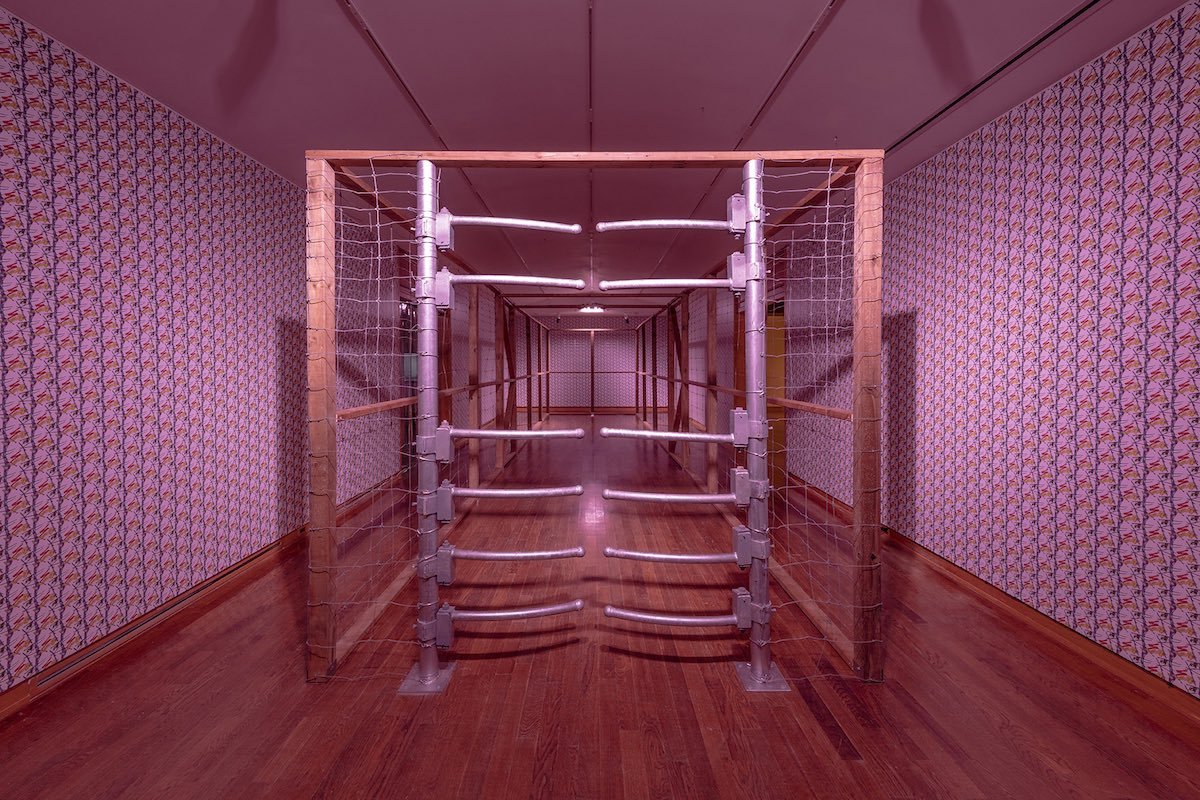
Johnson’s installation at the Sobey Art Award exhibition at U of T’s Art Museum is Moose Fence, based on fencing used to prevent animals from straying into traffic. NOW spoke with Johnson about the piece and her wider practice.

Congratulations on the win! How does it feel?

Thank you! I am kind of vibrating with excitement. I can’t believe it.

For any artist who wins this type of prize it must be a shock. It’s so separate
from what you do to win this kind of prize.

Yes. It seems more like what an athlete does – training for competition. Artists are creating things with materials or mediums to try to communicate what’s in our minds. There is no [finish] line.

I really love Moose Fence. Could you talk about it?

I’ve wanted to make Moose Fence for years now, but I needed the right space, one with an intersecting gallery to disrupt movement of people so the work could convey the idea I was interested in. This type of fence is very familiar for people in Eastern Canada. It has an ominous feel because it represents a dangerous situation for animals – specifically ungulates or animals with hoofed feet. I wanted to create that feeling for humans. I want visitors to think about these barriers we create between us and nature.

Visitors can choose to go inside the cage or not – nobody wants to be inside a cage, and neither do moose. So it points out that we have this power over animals.

Absolutely. I wanted to create a situation where people couldn’t tell at first – if they entered the cage – that there was a way out. If they are not familiar with this type of undulate gate, they don’t know it’s a one-way gate. There’s a moment of panic maybe before they realize there are also doors on the side. This introduces something that features a lot in my practice. You might ask someone to help – you collaborate.

This project also connects to your basket weaving performances. There’s one where you weave a basket so by the end you are enclosed by it. This implies you are only a part of the tradition you are working within.

My family are basket weavers. Once I started to explore this, it led me down a whole different path, being able to spend time with the elders in my community and my great grandmother and following them around with video cameras. I learned some important life lessons by asking them things like, “How does this relate to conservation practices and sustainability?”

The first time I did [the basket weaving performance] I was in art school, and I had the punk rock hair and piercings in my face. I thought, “I’m going to do something really on the edge,” and I went to ask my great grandmother if it would be okay. She laughed hysterically and said, “That’s going to be a really big basket!”

It was at an Indigenous art festival in Halifax at Dalhousie [University]. I worked for three days and struggled with it horribly. At one point, I looked up at people on a balcony who were looking down on me – these Maliseet First Nations women who were basically laughing at me. I felt so humbled and went up to them and said, “I have no idea what I’m doing. I really need some help.” They helped me and that was an important lesson. So many people engaged in this beautiful process and that propelled the entire way that I work now.

How did you get out of the basket in the end?

I fell onto the floor and lay there for a bit. Then I crawled out the bottom. I thought, “Oh, I’ve emerged from my cultural cocoon. I’m no longer a larva – I’m a butterfly now.”

BY ROSEMARY HEATHER
NOW MAGAZINE OCTOBER 31, 2017

https://nowtoronto.com/art-and-books/art/ursula-johnson-interview-sobey-art-award/

More about the 2017 Sobey Prize here.

More information about Ursula Johnson here.

Multimedia experience turned Rouge Park into a time warp

Sarah Fuller’s Illuminations is the latest artwork to question the Canada 150 time frame

Sarah Fuller's Illuminations, Rouge Park, Toronto, 2017
Illuminations in Rouge Park, Scarborough. Courtesy Moment Factory

BY 

Maybe it’s typically Canadian to have fumbled the football that was supposed to be our celebration of 150 years of nationhood. That’s one conclusion we can make about this year’s sesquicentennial events. For one thing, the focus on 150 years seems trivial. It’s a time span that disregards the histories of peoples who have been living on these lands for much longer than that. While probably not its goal, the 150 has ushered in a wider awareness of this legacy.

Most cultural events in the city now begin with an acknowledgement that they are happening on traditional, or unceded, Indigenous territory. The 150 has apparently been a catalyst for this practice to be widely adopted.

So while not exactly a bust, the most impressive accomplishment of 150 is how it expanded the discussion about who makes up Canada.

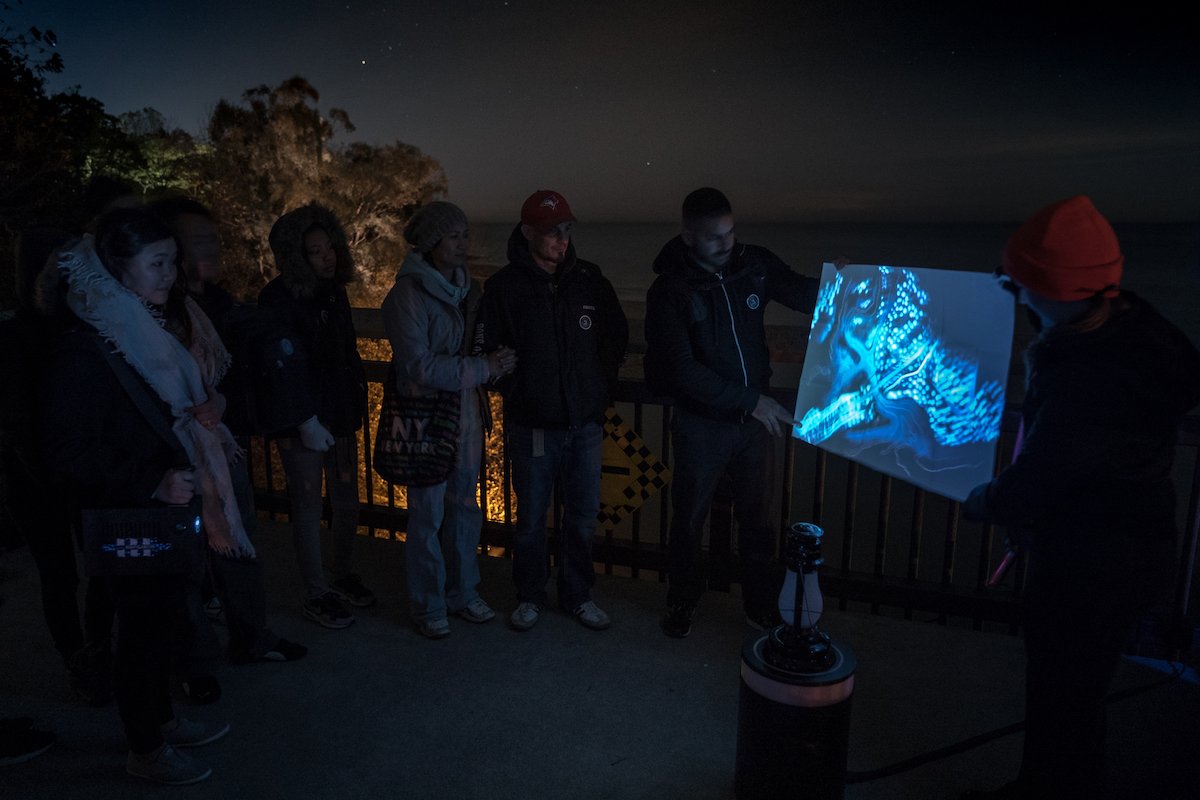
Which brings us to Illuminations, a “participative artwork experience,” that happened in Rouge Park from October 5-7. The event found its premise in questioning the 150 time frame. A collaboration between the artist Sarah Fuller and Montreal-based multimedia lab Moment Factory, the project also showed in Banff National Park earlier this month (the Banff Centre is the producer of the event).

The project sidesteps questions of nationhood. Instead, it focused on ecologies of the park that expand the celebration to a time frame of 10,000 (or more) years.

Scarborough’s Rouge Park has the distinction of being Canada’s newest national park. Established in 2011, this work in progress has long-term ambitions to become the largest urban park in North America.

It’s a gorgeous setting, one the Illuminations team clearly had no intention of upstaging. A multimedia experience presented at night in nature lends itself most readily to things like images projected onto trees using projection mapping technology – and Moment Factory is known for creating exactly these kinds of amped up visual extravaganzas.

Maybe you saw their “kinetic installations” staged for Madonna or the Red Hot Chilli Peppers while on tour? Or enjoyed the “experiential marketing” they devised for the 2014 Super Bowl, or any of myriad similar events staged globally? For their Banff collaboration, Moment Factory and Fuller took quieter approach.

Gathered into small groups, visitors received tools to mediate their experience of the park: backpacks, flashlights, maps, projectors and a lantern that activates short multimedia interludes at wayfaring stations throughout the site. At each station, the groups were told a story about the history and ecology of the park, with visitors using the handheld projectors to cast images that were accompanied by voice-over narration. It was a gentle, meditative experience.

Images of the region’s endangered Blanding’s Turtle were cast on the sand, creating a ghostly picture that reinforced the message that it’s a threatened species the park is working to conserve. The tour ends with a gathering around a fire, evoking the idea of groups who have gathered in this way for millennia – though most such groups no doubt enjoyed a real fire and not the simulated one Illuminations devised (likely for insurance purposes).

An artist with an expanded practice in photography, Fuller has done experiments in video, public commissions and collaborations with members of the public. The baseline throughout is an engagement with landscape, often in the more northern environs of the country. Her sensitivity as an artist came through in her photographs, particularly in a wry series documenting her former colleagues (and eventually herself) leaving the Banff Centre, an arts centre in the mountains where no one ever stays for very long.

Fuller has noted that 150 years is a mere speck in time when compared to “the larger continuum of geological, ecological and human history” of the country we now call Canada.

Her commitment to making the importance of this continuum evident began with the negotiations visitors undertook while navigating the park. The small gestures of carrying the lantern or pointing the projector (to show, for instance, images of the Blanding’s Turtle) suggests ideas of stewardship. The message might be subtle, but efforts to reveal the hidden ecologies of the site emphasized their fragility – and the role humans can play in either preserving or destroying them.

Aside from the somewhat forced encouragement to our group of visitors to “bond,” and a few technical glitches, Illuminations succeeded in its goal of putting human scale – and national celebrations – into perspective alongside the vast expanse of planetary time.

art@nowtoronto.com | @rosemheather

Originally published by NOW Magazine, October 29, 2017

More information about Sarah Fuller here

More information about Illuminations and the Banff Centre here