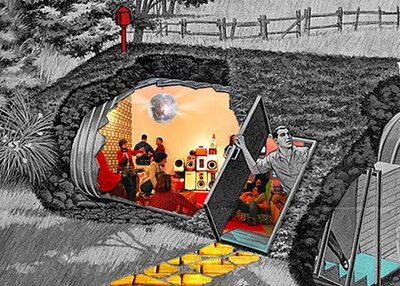
Instant Coffee, Disco Fallout Shelter, 2009, Concept collage
“For both Manet and Baudelaire, can their invention of powerful models of modernist practice be separated from the seductive and nauseating image the capitalistcity seemed to be constructing for itself?” [1]
Thomas Crow
At first, I couldn’t understand why Instant Coffee would deep-six itself into a Fallout Shelter. Their motivations for doing this seemed rather obscure to me. Weren’t bomb shelters a thing of the past? The millenialism of the gesture a little late?
A garden today more readily evokes narratives of sustainability. Whatever the state of contemporary geo-politics, there is hardly a nuclear winter on humanity’s horizon.
When I asked IC’s Jenifer Papararo about this she averred — the tale told here was a happy one, it may be “a dark fairytale…but, we are together, even under fallout.”
Ah, survival. So IC sees its future to be much like its past. Improbably succeeding, setting the agenda. Outwitting and outlasting and the competition. Still here. Ha.
And if the terminus point imagined seems a bit grim, well, artworks are never only about the artists that make them. Implicit to Instant Coffee’s Fallout Shelter project is a larger narrative about the fate of all utopias.
………..
Now clearer that my first impression had been too literal, I remembered thatI had always kind of misunderstood what IC was trying to do. And I was not alone in this.
Severed from work done in a specific medium, the zone of representation is a tricky substance from which to hone an art practice. This is especially true if you hardly bother to—or deliberatelyavoid—differentiating what you do from representation’s more mundane existence as the language of commerce.
Perhaps, too, because of the collective’s proven ability to anticipate the forms of their ongoing relevance which is on pace with wider art world trends, but may be a little in advance of their audience, the Instant Coffee project has always been somewhat misunderstood.
Throwing parties will do that to your reputation; enjoyment, for some reason, is one of the more hypocritical realms of human experience.
………..
The art show as party was the original format of IC-engineered inclusivity. In the collective’s own words, creating event-based exhibitions was a way to “renegotiate…traditional exhibition structures”. In the process, they jettisoned outmoded medium-specific hierarchies of the more traditional exhibition venues.
Self-reflexive about their own role as facilitators of art experiences, IC recognized the important part that brand identity could play to formalize the collective as a framework of possibility. Cannily adopting the language of globalism, IC staked its territory as a “service-oriented artist collective.”
The claim is funny in itself. Self-aware and proactive, it lives up to the ideal of truth in advertising, yet partakes of the peculiarly Canadian preoccupation with being nice and non-threatening.
……
To embrace a plurality of practices means to embrace the plurality of artists responsible for them. And at the point of this connective tissue, we find the core Instant Coffee ethic. Not only were collective members party people, they were people people too.
So, forinstance, in early incarnations, Instant Coffee’s parties and their predecessors — Jin’s Banana House and the Money House — used the device of the slide show to provide an easy format of participation for all invited,artists and non-artists alike.
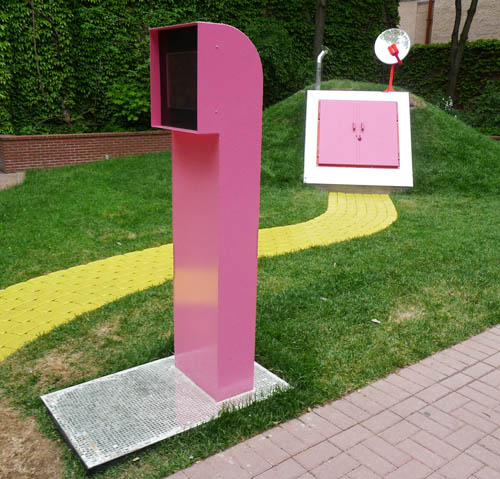
Instant Coffee, Disco Fallout Shelter, Toronto Sculpture Garden, 2009
A practical approach to curating contemporary art, Instant Coffee’s democratizing strategy was also a way to contend with the difficulty of assigning value to artworks. This is a problem, one of positively diluvial proportions, that follows in the wake of post-minimalism.
Increasingly, when de-skilled and neo-conceptual, the possiblein contemporary practice has become difficult to differentiate from the necessary.
IC’s brand-defining rhetoric energetically addressed this predicament. Starting with their name, Instant Coffee (i.e., the ersatz version), the collective declared itself a non-arbiter of value. Taste, they contended, distracted “from the fundamental reasons for ingesting either the real thing or its substitute.”
The above excerpt from IC’s manifesto—which has served as the collective’s credo throughout their career—suggests that artworks are a medium of social interaction, and in some cases a mere pretext for it; an idea which has subsequently played out in the contemporary art world at large.
In Instant Coffee terms, the figure of ‘the party’ was the refuge—and the metaphor, perhaps—for the demotion of the curatorial role. To explain the circumstances they saw themselves operating within, the collective chose an ironic voice…
Instant Coffee. No Better Than You… Instant Coffee: it doesn’t have to be good to be meaningful…
…creating a ground ripe for misapprehension; but that, too, was part of the act. Those observers who took the IC party for the main event were missing the point.
Because inventing an art scene that accommodated and gave validity to the activity of your peers was a kind of utopia – symptomatic, maybe, and expressive of a wider condition — but a utopia nonetheless.
………
It is possible to characterize ICs commitment to inclusion as a practice of extreme courtesy, an idea that is fully in keeping with the collective’s ethos. Which is why their Toronto Sculpture Garden project is a departure in more ways than one.
…
With the inception of the Instant Coffee Disco Fallout Shelter, the question arises as to who now is being served? For the outside observer, a look into the sculpture’s video kiosk reveals the collective to be inside the shelter hanging out; business, for them, as usual.
But six people living cramped together in an underground space — what kind of paradise is this?
By choosing to sequester only IC’s immediate members, and bymaking an artwork out of that decision, it is as if the collective has devolved into real personalities. They have become the artwork. It is a hard won conclusion to this story—or at least this chapter of it. The IC DiscoFallout Shelter probably has always been IC’s inevitable destination.
[1] Thomas Crow, Modern Art in the Common Culture, Yale University Press, New Haven and London (1996) p. 3.
This text was written to accompany Instant Coffee’s commission for the Toronto Sculpture Garden in 2009.
Ron Giii “During the clearance and fixation of the fourth salt man, experts found an iron stagger in the scabbard attached to his waist. Also, two ceramic jugs have been found with a kind of oil inside which, scholars believe, could have been used for a lantern.”
—Abolfazl Ali, head of Chehr-Abad research group
“To open the doors of the Atomic Theatre your eyes have to open up like a vast reservoir of water falling from another planet. Once the mind has turned inside out, the springs of time will emerge as the centre of your cognition. The Atomic Theatre takes its pulse from the antimatter of materials that exist in an unknown dimension called invisibility.”
—Ron Giii, The Atomic Theatre and The Dictator’s Opera
Ron Gillespie
Things change. A banal metaphysical statement worth reflecting on. This is especially true if you have the materials at hand to give substance to the idea. The work Ron Giii has made over the course of thirty-five years provides the perfect vessel for these considerations; in Giii’s oeuvre you can see what changes and what stays the same, much as you can in a biological body over time. This is also to say that art provides an excellent answer to the question, Where are we?
If you ask Giii, the continuities that both defy and define the present are “the antimatter of materials that exist in an unknown dimension called invisibility.” Even in this fragment from the artist’s writings there is so much to discuss, as in his work as a whole: mine deep and you will discover riches.
Ron Giii
Giii’s work presents itself at the place where the invisible meets the visible; another example of this is theatre, which like visual art takes place within a framework, or proscenium arch. As in art, theatre is the forum where antimatter becomes visible, precisely because the primary consideration of art is form. In Giii’s case, artistic form and the forum of its presentation converge in a way that is especially distinctive. Giii’s full sentence: “The Atomic Theatre takes its pulse from the antimatter of materials that exist in an unknown dimension called invisibility.”
This is a quotation from a text written by Giii to accompany a show of his drawings in New York in 1986. A wholly coherent statement about his oeuvre, the text and the show provide a good pivot point on which to consider the stages of his career. What began as performance continues as drawing, all of it taking place within the conceptual framework of theatre. In Giii’s view, theatre formalizes the process of becoming that is all of our lives. Like us, the figure within the frame or on the stage looks outward, seeks a connection with others and beckons to an audience more often than it turns its back to the world. The proscenium, like the page, presents a threshold of possibility just waiting for the moment of its random apprehension.
Uncle Ron
Looking at Giii’s art, one understands that the simple encounter is his fondest hope for it; each work provides this encounter, fulfilling this desire with imperceptible ease. The drawings live and shimmer with unimagined sensitivity. In The Atomic Theatre, Giii speaks about the figures in his drawings as real people, “laughing and hiding from me as if they had their own reality.”
Giii was already active and engaged in the Toronto scene when he was a student at what was then the Ontario College of Art (now OCAD), in the 1970s. It was a cultural moment in which the bohemian sectors of society were alive with dreams and ambitions that are difficult to fully access today. Giii’s early works provide a way in. At the time, “live art” was a fringe pursuit. In 1978, Roselee Goldberg, writing in the first authoritative study of performance, noted that it had only recently been accepted as “a medium of artistic expression in its own right.” Like other practices in the visual arts in that moment, it was a hybrid—theatre or sculpture and dance—newly unbound from traditional constraints. In common with much that happened post Minimalism, performance art found its possibility in the context of art itself.
Jimmy Algebra
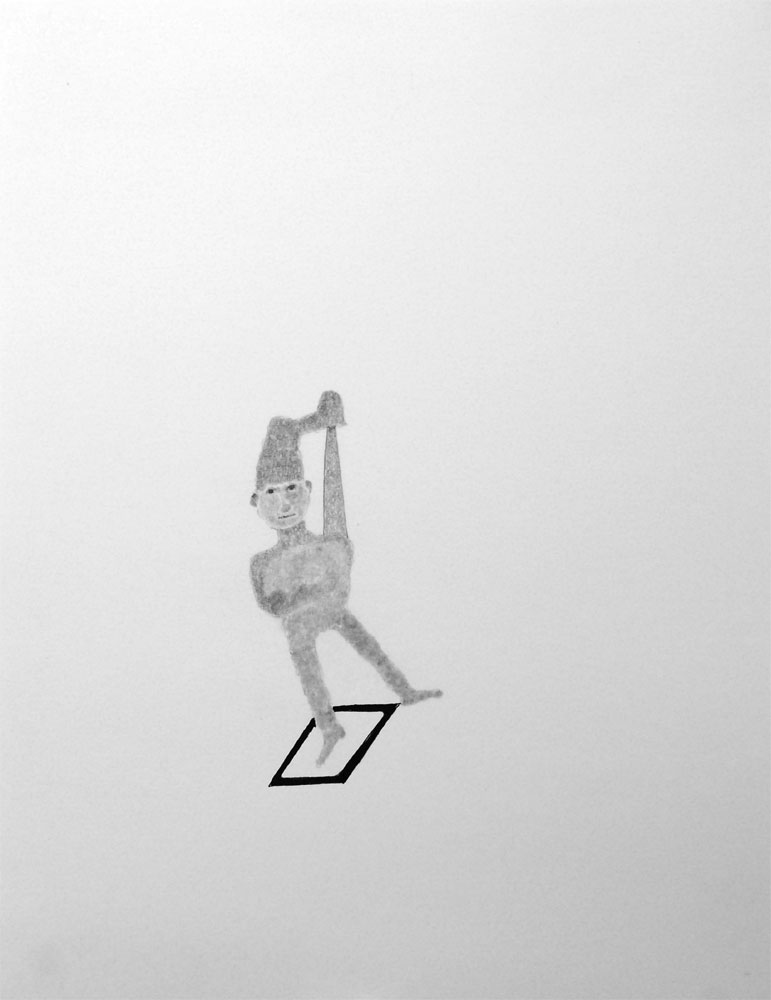
Pervading the era in which Giii first started working were the powerful cultural tendencies of political radicalism and lifestyle utopianism, not to mention the commercialism of these trends in the pop-cultural mirror, with its attendant distortion. Artistic disciplines intermingled to electric effect. Along with freedom from medium specificity and craft was an embrace of ordinary things as subject matter for art, including garbage and noise—the incidental art of John Cage and Fluxus—and, above all, people. The Happenings of the 1960s included audiences reimagined as paintings and sculptures, with the gallery as frame. In this context, real human bodies—frequently naked—had an incredible impact. Ron Giii (drawing) undated.
The shock produced by a simple encounter with a human body—naked or otherwise—and the things you could do with it, was a basic element in Giii’s art at that time. The experience could result in a psychological and sometimes physical violence. While both were still students, Kimo Eklund and Giii created the performance entity SHITBANDIT. Giii has said,
We used the name to shatter the very conservative milieu surrounding OCA . . . we did Christ on a pair of two-by-fours with microphones placed out in the street, and a used Volkswagen where males and girls got it on and they were surrounded by porn mags.
Johnny Pizza
A site for many of Giii’s early performances was the Centre for Experimental Art and Communication (CEAC) in Toronto, one of Canada’s first artist-run centers and one with a short, explosive history. Ever more and more radical in the theoretical and political platforms it promoted, CEAC eventually lost its government funding. Its many provocations gave birth to a notoriety that is increasingly obscure—and that appears to have little relevance to the activities and self-image of the Toronto arts scene today.
As part of a group of artists associated with CEAC, Giii traveled and performed extensively in Europe and the United States. A 1976 tour, for instance, took the group to Sweden, Germany, Italy and Belgium. Communicating with each other via the postal system, among other methods, rather than the Internet, they were part of the first globalized artists’ network, made possible by the dematerialization of artwork. Dot Tuer comments on the intense schedule of activities carried out by CEAC. She has noted that “during 1976 and 1977, there was literally an event held at CEAC every night of the week.” As with everything, the moment was fleeting; as Giii wrote, “The performances were wild like animals who were going extinct.”
The General
In her fascinating and very thorough scholarly essay on the history of CEAC, Tuer notes the influence of Hermann Nitsch and the Vienna Actionists on the kind of performance work Giii, SHITBANDIT and others did at CEAC.1 Self-exposure, transgression and ritualized actions formed a common thread, the goal being to orchestrate a moment of “raw” experience for audience and performer. Informing it all was the idea that confrontational art stripped away layers of falsity in consciousness and social interactions, and the naked individual in the gallery promised a return to Rousseauian innocence and/or political consciousness or some combination of the two.
While the Vienna Actionists were motivated by the desire to expose the incipient societal guilt stemming from the not-so-distant (Nazi) past, Canadian shock performance tactics had the broader target of exposing the individual’s complicity in a generally corrupt society. Giii: “After reading texts on the destruction of nature we adapted the wild behaviour and hence we entered the world of dominance, force, power and abuse.” This focus in Giii’s work continued into the 1980s in the film Taste, the only surviving example of his work in Super 8. In Taste, which was shot in a garbage-strewn alley for about $100 in 1984, Giii and Darinka, his female accomplice, subject each other and themselves to a series of ad hoc actions. By turns emotionally disturbing and theatrical, even Dadaesque, the performers’ actions have quasi-sado-masochistic overtones, but Giii’s intention in the film was to do more than shock. He makes this clear in the soundtrack, which he narrated spontaneously in a single take after the fact in complement to the film’s continuous improvisational performance. “The artist is a fascist,” Giii intones many times throughout the film, questioning the power dynamics inherent in the artist’s relationship to the audience and to the work of art. Enacting a theatrical sado-masochism in the film, Giii indicts himself, but as with the doctrine of original sin itself, this is only to declare that he is part of humanity.
Hegel’s Salt Man
In his later work, Giii’s investigations into the dynamics of power gave way to openness and vulnerability. The figures in his drawings are always tender and are rendered with the lightest of touches, like a mere breath upon the page. Frequently also present in these works is a proscenium arch; figures float inside a box or within intersecting lines that delineate geometric space. Together, the lines and the figure represent a new naked self, one that grapples with and must survive life’s intractable circumstance and that does so with moments of joy and lucidity. Another quote from Giii: “Each instance of conception is a view of a theatre that has no words nor semblance of a rational world with all its contradictions and confusion.” Combined, the early and later works compose a biographical “before” and “after,” that corresponds to Giii’s experience with bipolar disorder; the drawings belong in the “after,” which continues to this day. More striking, however, is the work’s extraordinary coherence and wholeness, as if all of it were of a piece, antimatter that was once and will be again invisible, that is available as a point of contact in this moment and yet is just passing through.
By Rosemary Heather
Epigraph Ron Giii, from his text produced to accompany the exhibition The Atomic Theatre and The Dictator’s Opera, 1984–86 at 49th Parallel gallery, New York, 1986.
1. Dot Tuer, “‘The CEAC was banned in Canada’: Program Notes for a Tragicomic Opera in Three Acts,” in Mining the Media Archive: Essays on Art, Technology, and Cultural Resistance (Toronto: YYZ Books, 2005), which can be purchased here.
This text was originally published to accompany the exhibition I curated, Ron Giii: Hegel’s Salt Man, presented at the Doris McCarthy Gallery, University of Toronto (2007) and Carlton University Art Gallery (2008). The catalogue Ron Giii: Hegel’s Salt Man: writings/works 1975-2007, featuring essays by me and Eli Langer, can be purchased at Art Metropole.
Andrew Patterson wrote a review of Hegel’s Salt Man you can read here.
A couple years later, I visit Second Life again, this time with a more ‘legitimate’ destination. I am going to RMB City, a project of the Beijing-based artist Cao Fei. Still my experience is much the same. Where is everybody? I am suffering from a disjunction between real the virtual, a dynamic Cao Fei had explicitly set out to explore. My experience helps to shed light on the problem, but it’s of the unintended sort. If my navigations through the world of Second Life are cumbersome and alienating, it’s because I have a sub par computer. It’s an issue of processing speed. Inadvertently perhaps, Cao Fei’s ambitions in Second Life provide a metaphor for the looming dilemma faced by the West. We are lagging behind but lack the drive needed to overcome this predicament.
Disjunctions between the real and virtual worlds, often unintended, also dominate the Residency in RMB City project. Because it is located in the Japanese Canadian Cultural Centre in the Toronto suburb of Don Mills, the Gendai Gallery is somewhat hard to get to. With this exhibition Gendai curator, Yan Wu, puts the venue’s peripheral status to good conceptual use, proposing a show that can be, in part, accessed by computer. Working with the artists, Adrian Blackwell, Yam Lau and the collaborative duo of Judith Doyle and Fei Jun (known as GestureCloud), Wu creates an exhibition that combines a gallery presentation with digital artworks created for Cao Fei’s Second Life property.
Made up of an amalgamation of references to Chinese architecture, RMB City features the Herzog and de Meuron Bird’s Nest along with shiny skyscrapers, motorways and sidewalks, warrens of small shops selling take out food and the like, all of it organized around the central structure of the Forbidden City, Beijing’s Imperial Palace, which dates from the Ming Dynasty. Although Cao Fei promotes her project as a platform for artist collaboration, miscommunications meant that Wu found her initial proposal to create an artist residency in RMB City rejected by the artist. Further communications remedied the situation; as of press time, the artists are soon to begin moving their projects to the Second Life location. In recognition of the changed status of the project, this second phase will now be termed Intervention into RMB City. A publication about the project, called From Residency to Intervention will be published in the spring.
In the Gendai gallery, Blackwell presents Lóng Sùshè (Dormitory) (2011) a plywood maquette of a workers’ dormitory proposed for RMB City. Trained as an architect, Blackwell has lived in China, teaching architecture there at an offsite campus of U of T. With Lóng Sùshè he provides infrastructural context for Cao Fei’s metropolitan fantasy. An interest in sculpture as a platform for public discourse has been the long term focus of Blackwell’s practice. Referring to an actual dormitory in the industrial region of Shenzen, one that is continually being built in an effort to meet the growing demand for worker’s housing, Lóng Sùshè, helps to clarify certain questions that will emerge along with China’s growing economic dominance. What kind of public will China’s new global order create? How easily do traditions of the West translate, and are they even relevant? The notion of a public sphere is amongst the highest ideals of a functioning Democracy, but it’s not clear how it will figure in a country that has little in the way of democratic traditions as they are known in the West.
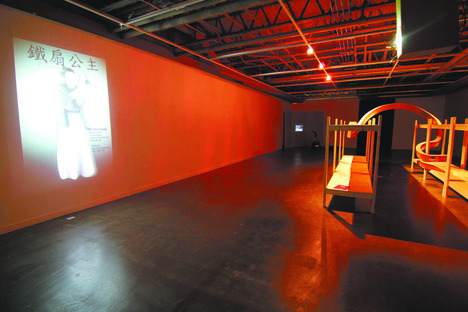
Writing about the legion of workers that power the engine of China’s economic expansion has become a journalistic trope in Western reports about the country. China’s nineteenth century industrial conditions are a subject of some fascination in the West. Such reportage helps provide a salve for the conscience of those enjoying the products of cheap Chinese labour. Judith Doyle and Fei Jun’s GestureCloud (2011) uses the space of Second Life to rewrite this narrative, to great critical effect. In place of the whole, but nameless, Chinese worker, the artists create a virtual inventory of the gestures factory employees are forced to repeat, ad infinitum, when doing their job. Based on video documentation of the duties performed in a printing factory in Beijing, GestureCloud represents these workers in terms of their real world effects. This distillation by the artists’ creates clarity: like everybody, really, in global economy, the factory workers are mere nodal points within a vast system — or to borrow a 19th century metaphor, cogs in the machine. As with other multi-user online environments, Second Life has a real world economy, money changing hands in the form of Linden Dollars (San Francisco’s Linden Labs is the company behind the site). For the RMB City stage of the project, these gestures will be available for purchase via a vending machine in Second Life, the animations being useful presumably for avatar-related Second Life labours. Gesture Cloud’s ultimate ambition is to return the money they make back to the factory workers in Beijing. Residency in RMBCity installation: Yam Lau, Princess Iron fan (l), Adrian Blackwell, Long Sushe (r)
One translation of RMB City is Money Town; a mordant commentary on the breakneck pace of economic development in China, Cao Fei’s project also creates a narrative for the transition China is currently undergoing — and the implications it has for the rest of the world. Anyone with a computer and an internet connection can use Second Life; the language of software is more or less universal. With Princess Iron Fan (2011), Yam Lau gives expression to the heterogeneity of elements from which this new Global culture is being constructed. Princess Iron Fan is character from a Chinese folk tale, adapted for a film of the same name, which was the first animated feature film made in China, in 1941. Lau adopts the figure of Iron Fan as it appeared in the 1941 animation for his Second Life avatar, but with important alterations. Presented in pleasingly anachronistic black and white, the avatar is given certain ghostly characteristics. It is visible from the front but not the sides or back; the artist slyly attributes vaporous qualities to a thing that already has no substance. In the gallery, the projected animation appears from time to time, mimicking the avatar’s movement through the virtual world; in Second Life, Princess Iron Fan is programmed to similarly ambulate around. However, she never appears in both places at once: Princess Iron Fan is perpetually destined to exist on the threshold between the virtual and the actual. In metaphorical terms, the virtual animation of a Chinese folk hero points to the changed cultural landscape that will characterize the 21st century – an expanded world no longer necessarily bound by Western ideas or traditions.
By Rosemary Heather
Residency in RMB City is a project of Gendai Gallery, Toronto.
This text originally appeared in Bordercrossings, Issue 118.
Melanie OBrian (foreground), Elizabeth Milton (centre) and Colleen Brown.
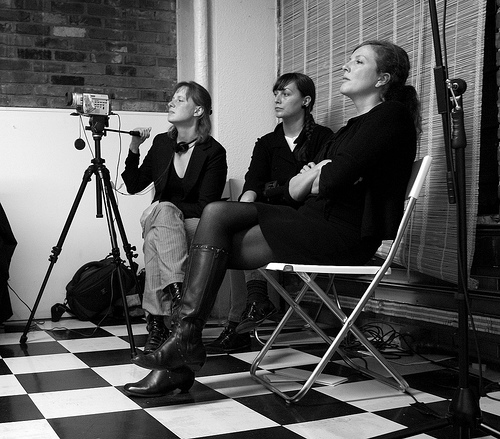
Melanie O’Brian, Director/Curator of Artspeak in Vancouver for the past six years, recently moved to Toronto to take up the post of Curator & Head of Programs at The Power Plant. With this appointment, O’Brian makes the shift from what’s known in Canada as the artist-run sector to one of the country’s major venues. We spoke over email in March, 2011.
RH: Your professional career up to now has been firmly rooted in Vancouver. How do you think this experience will translate to Toronto? Do you expect to shift your priorities, or will you continue with the type of programming you developed at Artspeak?
MO: My goal is to maintain a strong foundation in the local while intersecting with international practices and dialogues. My programming interests regarding site will undoubtedly shift at The Power Plant. At Artspeak I addressed the institution’s mandate to reflect a dialogue between language and contemporary visual art and I also extended the program outside of the limited confines of the gallery. Through the OFFSITE program (2008-2010), I took artists’ projects into various ‘public’ situations using the street, parks, print, large-scale advertising, building sites, the postal system, etc. While I certainly maintain a desire to do offsite projects in Toronto and address contextual specificities, the institutional spaces at The Power Plant will allow me to initiate projects that would never have been possible at Artspeak.
RH: Speaking about OFFSITE, why do you think art institutions feel the need to develop audiences beyond what you refer to as the “confines” of the gallery? Is this tendency artwork-driven or institutionally-led?
MO: Artists are engaging strategies that re-activate wide cultural, political, and economic discussions within the process of art production and its reception. Institutions are encouraging this activity, often arguing that the audience for contemporary art is wider than ever before. But only a select audience overtly sustains contemporary art’s dialogues. Contemporary art is intersecting with audiences on multiple levels from the gallery to the street, from the blockbuster to the festival, from the biennial to the incidental. Perhaps the spectacularization of contemporary art’s presentation is a point for discussion?
RH: Toronto has a wildly successful Nuit Blanche event, presenting public art works across the city for one night. It attracts an estimated audience of one million people. The number one criticism of the event is that it tends to feature spectacular artworks. This could be seen as pandering to the crowd, or it could simply reflect the changing nature of art. Any thoughts?
MO: These types of events are increasingly common, whether autonomous or embedded in the Olympics. They do not necessarily reflect the changing nature of art, but rather the changing nature of the art system.. Art fairs, biennials, and other large scale spectacles provide a point of comparison. They are formats that often request, if not demand, art that competes with or withstands the spectacle. I might add that in what could be touted as a post-relational aesthetics, post-participatory moment, artists and artworks must not just engage with the art system, but intervene in it and question it productively.
Interview by Rosemary Heather
This text originally appeared in the May/June 2011 issue of Flash Art.
Melanie OBrian is the Editor of Vancouver Art and Economies, an anthology of writing about the Vancouver art scene, which can be purchased here.
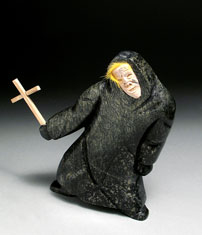
Samonie Toonoo, Missionary Man, Stone, antler, fur 9” x 8.5” x 2” (2007)
Ransacking the past, while denying any knowledge of it, has always kind of been the program for artists. Suppression of your antecedents is a good way to create a neat little package from your own historical moment. This was also true of pushed-to-the-sidelines non-Western traditions in art. A recent show of Picasso’s work at the Metropolitan Museum of Art in New York, for instance, gave viewers an eye-opening if perhaps not entirely intentional look at adjoining rooms full of his African and Oceanic source materials.
Not that it matters much at this point. Our own historical moment has a rather more pressing need to seek out continuities with the past and other artistic traditions. Motivated by this impulse, Scream helps to dismantle another long-standing partition, between Inuit art and contemporary practice. Scream is a companion exhibition to last year’s Noise Ghost, which featured Toronto’s Shary Boyle and Cape Dorset artist Shuvinai Ashoona, and takes a similar approach, pairing Ed Pien with Samonie Toonoo, artists who reside in the same two respective locations. Resonances in their work begin with an interest in the figure; it is a common denominator that points to a primordial intelligence always at work in art. Curator Nancy Campbell makes this reading explicit by titling the exhibition after the famous painting by Edward Munch. She connects three points on a map rendered in space and time. As the show makes apparent, once these connections are drawn, certain assumptions start to become undone.
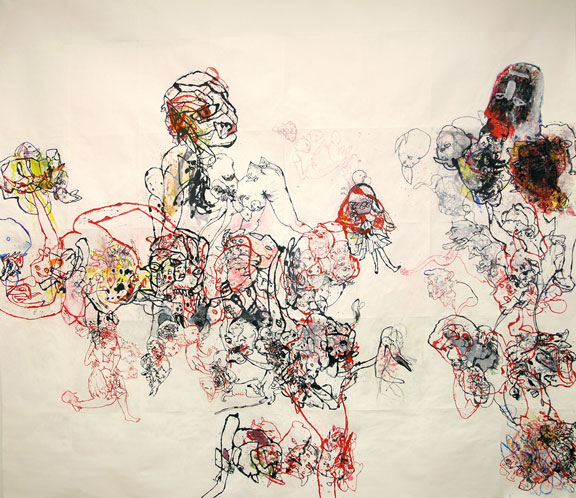
Ed Pien, The Offering, ink and Flashe on paper, 152.5 x 171.5 cm (2009)
The expressive potential of the figure is powerfully put to use in Toonoo and Pien’s work. Toonoo presents stone carvings, embellished with detailing – of a fur fringe on a hood or a face, sometimes a skull, carved in bone. Each carving tells a story, often tragic. Pien’s drawings are created through a process he calls monoprinting. Taking quickly drawn sketches in coloured ink, he creates overlapping compositions with the wet ink applied to fresh paper, often placed on top of other drawings, or cut out and collaged together. Combined into large densely layered composite pictures, the effect is mesmerizing.
By strictly adhering to the elements of line and color, but at the expense of volume, Pien creates drawings that look stencil-like, and further evoke the ancient art of Chinese brush drawing. Pien is an Asian-Canadian who immigrated to Canada from Taiwan at the age of 11. While reminiscent of Chinese art traditions, the artist reports he developed the monoprinting process in the course of his art practice. The technique is entirely his own. Born into a family of artists, Toonoo has deep roots in the artmaking traditions of his people. He adds embellishments to traditional-looking stone carvings, such as a figure brandishing a wooden hockey stick, or cross hung around the neck of a hooded figure, to clearly place his work in the contemporary world. Detailing allows Toonoo to align obdurate stone and Inuit carving techniques with drawing, and drawing’s aptitude for editorial commentary.
Loss of a need for boundaries, between not only artmaking epochs but also artmaking traditions, suggests we have arrived at a historical moment free from pastiche. Instead, artists are seeking out the terms for a deeper kind of renewal. Once again art proves its relevance as a prognosticator of what is to come: a loss of dominance for the West in a Globalized world.
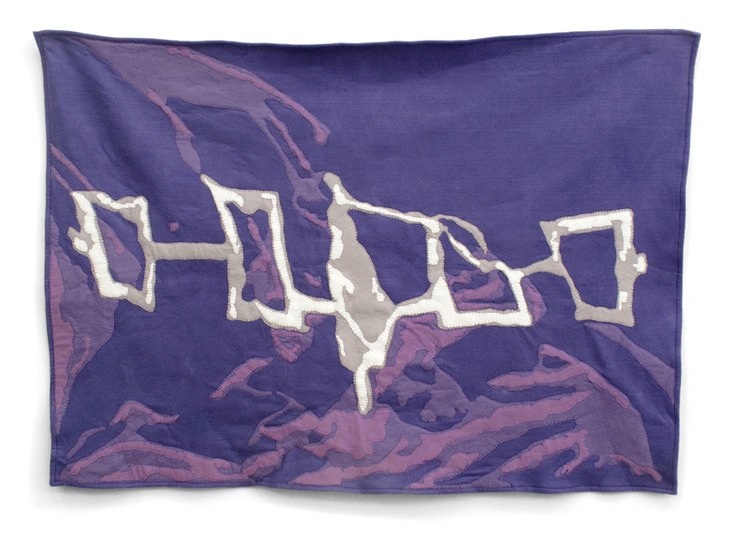
Miles Collyer makes felt flags based on images he finds online. Few works of art convey ideas about the world we live in so effectively. Today, a flag could stand for the frivolity of a regatta, or the half-serious declaration of micro-nationhood. Collyer chooses to focus instead on symbols of political conflict; flags that express the statehood aspirations of disenfranchised groups. In the single video he showed at Toronto’s G Gallery, Collyer painted a pennant black and animated it, making the felt triangle appear menacing. It was the only flag that flew in the show, and it clearly announced what territory Collyer wants to claim as his native ground.
We live in a world where images condense territories, which is also a good definition of the Internet. Recreating found images as life-sized replicas in felt, Collyer takes particular interest in the distortions that data transmission brings. Working from digital files, Collyer matches the crudity of pixelation with his chosen material’s lack of finesse. With meticulous care, he sews chunky, abstract artworks. The ripples of a flag that once flapped in the wind are given form as a layered, two-dimensional object. The result is eerie: the flag’s distortions lack detail, and thus take on the contours of a topographical map. Subjected to a multi-step process of translation, Collyer’s works continue to convey a message about their origins. The effect is an uncanny one, which brings to mind the Surrealists’ belief that they could find beauty and truth in a flea market.
Collyer trained as a photographer, and this work is ultimately an investigation into the power of the photographic image. In a previous series of photographs, Collyer confronted this issue directly. He took portraits of himself wearing a variety of coloured knit balaclavas he had found in thrift stores. Even when styled as a fashion statement, the balaclava speaks the language of political insurgency. The images Collyer made cannot escape this implication; they draw resonance from the idiom of 21st-century terrorism.
Miles Collyer, Haudenosaunee, felt and thread (2007)
With his flag series, Collyer looks at the politics of the image from a different angle. The innocuousness of felt neutralizes the political flag, and yet its message remains undiluted. This is not because his audience knows much about the political struggles of, say, the people, whose flag Collyer has used as source material. Rather, it is because the picture frame flattens and condenses information into form. Flag symbolism is cultural expression at its most basic or, dare I say, primitive; this is why Collyer can create soft, distorted versions of the real thing and still find that they pack a powerful, atavistic punch.
By Rosemary Heather
This text originally appeared in the Spring 2011 issue of Canadian Art.
You can find more info about Miles Collyer here.
A bemused and slightly anxious film, Daniel Cockburn’s first feature You Are Here(2010) is a perfectly concocted expression of everything we don’t understand about our new century.
Fitting for a movie that features the viewer in its starring role – the “you” of the title – a central character in Daniel Cockburn’s You Are Here (2010) is the aggregate entity ‘Alan’. The film creates Alan by layering in quick succession, shots of different men and women performing – or failing to perform – a series of small actions. Cockburn uses this device to displace the viewer identification that typically drives a film’s narrative. Meanwhile, a voice muses about the fragile nature of identity. “Are you the same person before and after putting something down and picking it up again?“
The fusion of art with everyday life has been a perennial ambition of contemporary art, but today it seems forgotten. An obvious explanation: this goal has already been achieved. The future as predicted by the avant-garde is here, in other words. The signs for this are ample, if poorly organized in the contemporary psyche; futurologist Alvin Toffler has made a career out of the insight that the rate of change in the West far outstrips our ability to adapt to it. Even if the avant-garde’s penchant for prognostication is now a thing of the past, art continues to be adept at creating the templates to help us recognize change, to see the reality of it. For a template close at hand, look no further than the work of Toronto artist, Kelly Mark; or rather look to the artist, Kelly Mark, fusion of art and life.
Tracing her history, it is easy to see how the changes undergone within Mark’s art-making parallel changes undergone within the wider culture. Starting out a hardcore conceptualist, the art she makes today has more in common with what Mark terms, “re-creativity”; this shift in thinking about her practice is in part inspired by the wholesale changes in culture being wrought by digital technologies. All the while, the work she produces retains the elegance that only the formal solutions found within art can provide.
An artist of prodigious output, Mark’s artworks bear the distinctive attributes of Canadian East Coast conceptualism. Originating at the Nova Scotia College of Art and Design (NSCAD), this is a legacy that begins with the 1967 appointment as Director of Garry Neil Kennedy, himself an inveterate conceptualist. Kennedy’s 23 year long tenure transformed the school, in part because he initiated a visiting artist program that featured leading-edge practiconers of the moment, including Vito Acconci, Dan Graham and Sol Lewitt. The rugged costal outpost of Halifax proved to be an ideal backdrop for the imagining of the spare de-materialized artworks characteristic of first generation conceptualism. This combined with the 1972 launch of NASCAD University Press, which published monographs by influential artists’ like Michael Snow and Yvonne Rainer, helped to cement the school’s reputation, one that lingers to this day.
Sol Lewitt famously described ‘the idea’, the core attribute of conceptualism, as the “machine that makes the [art]work.” In its purest form, this type of practice can consist purely of verbal statements, either written on the wall, as in the declarative sentences of Laurence Weiner, or existing as a set of instructions, as in the Fluxus-aligned work of Yoko Ono. Although seemingly easy to do, the difficulty of making artworks in this vein finds its best summation in the colloquial expression, “ideas are a dime a dozen.” Because it begins with an idea, the conceptual artwork is necessarily anchored in the person of the artist. For such an artwork to become ‘real’, the artist must be unwavering in their commitment to the concept that makes it possible, maintaining it in whatever way is necessary.
The performance-based works by the German artist, Tino Seghal, for example, are only realized in the moment of their enactment by performers hired by the artist, and are never documented. Forbidding any images to be made of his work ensures that Seghal remains the final authority of their verification; they ensue from and return to him, as it were. Seghal’s work represents one extreme of conceptualism’s contemporary legacy. Works by Kelly Mark on the other hand have more in common with minimalist strategies for art making, but employ a similar steely resolve in the use of self to establish their veracity.
Like a Donald Judd sculpture, many of Mark’s works’ find form through repetition. In the ongoing performance, In & Out (1997-), Mark punches a time clock installed in her studio every time she starts and finishes work since 1997. That her studio doubles as her living space points to the fluidity the artist sustains between the two modes. The punch clock performance stands as a wry commentary on how very thin the dividing line is between the two for the artist. Adding a further dimension of self-deprecation to the piece, since 1999 it has been owned by the Toronto collector, Dr. Paul Marks, meaning that Mark, in effect, has a “boss” who pays her on a yearly basis for the work. Currently, employer and employee in this arrangement are looking for a buyer for the piece, preferably by a Canadian art institution that has the vision to match Mark’s long-term commitment to her art.
In & Out is an update on Tehching Hsieh’s Time Piece, one of a number of year-long performances enacted by the artist. Originally from Taiwan, the New York-based Hsieh punched a time clock once an hour, every hour, for a year, from April 11th, 1980 through April 11th, 1981. Each time, he documented the performance by taking a picture, resulting in a 6 minute-long stop-motion animation. Hsieh counts only six pieces in his body of work as a whole, all of them employing a combination of declaration (“I will…”) and action that often involved extraordinary feats of endurance (perhaps most famously, he spent an entire year tied to the artist Linda Montano by a rope, the two never touching.) His use of the calendar year to structure each performance gives his work a conceptual clarity, one that invites his audience to contemplate the meaning of time and the arbitrary nature of our frameworks for measuring it.
Mark has said that her own time clock piece will continue until she “retires.” Itself a work of endurance, In & Out resonates with certain conditions in the contemporary world in a way that distinguishes it from Hsieh’s Time Piece. If Hsieh’s work, in its conceptual purity, is the art world equivalent of the Great Wall of China as viewed from space, Mark approaches the goal of marking her time as an artist from a less exulted perspective. In a related performance that has been ongoing since 2003, she often wears a dark blue nylon windbreaker in public, sometimes in combination with a peaked cap each embroidered with the word, “Staff”, which is also the title of the work. For its humor and the insight it offers into Mark’s choice of art as a profession, a statement posted on her website about it is worth quoting in full:
“I tend to show up late. I usually leave early. I take long breaks. I have issues with authority. I don’t follow instructions. I don’t work well with others. I drink on the job. I complain a lot. But I’m always working…”
By her own account, she is a ‘bad’ employee, but the job requires nothing less than her full commitment. Setting herself up as an ‘art worker’, she comments on the 21st century conditions of both work and art. She is “always working” and yet, at least in the case of In & Out, faces potential job insecurity. Saving the artist from the prospect of ever experiencing real joblessness, however, is the purpose she applies to the tasks she sets herself, one that gives a whole new meaning to the term: ‘self-employment’. For Mark, art is not a job, it’s a vocation.
Mark’s refashioning of first generation conceptualist heroics into the register of mundane serves as a comment on the banal status of the object in contemporary art. This is a utilitarian approach to art making which privileges not the unique object but any ‘ready made’ substitute thought suitable for making the artist’s point. It’s a type of practice that dates back at least to Duchamp, although the use of what Clement Greenberg termed “extraneous elements” in collage, such as pieces of newspaper or graphics from commercial advertising marks perhaps the first appearance of the ‘everyday’ in art. In an early work, Mark used a thimble to count grains of salt. Arriving at the number of approximately 52,000, she then used this figure to create Pillar: 100 Million Grains of Salt (1997). Composed of stacked identical sets of filled salt shakers, of the variety you would find in a greasy spoon, the work resonates with the readymade, minimalist practice, and the biblical story of Lot’s wife. It also demonstrates how conceptual rigor combined with the fact of sheer repetition can push meaningless activity–like counting grains of salt or punching a time clock–over an invisible line to a point where it accrues meaning within the field of art.
Early conceptual practice was often said to be engaged in a process of “dematerializing” the art object. In its immateriality and indifference to traditional forms of art-making it was thought to represent a kind of resistance to the art market. Considered thirty odd years after it began, however, conceptual art looks to have a wider ramification, that is: as a prefiguring of the very dematerialization of Western culture into the virtual world we semi-inhabit today.
Across her practice, Mark makes free use of whichever conceptual strategies she chooses, in which ever combination she finds useful. In the 20th century art parlance, such a bold repurposing of the work of one’s predecessors was given an oedipal narrative; aesthetic innovation required a certain degree of disrespect and even patricide of what had come before. Now it looks as if not only works of art, or oeuvres or traditions of art-making are under threat, but that an entire cultural order is coming to an end. The difficulty experienced by the music industry in preventing the sharing of music files on the internet is the most tangible symptom of this change; fatally undermining the argument that, although freely available digital music files should be paid for, is the ease with which new technologies abet such activity. Mark’s polyglot practice indicates the artist holds a similar viewpoint on ideas about ownership: conceptual strategies are in the ether, free for everyone to use. This is the obverse side of the readymade coin, and is an attitude given guileless expression on the button Mark occasionally wears and has been informally distributing since 2003 that says, “Everything is Interesting”.
The idea that everything is potential subject matter for art suggests that the postmodern dismantling of the dichotomy between high and low cultures has reached a point of synthesis. The culture we currently live in has a tendency towards the immersive; we are all insiders now, sophisticated manipulators within the spectrum of codes history has left to us. Many of Mark’s more recent works address this condition. Embodying the idea of the immersive is Glow House, a work that Mark has created three times in three different cities (Winnipeg, Birmingham and Toronto) since 2003. In it numerous TV sets are placed in every room of a house acquired for the project, all of them tuned to the same channel. Looking at the work from the street at night, viewers see the house gently pulsing from the collective glow of the TV monitors. Taking her cue from the televisual flicker that emanates from residential neighborhoods every night, Mark metaphorically accumulates the ether of our communal entertainments to create a gorgeous, evanescent artwork.
Writing about the project, Toronto artist and curator Dave Dyment notes that, “we rarely think of televised images as made of light.” From this initial perception, Mark has gone on to make a number of works that use TV light as a source material. In the Glow Video Installation Series(Horror/Suspense/Romance /Porn/Kung-Fu) (2005), she records the pulse of light from different film genres as it is reflected off the wall. The films that result are then presented on monitors as sculptural works. Installed a number of different times with the monitors positioned back to back or pointing towards the ceiling, each permutation of the work is titled according to the film genre of its original light source, the different genres creating different perceptual experiences in rhythm and light. That the experience of TV is no less seductive with its content removed, speaks to a mass cultural preference for to live in a netherworld made up of molecules of light.
Writing about the effects of mechanical reproduction over 70 years ago, Walter Benjamin theorized that mass entertainments created a new form of reception, cinema viewers absorbing a film in a way that did not require their direct attention. Itself a kind of prophecy of the eventual fusion of art with everyday life, with the advent of digital technologies, this cultural capacity for distracted apperception has been multiplied tenfold. Mark’s epic work REM (2007) recreates this experience using cinema as its source. Over two hours in length and compiled from over 170 films and TV shows, REM creates a composite feature film from disparate clips she recorded off the television. The narrative presented is coherent because by definition film genre provides the building blocks of storytelling. Watching the work, however, it soon becomes apparent that a semblance of coherence is all that is required; in REM following the ‘narrative’ is akin to the experience of being adrift in your own thoughts. The work is a parable for our culture lost inside the figments of its own imagination. Like her practice as an artist as a whole, it brings a syncretic intelligence to bear on film detritus to bring us the insight that our culturebelongs to us. In the subtle shift in thinking that is required to grasp this idea is the future of our culture, one that we already living in today.
This text orginally published in Canadian Art, Winter 2007.
Andrew Reyes. All that is, 2004, The Balcony, Toronto
By Rosemary Heather
Art is the great provider of context, which is the primary feature of its contemporary practice. Anything can be art, provided certain conventions of its presentation are observed. This makes art practice like a sport in which participants test the limits of what its context can absorb. James Carl’s Balcony project in Toronto’s Kensington Market offers precisely this kind of opportunity for a gamesmanship of artistic ingenuity. An improvised billboard space, Carl shows work screenprinted on Coreplast, attached to the exterior of his second floor balcony, a site that overlooks a small park in the city’s downtown. Because it must adhere to no commercial imperative, the Balcony offers artists a relatively unfettered occasion for public address. Judging by past efforts, most artists chose to speak to their de facto audience in only the most oblique fashion, referencing instead trends in contemporary art in a way that resonates with the context and speaks to the interests of the informed art viewer.
By contrast, for his Balcony project Andrew Reyes devised a way to push further against the limits of the art context that at the same time quite possibly obliterates it. Silver letters on a chocolate brown background present a new-agey exhortation that begins with the sentence: “Our deepest fear is not that we are inadequate/ our deepest fear is that we are powerful beyond measure…” According to Reyes, the quotation is commonly attributed to Nelson Mandela, but was in fact written by the Californian new age writer Marianne Williamson. A popular author of spiritual self-help books, Williamson has built a saleable life philosophy around the idea that happiness appears when we “let go of fear”. This Manichean idea – recognize that fear is in battle with love in your heart and you too can be a victor in life – seems a plausible, if somewhat general, analysis of what’s wrong with the world. Widely distributed on the net, the quote’s misattribution to Mandela speaks of a popular consensus about the import of the sentiment it expresses and the inspirational values the figure of Mandela represents – although it is doubtful that Mandela would speak about one’s duty to be “gorgeous, talented and fabulous”, as Williamson does.
The 16th Balcony project since its start in 2002, Reyes use of a quotation is, in the context of what Carl has previously shown, a novel strategy, prior projects that used text choosing to employ either slogans, like Ross Sinclair’s “I Love Real Life”, or in the case of the Icelandic artist Hlynur Hallsson, a single word: “Yes”. Reyes states that his intention was to present something “instantly recognizable and accessible”. A most common-sense use of the site, the text is also self-explanatory, dispensing handily with the need for the interpretive framework known as art. Preserving a smidgen of ambiguity that tethers the project back to its art provenance, the quote appears on the balcony without note of its authorship. Reyes does this presumably in reference to the history of its confused origin, but also because it doesn’t need it. The statement is sufficient in itself: What the world needs now is love. By using Williamson’s text, and quoting her in full, Reyes crosses over from the vagaries of art into the realm of readily intelligible meaning. In the process, he risks appearing sincere, not a known tendency in the artworld. But then maybe that is his point? When he says that he “liked the idea of bringing unusual content to an unsuspecting audience” you have to wonder who he thought would be unsuspecting? Surely not the guy Carl saw standing in the street last week, copying the text down into his notebook.
This text orginally published in Canadian Art, Summer2005.
Well, Googie in Super 8½says “I don’t give a damn about continuity.” And it is kind of a luxury, continuity. Because you have to have a person who is specifically hired to do that job and you really need someone who knows what they’re doing. The person who was doing it on Otto had no clue what she was doing and she’d never done it before and she would come to me and explain all the continuity errors of a scene that I just shot after the fact. And I’d be like, “Oh well, thanks for telling me now”. After everything had been shot…



 Rosemary Heather