Writer. This blog is an archive of things I have published elsewhere. Mostly these texts are about art. Other topics include Political Populism and blockchain.
A bemused and slightly anxious film, Daniel Cockburn’s first feature You Are Here(2010) is a perfectly concocted expression of everything we don’t understand about our new century.
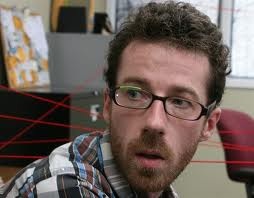
Fitting for a movie that features the viewer in its starring role – the “you” of the title – a central character in Daniel Cockburn’s You Are Here (2010) is the aggregate entity ‘Alan’. The film creates Alan by layering in quick succession, shots of different men and women performing – or failing to perform – a series of small actions. Cockburn uses this device to displace the viewer identification that typically drives a film’s narrative. Meanwhile, a voice muses about the fragile nature of identity. “Are you the same person before and after putting something down and picking it up again?“
The Autobiography of Nicolae Ceausescu, Andrei Ujica (2010)The 2010 edition of the Toronto International Film Festival (TIFF) seemed particularly hysterical. Toronto crowds have proved reliable predictors of future box office success – Slumdog Millionaire (2008) was rescued from straight-to-DVD obscurity at TIFF, and Precious (2009) was an audience favourite here before becoming an Oscar contender. It’s a track record that contributes to the sense that TIFF has arrived, it now being considered second in importance only to Cannes in terms of industry weight. Burnishing this image is the glamorous new TIFF Bell Lightbox, home to the festival and the branding of its corporate sponsor Bell, the hated pretty much by everyone Canadian telephone conglomerate. Not that we live in an age where anyone cares about this kind of thing. One of the main venues for TIFF screenings was a big commercial movie complex that is mystifyingly (to me at least) branded with the name of a bank. Regardless, the Lightbox is a glorious addition to the city’s art ecosystem, a reassuring sign that, better late than never, Toronto has caught on to the prestige and economic power that culture can bring to a city.
Apichatpong Weerasethakul, A Letter to Uncle Boonmee, Thailand 2009
The 35th Toronto International Film Festival 2009
by Rosemary Heather
For all their stately elegance and clarity of intent, on the whole, the films I saw in the Wavelengths section of TIFF, a series of screenings devoted to avant-garde film, were not involving. The comments I jotted down tell the story. My notes are voluminous. I made jokes and then would write “haha!” when I thought I was being funny. It was like I was ‘live blogging’ (one of the jokes I made…haha). They were the musings of someone venturing to entertain themselves; I was compensating for what wasn’t happening on the screen. It may be a cheap shot to say I had a good nap during avant-garde film eminence Ernie Gehr’s Waterfront Follies (2009), but it’s true. Although, I knew there was a point to the film’s strategy of presenting long static shots of a sunset in a bay somewhere,I struggled to remember what it was. In Gehr’s case, refusing to abide by the conventions of narrative cinema has the value of deepening and expanding upon the viewer’s perception of time, and to a certain extent, his film succeeded in having this effect on me. Given the deeply distracted state of a portable-computing-enhanced contemporary existence, it is curious to think there would be no need for an antidote like this. But I would be happy if I never saw Gehr’s film, or any film like it, again.
Even given my apparent unsuitability for such viewing, I am tempted to say that our culture has moved on from the lessons avant-garde cinema has to teach us. But there were films in the Wavelengths screenings that I enjoyed. The TIFF audience was lucky enough to see Titan (2008) by Klaus Lutz, a screening that was dedicated in memorium to the Swiss filmmaker, who died just days before he was about to travel to Toronto for the festival. The film, which features Lutz making his way, sometimes crawling insect-like, through a gorgeous, optically-printed universe, fulfills an ambition close to the heart of the discipline: to recreate cinema in its originary moment, when it is closest to the dream state. Shot in lustrous black and white, Titan is profoundly connected to the now seemingly ancient traditions of the European avant-garde. The announcement of the filmmaker’s death moments before the film’s screening made it all the more otherworldly. Klaus Lutz (1940-2009) R.I.P.
I also liked the always-terrific Harun Farocki’s In comparison (2009), for counter-intuitive reasons. Does a short documentary about methods of brickmaking in different countries have to be boring? Not in Farocki’s case; the exercise was meditative and instructive. Adhering to a brick-like one-after-another structure, In comparison exemplified the ‘show’ rather than ‘tell’ approach to filmmaking. Instead of voice-over narration, Farocki used intertitles with brick diagrams to give his images’ context. Constructing a subtle joke about the very idea of inference, In comparison brings a message about the coherence of a world infused with an everyday intelligence.
By far the best film I saw in Wavelengths was A Letter to Uncle Boonmee (2009) by Apichatpong Weersethakul. In a landscape of pretenders, Weersethakul is the real deal: an artist working at the leading edge of cinematic practice today. Far from keeping his audience at the formalized distance so characteristic of the avant-garde ethos, he makes full use of cinema’s ability to immerse viewers in an experience of time and place. As with Weersethakul’s features, A Letter… is highly evocative of its location (in a luscious, rain-soaked Nabua in northeastern Thailand), but otherwise has little in common with conventional narrative cinema. Lacking the perspective of any view of the horizon, panoramic shots of the jungle work to create an interior space, inside of which the film situates the viewer. Matching the circular movement of the camera is the narrator’s repeat readings of the titular letter. Far from being an exercise in cinematic distanciation, Weersethakul makes believers of us all.
If once abhorred as being complicit with a spectacle-driven mass entertainment industry, the possibilities inherent to cinematic seduction would today seem to offer a viable strategy to the avant-garde – if only because of the level of sophistication such a strategy assumes on the part of its audience. This makes Tsai Ming-Liang’s Face the best film I saw at TIFF – although saying so is itself controversial, mainly because a number of people I talked to thought it was bad, their verdict, they suggested, backed-up by a more general consensus. Albeit long and sometimes overwrought, Face is also absurdly ambitious and extravagantly beautiful. How to enumerate its pleasures?
A series of languorous tableaux shot in Taipei, and later in the film, in and around the Louvre (for which it was a commission), Face dazzles because of the faith it invests in the power of the image. Ming-Liang has an extraordinary ability to construct film segments that reward that faith. He then redoubles the complement, through the assumption he makes that he doesn’t have to explain anything. Aside from tangentially taking place within an imaginative realm governed by the tale of Salomé, Face follows no narrative. All power to an audience that likes their cinema majestically realized and unfettered by any further explanation.
Face succeeds because of what its structure of successive tableaux allows Ming-Liang to get away with: melodrama, grand emotions, stark eroticism. It gives him the freedom to unapologetically create the world he wants. If it happens to be a world fluent in the aspirational language of globalism at its most perverse – a world of luxury and elitism, blissfully free of any knowledge of the underclass – so be it. That makes Ming-Liang’s film all the more appropriate as a coda to our era.
I liked Face because it affirms the value of beauty in the world, and of material things, as opposed to the infinite regress of irony and the referent. In this sense it shares much in common with Harmony Korine’s Trash Humpers (2009), except for the part about beauty, and maybe the irony too – with Korine its hard to tell. A polar opposite to Ming-Liang’s film, Trash Humpers would seem to be the product of an auteur who set out to make the worst film he could possibly think of; and in return has received nothing but accolades for his trouble. Korine’s audacity begins with his decision to shoot on VHS and blow it up to a murky 35mm. It continues with the film’s opening sequence: young people made-up to look like old people humping plastic garbage cans. This as advertised brilliance continues. The Trash Humpers smash things up, and then break into a passable-enough tap dance. Mysteriously absorbing, Korine somehow manages to sustain our interest, in itself a considerable accomplishment, given the ugly look of the film and the behaviour on view.
Some people have argued that Trash Humpers would work better as an installation, but I think on the contrary it is entirely suited to its presentation as cinema. Filmic duration and a seated (not to say captive – plenty of people left the screening I attended) audience allows it to unfold as if emanating from a recognizable place. The people in it are recognizable too. The poverty of experience on display is after all not so far fetched. You can see it every night on American TV. Notably, on shows like America’s Dumbest Criminals that seem to consist solely of meth-fuelled car cashes caught on surveillance camera, the grainy veracity of which Trash Humpers recreates. If I admit that the latter is a personal favorite of mine, I say so without attempting to justify my viewing on any terms other than voyeurism. The show offers the exploits (and exploitation of) the American underclass as entertainment. This is something I understand much better now after seeing Korine’s film. He gives the phenomenon a context larger than my own prurient interest. So I have to say “Thanks, Harmony!” – you have, paradoxically, made my world a little bit bigger and more humane. What better goal is there for cinema?
Cathy Busby, NEW!, 2006 Latex and oil on canvas, 4/8 30.6 x 40.5 cm Signs Taken for Wonders is the title of a book of literary criticism by Franco Moretti, but it also serves as a good description of what unites the practices of Cathy Busby and Garry Neill Kennedy. Both artists combine found objects with abstraction, working to expose the socio-political content of cultural forms. The methods they use are at complementary cross-purposes: Busby strives to elevate ephemeral materials to the status of art, while Kennedy contrives to contaminate the histories of minimalism and abstraction with news of the everyday.
Paul Petro Gallery, Toronto, July 13th – Aug 11th, 2007
By Rosemary Heather
Many people were struck by the confounding elegance of Eli Langer’s latest exhibition in Toronto. Like much contemporary art, you could ‘get it’ in an instant – but what you ‘got’, that was less certain.
A powerful florescent light eliminating all shadow enhanced the dazzling white ground of a painting hanging in the gallery’s window vitrine. Floating against this whiteness were a couple of insouciant washes of oil paint in purple and blue, the lines intersecting in the work’s upper right hand corner to make a 45 degree angle.
That this work has been described as both “Zen-like” and “baroque” gives an indication of the freshness of ground that the artist marks out with this exhibition.
In a media environment that thrives on monotony, shock, and repetition (this is what celebrities are for!) it is exceedingly difficult to create a visual frisson of the new. Much worthy art founders on exactly this rock of seeming overly familiar. Langer’s work in this show has the opposite effect; the artist combines familiar elements to free us from tired habits of looking.
A case in point is a sculpture leaning against the gallery’s back wall in the shape of a large but skinny black ‘x’. Attached to the axis where the two intersecting pieces of wood meet is a small black and white photograph. In it two women stand with their backs to the camera. Doubling the vista they contemplate is the vanishing point conjured by the ‘x’. Like the show as a whole, the work makes for a simple and yet highly sophisticated configuration of the problems of representation.
Across the room a companion piece leans against the wall. Titled, ‘Rum De Dum’ (2007), it features a tightly cropped photo of a woman’s face affixed to the top of a slender black piece of wood. Because the girl in the photo floats above the viewer’s head and touches the floor, the work enacts a literal disembodiment.
Langer speaks about these sculptures as “props,” as a way to position the image. They also serve a related function, as a means to reduce the referential power of the images. This is a canny double maneuver, pushing the show towards abstraction, but keeping it anchored in the real.
The two other paintings in the show echo the window piece’s minimal sensualism. It is the artist’s lightness of touch and assured aesthetic intelligence that allows for his extravagant use of pastels and wash. It is weirdly risky to create works that are this ethereal and pretty.
Although the people in the photos are key figures in Langer’s life, his work here is decidedly non-biographical. Like the disembodied girl’s face, small in scale, dreamy and distant, the artist seems to be pointing his audience in a direction away from humankind’s destructive self-absorption. Of a piece with the whole installation, the girl in ‘Rum De Dum’ is anonymous, just a part of nature. Her subjectivity, like the artist’s is in the work itself.
In this show, Langer uses modest means to deliver euphoric effects. In his return to the fine sensitivity of fine art –a practice long developed by the artist–he presages a massive cultural shift that seems all but imminent.
Professor Steve Mann photographed wearing the EyeTap digital eye glass in Toronto Monday Dec. 22, 2003. (Aaron Harris/Canadian Press)
Steve Mann – Prior Art: Art of Record for Personal Safety
Curated by Kathleen Pirrie-Adams
July 5-28, 2001,
Gallery TPW, Toronto
By Rosemary Heather
Wearable computing was in the past an ideal of the future we now live in. If we used to dream of building robots, a more likely scenario today is that we will become robots ourselves. A professor of Computer engineering at the University of Toronto, Steve Mann has been pursuing the dream of wearable computing for over twenty years. At the Gallery TPW in Toronto, Mann displayed the artifacts of the sci-fi reality that is his daily life.
Since 1980 he has on a full-time basis worn an evolving prototype that combines a computer screen attached to a pair of sunglasses with video, audio and data links to the Internet. The continuous data-stream that results, which was for two years, from 1994-1996, continuously available for anyone to view on the web, is one part of a complex project that underpins his development of prosthetic computing with socio-political critique.
Although Mann’s inventions may have the potential improve the life of the blind or people with Alzheimer’s, the show at TPW chose to focus on his work’s more theatrical edge. This includes a performative investigation into the surveillant nature of contemporary society.
Living your life as a full-time cyborg has certain repercussions. Unlike the institutional surveillance network, Mann has no interest in being covert. Although less so than it used to be, his gear is bulky, conspicuous, the better to drag into the light of public consciousness operations that would prefer to remain un-remarked on. At issue here is our otherwise tacit acceptance of private interests right to document our daily behaviors. By practicing his own form of counter-surveillance, Mann gives content, albeit from reverse view, to what otherwise exists as a shadowy realm of potential data that we know exists but never see. In its most radical implication, the project posits technology as the vehicle of an augmented subjectivity, a not inconceivable reality where computers interact not only with the world at large but also our own consciousness. The ideal Mann is celebrating is really one of degree. We already interact with computers in such a way that they augment our experience of the world. Mann places himself on the far edge of techno-fetishism by welcoming a human fusion with computers that is truly invasive.
The same could be said of Mann‘s chosen approach to these issues. In its current state, his personal computing get-up is intimidating, turning personal encounters into confrontations. Mann casts himself as a foot soldier in some kind of cyber-war, perpetrating a personal surveillance-oppression on unwitting victims. On view at TPW is one such encounter with a clerk from the Motor Vehicles Department. The resulting imagery is silent but fully communicative of a certain pathos. The clerk looks cowed, almost scared, Mann having removed the human element from the interaction. Part of his routine is to ask the clerk in question if he is being filmed, Mann winning the point by, in effect, asserting control over the situation. Implied here is a future where personal interests prevail, proto-militarized like the gated communities of today. Mann contends he does this in the name of “personal safety”, but it belies a vision that is ultimately dystopic. He exposes issues of great relevance to the contemporary world, but in the end his practice only manages to replicate the system that is the ostensible object of his critique.
Karpo Godina, Litany of Happy People (1969-71)Changing notions of what now constitutes ‘mainstream culture’ mean that ideas such as ‘underground’, ‘avant-garde’ or ‘oppositional’, are also in flux. The particularly thorough approach that Bourikas brings to the presentation of avant-garde film allows us to, as he says, “extract the context’” which, in the 20th century, gave the ethos of art experimentation such vitality.
TIFF’s Serbian Kino Clubs screenings, for instance, revive to memory the role that filmmakers in (then) Yugoslavia played in the international conversation about avant-garde film. A legacy of Tito’s program for ‘popular technological education’, the true origins of the Kino Clubs are in avant-garde notions about the revolutionary potential of film technology itself.
Vassily Bourikas is the programmer of the Experimental Forum at the Thessalonikki Film Festival. His passion for the format combined with an exceptional ability to root-out lost and forgotten film artifacts make for viewing experiences quite unlike any other. His Amantes Sunt Amentes programme for instance, seen at last November’s 50th edition of TIFF, brought together unknown 8-gage films by the Serb Ljubomir Simunic; an equally obscure feature-length film made by Hollywood character actor, Timothy Carey; Super-8 epics from Jeff Keen, an overlooked progenitor of the early British underground; and sui generis feature film experiments by the mad Italian theatre director, Carmelo Bene. Seen together, these films have the effect of demolishing notions one might have that experimental film is a completed project. Conversaton with Bourikas reveals a deeper connection between the films he programs and his perception that exisiting orders, whatever they happen to be, can always do with some disruption and reordering from below. I spoke with Vassily in Thessalonikki, after we had shots of raki he had been given as a gift, and before he had to rush off to present another one of his programmes at the Festival.
I guess we could start with an observation. Your programming is quite distinctive I’ve followed what you’ve done here pretty closely and I thought that there was a common denominator—in pretty much every film there is nudity or sexual content and gunshots…
Is there!? I never noticed that.
Yeah! But that’s specific to what was happening at that time; and to your interest in experimental film from the 60’s and 70’s.
You mean the Serbian Kino Clubs programmes or in all the programmes?
All of the programmes, I mean they’re all experimental to a certain degree, so I just wondered if you could elaborate more on that interest …
I thought that too, when I saw the films in the cinema with the audience, I thought, “Hey there’s a lot of tits in this film!” But not in most films, it’s just what stays with you, maybe. Because if you think about it there’s some nudity in maybe one one film per programme of the Serbian Kino Clubs. There is nothing like that, not a single gunshot or a naked person in the Ex-Yu Experimental programme.
But there were gunshots in the Ex-Yugoslav programme! On the soundtrack in Vlado Kristi’s Poor People (Arme Leute) (1963). This really spoke to me about the time that these films were made, there was a lot of tumult.
This was a time of turmoil in the streets–and in the jungles–but it was also the time when avant-garde cinema all over the world was laying its theoretical foundations. Avant Garde scholarship is still very much devoted to work from that era. Material and structural films, were developed then. Most of the avant-garde filmmakers we revere today made their mark around that time. But many of the films in these programs are not part of that canon and have not made their mark yet. So I didn’t really focus on whether there would be gunshots or not in them, the fact they were made at that time was good enough a reason to want to put them in this “picture”.
Military sounds, drumming, marching, and nudity. It’s expressive of the time, there’s an expression of freedom and anti-authoritarian attitudes, and this goes with the form of the films…
I think it just happened those days, from the early 60’s till the mid 70’s, that people expressed themselves differently and used the form as they felt. Like Tweet’s Ladies of Pasadena (1972), which is a rather unique example, but also many other American films they did not obey rules, there were more stream of consciousness works back then. Films like Doctor Chicago by George Manupelli (1968) or Ron Rice’s Queen of Sheeba meets the Atom Man (1963), or what Jack Smith was doing. That’s when people were revolting against conformity in any way they could. But what is interesting is that you notice this same attitude at the same time even when looking at these most precursory expressions of film experimentation from Yugoslavia. It was similar in many other Eastern Bloc countries.
There was so much open-mindedness and originality in the experimental film in those parts of the world, and we don’t know about it. The issue is still with us today: Where do we look for this type of work, which is very important in certain ways for cinema and for media altogether?
So how did it come about that you did this programme of cinema from former Yugoslavia?
I was travelling a lot to Hungary by train, preparing programmes on Hungarian experimental cinema, which I find is equally neglected. There was a lot for me to see there, they have an organized archive. As I was passing through Serbia, I came across snippets of forgotten films at the AFC (Akademski Filmski Centar). I first came across a couple of films and some catalogues in Serbian. With the second visit I found a few more; and then I felt the need to go there again. Soon I realized, when looking at Yugoslavian cinema, not the mainstream, but the narrative fiction film from that time, that its techniques and themes where very progressive. In the early works by Makavejev, for example, you find extensive use of found footage, appropriated in a feature length fiction film made for the general public.
And that was done without much fanfare. So I thought, there must be interesting works from there. I mean, thinking about Amos Vogel’s book Film as a Subversive Art (1974). The cover of the book is a scene from Makavejev’s WR: Mysteries of the Organism (1971). It’s not a coincidence. Makavejev at that time epitomised the global subversive film, he was very open-minded, was not really concerned only about Yugoslavia, but was not ashamed to be from there. He was showing the world what was happening in his country, but at the same time looking at everywhere else.
As you said, it’s interesting to show that certain cultural currents are global and may move through different societies
Yeah, It’s just that now we don’t remember and acknowledge this. I learnt a lot about that last year because of the programmes we did with Ivan Ladislav Galeta. He taught me a lot about a festival called GEFF (Genre Film Festival) in Zagreb. A couple of years ago there was a GREAT presentation at the Rotterdam Film Festival about the history of another Festival, the equally important Knokke-le-Zoute. This festival was held in a small town in Belgium and in the early sixties was also hailed as a key event for avant-garde film in Europe. I guess it still is. It was a really international event with important artists from all over the world. But there was very little work from the East of Europe at Knokke Le Zout, as if nothing of the sort was produced on the other side of the Iron Curtain.
At the same time there was this GEFF festival in Croatia, it started in 1959—so it was Yugoslavia then—showing works from the West as much as from the East. People were very open-minded about film, there were a lot of philosophers and even clerical philosophers—theologists and writers—discussing cinema, but also theater poetry, all the arts. Galeta told me that back then certain films like Le Chant D’amour (1950) by Jean Genet were banned in France, but you could watch them in a state funded festival in Yugoslavia.
People forget how cosmopolitan Yugoslavia was up to about 1972. I don’t know much about politics, but I can imagine that the early days of Socialism in a country like Yugoslavia–which was not even Stalinist–would be interesting. We never really think about it, but this is a country that has been penalised more than any other–not Serbia the whole of Yugoslavia–in the region after the fall of the Berlin Wall. Whereas before that, it was the land with the most liberal model of Socialism in the east of Europe. So I was really curious to see what happened there in an artistic way. And I’m not talking about artists like Marina Abramović, who had a career abroad, but the people who stayed there, those we never really hear about.
What you find out if you look at the credits of those films is that these filmmakers who experimented in the Kino Clubs worked very much together, despite their different ethnic backgrounds, which later caused civil wars. They loved each other, exactly those were the words of one of the people interviewed for our publication.
They loved each other because they were all artists, he told me. I do believe that; they were people living in urban environments, caring about the exchange of ideas. Being an artist back then and over there seemed to me to be different concept from what we are used to today. When it came to what they saw as avant-garde cinema, there were different systems and ways of thinking in the different parts of Yugoslavia. But there were very good ideas in every area, and they were blending together very well. It was a period of vitality in that country and I think it’s one that we should explore, not just in experimental film.
I thought all the films you showed in the Experimental Forum had in common a kind of a sensibility, as I mentioned before, a lack of concern for conventions, or the desire to explode the conventions, and an anti-authoritarian very liberated attitude. I’m curious about what your interest is in this type of film?
Everything! I like everything, as long as it’s free. ‘Experimental film’–that category–the way that it is pigeonholed, is actually quite conservative, in my opinion. We must look for what is really free, and we must show it. We should not manufacture it. Especially with the kind of film that claims to be an experiment.
The Ex-Yu films we showed were made in film clubs by amateurs, there was no ambition to become rich or famous through that work. In Yugoslavia there was freedom at a certain stage, or at least people believed there was and that they could make what they wanted to. Until the authorities took notice and pulled the plug on them. This entire historical and political context became for me a very interesting area of focus for my presentations at TIFF.
And the idea of being free and of doing exactly what you love made me think more about the concept of amateurism. Which is not about being an amateur in the sense of not caring too much about detail; it’s more about really loving what you do and not having any aspirations for getting financial reward or glory from it. This leads to the next big section of the Experimental Forum, which was called Amantes Sunt Amentes; that is Latin for “lovers are lunatics”. The word Amantes is etymologically quite close to the word ‘amateur’. I wanted to say that many of these filmmakers were people who desperately needed to get their work produced. And I think we have so much to learn from them. One can take the path of professional industry run cinema. The professional cinema will always have possibility to reach more people, because its structures exist almost since the beginning of “cinema TIME”. But for me it’s ridiculous to think that we are facilitating a professional structure of experimental or avant-garde cinema production, because such a thing shouldn’t exist, you know, and it does.
Can you define what that is, the professional structure of avant-garde?
Okay well, I mean I don’t know if I am going to get people upset for saying this, but I think there are a lot of filmmakers who are creating the work based on what already has been done, what already has been approved, historicized . That is often apolitical or minimal or basically, shall I say, superficial, based on very vague philosophical notions and ideas that could be talked about forever but they don’t have any relevance to people. The general public is not expected to understand. I am concerned about a certain regurgitation of concepts and subjects, a repetition of formal treatments. And one notices that much of this work is the result of a regular cooperation with academic structures, arts councils, and perhaps festivals .
In every profession, there are people who always manage to get as much as they can from a given condition, like a situation that supports the arts, and they can do it well. And it’s good that this support exists, because the arts need to be funded. But art councils and film festivals shouldn’t just create a circle of the “funded” and “supported” for a standardised kind of experimental film work, produced by the same people and their artistic offspring. In the feature-length film sector, it is not uncommon for important festivals to fund a production, then to select it, maybe even give it a prize; or national film funding authorities that fund certain films and then make sure that these films have to be shown.
It shouldn’t be like that in the realm of experimental film. It should be more free. It’s good to fund some filmmakers, but it’s also really important to go and find those that never got funding and never got help and still found ways to get their films made. And to give them a tap on the shoulder, even if they don’t need it. When I see that the type of work that doesn’t get much attention and is not going to be shown, whereas other films are repeatedly shown from festival to festival, the same people, you know, the same organisers and the same structures, then, yeah, maybe I will make that decision and say, “I’m not going to show any of that because it’s going to be shown anyway. I will go find something else; there has got to be something else. “
It’s a good project to expand or dismantle the canon, and to show that it’s still living. I think this is what your programming does is show that this type of film is not just solidified into this thing in the past, but is still really alive. Jeff Keen’s films, for instance, are incredibly fresh. Carmelo Bene–this is like almost nothing I’ve ever seen before. I felt so energised by it, and the Yugoslav films as well.
I think it’s not just about considering different countries that do not get shown as much, like Serbia, but it’s also about different modes of operation, about how people worked. Like maybe people wouldn’t put Carmelo Bene in an Experimental film section, but why not? Why does Experimental film need to be short or really long? Or why should avant garde film have no actors and acting in it? What rule says that this is not an experiment, if it is as free and as radical and philosophical and weird? Because it’s not about originality, these people are not looking for a gimmick that would set them apart.
They are just what they are, and I find that free. I feel that art is, by nature, something that should oppose the structures that suppress us. It’s about expressing yourself against whatever everybody else says. These films, like you said, they show that this thing is still alive, we haven’t closed that circle. Maybe those people were forgotten on purpose or by accident, I don’t know, but if we like their work and if we think that it is valid today then we should go back and find it. It might remind us that we can also do this for what’s going on today.
So that leads me to the question about your method of discovering these filmmakers who’ve been forgotten, like Timothy Carey or Ljubomir Šimunić?
I think everybody has got some sort of spider sense, or something, and sometimes you just see a photograph and you think, “What’s this?” And then you ask a question, and then you get a first answer, and you start realising that something is interesting there, and sometimes it works out, sometimes it doesn’t. It’s just if you carry on asking a lot of questions you might get some interesting answers, and if you lift up a lot of rocks you might find something somewhere underneath, so you’ve just got to do it often.
And you are creating a platform for this…
A small platform. I think that this would be nice if it remains a small platform because there are a lot of other important things out there to do in many aspects of life. But if we had a lot of small platforms it would be a lot better because then we could choose. Rather than everyone going to one big platform, if all these little small platforms were left alone and free to decide who they want to play with, then it would be interesting to see what happens when they come together and big platforms or bigger meetings could occur, but they would done freely.
The Thessaloniki festival gets impressive audiences, big audiences, it doesn’t matter what the time of the day is. And they largely stay at the screenings, they’re interested. I thought that maybe there was an ability to access this material because it’s retrospective and also the programming is identified with a region…
Not all of the films are about the region, I mean we showed Harun Farocki’s “In Comparison” (2009), and loads of people came to see this great film. But what impressed me is that people carried on coming, and on the weekdays too, and that’s nice. And it’s interesting that these are people from all walks of life; we’re not related to each other, like often occurs in such film screenings .
It’s not a ghetto.
It’s not an artistic ghetto definitely. You see people from all walks of life, all ages, all type of financial strata. I knew that from last year and I was impressed and that’s what gave me the energy to carry on working harder this year to make a bigger programme. In my introduction for the catalogue I was asked to answer the question that was the motto for this year’s festival, which is: ‘Why Cinema Now?’
It was a peculiar question but it made me consider my involvement with experimental cinema. To me its important not to take cinema away from the traditional audience of the movies, which is pretty much everybody in a dark room not aware of what the other person is wearing, what they look like, how pretty they are. But you do know what they feel, maybe, how they gasp or how they cry or how they laugh, which is what you do in a dark room. I thought it’s an important question and that we could answer it with programmes that say: “Experimental cinema can be interesting now”. I think it’s a question I would like to carry on answering for a while: Why do we do it? Who do we do it for, basically? Is it just for a bunch of people somewhere else? What’s the point to be avant-garde when you’re the avant-garde of nothing. The avant-garde is a scout , in military terms, for the rest of the bunch; it seems now we’ve got an avant-garde that’s leading just itself. And doesn’t give a shit about where anybody else is going.
This interview originally published by apengine.org (now defunct) in spring 2010.
The fusion of art with everyday life has been a perennial ambition of contemporary art, but today it seems forgotten. An obvious explanation: this goal has already been achieved. The future as predicted by the avant-garde is here, in other words. The signs for this are ample, if poorly organized in the contemporary psyche; futurologist Alvin Toffler has made a career out of the insight that the rate of change in the West far outstrips our ability to adapt to it. Even if the avant-garde’s penchant for prognostication is now a thing of the past, art continues to be adept at creating the templates to help us recognize change, to see the reality of it. For a template close at hand, look no further than the work of Toronto artist, Kelly Mark; or rather look to the artist, Kelly Mark, fusion of art and life.
Tracing her history, it is easy to see how the changes undergone within Mark’s art-making parallel changes undergone within the wider culture. Starting out a hardcore conceptualist, the art she makes today has more in common with what Mark terms, “re-creativity”; this shift in thinking about her practice is in part inspired by the wholesale changes in culture being wrought by digital technologies. All the while, the work she produces retains the elegance that only the formal solutions found within art can provide.
An artist of prodigious output, Mark’s artworks bear the distinctive attributes of Canadian East Coast conceptualism. Originating at the Nova Scotia College of Art and Design (NSCAD), this is a legacy that begins with the 1967 appointment as Director of Garry Neil Kennedy, himself an inveterate conceptualist. Kennedy’s 23 year long tenure transformed the school, in part because he initiated a visiting artist program that featured leading-edge practiconers of the moment, including Vito Acconci, Dan Graham and Sol Lewitt. The rugged costal outpost of Halifax proved to be an ideal backdrop for the imagining of the spare de-materialized artworks characteristic of first generation conceptualism. This combined with the 1972 launch of NASCAD University Press, which published monographs by influential artists’ like Michael Snow and Yvonne Rainer, helped to cement the school’s reputation, one that lingers to this day.
Sol Lewitt famously described ‘the idea’, the core attribute of conceptualism, as the “machine that makes the [art]work.” In its purest form, this type of practice can consist purely of verbal statements, either written on the wall, as in the declarative sentences of Laurence Weiner, or existing as a set of instructions, as in the Fluxus-aligned work of Yoko Ono. Although seemingly easy to do, the difficulty of making artworks in this vein finds its best summation in the colloquial expression, “ideas are a dime a dozen.” Because it begins with an idea, the conceptual artwork is necessarily anchored in the person of the artist. For such an artwork to become ‘real’, the artist must be unwavering in their commitment to the concept that makes it possible, maintaining it in whatever way is necessary.
The performance-based works by the German artist, Tino Seghal, for example, are only realized in the moment of their enactment by performers hired by the artist, and are never documented. Forbidding any images to be made of his work ensures that Seghal remains the final authority of their verification; they ensue from and return to him, as it were. Seghal’s work represents one extreme of conceptualism’s contemporary legacy. Works by Kelly Mark on the other hand have more in common with minimalist strategies for art making, but employ a similar steely resolve in the use of self to establish their veracity.
Like a Donald Judd sculpture, many of Mark’s works’ find form through repetition. In the ongoing performance, In & Out (1997-), Mark punches a time clock installed in her studio every time she starts and finishes work since 1997. That her studio doubles as her living space points to the fluidity the artist sustains between the two modes. The punch clock performance stands as a wry commentary on how very thin the dividing line is between the two for the artist. Adding a further dimension of self-deprecation to the piece, since 1999 it has been owned by the Toronto collector, Dr. Paul Marks, meaning that Mark, in effect, has a “boss” who pays her on a yearly basis for the work. Currently, employer and employee in this arrangement are looking for a buyer for the piece, preferably by a Canadian art institution that has the vision to match Mark’s long-term commitment to her art.
In & Out is an update on Tehching Hsieh’s Time Piece, one of a number of year-long performances enacted by the artist. Originally from Taiwan, the New York-based Hsieh punched a time clock once an hour, every hour, for a year, from April 11th, 1980 through April 11th, 1981. Each time, he documented the performance by taking a picture, resulting in a 6 minute-long stop-motion animation. Hsieh counts only six pieces in his body of work as a whole, all of them employing a combination of declaration (“I will…”) and action that often involved extraordinary feats of endurance (perhaps most famously, he spent an entire year tied to the artist Linda Montano by a rope, the two never touching.) His use of the calendar year to structure each performance gives his work a conceptual clarity, one that invites his audience to contemplate the meaning of time and the arbitrary nature of our frameworks for measuring it.
Mark has said that her own time clock piece will continue until she “retires.” Itself a work of endurance, In & Out resonates with certain conditions in the contemporary world in a way that distinguishes it from Hsieh’s Time Piece. If Hsieh’s work, in its conceptual purity, is the art world equivalent of the Great Wall of China as viewed from space, Mark approaches the goal of marking her time as an artist from a less exulted perspective. In a related performance that has been ongoing since 2003, she often wears a dark blue nylon windbreaker in public, sometimes in combination with a peaked cap each embroidered with the word, “Staff”, which is also the title of the work. For its humor and the insight it offers into Mark’s choice of art as a profession, a statement posted on her website about it is worth quoting in full:
“I tend to show up late. I usually leave early. I take long breaks. I have issues with authority. I don’t follow instructions. I don’t work well with others. I drink on the job. I complain a lot. But I’m always working…”
By her own account, she is a ‘bad’ employee, but the job requires nothing less than her full commitment. Setting herself up as an ‘art worker’, she comments on the 21st century conditions of both work and art. She is “always working” and yet, at least in the case of In & Out, faces potential job insecurity. Saving the artist from the prospect of ever experiencing real joblessness, however, is the purpose she applies to the tasks she sets herself, one that gives a whole new meaning to the term: ‘self-employment’. For Mark, art is not a job, it’s a vocation.
Mark’s refashioning of first generation conceptualist heroics into the register of mundane serves as a comment on the banal status of the object in contemporary art. This is a utilitarian approach to art making which privileges not the unique object but any ‘ready made’ substitute thought suitable for making the artist’s point. It’s a type of practice that dates back at least to Duchamp, although the use of what Clement Greenberg termed “extraneous elements” in collage, such as pieces of newspaper or graphics from commercial advertising marks perhaps the first appearance of the ‘everyday’ in art. In an early work, Mark used a thimble to count grains of salt. Arriving at the number of approximately 52,000, she then used this figure to create Pillar: 100 Million Grains of Salt (1997). Composed of stacked identical sets of filled salt shakers, of the variety you would find in a greasy spoon, the work resonates with the readymade, minimalist practice, and the biblical story of Lot’s wife. It also demonstrates how conceptual rigor combined with the fact of sheer repetition can push meaningless activity–like counting grains of salt or punching a time clock–over an invisible line to a point where it accrues meaning within the field of art.
Early conceptual practice was often said to be engaged in a process of “dematerializing” the art object. In its immateriality and indifference to traditional forms of art-making it was thought to represent a kind of resistance to the art market. Considered thirty odd years after it began, however, conceptual art looks to have a wider ramification, that is: as a prefiguring of the very dematerialization of Western culture into the virtual world we semi-inhabit today.
Across her practice, Mark makes free use of whichever conceptual strategies she chooses, in which ever combination she finds useful. In the 20th century art parlance, such a bold repurposing of the work of one’s predecessors was given an oedipal narrative; aesthetic innovation required a certain degree of disrespect and even patricide of what had come before. Now it looks as if not only works of art, or oeuvres or traditions of art-making are under threat, but that an entire cultural order is coming to an end. The difficulty experienced by the music industry in preventing the sharing of music files on the internet is the most tangible symptom of this change; fatally undermining the argument that, although freely available digital music files should be paid for, is the ease with which new technologies abet such activity. Mark’s polyglot practice indicates the artist holds a similar viewpoint on ideas about ownership: conceptual strategies are in the ether, free for everyone to use. This is the obverse side of the readymade coin, and is an attitude given guileless expression on the button Mark occasionally wears and has been informally distributing since 2003 that says, “Everything is Interesting”.
The idea that everything is potential subject matter for art suggests that the postmodern dismantling of the dichotomy between high and low cultures has reached a point of synthesis. The culture we currently live in has a tendency towards the immersive; we are all insiders now, sophisticated manipulators within the spectrum of codes history has left to us. Many of Mark’s more recent works address this condition. Embodying the idea of the immersive is Glow House, a work that Mark has created three times in three different cities (Winnipeg, Birmingham and Toronto) since 2003. In it numerous TV sets are placed in every room of a house acquired for the project, all of them tuned to the same channel. Looking at the work from the street at night, viewers see the house gently pulsing from the collective glow of the TV monitors. Taking her cue from the televisual flicker that emanates from residential neighborhoods every night, Mark metaphorically accumulates the ether of our communal entertainments to create a gorgeous, evanescent artwork.
Writing about the project, Toronto artist and curator Dave Dyment notes that, “we rarely think of televised images as made of light.” From this initial perception, Mark has gone on to make a number of works that use TV light as a source material. In the Glow Video Installation Series(Horror/Suspense/Romance /Porn/Kung-Fu) (2005), she records the pulse of light from different film genres as it is reflected off the wall. The films that result are then presented on monitors as sculptural works. Installed a number of different times with the monitors positioned back to back or pointing towards the ceiling, each permutation of the work is titled according to the film genre of its original light source, the different genres creating different perceptual experiences in rhythm and light. That the experience of TV is no less seductive with its content removed, speaks to a mass cultural preference for to live in a netherworld made up of molecules of light.
Writing about the effects of mechanical reproduction over 70 years ago, Walter Benjamin theorized that mass entertainments created a new form of reception, cinema viewers absorbing a film in a way that did not require their direct attention. Itself a kind of prophecy of the eventual fusion of art with everyday life, with the advent of digital technologies, this cultural capacity for distracted apperception has been multiplied tenfold. Mark’s epic work REM (2007) recreates this experience using cinema as its source. Over two hours in length and compiled from over 170 films and TV shows, REM creates a composite feature film from disparate clips she recorded off the television. The narrative presented is coherent because by definition film genre provides the building blocks of storytelling. Watching the work, however, it soon becomes apparent that a semblance of coherence is all that is required; in REM following the ‘narrative’ is akin to the experience of being adrift in your own thoughts. The work is a parable for our culture lost inside the figments of its own imagination. Like her practice as an artist as a whole, it brings a syncretic intelligence to bear on film detritus to bring us the insight that our culturebelongs to us. In the subtle shift in thinking that is required to grasp this idea is the future of our culture, one that we already living in today.
This text orginally published in Canadian Art, Winter 2007.
Andrew Reyes. All that is, 2004, The Balcony, Toronto
By Rosemary Heather
Art is the great provider of context, which is the primary feature of its contemporary practice. Anything can be art, provided certain conventions of its presentation are observed. This makes art practice like a sport in which participants test the limits of what its context can absorb. James Carl’s Balcony project in Toronto’s Kensington Market offers precisely this kind of opportunity for a gamesmanship of artistic ingenuity. An improvised billboard space, Carl shows work screenprinted on Coreplast, attached to the exterior of his second floor balcony, a site that overlooks a small park in the city’s downtown. Because it must adhere to no commercial imperative, the Balcony offers artists a relatively unfettered occasion for public address. Judging by past efforts, most artists chose to speak to their de facto audience in only the most oblique fashion, referencing instead trends in contemporary art in a way that resonates with the context and speaks to the interests of the informed art viewer.
By contrast, for his Balcony project Andrew Reyes devised a way to push further against the limits of the art context that at the same time quite possibly obliterates it. Silver letters on a chocolate brown background present a new-agey exhortation that begins with the sentence: “Our deepest fear is not that we are inadequate/ our deepest fear is that we are powerful beyond measure…” According to Reyes, the quotation is commonly attributed to Nelson Mandela, but was in fact written by the Californian new age writer Marianne Williamson. A popular author of spiritual self-help books, Williamson has built a saleable life philosophy around the idea that happiness appears when we “let go of fear”. This Manichean idea – recognize that fear is in battle with love in your heart and you too can be a victor in life – seems a plausible, if somewhat general, analysis of what’s wrong with the world. Widely distributed on the net, the quote’s misattribution to Mandela speaks of a popular consensus about the import of the sentiment it expresses and the inspirational values the figure of Mandela represents – although it is doubtful that Mandela would speak about one’s duty to be “gorgeous, talented and fabulous”, as Williamson does.
The 16th Balcony project since its start in 2002, Reyes use of a quotation is, in the context of what Carl has previously shown, a novel strategy, prior projects that used text choosing to employ either slogans, like Ross Sinclair’s “I Love Real Life”, or in the case of the Icelandic artist Hlynur Hallsson, a single word: “Yes”. Reyes states that his intention was to present something “instantly recognizable and accessible”. A most common-sense use of the site, the text is also self-explanatory, dispensing handily with the need for the interpretive framework known as art. Preserving a smidgen of ambiguity that tethers the project back to its art provenance, the quote appears on the balcony without note of its authorship. Reyes does this presumably in reference to the history of its confused origin, but also because it doesn’t need it. The statement is sufficient in itself: What the world needs now is love. By using Williamson’s text, and quoting her in full, Reyes crosses over from the vagaries of art into the realm of readily intelligible meaning. In the process, he risks appearing sincere, not a known tendency in the artworld. But then maybe that is his point? When he says that he “liked the idea of bringing unusual content to an unsuspecting audience” you have to wonder who he thought would be unsuspecting? Surely not the guy Carl saw standing in the street last week, copying the text down into his notebook.
This text orginally published in Canadian Art, Summer2005.



 Rosemary Heather