Writer. This blog is an archive of things I have published elsewhere. Mostly these texts are about art. Other topics include Political Populism and blockchain.
Ayreen Anastas + Rene Gabri, Neil Beloufa, Keren Cytter, Claire Fontaine and Reza Haeri. Curated by cheyanne turions
Gallery TPW, Toronto June 23 – July 30, 2011
By Rosemary Heather
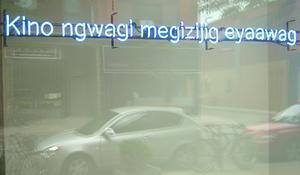
This exhibition begins with a quote from Rancière: “The normal condition of any communication is distance.” Distance is arguably the first principle of any art exhibition. Visual art has indirection built into it; witness the tendency to glance sideways from artwork to wall label in search of clues to its meaning. Curator cheyanne turions finds different ways to foreground this process of translation. Ayreen Anastas + Rene Gabri present notebooks of their collaborative texts and drawings. Ostensibly a project to make sense of things, the artists’ meanderings are curiously written in miniature. Their texts are then made almost illegible by the notebooks presentation in a vitrine. Claire Fontaine’s Foreigners Everywhere (2011), is an ongoing neon project that translates the eponymous into languages other than English, depending on where it is shown. In Toronto, the phrase is translated into Ojibway to highlight gallery’s location, on the territory of a disputed land claim the tribe has with the Canadian government. Godard once famously spoke of the Children of Marx and Coca Cola. The three video works that make up the remainder of the show are by artists who could easily be called the Children of Jean Luc Godard. Neil Baloufa’s Untitled (2010) displaces cinematic verisimilitude onto its facsimile: artifice. Flimsy paper constructions set the scene in an Algerian villa, while actors, their backs mostly to the camera, talk about the time unnamed terrorists came to visit. Strategies of storytelling mirror shifting subjectivities of understanding. Iranian Reza Haeri’s All Restrictions End (2009) a cinematic essay in the manner of JLG’s Histoire(s) du cinéma (1988-98), looks at fashion as a mode of desire, one that has been made particularly acute by the Islamic Republic’s injunctions against Western dress. Finally, Keren Cytter’s The Hottest Day of the Year (2010) makes audacious use of montage to cleave together seemingly unrelated stories about a fictional French nurse in Africa and female Israeli soldiers. Of all the works in the show, Cytter’s shares most in common with Clare Fontaine in exploiting the art context to produce canny meta-contextual meanings.
This review appears in the October 2011 issue of Flash Art #110
Writing about the paintings of Jan van Eyck, art historian Erwin Panofsky said: “Jan van Eyck’s eye operates as a microscope and as a telescope at the same time…compelling the beholder to oscillate between positions very far from the picture and many positions close to it.” The quote could also describe the paintings of Gary Evans — but with the important distinction that, in Evans’ work, the oscillations are inscribed onto the canvas. Rendering dimension in a picture as shifting planes of paint has always been a predominant feature of Evans’ art. It’s a technique that creates oscillations, or suggested shifts in position for the viewer that, in their way, are just as characteristic of the world the artist inhabits as van Eyck’s more detailed figurative paintings were of his.
Panofsky’s quote points to the broad context Evan’s paintings have always had as their first point of reference: the tradition of landscape painting. For Evans, the Dutch painters of the 17th century have particular significance. Van Eyck provides a reference point as a Nordic master who worked in what is considered to be a naturalistic style – which is to say a style unencumbered by the idealizations of Italian Renaissance Humanism. Of greater relevance is Jacob van Ruisdael, whom Evans cites as an influence. Indeed when looking closely at the artist’s paintings, viewers can often glimpse segments of landscape peaking through, styled in a descriptive mode that is distinctively Flemish.
This text was originally written to accompany Gary Evan’s show ‘spce invdrs’ at Paul Petro Contemporary Art. More info here.
Douglas Gordon: 24 Hour Psycho, 1993. Photo: courtesy of the artist and Hirshhorn Museum and Sculpture Garden, Smithsonian Institution, Washington. Photographer: Christopher Smith. Film stills from Psycho, 1960. Director: Alfred Hitchcock.
Works from the Flick and Kramlich Collections and others
Curated by Stan Douglas, Christopher Eamon, Gabriele KnapsteinAnd Joachim Jäger
Hamburger Bahnhof, Berlin 29 September 2006 – 25 February 2007
By Rosemary Heather
It is hard to imagine that only 30 years ago John Szarkowski’s presentation of William Eggleston’s photographs at the Museum of Modern Art could be considered a breakthrough because they were in colour. By separating lens-based imagery from the 19th century notion of fine art to which the black and white photograph had been, up to that point, confined, MOMA – a key player in the creation of the very idea of modern art – expanded the definition of art to include contemporary production, opening the door to, among other things, works in new media. Arguably it is this event, rather than say work done in structural film, that augured the current dominance of video installation in contemporary art: It points to the growing importance of the institution itself. This is especially true of work on video. If Duchamp had critiqued the artwork’s institutional dependence a prescient 90 odd years before, the triumph of video installation as an art form represents its wholesale consolidation; the two cannot be separated.
Functioning as a companion piece to, and update of, the Whitney Museum’s 2002 exhibition about the projected image “Into the light: Image in American art 1964-1977”, Beyond Cinema presents 27 works designated as markers along the road to video’s present supremacy. The focus of both shows is the art form’s basic technical requirement of projection as a stepping off point for the creation of a spatial experience in the gallery, whether perceptual or psychological and usually a combination of the two. Video’s ability to be projected from the rear, as opposed to film’s frontal orientation, adds an extra dimension to this dynamic. The exhibition does an excellent job of showing the different ways that artists have devised to think through the permutations of this possibility.
Edge of a Wood (1999) a ravishing installation by Rodney Graham opens the show, and suggests its emphasis. While early video art was once valued for its anti-aesthetic austerity, Graham’s work has a shimmering painterly lushness. On a two-screen projection, helicopter-mounted searchlights illuminate trees at the edge of the forest to the deafening sound of the chopper’s blades. With this simple but gorgeous update on the genre of landscape painting, Graham implies that art may change in keeping with technological developments but its focus stays the same: the world and the complicated business of how we see it.
Graham’s work creates a threshold for the viewer’s entry into the exhibition – this is especially true due to the enveloping nature of its soundtrack ¬– suggesting that the prevalence of video projection in art is only a reflection of the immersion of our culture in a mediated world. Douglas Gordon’s 24-hour Psycho (1993), is well-served in this context. The artist’s slowing down of Hitchcock’s film to a molasses pace looks today less like a neat trick than a statement of millennial significance: The dream – and the nightmare – of our mediated lives has no beginning or end.
On a lower level of the venue,
Diana Thater: The best space is the deep space, 1998. Courtesy of the MAK Center for Art and Architecture, Los Angeles, California, USA. Photographer: Fredrik Nilsen.
encapsulates this idea in a dazzling four-part installation. An image of a white horse and her handlers standing in a ring is seen through the haze of dry ice and a changing array of colored spotlights. Variations of this scene are repeated in two large screen projections and on a monitor placed on the floor: viewers see what the cameras see and see the crew filming this in a shot from behind their backs. As the colored gels change from pink, to yellow to blue, the horse appears and disappears, and on another monitor, alphabet fridge magnets in primary colours spell out the production credits against a white background. The installation acts like an object lesson in the persuasive authority of the image. For all of Thater’s efforts’ to break down the illusion, its powers of mystification remain no less profound.
Another stunning work, Monica Bonvicini’s Destroy She Said (1998), uses repetition and dissonance to fracture the space of filmic artifice. On an angled two-screen projection with the wooden grid of its support sticking out on all sides, the artist presents clips of European film stars, such as Anna Karenna and Monica Vitti, in a variety of fraught cinematic moments. On the audio track we hear a women crying, a phone ringing, a plane traveling overhead, the sounds sometimes in sync with the image but mostly not. When in this montage of distress, a woman shoots a gun, the repertoire of dramatic effects is complete, the artist suggesting that, at least as far as cinema is concerned, the psychological space of femininity is dangerously overwrought.
Toronto artist John Massey’s seminal As the Hammer Strikes (A Partial Illustration) (1982) offers a kind of masculine counterpart to Bonvicini’s work. A three-channel installation in black and white and color, the artist drives a car on the highway in the desolate Canadian winter. As he converses with a hitchhiker he has picked-up, the screens alternate between images of the landscape, the driver and his passenger, and stock footage shots of the things they talk about. Because the hitchhiker speaks with a slight stutter, the conversation is somewhat stilted, and this impression is reinforced by the image montage. When the passenger talks about being at a strip bar and we simultaneously see the image of a stripper on an adjacent screen, it creates a strangely hollow feeling, as if the speaker had no interiority. A little seen example of video projection in its early form, as a critique of mediated subjectivity the work is devastatingly effective.
For Canadians, Beyond Cinema is a watershed for two reasons. Amongst a curatorial team of four, two are from Canada, the artist Stan Douglas and Christopher Eamon, curator of the San Francisco-based Kramlich collection, one of the largest and most important private collections of media art. The duo’s involvement and the strong presence of Canadian artists in the show attests to the leading role Canadians have played in the development of this art form (Douglas’ is represented in the show with his magnificent 1986 work Overture.) A crucial acknowledgement of this contribution, The Art of Projection may also represent a turning point in Canada’s ability – or willingness – to sponsor its artists internationally. Beginning April 1st, 2007, the Harper government has allotted a budget of exactly zero dollars to its missions abroad for the promotion of Canadian culture. This from a Federal government that the Oct 25th Globe and Mail reported was “awash in surplus cash.” Although in Quebec there has been considerable uproar about this disturbing shift in cultural policy, it appears to have gone relatively unnoticed in English Canada. Now is the time is for everyone involved in the arts in Canada to work to reverse this trend. There is more at stake here than the careers of Canadian cultural producers abroad. It is not much of an exaggeration to say that a government so unaccountably hostile to the arts portends a dark future for the country.
Lawrence Paul Yuxweluptun, Colour Zone, Acrylic on Canvas, 2000
“It’s nice to make beautiful paintings, but at some point I have to record history”
By Rosemary Heather
Given its aversion to rankings, I will risk offending Canada’s ultra-egalitarian sensibilities by saying Lawrence Paul Yuxweluptun is Canada’s best artist. By this I mean, Yuxweluptun is the artist you would learn the most from if you were lucky enough to see his works presented in a career retrospective. Far from poking around in the increasingly dimly-lit corridors of conceptual art practice, Yuxweluptun maps out his own territory in art. Yuxweluptun’s work shows how a long term commitment to craft and the set of problems it presents to the artist will pay in the end a certain dividend of freedom. If an artist’s work is good enough to merit career examination, viewers’ get the chance to understand what it means to be an artist. A Yuxweluptun retrospective, currently only available on his website, would tell you how the best art creates its own context of authority, and that this is the way an artist speaks to his or her audience; speaks as if gifted with language, that is, regardless of the format of expression. In his work, it is clear how the words ‘authority’ and ‘authorship’ are related, and why mastery of an art form can create a position of autonomy for the one who has mastered it —and if words like ‘craft’, ‘self-expression’, and ‘mastery’ have been in recent years have become unfashionable, maybe its time to bring them back again?
When I spoke with him on the phone, Yuxweluptun seemed to have little interest in discussing his work. His focus instead was almost exclusively on the subject matter that informs his paintings: the double bind of the Pacific Northwest Coast Indian, who in Yuxweluptun’s view has been sold out by white man and Indian chief alike. From speaking with Yuxweluptun, I know it would be wrong to call him a ‘Canadian’ artist. His ancestry is a mix of Coast Salish and Okanagan First Nations. It is a heritage embodied in the iconography and political perspective made manifest in his work. Differing from most other parts of Canada, First Nation land claim negotiations in British Columbia are ongoing, to this day. For Yuxweluptun, this means the potential for betrayal of his land and people is ongoing, feelings of connection to the land carrying within them a threat of dispossession. For Yuxweluptun, then, history is not in the past, something understood in retrospect. Rather it is the developing story of his people, their present reality, something, as he says “you wake up to every day.”
That Yuxweluptun sees himself as a History painter is clear. He is a newspaper reporter and polemicist, dramatizing the issues he cares about with the suspicion that some people would prefer he didn’t do this. Few artists in any medium have more successfully vilified ‘the man’, an enemy who in Yuxweluptun’s paintings—whether he is Indian Chief, government official or corporate factotum—wears a suit and a tie. Each of these figures bears a head derived from the artistic iconography of the Pacific North West Coast as a marker of the compromise or worse betrayals he represents: the mask worn is one of perfidy. That he chooses to characterize this iconography as sinister is a measure of not necessarily of Yuxweluptun’s alienation, but of his desire portray alienation of his people. Not quite human, Yuxweluptun’s figures are recognizably a part of the landscape he depicts in his paintings. It is a fully animistic universe, with hills, trees and mountains given life through compositional use of those same iconographic forms. And if his counterparts who inhabit an everyday reality of common sense–that would be us, the audience–fail to see the world as similarly alive and animated by a cosmology of good and evil, this is a mark of our own alienation and complacency, one that will probably doom us in the end.
As a history painter working in the realm of contemporary art, Yuxweluptun keeps company with a select group of artists in Canada, none other that I can think of who make paintings. Rather, Jeff Wall and some of the other Vancouver photoconceptualists come to mind, and maybe the work of Althea Thauberger, an artist who makes video and photo-based installations with the aim of bearing witness to history. I can only speculate that the powerful presence of the natural landscape on the West Coast in Canada makes ‘History painting’ in its contemporary incarnations a concern of artists living there. By comparison, Toronto artists seem preoccupied by the contemporary formats of the still life, suggesting that while West Coast art ensues from a sense of place, Toronto’s artistic imagination is more inward looking and reduces down to the scale of the domestic.
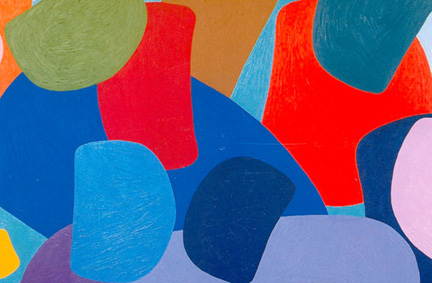
Extending his cosmology beyond the figurative is the body of work Yuxweluptun has made around the compositional figure of the ovoid. Freeing the ovoid from the role it traditionally plays in the art of the region, most recognizably as a pictorial component of the totem pole, Yuxweluptun then lobs the form at the familiar styles of Modernist painting, causing Modernism’s eternal verities to come tumbling down. This tells us not that Modernism had a short eternity so much as it represents a territory that continues to expand. Stacked one on top of the other Yuxweluptun’s ovoids make up a totem pole of Colour Field composition. Gently upending a succession of Modernist genres, the ovoid becomes the ‘Indianized’ format of art history’s re-composition. The playfulness of Yuxweluptun’s approach does not undermine his seriousness of purpose, or the clarity of message his simple method of historical revisionism imparts. Few artists I can think of find such freedom in their facility with a medium. To have this degree artistic control and such a strong of editorial point of view is to be a complete artist. As such, Yuxweluptun sets a standard. The deskilling of art in recent decades has meant a loss in our ability to set criteria for the judging of artworks. Take a look at the paintings of Lawrence Paul Yuxweluptun if you want to find them again.
In the best part of Harry Potter and the Deathly Hallows – Part 2, the last instalment of the eight part series, Harry speaks to Dumbledore in a vast white space. ‘Is this real?’ Harry asks, ‘Or is it inside my head?’ ‘Of course it’s inside your head,’ the wizard replies, ‘but why should it be any less real?’ From the mouth of a wizard in a children’s tale comes wisdom about the metaphysical problem of our age.
Like storybooks, image-based media tend to be thought of as ‘not real’. When you watch a movie you are participating in an illusion; it’s made-up, in part ‘inside your head’. With the proliferation of electronic media, the boundaries of this ‘in your head’ dimension are expanding and consequently our understanding of the real is changing. Sarah Jane Gorlitz and Wojciech Olejnik, working together as Soft Turns, create artworks that examine a key part of this phenomenon: our credulity. Their video, Enclosed (2009), dramatises this shift in the form of a question: What is real? With Enclosed, theartists suggest that representational media, in the form of film or video, is one cause of the complexity of this question. Just how real is the world created by image technologies?
We are so easily fooled. It’s a narrative Soft Turns often play out in their work. In /mm (2007) and just add water (2007) stop-motion animations move through maquettes of subway stations the artists have constructed. In Enclosed, the camera pans amongst the shelves of a library. In this work, sleek spaces cast shadow and reflect light, and as we look at these volumes and surfaces our eyes draw their own conclusions. What we see is real enough, that is, we understand that we are looking at a subway or library; we refer to the idea of these things we already have in our mind and recognize contemporary, familiar enough places, which happen (not incidentally) to be devoid of people.
In the artists’ hands, verisimilitude is achieved by a meticulous attention to detail. Soft Turns describe their work as “meditative”—this applies equally to the time they spend making their works and to the pleasure viewers get from looking at them. Scaled to the size of a hardcover book, the library featured in Enclosed is made of salvaged material from discarded books the artists found in Berlin. Through a labour-intensive process, Soft Turns have transformed the substance of books into a library, a sly commentary on the idea that books contain multitudes. That the library is a universe in itself is one potential reading of the work’s title.
Soft Turns’ use of real world source materials (as opposed to computer-generated graphics) in combination with their concern for accuracy of architectural scale and their careful attention to detail has the effect of infusing the animation with a tangible presence and gives the represented space a feeling of substance. This is a figural space, a library we might visit in our dreams. It is important to note what we see is a composite structure, made up of 12 different maquettes, each a different library. The end result is a generalized space, a Platonic Form as it were. Enclosed, then,presents ‘library’ as an idea, accessible and yet just out of reach—a contemplative entity. We recognize what we see but we will never read these books.
The world of Enclosed is not real but does exist within the real world of film. By creating a space for the purpose of filming it, the artists concede to practicalities. However heroic the effort, making art is certainly less arduous than making architecture—and serves a different purpose. In the construction of each maquette, fidelity to detail translates into the indeterminate scale of filmic space. Miniature-ness does not necessarily matter when filmic illusion sets in; it simply becomes the volume that defines the space in the film. By shooting the maquettes and editing all views into one homogenous entity, the artists create an encompassing view. However, the continuous motion within the film, and of the film itself, prevents close looking. The illusion is protected from scrutiny and so further perpetuated. This is true even though Enclosed is presented as two films on a split screen, each providing slightly different views of the library construct.
In his book The world viewed: reflections on the ontology of film (1971), Stanley Cavell writes, “In viewing a movie my helplessness is mechanically assured. I am present not at something happening…but at something that has happened, which I absorb (like a memory).”[i] Elaborating on this passage by Cavell, Rosalind Krauss notes that the viewing of a film “suspends our presence to the world it shows us.”[ii] In Enclosed, however, the artists create the world they show us; they determine the materials used in making the film as well as how it plays out for the audience. This process is co-enacted by the viewer in every instance of watching. The camera pans through the halls of a ‘library’ and we see the books on its shelves. At a certain point, the camera zooms close enough so we can see that the books are something other: cut up pages folded into dummy books. This is the reveal: the moment when the mise en scène looks fake and the illusion is dispelled. The film plays on a loop such that the world of this particular library is created and destroyed over and over again.
As sophisticated viewers, we greet each stage of this cycle with equanimity. We credit the library as real in the moments that this is possible and we accept that it’s a maquette when the cracks in the illusion start to show. Initial perceptions are followed by a reassessment. And each time, arguably, we are willing to be duped. Perhaps this is the real meaning of the title Enclosed: we live inside the world inside us.
[i] Stanley Cavell, The world viewed: reflections on the ontology of film (New York: Harvard University Press, 1971) 27.
[ii] Rosalind E. Krauss, Perpetual Inventory (Cambridge: MIT Press, 2010) 63.
This text was written to accompany Soft Turns’ exhibition Enclosed at the Stride Gallery in Calgary.
Soft Turns is Sarah Jane Gorlitz and Wojciech Olejnik. You can find more info about them here.
Fassbinder: “Berlin Alexanderplatz - An Exhibition,” 2007. View of the exhibition at KW, Berlin. Photo: Uwe Walter.Writing about Berlin Alexanderplatz in 1983 when Reiner Werner Fassbinder’s 14 1/2 hour film epic was first shown in the US, the New York Times’ film critic Vincent Canby noted that the – at that time – recent appearance of home video rental offered a way to negotiate the film’s unfeasible length, and also possibly presaged the creation of a new art form. Canby was right about this, but in a way that he could not have anticipated. The idea that video rentals could democratize and decentralize artworks, putting control into viewer’s hands has been borne out in spectacular fashion by the online video site YouTube, which invented not only new conditions for viewing but an entire universe of viewer-created content.
The question of whether the short videos that can be seen on YouTube can be considered art is entirely germane to Klaus Bisenbeck’s presentation of Berlin Alexanderplatz at the Kunst Werker in Berlin. A major force at the KW since its inception, and now also a curator at PS1 in New York, Bisenbeck is a controversial figure in the Berlin art world. This exhibition will do nothing to alter that reputation. All credit should be given to him for the scale of vision he brings to the staging of Fassbinder’s film. Although revered internationally, the German attitude to the director continues to be ambivalent. As a friend of mine said Fassbinder was “too gay, too political and took too many drugs” to really be a welcome addition to the pantheon of great German artists. Recognition of Bisenbeck’s achievement, however, can’t avoid mention of the obvious caveat about the way this exhibition reduces the conditions for viewing the work to the diminished scale of a contemporary audiences’ YouTube-like attention spans.
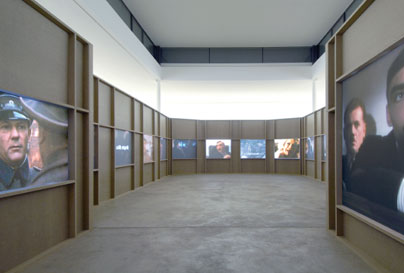
Originally made for German television in 1980, the film’s 13 episodes plus an epilogue, which have been re-mastered for 35mm, are shown as loops in 14 separate viewing booths. The film is also screened in its entirety in a small adjacent room outfitted with cinema-style seating. While this is intended to provide a context for the liberties the KW takes in presenting the film as an art installation, the intact screening of the film also makes the weaknesses of the latter strategy apparent. Perhaps this was intentional too? Certainly the exhibition is successful in staging a dialogue between the two formats of viewing. In contrast to the strong narrative pull one experiences when the film is seen as a whole, the installation caters to a more distracted form of reception. Temporarily constructed for the show, the 14 connected booths snake around the perimeter of the KW’s ground floor exhibition space, the last booth functioning like an exit into a central atrium-like area where the obverse screen of all the projections can be seen simultaneously. The effect is spectacular, the coherence of Fassbinder’s vision being blown apart into competing disjunctive fragments.
The claim of the show’s press release is that presenting the film in this way allows the viewer to decide “how they want to approach it”. The assertion ignores the fact that viewers’ have always been able to decide how they approach an art exhibition, but the KW is merely speaking in lingua franca of the contemporary art world when it emphasizes the viewer’s ability to participate in an exhibition as one of its main attributes. As English literary theorist Terry Eagleton notes, the current culture’s preoccupation with audience interactivity originates in reception theory’s insight that, “readers were quite as vital to the existence of writing as authors.”1.
Reception theory gave the world the idea that readers and viewers have an active role to play in the creation of meaning, but the question remains: What meaning can result from presenting Fassbinder’s film in this way? Fragmenting the German director’s massive cinematic accomplishment into bite-sized pieces would seem to play to our culture’s worst atomizing tendencies. Take the time to watch an episode from beginning to end, sitting in a viewing booth on one of the cushions provided, and your patience will be rewarded; Fassbinder’s greatness as a director ensures that. Presented with so much choice, however (leaving aside the possibility of watching each episode in full, laboriously going from booth to booth in chronological order to undermine the show’s premise) the urge is to flit around and sample the film, suggesting that the point is to experience its ambience rather than meaningfully engage with its content.
View the work as a momentary series of encounters, and the static quality of Fassbinder’s dramaturgy becomes apparent — but then he never was a director interested in naturalism. Enter a random choice of rooms in quick succession and you get the impression that all of Berlin Alexanderplatz takes place while the characters sit around talking to each other in one bar or another. The presentation makes the film’s typological connection with the genre of the soap opera apparent. Regardless, viewing the film in this way also gives it the fascinating quality of a parallel universe. Each screen is like a window proving a figurative glimpse into Berlin’s past, a world comprised of the extraordinary history of the city and the artworks and literature it has inspired.
The precedent for Bisenbeck’s show is Scottish artist Douglas Gordon’s 24 Hour Psycho (1993). Gordon’s premise was that presenting Hitchcock’s famous film as an installation (slowing the projection down to a speed of 24 frames per minute) would reveal the film’s unconscious: the ulterior world it created beyond any of individual element of the director’s intention. Considered from this angle, Bisenbeck’s installation works exceptionally well; he compounds the brilliance of Fassbinder’s work by abstracting it. In the process, the prismatic reality he created is made apparent, not only in this film but in Fassbinder’s body of work as a whole.
1. After Theory, Terry Eagleton, Penguin Books, London, 2003. p. 53.
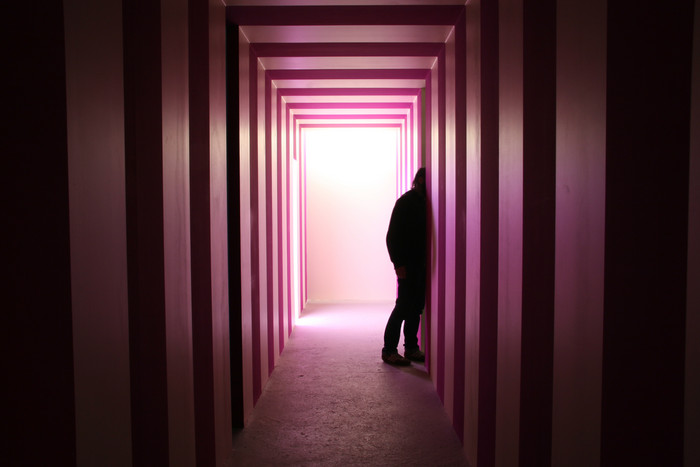
Rodney LaTourelle, In the Absence of Unambiguous Criteria, 2007 For his show at Program Berlin-based Canadian artist Rodney LaTourelle created one of his so-called walk-in paintings, a site-specific installation he has created in a number of cities internationally. Occupying two-thirds of the venue’s store-front exhibition space, the maze-like structure came complete with ceilings and three small, all but hidden, vestibules with a built-in seat that was big enough for one person. Leaving the construction’s steel studs visible on the outside like the frame on the back of a canvas, visitors to the exhibition could navigate the work’s three interconnecting hallways, each one painted with alternating bands of colour; of three sets in all, these vertical stripes comprised the work’s fictive dimension. Using natural light from the venue’s exterior windows, which the structure abutted, and ceiling-mounted florescent lights at each section’s opposite end, LaTourelle created the tactile conditions for shifting perceptions of colour, light and self…
By Rosemary Heather
Rodney La Tourelle, In the Absence of Unambiguous Criteria was presented at Program, Berlin, Winter 2007
This text was orginally published in Von Hundert, Berlin, Spring 2007
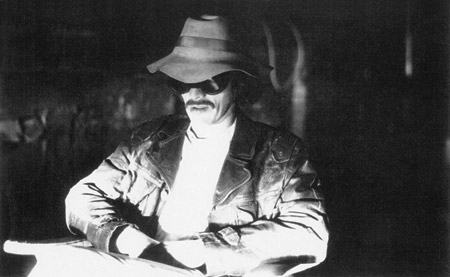
Ron Giii “During the clearance and fixation of the fourth salt man, experts found an iron stagger in the scabbard attached to his waist. Also, two ceramic jugs have been found with a kind of oil inside which, scholars believe, could have been used for a lantern.”
—Abolfazl Ali, head of Chehr-Abad research group
“To open the doors of the Atomic Theatre your eyes have to open up like a vast reservoir of water falling from another planet. Once the mind has turned inside out, the springs of time will emerge as the centre of your cognition. The Atomic Theatre takes its pulse from the antimatter of materials that exist in an unknown dimension called invisibility.”
—Ron Giii, The Atomic Theatre and The Dictator’s Opera
Ron Gillespie
Things change. A banal metaphysical statement worth reflecting on. This is especially true if you have the materials at hand to give substance to the idea. The work Ron Giii has made over the course of thirty-five years provides the perfect vessel for these considerations; in Giii’s oeuvre you can see what changes and what stays the same, much as you can in a biological body over time. This is also to say that art provides an excellent answer to the question, Where are we?
If you ask Giii, the continuities that both defy and define the present are “the antimatter of materials that exist in an unknown dimension called invisibility.” Even in this fragment from the artist’s writings there is so much to discuss, as in his work as a whole: mine deep and you will discover riches.
Ron Giii
Giii’s work presents itself at the place where the invisible meets the visible; another example of this is theatre, which like visual art takes place within a framework, or proscenium arch. As in art, theatre is the forum where antimatter becomes visible, precisely because the primary consideration of art is form. In Giii’s case, artistic form and the forum of its presentation converge in a way that is especially distinctive. Giii’s full sentence: “The Atomic Theatre takes its pulse from the antimatter of materials that exist in an unknown dimension called invisibility.”
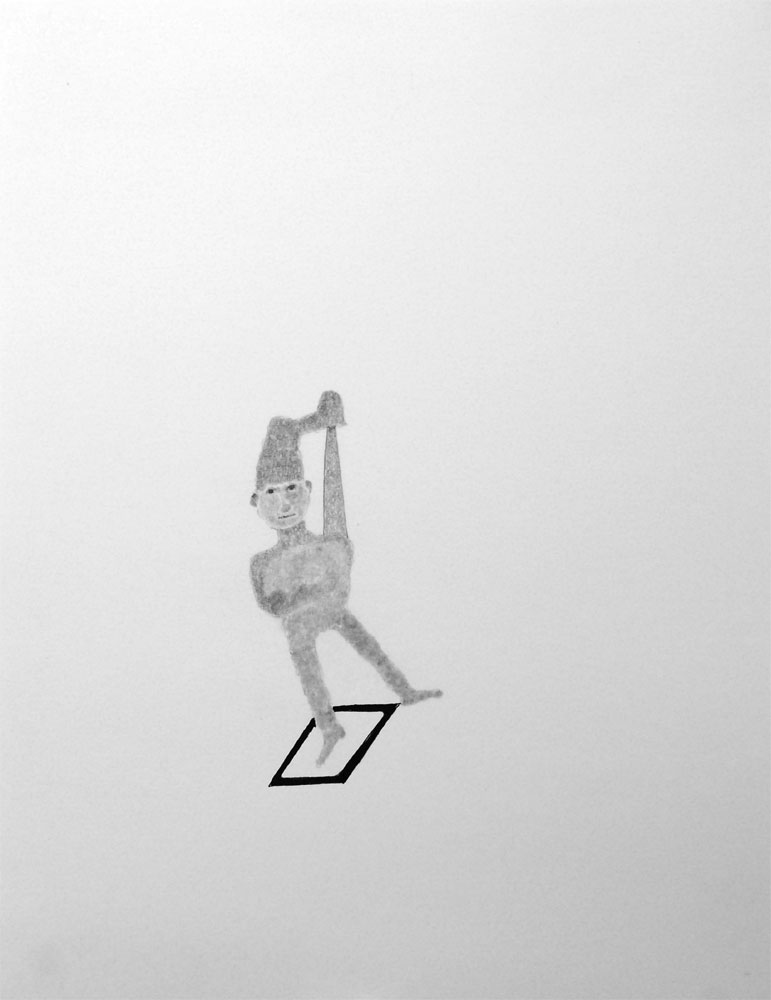
This is a quotation from a text written by Giii to accompany a show of his drawings in New York in 1986. A wholly coherent statement about his oeuvre, the text and the show provide a good pivot point on which to consider the stages of his career. What began as performance continues as drawing, all of it taking place within the conceptual framework of theatre. In Giii’s view, theatre formalizes the process of becoming that is all of our lives. Like us, the figure within the frame or on the stage looks outward, seeks a connection with others and beckons to an audience more often than it turns its back to the world. The proscenium, like the page, presents a threshold of possibility just waiting for the moment of its random apprehension.
Uncle Ron
Looking at Giii’s art, one understands that the simple encounter is his fondest hope for it; each work provides this encounter, fulfilling this desire with imperceptible ease. The drawings live and shimmer with unimagined sensitivity. In The Atomic Theatre, Giii speaks about the figures in his drawings as real people, “laughing and hiding from me as if they had their own reality.”
Giii was already active and engaged in the Toronto scene when he was a student at what was then the Ontario College of Art (now OCAD), in the 1970s. It was a cultural moment in which the bohemian sectors of society were alive with dreams and ambitions that are difficult to fully access today. Giii’s early works provide a way in. At the time, “live art” was a fringe pursuit. In 1978, Roselee Goldberg, writing in the first authoritative study of performance, noted that it had only recently been accepted as “a medium of artistic expression in its own right.” Like other practices in the visual arts in that moment, it was a hybrid—theatre or sculpture and dance—newly unbound from traditional constraints. In common with much that happened post Minimalism, performance art found its possibility in the context of art itself.
Jimmy Algebra
Pervading the era in which Giii first started working were the powerful cultural tendencies of political radicalism and lifestyle utopianism, not to mention the commercialism of these trends in the pop-cultural mirror, with its attendant distortion. Artistic disciplines intermingled to electric effect. Along with freedom from medium specificity and craft was an embrace of ordinary things as subject matter for art, including garbage and noise—the incidental art of John Cage and Fluxus—and, above all, people. The Happenings of the 1960s included audiences reimagined as paintings and sculptures, with the gallery as frame. In this context, real human bodies—frequently naked—had an incredible impact. Ron Giii (drawing) undated.
The shock produced by a simple encounter with a human body—naked or otherwise—and the things you could do with it, was a basic element in Giii’s art at that time. The experience could result in a psychological and sometimes physical violence. While both were still students, Kimo Eklund and Giii created the performance entity SHITBANDIT. Giii has said,
We used the name to shatter the very conservative milieu surrounding OCA . . . we did Christ on a pair of two-by-fours with microphones placed out in the street, and a used Volkswagen where males and girls got it on and they were surrounded by porn mags.
Johnny Pizza
A site for many of Giii’s early performances was the Centre for Experimental Art and Communication (CEAC) in Toronto, one of Canada’s first artist-run centers and one with a short, explosive history. Ever more and more radical in the theoretical and political platforms it promoted, CEAC eventually lost its government funding. Its many provocations gave birth to a notoriety that is increasingly obscure—and that appears to have little relevance to the activities and self-image of the Toronto arts scene today.
As part of a group of artists associated with CEAC, Giii traveled and performed extensively in Europe and the United States. A 1976 tour, for instance, took the group to Sweden, Germany, Italy and Belgium. Communicating with each other via the postal system, among other methods, rather than the Internet, they were part of the first globalized artists’ network, made possible by the dematerialization of artwork. Dot Tuer comments on the intense schedule of activities carried out by CEAC. She has noted that “during 1976 and 1977, there was literally an event held at CEAC every night of the week.” As with everything, the moment was fleeting; as Giii wrote, “The performances were wild like animals who were going extinct.”
The General
In her fascinating and very thorough scholarly essay on the history of CEAC, Tuer notes the influence of Hermann Nitsch and the Vienna Actionists on the kind of performance work Giii, SHITBANDIT and others did at CEAC.1 Self-exposure, transgression and ritualized actions formed a common thread, the goal being to orchestrate a moment of “raw” experience for audience and performer. Informing it all was the idea that confrontational art stripped away layers of falsity in consciousness and social interactions, and the naked individual in the gallery promised a return to Rousseauian innocence and/or political consciousness or some combination of the two.
While the Vienna Actionists were motivated by the desire to expose the incipient societal guilt stemming from the not-so-distant (Nazi) past, Canadian shock performance tactics had the broader target of exposing the individual’s complicity in a generally corrupt society. Giii: “After reading texts on the destruction of nature we adapted the wild behaviour and hence we entered the world of dominance, force, power and abuse.” This focus in Giii’s work continued into the 1980s in the film Taste, the only surviving example of his work in Super 8. In Taste, which was shot in a garbage-strewn alley for about $100 in 1984, Giii and Darinka, his female accomplice, subject each other and themselves to a series of ad hoc actions. By turns emotionally disturbing and theatrical, even Dadaesque, the performers’ actions have quasi-sado-masochistic overtones, but Giii’s intention in the film was to do more than shock. He makes this clear in the soundtrack, which he narrated spontaneously in a single take after the fact in complement to the film’s continuous improvisational performance. “The artist is a fascist,” Giii intones many times throughout the film, questioning the power dynamics inherent in the artist’s relationship to the audience and to the work of art. Enacting a theatrical sado-masochism in the film, Giii indicts himself, but as with the doctrine of original sin itself, this is only to declare that he is part of humanity.
Hegel’s Salt Man
In his later work, Giii’s investigations into the dynamics of power gave way to openness and vulnerability. The figures in his drawings are always tender and are rendered with the lightest of touches, like a mere breath upon the page. Frequently also present in these works is a proscenium arch; figures float inside a box or within intersecting lines that delineate geometric space. Together, the lines and the figure represent a new naked self, one that grapples with and must survive life’s intractable circumstance and that does so with moments of joy and lucidity. Another quote from Giii: “Each instance of conception is a view of a theatre that has no words nor semblance of a rational world with all its contradictions and confusion.” Combined, the early and later works compose a biographical “before” and “after,” that corresponds to Giii’s experience with bipolar disorder; the drawings belong in the “after,” which continues to this day. More striking, however, is the work’s extraordinary coherence and wholeness, as if all of it were of a piece, antimatter that was once and will be again invisible, that is available as a point of contact in this moment and yet is just passing through.
By Rosemary Heather
Epigraph Ron Giii, from his text produced to accompany the exhibition The Atomic Theatre and The Dictator’s Opera, 1984–86 at 49th Parallel gallery, New York, 1986.
1. Dot Tuer, “‘The CEAC was banned in Canada’: Program Notes for a Tragicomic Opera in Three Acts,” in Mining the Media Archive: Essays on Art, Technology, and Cultural Resistance (Toronto: YYZ Books, 2005), which can be purchased here.
This text was originally published to accompany the exhibition I curated, Ron Giii: Hegel’s Salt Man, presented at the Doris McCarthy Gallery, University of Toronto (2007) and Carlton University Art Gallery (2008). The catalogue Ron Giii: Hegel’s Salt Man: writings/works 1975-2007, featuring essays by me and Eli Langer, can be purchased at Art Metropole.
Andrew Patterson wrote a review of Hegel’s Salt Man you can read here.
A couple years later, I visit Second Life again, this time with a more ‘legitimate’ destination. I am going to RMB City, a project of the Beijing-based artist Cao Fei. Still my experience is much the same. Where is everybody? I am suffering from a disjunction between real the virtual, a dynamic Cao Fei had explicitly set out to explore. My experience helps to shed light on the problem, but it’s of the unintended sort. If my navigations through the world of Second Life are cumbersome and alienating, it’s because I have a sub par computer. It’s an issue of processing speed. Inadvertently perhaps, Cao Fei’s ambitions in Second Life provide a metaphor for the looming dilemma faced by the West. We are lagging behind but lack the drive needed to overcome this predicament.
Disjunctions between the real and virtual worlds, often unintended, also dominate the Residency in RMB City project. Because it is located in the Japanese Canadian Cultural Centre in the Toronto suburb of Don Mills, the Gendai Gallery is somewhat hard to get to. With this exhibition Gendai curator, Yan Wu, puts the venue’s peripheral status to good conceptual use, proposing a show that can be, in part, accessed by computer. Working with the artists, Adrian Blackwell, Yam Lau and the collaborative duo of Judith Doyle and Fei Jun (known as GestureCloud), Wu creates an exhibition that combines a gallery presentation with digital artworks created for Cao Fei’s Second Life property.
Made up of an amalgamation of references to Chinese architecture, RMB City features the Herzog and de Meuron Bird’s Nest along with shiny skyscrapers, motorways and sidewalks, warrens of small shops selling take out food and the like, all of it organized around the central structure of the Forbidden City, Beijing’s Imperial Palace, which dates from the Ming Dynasty. Although Cao Fei promotes her project as a platform for artist collaboration, miscommunications meant that Wu found her initial proposal to create an artist residency in RMB City rejected by the artist. Further communications remedied the situation; as of press time, the artists are soon to begin moving their projects to the Second Life location. In recognition of the changed status of the project, this second phase will now be termed Intervention into RMB City. A publication about the project, called From Residency to Intervention will be published in the spring.
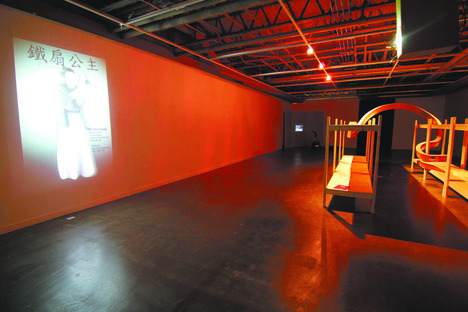
In the Gendai gallery, Blackwell presents Lóng Sùshè (Dormitory) (2011) a plywood maquette of a workers’ dormitory proposed for RMB City. Trained as an architect, Blackwell has lived in China, teaching architecture there at an offsite campus of U of T. With Lóng Sùshè he provides infrastructural context for Cao Fei’s metropolitan fantasy. An interest in sculpture as a platform for public discourse has been the long term focus of Blackwell’s practice. Referring to an actual dormitory in the industrial region of Shenzen, one that is continually being built in an effort to meet the growing demand for worker’s housing, Lóng Sùshè, helps to clarify certain questions that will emerge along with China’s growing economic dominance. What kind of public will China’s new global order create? How easily do traditions of the West translate, and are they even relevant? The notion of a public sphere is amongst the highest ideals of a functioning Democracy, but it’s not clear how it will figure in a country that has little in the way of democratic traditions as they are known in the West.
Writing about the legion of workers that power the engine of China’s economic expansion has become a journalistic trope in Western reports about the country. China’s nineteenth century industrial conditions are a subject of some fascination in the West. Such reportage helps provide a salve for the conscience of those enjoying the products of cheap Chinese labour. Judith Doyle and Fei Jun’s GestureCloud (2011) uses the space of Second Life to rewrite this narrative, to great critical effect. In place of the whole, but nameless, Chinese worker, the artists create a virtual inventory of the gestures factory employees are forced to repeat, ad infinitum, when doing their job. Based on video documentation of the duties performed in a printing factory in Beijing, GestureCloud represents these workers in terms of their real world effects. This distillation by the artists’ creates clarity: like everybody, really, in global economy, the factory workers are mere nodal points within a vast system — or to borrow a 19th century metaphor, cogs in the machine. As with other multi-user online environments, Second Life has a real world economy, money changing hands in the form of Linden Dollars (San Francisco’s Linden Labs is the company behind the site). For the RMB City stage of the project, these gestures will be available for purchase via a vending machine in Second Life, the animations being useful presumably for avatar-related Second Life labours. Gesture Cloud’s ultimate ambition is to return the money they make back to the factory workers in Beijing. Residency in RMBCity installation: Yam Lau, Princess Iron fan (l), Adrian Blackwell, Long Sushe (r)
One translation of RMB City is Money Town; a mordant commentary on the breakneck pace of economic development in China, Cao Fei’s project also creates a narrative for the transition China is currently undergoing — and the implications it has for the rest of the world. Anyone with a computer and an internet connection can use Second Life; the language of software is more or less universal. With Princess Iron Fan (2011), Yam Lau gives expression to the heterogeneity of elements from which this new Global culture is being constructed. Princess Iron Fan is character from a Chinese folk tale, adapted for a film of the same name, which was the first animated feature film made in China, in 1941. Lau adopts the figure of Iron Fan as it appeared in the 1941 animation for his Second Life avatar, but with important alterations. Presented in pleasingly anachronistic black and white, the avatar is given certain ghostly characteristics. It is visible from the front but not the sides or back; the artist slyly attributes vaporous qualities to a thing that already has no substance. In the gallery, the projected animation appears from time to time, mimicking the avatar’s movement through the virtual world; in Second Life, Princess Iron Fan is programmed to similarly ambulate around. However, she never appears in both places at once: Princess Iron Fan is perpetually destined to exist on the threshold between the virtual and the actual. In metaphorical terms, the virtual animation of a Chinese folk hero points to the changed cultural landscape that will characterize the 21st century – an expanded world no longer necessarily bound by Western ideas or traditions.
By Rosemary Heather
Residency in RMB City is a project of Gendai Gallery, Toronto.
This text originally appeared in Bordercrossings, Issue 118.
Evan Lee, Ginseng #27, giclee print, 5 x 7 inches (2006)Going one step beyond the film-less photography of the digital age, in this series of pictures Evan Lee eliminates the camera as well. The Vancouver artist presents images created with a flatbed scanner. Printed as photographs, the works do not immediately betray their provenance as so-called camera-less pictures. In the gap between their appearance and their origin resides the work’s conceptual dimension, one that has deep epistemological implications.
The centerpiece of the show is ‘Every Part From a Contaflex Camera Disassembled by the Artist During Winter, 1998’ (2006). Like a skeleton minus its musculature, the pieces of the camera lie on the surface of the picture as if collapsed in a pile. The image, which reveals the complexity of the mechanism and the surprising delicacy of its parts, also serves as an apt metaphor for the dismantled hierarchies of the digital age.
A suggestion of just how the digital realm is reorienting our relationship to time and space is the most compelling aspect of this show. Conceptually, the picture plane offers a view that is downward and horizontal. Except that it doesn’t, because the works are mounted vertically on the wall. It is a confusion that profoundly disorients cultural assumptions about what constitutes the space of looking. Whereas the picture plane used to open up onto the Quattro Centro, viewers now contemplate a terrifying vista of emptiness.
All works in the exhibition fall within the genre of the still life, the artist using cheap props like plastic fruit or the brightly colored lures used in fly-fishing. In each work’s title he specifies the paltry cost of the props, helping to emphasize an enduring aspect of the memento mori’s message that human’s are vain, time is empty and life is futile.





 Rosemary Heather