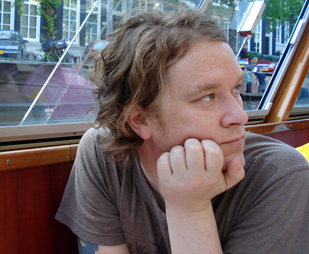
Eli Langer

Eli Langer, Shadow Shift, 2007

Eli Langer

Paul Petro Gallery, Toronto, July 13th – Aug 11th, 2007

By Rosemary Heather

Many people were struck by the confounding elegance of Eli Langer’s latest exhibition in Toronto. Like much contemporary art, you could ‘get it’ in an instant – but what you ‘got’, that was less certain.

A powerful florescent light eliminating all shadow enhanced the dazzling white ground of a painting hanging in the gallery’s window vitrine. Floating against this whiteness were a couple of insouciant washes of oil paint in purple and blue, the lines intersecting in the work’s upper right hand corner to make a 45 degree angle.

That this work has been described as both “Zen-like” and “baroque” gives an indication of the freshness of ground that the artist marks out with this exhibition.

In a media environment that thrives on monotony, shock, and repetition (this is what celebrities are for!) it is exceedingly difficult to create a visual frisson of the new. Much worthy art founders on exactly this rock of seeming overly familiar. Langer’s work in this show has the opposite effect; the artist combines familiar elements to free us from tired habits of looking.

A case in point is a sculpture leaning against the gallery’s back wall in the shape of a large but skinny black ‘x’. Attached to the axis where the two intersecting pieces of wood meet is a small black and white photograph. In it two women stand with their backs to the camera. Doubling the vista they contemplate is the vanishing point conjured by the ‘x’. Like the show as a whole, the work makes for a simple and yet highly sophisticated configuration of the problems of representation.

Across the room a companion piece leans against the wall. Titled, ‘Rum De Dum’ (2007), it features a tightly cropped photo of a woman’s face affixed to the top of a slender black piece of wood. Because the girl in the photo floats above the viewer’s head and touches the floor, the work enacts a literal disembodiment.

Langer speaks about these sculptures as “props,” as a way to position the image. They also serve a related function, as a means to reduce the referential power of the images. This is a canny double maneuver, pushing the show towards abstraction, but keeping it anchored in the real.

The two other paintings in the show echo the window piece’s minimal sensualism. It is the artist’s lightness of touch and assured aesthetic intelligence that allows for his extravagant use of pastels and wash. It is weirdly risky to create works that are this ethereal and pretty.

Although the people in the photos are key figures in Langer’s life, his work here is decidedly non-biographical. Like the disembodied girl’s face, small in scale, dreamy and distant, the artist seems to be pointing his audience in a direction away from humankind’s destructive self-absorption. Of a piece with the whole installation, the girl in ‘Rum De Dum’ is anonymous, just a part of nature. Her subjectivity, like the artist’s is in the work itself.

In this show, Langer uses modest means to deliver euphoric effects. In his return to the fine sensitivity of fine art ­–a practice long developed by the artist–he presages a massive cultural shift that seems all but imminent.

http://www.paulpetro.com/

Kelly Mark: Always Working

Kelly Mark

Kelly Mark: Always working

By Rosemary Heather

The fusion of art with everyday life has been a perennial ambition of contemporary art, but today it seems forgotten. An obvious explanation: this goal has already been achieved. The future as predicted by the avant-garde is here, in other words. The signs for this are ample, if poorly organized in the contemporary psyche; futurologist Alvin Toffler has made a career out of the insight that the rate of change in the West far outstrips our ability to adapt to it. Even if the avant-garde’s penchant for prognostication is now a thing of the past, art continues to be adept at creating the templates to help us recognize change, to see the reality of it. For a template close at hand, look no further than the work of Toronto artist, Kelly Mark; or rather look to the artist, Kelly Mark, fusion of art and life.

Tracing her history, it is easy to see how the changes undergone within Mark’s art-making parallel changes undergone within the wider culture. Starting out a hardcore conceptualist, the art she makes today has more in common with what Mark terms, “re-creativity”; this shift in thinking about her practice is in part inspired by the wholesale changes in culture being wrought by digital technologies. All the while, the work she produces retains the elegance that only the formal solutions found within art can provide.

An artist of prodigious output, Mark’s artworks bear the distinctive attributes of Canadian East Coast conceptualism. Originating at the Nova Scotia College of Art and Design (NSCAD), this is a legacy that begins with the 1967 appointment as Director of Garry Neil Kennedy, himself an inveterate conceptualist. Kennedy’s 23 year long tenure transformed the school, in part because he initiated a visiting artist program that featured leading-edge practiconers of the moment, including Vito Acconci, Dan Graham and Sol Lewitt. The rugged costal outpost of Halifax proved to be an ideal backdrop for the imagining of the spare de-materialized artworks characteristic of first generation conceptualism. This combined with the 1972 launch of NASCAD University Press, which published monographs by influential artists’ like Michael Snow and Yvonne Rainer, helped to cement the school’s reputation, one that lingers to this day.

Sol Lewitt famously described ‘the idea’, the core attribute of conceptualism, as the “machine that makes the [art]work.” In its purest form, this type of practice can consist purely of verbal statements, either written on the wall, as in the declarative sentences of Laurence Weiner, or existing as a set of instructions, as in the Fluxus-aligned work of Yoko Ono. Although seemingly easy to do, the difficulty of making artworks in this vein finds its best summation in the colloquial expression, “ideas are a dime a dozen.” Because it begins with an idea, the conceptual artwork is necessarily anchored in the person of the artist. For such an artwork to become ‘real’, the artist must be unwavering in their commitment to the concept that makes it possible, maintaining it in whatever way is necessary.

The performance-based works by the German artist, Tino Seghal, for example, are only realized in the moment of their enactment by performers hired by the artist, and are never documented. Forbidding any images to be made of his work ensures that Seghal remains the final authority of their verification; they ensue from and return to him, as it were. Seghal’s work represents one extreme of conceptualism’s contemporary legacy. Works by Kelly Mark on the other hand­ have more in common with minimalist strategies for art making, but employ a similar steely resolve in the use of self to establish their veracity.

Like a Donald Judd sculpture, many of Mark’s works’ find form through repetition. In the ongoing performance, In & Out (1997-), Mark punches a time clock installed in her studio every time she starts and finishes work since 1997.  That her studio doubles as her living space points to the fluidity the artist sustains between the two modes. The punch clock performance stands as a wry commentary on how very thin the dividing line is between the two for the artist. Adding a further dimension of self-deprecation to the piece, since 1999 it has been owned by the Toronto collector, Dr. Paul Marks, meaning that Mark, in effect, has a “boss” who pays her on a yearly basis for the work. Currently, employer and employee in this arrangement are looking for a buyer for the piece, preferably by a Canadian art institution that has the vision to match Mark’s long-term commitment to her art.

In & Out is an update on Tehching Hsieh’s Time Piece, one of a number of year-long performances enacted by the artist. Originally from Taiwan, the New York-based Hsieh punched a time clock once an hour, every hour, for a year, from April 11th, 1980 through April 11th, 1981. Each time, he documented the performance by taking a picture, resulting in a 6 minute-long stop-motion animation. Hsieh counts only six pieces in his body of work as a whole, all of them employing a combination of declaration (“I will…”) and action that often involved extraordinary feats of endurance (perhaps most famously, he spent an entire year tied to the artist Linda Montano by a rope, the two never touching.) His use of the calendar year to structure each performance gives his work a conceptual clarity, one that invites his audience to contemplate the meaning of time and the arbitrary nature of our frameworks for measuring it.

Mark has said that her own time clock piece will continue until she “retires.” Itself a work of endurance, In & Out resonates with certain conditions in the contemporary world in a way that distinguishes it from Hsieh’s Time Piece. If Hsieh’s work, in its conceptual purity, is the art world equivalent of the Great Wall of China as viewed from space, Mark approaches the goal of marking her time as an artist from a less exulted perspective. In a related performance that has been ongoing since 2003, she often wears a dark blue nylon windbreaker in public, sometimes in combination with a peaked cap each embroidered with the word, “Staff”, which is also the title of the work. For its humor and the insight it offers into Mark’s choice of art as a profession, a statement posted on her website about it is worth quoting in full:

“I tend to show up late. I usually leave early. I take long breaks. I have issues with authority. I don’t follow instructions. I don’t work well with others. I drink on the job. I complain a lot. But I’m always working…”

By her own account, she is a ‘bad’ employee, but the job requires nothing less than her full commitment. Setting herself up as an ‘art worker’, she comments on the 21st century conditions of both work and art. She is “always working” and yet, at least in the case of In & Out, faces potential job insecurity. Saving the artist from the prospect of ever experiencing real joblessness, however, is the purpose she applies to the tasks she sets herself, one that gives a whole new meaning to the term: ‘self-employment’. For Mark, art is not a job, it’s a vocation.

Mark’s refashioning of first generation conceptualist heroics into the register of mundane serves as a comment on the banal status of the object in contemporary art. This is a utilitarian approach to art making which privileges not the unique object but any ‘ready made’ substitute thought suitable for making the artist’s point. It’s a type of practice that dates back at least to Duchamp, although the use of what Clement Greenberg termed “extraneous elements” in collage, such as pieces of newspaper or graphics from commercial advertising marks perhaps the first appearance of the ‘everyday’ in art.  In an early work, Mark used a thimble to count grains of salt. Arriving at the number of approximately 52,000, she then used this figure to create Pillar: 100 Million Grains of Salt (1997). Composed of stacked identical sets of filled salt shakers, of the variety you would find in a greasy spoon, the work resonates with the readymade, minimalist practice, and the biblical story of Lot’s wife. It also demonstrates how conceptual rigor combined with the fact of sheer repetition can push meaningless activity–like counting grains of salt or punching a time clock–over an invisible line to a point where it accrues meaning within the field of art.

Early conceptual practice was often said to be engaged in a process of “dematerializing” the art object. In its immateriality and indifference to traditional forms of art-making it was thought to represent a kind of resistance to the art market. Considered thirty odd years after it began, however, conceptual art looks to have a wider ramification, that is: as a prefiguring of the very dematerialization of Western culture into the virtual world we semi-inhabit today.

Across her practice, Mark makes free use of whichever conceptual strategies she chooses, in which ever combination she finds useful. In the 20th century art parlance, such a bold repurposing of the work of one’s predecessors was given an oedipal narrative; aesthetic innovation required a certain degree of disrespect and even patricide of what had come before. Now it looks as if not only works of art, or oeuvres or traditions of art-making are under threat, but that an entire cultural order is coming to an end. The difficulty experienced by the music industry in preventing the sharing of music files on the internet is the most tangible symptom of this change; fatally undermining the argument that, although freely available digital music files should be paid for, is the ease with which new technologies abet such activity. Mark’s polyglot practice indicates the artist holds a similar viewpoint on ideas about ownership: conceptual strategies are in the ether, free for everyone to use. This is the obverse side of the readymade coin, and is an attitude given guileless expression on the button Mark occasionally wears and has been informally distributing since 2003 that says, “Everything is Interesting”.

The idea that everything is potential subject matter for art suggests that the postmodern dismantling of the dichotomy between high and low cultures has reached a point of synthesis. The culture we currently live in has a tendency towards the immersive; we are all insiders now, sophisticated manipulators within the spectrum of codes history has left to us. Many of Mark’s more recent works address this condition. Embodying the idea of the immersive is Glow House, a work that Mark has created three times in three different cities (Winnipeg, Birmingham and Toronto) since 2003. In it numerous TV sets are placed in every room of a house acquired for the project, all of them tuned to the same channel. Looking at the work from the street at night, viewers see the house gently pulsing from the collective glow of the TV monitors.  Taking her cue from the televisual flicker that emanates from residential neighborhoods every night, Mark metaphorically accumulates the ether of our communal entertainments to create a gorgeous, evanescent artwork.

Writing about the project, Toronto artist and curator Dave Dyment notes that, “we rarely think of televised images as made of light.” From this initial perception, Mark has gone on to make a number of works that use TV light as a source material. In the Glow Video Installation Series (Horror/Suspense/Romance /Porn/Kung-Fu) (2005), she records the pulse of light from different film genres as it is reflected off the wall. The films that result are then presented on monitors as sculptural works. Installed a number of different times with the monitors positioned back to back or pointing towards the ceiling, each permutation of the work is titled according to the film genre of its original light source, the different genres creating different perceptual experiences in rhythm and light. That the experience of TV is no less seductive with its content removed, speaks to a mass cultural preference for to live in a netherworld made up of molecules of light.

Writing about the effects of mechanical reproduction over 70 years ago, Walter Benjamin theorized that mass entertainments created a new form of reception, cinema viewers absorbing a film in a way that did not require their direct attention. Itself a kind of prophecy of the eventual fusion of art with everyday life, with the advent of digital technologies, this cultural capacity for distracted apperception has been multiplied tenfold. Mark’s epic work REM (2007) recreates this experience using cinema as its source. Over two hours in length and compiled from over 170 films and TV shows, REM creates a composite feature film from disparate clips she recorded off the television. The narrative presented is coherent because by definition film genre provides the building blocks of storytelling.  Watching the work, however, it soon becomes apparent that a semblance of coherence is all that is required; in REM following the ‘narrative’ is akin to the experience of being adrift in your own thoughts. The work is a parable for our culture lost inside the figments of its own imagination. Like her practice as an artist as a whole, it brings a syncretic intelligence to bear on film detritus to bring us the insight that our culture belongs to us. In the subtle shift in thinking that is required to grasp this idea is the future of our culture, one that we already living in today.

This text orginally published in Canadian Art, Winter 2007. 

Andrew Reyes

Andrew Reyes

Andrew Reyes. All that is, 2004, The Balcony, Toronto

By Rosemary Heather

Art is the great provider of context, which is the primary feature of its contemporary practice. Anything can be art, provided certain conventions of its presentation are observed. This makes art practice like a sport in which participants test the limits of what its context can absorb. James Carl’s Balcony project in Toronto’s Kensington Market offers precisely this kind of opportunity for a gamesmanship of artistic ingenuity. An improvised billboard space, Carl shows work screenprinted on Coreplast, attached to the exterior of his second floor balcony, a site that overlooks a small park in the city’s downtown.  Because it must adhere to no commercial imperative, the Balcony offers artists a relatively unfettered occasion for public address. Judging by past efforts, most artists chose to speak to their de facto audience in only the most oblique fashion, referencing instead trends in contemporary art in a way that resonates with the context and speaks to the interests of the informed art viewer.

By contrast, for his Balcony project Andrew Reyes devised a way to push further against the limits of the art context that at the same time quite possibly obliterates it. Silver letters on a chocolate brown background present a new-agey exhortation that begins with the sentence: “Our deepest fear is not that we are inadequate/ our deepest fear is that we are powerful beyond measure…” According to Reyes, the quotation is commonly attributed to Nelson Mandela, but was in fact written by the Californian new age writer Marianne Williamson. A popular author of spiritual self-help books, Williamson has built a saleable life philosophy around the idea that happiness appears when we “let go of fear”. This Manichean idea – recognize that fear is in battle with love in your heart and you too can be a victor in life – seems a plausible, if somewhat general, analysis of what’s wrong with the world. Widely distributed on the net, the quote’s misattribution to Mandela speaks of a popular consensus about the import of the sentiment it expresses and the inspirational values the figure of Mandela represents – although it is doubtful that Mandela would speak about one’s duty to be “gorgeous, talented and fabulous”, as Williamson does.

The 16th Balcony project since its start in 2002, Reyes use of a quotation is, in the context of what Carl has previously shown, a novel strategy, prior projects that used text choosing to employ either slogans, like Ross Sinclair’s “I Love Real Life”, or in the case of the Icelandic artist Hlynur Hallsson, a single word: “Yes”. Reyes states that his intention was to present something “instantly recognizable and accessible”. A most common-sense use of the site, the text is also self-explanatory, dispensing handily with the need for the interpretive framework known as art. Preserving a smidgen of ambiguity that tethers the project back to its art provenance, the quote appears on the balcony without note of its authorship. Reyes does this presumably in reference to the history of its confused origin, but also because it doesn’t need it. The statement is sufficient in itself: What the world needs now is love. By using Williamson’s text, and quoting her in full, Reyes crosses over from the vagaries of art into the realm of readily intelligible meaning. In the process, he risks appearing sincere, not a known tendency in the artworld. But then maybe that is his point? When he says that he “liked the idea of bringing unusual content to an unsuspecting audience” you have to wonder who he thought would be unsuspecting? Surely not the guy Carl saw standing in the street last week, copying the text down into his notebook.

This text orginally published in Canadian Art, Summer 2005.

Franz West

The best artworks measure the distance between the past and the present by reminding us of what has changed—inflections on a standardized vocabulary deriving from the particularities of historical time.

Franz West’s sculpture and collage works occupy the extended present of the post-war period. Partaking of a sensibility similar to his fellow Austrians, the Viennese Actionists, West rejects their extreme form of existential histrionics for a more lighthearted—and for that reason maybe more problematic—kind of self-abasement. His work embraces the spectrum of recent creative endeavour, anticipating and participating in contemporary trends—from hippie utopianism through pathetic (slacker) art to the current vogue for the relational aesthetics of audience participation.

Eli Langer

Eli Langer (center)
If small-scale paintings are like exercises, these works are exercises in Langer’s ability to remember in paint. He captures the intermediate space of his own recent past. All of the works are painted on pieces of wallboard, some of which came from the now defunct Audubon Hotel in New Orleans, where the artist was resident in 1999. Hovering between figuration and abstraction, the paintings mostly depict interiors, rooms remembered in terms of an angle of light on a corner of the ceiling or the floor. All of the paintings consist of flatly applied laminae washes of oil paint, the objective being to portray the idea of two-dimensionality as it dissolves into light.

Jack Pierson: From Here to Eternity

Jack Pierson (Pyramid, pink) 2010 © Jack Pierson Courtesy Regen Projects Los Angeles
If you saw Jack Pierson’s “Some Other Spring” in Los Angeles, you might believe the show to be about that place. On the level of the facts, you’d be wrong. Images in the exhibition were taken in a variety of locations: Egypt, Las Vegas, southern Spain, Yves Saint Laurent’s Paris apartment…the specifics hardly matter. Pierson’s artworks are of a piece in terms of the sensibility that created them. Like the highway billboard advertisements that form one aspect of their provenance, he presents his luscious pigment prints as blown-up posters, unframed and complete with folds typical of far less valuable pieces of paper. Helping to nail down a more exact location for the work are the artist’s trademark text pieces, which consist of words assembled out of letters from commercial signs. Eternity is the relevant time frame here, or, in Pierson’s words, A THOUSAND YEARS, as spelled out in letters on the wall.

Krista Buecking

Krista Buecking
“Under the paving stones the beach!” So goes the slogan from Paris in May 1968: dismantle civilization and you will find paradise. For her show at Susan Hobbs Gallery, Krista Buecking looks at the brick as a trope of cultural upheaval, in the process suggesting a way to understand the political uncertainties of our time. As an artist, she finds freedom in her ability to draw. As a thinker, she sees reasons to be circumspect. The end result is a series of diptychs that caution us: revolutions are never without their consequences.

Ryan Trecartin Makes Art Cool Again

Ryan Trecartin, K-Corea INC.K (section a), 2009.

By Rosemary Heather


The third time I visited Ryan Trecartin’s show of video installations,  Any Ever in Toronto, it was near the end of the exhibition. People moved from room to room, notebooks in hand, recording their thoughts. Like few other art events I can think of, the show contained within it the seeds of a conversation. See Ryan Trecartin’s work and you want to talk about it.

Trecartin opens up a space that is innate to video’s technological capabilities; yet, before him, no one had quite dared to go there. And treading where others fear to tread can produce fear itself. Fear and a reluctance to engage is one response his work tends to get. Fear because a goal of sensory perception overload would seem to be one of the first principles from which Trecartin operates.

Ramping up the confusion, he leaves no aspect of the world within the frame unaltered. His performers, some of them former aspiring Disney child stars, wear a hybrid of clubbing gear and campy almost-drag. Spaces are filled-up with bodies and things; in one video, a gaggle of boys and girls in blonde wigs simper and scream while crowded onto a bus. Competing with the actors are layers of motion graphics, of the kind you might see on an infomercial – that is, the graphics normally relegated to a netherworld of bad video aesthetics – which are overlaid or inset, or spin and scroll across the screen.

Trecartin himself, ubiquitous throughout his work, sports bitchy attitude and mastectomy scars. Faces are adorned with self-tan, white lipstick or day-glo swatches of colour; this is make-up applied to bring the work’s human element into alignment with its tawdry mise-en-scene. The scenarios play out among the accoutrements of a cheap Florida vacation; Trecartin produced the videos in the nine rooms of a rented house in Miami. His use of disposable IKEA dreck makes sense, considering the casual destruction the performers wreck on the place.

People break things and smash Blackberries against the floor. Posters of things like fluffy white dogs on the walls further help to fragment the screen space, and everything is accompanied by the drone of cheesy synthesizer music. When the actors speak, their voices are sped-up, an especial irritant for some viewers. People talk into cell phones, or mimic this by holding thumb and pinkie up to their face, all the while mugging for the camera.

Trecartin’s extreme emphasis on artifice helps to reinforce the feeling that you and the performers in his work exist in separate worlds.  The focal point of a single camera lens means you peer into the frame, and they peer out at you. Trecartin’s actors seem stuck in a box; one in which they are always compelled to perform for the camera. Of course, such an existential state of affairs would only seem like hell to a portion of Trecartin’s audience. The actors he works with are adept at suggesting this is their native habitat. It’s a naturalism of sorts, if of a world organized along the lines of a hilarious late night trip to the 711, where fluorescent lighting, a riot of purchasable items and the drugs you took are responsible for your disorientating experience of the place. It’s a world as seen through the frame of TV, but with no discernible narrative – Sit-com or otherwise – to give it coherence.

Keeping the operatic pitch of Trecartin’s vision in check, ensuring that, finally, there is order in this world, is the absolute brilliance of the artist’s language and editing technique. As with every other aspect of the work, the lines delivered by the performers are fragmented and nonsensical – but what poetry! “Don’t worry, my death was really sexy and ultra tan!” Or in the opening moments of the video, K-Corea INC.K (section a) (2009) “I really need a case of atmosphere. Are you finding Position? It’s such a hunt.” He achieves the imagined ideal of an invented language that remains comprehensible. The same could be said for his work as a whole.

In response, people I’ve talked to have called Trecartin’s work “empty.” “Visually stunning but vapid” opined a friend; another disparaged it rather grandly as “outtakes from the world’s worst reality show.” In contrast to this opprobrium, the most intriguing comment I heard is that Trecartin’s work gives us “a new way to look at the world.” Let’s shorten that to “new”, as in “what kind of news does this artist bring us”? My guess: Trecartin answers the question about exactly where contemporary art fits into the cultural landscape. As with the response to his work, the news is both good and bad.

In his excellent book, I.O.U.: Why Everyone Owes Everyone and No One Can Pay (2010), John Lanchester observes that a postmodern era in finance led to the 2008 meltdown: “value, in the realm of finance capital, parallels the elusive nature of meaning in deconstructionism.”  The financial world of course runs parallel to the artworld; at many points, the two intersect. As recent events have shown, both realms are adept at conjuring value out of practically nothing. Compared to the art profession, the financial world is a relative latecomer to this game, one who found itself seduced by the question: how far can you abstract monetary value away from its origin in real things before it collapses?  It is still digging out from the wreckage of the answer it got. By comparison, the art system proves its resilience. It produces value around consensus that, however specious sometimes, is far from reckless. Art offers a model for the management of risk that is finely calibrated, and though it may conspire to elicit the occasional bad bet, it probably won’t ever collapse.

Trecartin’s work confirms something about this truth of the art world as purveyor of bankable assets. But he does this by showing us how the artwork as a value unto itself survives in spite of that. That’s the good news. The bad news is that, while the art business might be a centre of value production, it for the most part isn’t a centre of cultural energy today. It’s easy enough to find this energy elsewhere; I hardly need to name the culprit: suffice to say, if you are reading this, you are looking it. Trecartin smuggles some of this energy into the art gallery and its inhabitants, who are used to more calculated outrages, are amazed.  Even the Guggenheim, while acknowledging YouTube’s power with its Play Biennial, balked at going the full distance in their efforts. Almost all of the 25 shortlisted videos are slick graphic animations. This isn’t what people care about on YouTube, which is at its best as a hybrid vernacular entertainment medium and communications tool. I took note when I heard my friend say Trecartin gives us a “new way to look at the world”, partly because it’s such a big claim, but more important, because it begs the question why is Trecartin accorded this honour and not Facebook and YouTube? Isn’t the Internet the new way we look at the world, so obvious we can’t see it staring us in the face? Why is it we need art to tell us what we are seeing is New, confirming the truth of what we already intuitively understood?

Trecartin relates to this new internet-defined field of play first of all as an unselfconscious participant. As a performer, image-maker and manipulator, he is one among the thousands who upload material everyday to the web. Second, Trecartin acts out his affinity with web aesthetics in his use of what Hito Steyerl has termed the ‘ poor image’. While not making degraded images per se, the sheer busyness of Trecartin’s videos places his work within the visual field of the degraded image produced by illicit copies, cellphones, handheld video cameras, and webcams. Widespread access to video technology means the image proliferates, and on the whole, its legion of producers isn’t too concerned about quality. The degree of visual noise Trecartin crams into his videos, places his work on the low end of what Steyerl identifies as the contemporary hierarchy of images, with “sharpness…and high resolution” being at the top; as Steyerl points out, this competition between image qualities is a form of class struggle. In Any Ever co-curator  Jon Davies’ characterisation, Trecartin “transforms the space of the screen into that of the computer desktop with hundreds of windows open.”  He degrades the video image by overloading it with information and indulging in its worst aesthetic tendencies.

A wildly accomplished practitioner of his craft, Trecartin is widely lauded but his work does tend to inspire a certain amount of aversion. I suspect this is because he single-handedly revives the dynamic between high and low art; something a largely ossified artworld had forgotten about. However, even though Trecartin’s work might expose other visual art conceits to be hopelessly dated, the significance of the work he makes goes beyond that. Trecartin is important because he reaffirms the value of art beyond its monetary worth. He shows us the role artworks can play in reducing the world to its purely visual dimension. His work helps us extract what is New from the morass of everyday experience so that we can see it as historically specific, of today and therefore quite alien to any idea we might have of the past. It’s the Shock of the New all over again; how surprising to discover again that artworks have to the power to deliver it.

This text orginally published on apengine.org (now defunct), December, 2010.

Phil Collins talks to Rosemary Heather

That political conflict can be located in the mother tongue you speak is familiar to anyone living in Canada, with
its Two Solitudes, so called, of French and English. When visiting Kosovo, Collins stumbled across a much more complex situation of a particular language being suppressed in the aftermath of war. The sensitivity of the situation called for use of the film apparatus in its documentary mode, something of a departure for the artist.

Shot in black and white, Collins makes film a medium of self-expression for those caught up in history’s wider machinations. He gives voice to a little known consequence of the war in Kosovo, creating in the process a valuable historical document.

Can you tell me the title of your new film?

It’s called zasto ne govorim srpski (na srpskom) (2008). The title is in Serbian, and it means “Why I don’t speak Serbian (in Serbian)”. I have been working in the Balkans for the last 10 years, quite regularly, and have spent a reasonable amount of time in Kosovo. I’m really interested in historical and social contradictions that the conflict has thrown up.

One time I visited, in 2003 maybe, I was with a friend from Croatia. We were at a video conference, and it was really cold.

In order to warm up, we said, “Well, let’s go and get a beer.” So we went to the local shop. My friend said to the guy in the shop, “Have you got any beer? Bierra? Beer?” – we were trying to speak Albanian. Then we started miming, the international language of mimes! You know, just to buy a beer. And the guy didn’t understand, he pulled a blank, and my friend asked again “Imate li pivo, molim?” – in Serbo-Croat, a language which isn’t in use popularly or publicly. And this very strange moment occurred. The guy replied in Serbian, “But I’ve not spoken this language for such a long time.” Not in a hostile way, but in this moment of almost tenderness and wonder, which was then disturbed. The shop door opened, somebody else came in, and the moment was gone. So we left , but I never stopped thinking about it. I thought everybody of my age or older would have been able to speak or withhold the language, but it’s a language which had been abandoned by the Albanian majority – for obvious reasons. It was used as the official language, and so it became a language purely of the police and the military, of jurisdiction and repression; or so it was felt. But I wondered if it had been, previously, also a language of poetry or academia, or how else had it functioned? These are powerful impulses, to speak in a language which had become taboo. And I wondered what forms of memory are accessible only through speech? If language describes experience, what happens when we
repress this impulse?

And so I went back in 2008 to begin this project in which I asked people to explain, in Serbian, the reasons of why they no longer speak the language. It happened around the time of Kosovo’s declaration of independence from Serbia, so there was a certain charge to such a proposition. I went around explaining the project and trying to get the contributors, which was very difficult, because even to perform the language becomes a fraught and troubled experience for most people. But it also took me to different places, so I interviewed people like, Azem Vllasi,
who was the former head of the Communist Party in Kosovo; Bujar Bukoshi, who was an ex-Prime Minister; journalists, public figures; and then in the second part, I interviewed a Serbian language teacher, which took the film in an entirely different direction.

I thought it was interesting that at last night’s screening in the Q&A people pointed out; “Oh, this film’s not like your other work…it’s more of a straight ahead documentary” and you said, “Yes, but when it’s screened in Kosovo, that’s its intended audience – it has a meaning there. Outside of Kosovo it’s read as something simpler, possibly.” And I like this answer, because it was in disregard for these other audiences – the mainstream art audience – which is, supposedly, white and English-speaking. It’s as though you’re really Globalist. You’ve travelled so much, so you don’t think the audience of ‘the centre’ – wherever that is – is the most important one.

I think that’s true. One of my first videos, how to make a refugee (1999), was shot in Kosovo. And my other works are more rock ‘n roll – about popular culture, its genres and how we used them. But this piece is about something very specific. It is different, and still it’s part of my continuing investigation into troubled invitations and troubled platforms for certain forms of expression. I don’t think any of the projects are easy in their execution, you know. The Smiths project, for example, always comes under, or invites, certain kind of criticism as well.

Can you elaborate on that?

Well, with a lot of the projects, they revolve around the idea of exploitation, and also around an imposition. On one level, they appear generous, and on another, they seem to be exploiting the subject. And I think they have to – in a way, they must manage these two opposing axes. So, for instance, with The Smiths karaoke trilogy, people will say: “But why aren’t we seeing a Turkish singer or a Colombian singer, why is it the imposition of English language and an English language group?”

But who’s making that objection – Western people?

No, no – people in the countries themselves. They see it as a neo-colonial exercise, which, of course, is what I am interested in as well. How does an alternative group from Manchester, singing about a very local experience, about Whalley Range, Dublin and Dundee and Humberside – how does that translate to a very far away context?
I wrote down that line from that Smiths song about being “ crashed by a bus” – and in the film, they’re singing it in a cheerful, joyful sort of way. It’s a very joyful sequence, that sequence of the film. So yes, I think zasto ne govorim srpski (na srpskom) also follows these avenues of investigation, but its strongest dialogue is between Serbia and Kosovo. And if we, as an audience, are placed as outsiders, and if this also throws up our own lack of understanding, then that’s what the film is about as well. It’s not a particularly inviting film. It doesn’t give us all the signage that we need in order to understand what happened there. And it returns again and again to the fraught nature of language itself. People are
speaking a language which they generally refuse to speak, and explaining how that feels, some of them fluently, some with great hesitance and faltering recall. In the beginning, there is a moment when a contributor can’t remember Serbian word for ‘memory’. I was particularly interested in these slippages – the way in which we try to find or recall language, or a position. I mean, in the boldest terms – and it’s something which I don’t like to use – this is “the language of the enemy”. What does it feel like to adopt this position for a short period, and to investigate its
tenor, its palate?

Speaking about the coherence of your project as a whole, I would say that, in contrast to the idea that you’re investigating the exploitative nature of our relationship to forms of representation, there’s the flipside as well,
that’s also in your work, in The Smiths film, and even in the Kosovo film… For instance, the most heartbreaking moment  in ‘zasto ne govorim…’ is when the woman shows the photo of her son who was killed in the ethnic
violence. This shows how the photo works as a memento. It has very important role to play, a photograph; and maybe now video works this way as well…

So you have a nice coherence in your art, because it contains both sides of the implications of representation. It’s almost as if you’ve discovered this universal theme in the Globalist expanse of your practice, which is this quest for validation through mediation…

I think it’s not universal in that it’s not necessarily similar in different locations. These sites of self-expression – karaoke, the talk show, reality TV, photography – also have very local registers. But I am interested in seeking out moments of
becoming, of temporary transcendence. So within very basic familiar structures, like ‘testimony’, like ‘photography’, especially ‘domestic’ or ‘amateur’ photography, there is an inescapable, ineluctable beauty which appears democratic in certain ways.

Okay, not everybody does have a camera, but with a point and shoot, almost anybody can pick it up and use it. And what’s interesting to me is what information we’re generally not given about a place. People would be surprised that there was reality TV in Turkey in that it’s perceived as an underdeveloped economy, or that the cultural factor of Islam might mitigate against this kind of entertainment.

For me that’s hilarious. Turkey has an enormous range of reality TV, some of it very interesting in the sense that it also has to manage cultural restrictions or specificities. So you have dating shows where a mother-in-law picks for the son. Or Big Brother can be structured very differently in the Middle East to the way it’s structured in the West, because of gender relations and all of the problematic things this can pose.

I’m interested in the specifics of location, and what that might introduce. Because in a city of 20 million such as Istanbul, you’re going to find everything, you know. It might not be enormously popular – if we’d done Metallica or the Stones instead of The Smiths, it would have been much easier because metal and classic rock fans are easier to find. But it really isn’t about easiness. It was about finding this very slim, unrepresentative demographic in order to try and think through place.

And also, of course, my works are very much about performance, about what it means to speak. Sometimes the question for me is, you know, it feels inhumane to keep recording when we’re faced with distress, but it also feels inhumane to turn the camera off in those moments. Because, whilst we might encounter a surfeit or an excess when we face trauma, this moment can also be very instructive and powerful for the subject. This is where that basic idea of ‘the witness’ comes into play.

That moment when Desanka holds up the image of her son, is something very recognisable, especially from tales of ‘the missing’ and how photography functions in this traumatic scenario. And her language is very beautiful. She says, “This is a photo of my son. Perhaps it will be moving for someone.” It’s very powerful, but reductive as well, this moment of representation for the lost person, a lost family member.

I wanted to ask you about the origins of this project. Your work, “How to make a refugee” – that was shot when?

In May/June 1999, which was during the Kosovan war. At that point NATO had bombed Belgrade for 78 days.

To stop the conflict?

Well, that’s the interesting question. Because really it was a controversial intervention. It was the first time, I think, that NATO had intervened within a sovereign dispute. So it wasn’t like Iraq invading Kuwait – this was within a national territory. There was a humanitarian catastrophe going on, but that bombing was an intervention the reverberations of which we’re still living with today.

I was going to say, it initiated a new era of international relations.

Yes, and at that time I was at college in Belfast, and I just got a ticket and went to Skopje in Macedonia, and started visiting the refugee camps. I was also looking at how the West was thinking about this conflict – how they began structuring imagery of Kosovan Albanians, which was already very defined. It was largely rural, so you saw a lot of tractors and headscarves. It was about the spectacular, in a way, and the exotic also. And then I made a piece in Belgrade soon after called, young serbs (2001) which was a set of intimate portraits. So I’ve consistently made work over there…

So at the beginning, your motivation was an interest in areas with conflict zones…to bring another side of the story, through representation – that was your motivation?

The thing is, specifically if you are a British subject – because of course the British aren’t citizens, they’re subjects of the Crown and still live under the tyranny of the Royal Family – there are certain obligations in relation to the politics of the British Government, on the most basic level, to go and see for yourself. So when I visited Baghdad, or the West Bank, or Kosovo and Serbia, it was also on an impulse simply ‘to see’, to understand a little of what was happening in my name, without the meditation of the BBC or CNN, or the other news agencies, that largely support the ideological parameters of the government. So, in the Iraq War, you hardly ever saw civilians on telly, or comprehended what was their position in the conflict which was being enforced on their behalf. Similarly, the understanding of Kosovan Albanians
and Serbs was very much pre-defined in its iconography, and suited, it seemed to me, the ways in which the British government wanted to proceed at that time. I think, even when someone’s portrayed as a victim, this is also something which becomes a burden, a burden of representation. It’s something which shackles and has a heavy imprint on the psychology of the place…

On that person, on the people…

On a nation, as a whole – and largely in order to mobilise support or interest. There’s very little interest in the Balkans now, in that the news media and the world have moved on to other conflicts. But that becomes a specific harness, a specific shackle, because it embeds a very unitary form of self-understanding and self-representation.
Against, for instance, the global image of America, who looked very progressive when they elected Barack Obama as President…Globalisation means the so-called Western democracies become nations of outsourcers – to Indonesia, to Turkey, to Taiwan – and are reliant on slave labour, which becomes endemic and indentured in the Far East. So my projects hope to perform not the sanctimonious idea of the generous Utopian artist, but to show the
prickly aspects of the nature of production. Pick up a piece of clothing, take a sip of coffee – at each moment we’re complicit in the web of globalisation which isn’t always something particularly happy and fluffy, but can be incredibly unfortunate and distasteful and sour.

Hopefully, my work reflects back on this, or loops back on to such modes of production. I am not an artist who offers redemption through these processes, but one who hopes to negotiate in some way these sticky networks.

This interview originally published on apengine.org (now defunct), September 2010.

Candice Breitz talks to Rosemary Heather

Berlin-based South African artist, Candice Breitz
Candice Breitz has been Professor of Fine Art at the Braunschweig University of Art since 2007

When forgotten, pop stars become like wallpaper in our daily lives. Once they become ensconced as icons, they take on an ulterior function. Probably only students listen to Bob Marley these days, but this doesn’t stop me from singing on of his songs, involuntarily, when walking down the street. This is one of the subjects of Candice Breitz’s work. By recording a popular song as sung by its multitude of fans, or taking the overly familiar images of media stars and breaking them down into their constituent parts, Breitz makes evident the unconscious roles these icons play in our lives. If the idea of ‘Clint Eastwood’ has become as natural to us as a tree, Breitz works to make sure he comes to seem unnatural to us again, helping us to decode our world and understand it a little better. In Factum (2009), commissioned for her solo exhibition at the Power Plant in Toronto, she worked with sets of twins to literally construct a composite portrait of their public selves. Splitting the one into two–two people on two screens who look all but identical–serves as a nice metaphor for her practice as a whole, which reconfigures the mediated world into a self-reflective entity. I spoke with Candice in September 2009 when she was in Toronto for the opening of the Factum exhibition.

You’re working with not necessarily the newest stars but the most established. Figures like Bob Marley, Meryl Streep are so ubiquitous they’re almost beyond conscious attention. Even when I was preparing for this interview, I got Buffalo Soldier stuck in my head…


Candice: It happens to the best of us! There’s an excellent German word for this phenomenon… a song that gets annoyingly stuck in one’s head is called an Ohrwurm or Earworm.

This goes the heart of what you’re doing. You could have chosen Colin Firth or Brad Pitt, so I’m just wondering what it is about those stars in particular that interest you? Is it because you’re a fan?

Well, I’m interested in the kind of patina that celebrity acquires with a little bit of distance. And I think that—with very rare exception—I haven’t really been interested in addressing things that are happening now, things that are too
contemporary, because I think it can be hard to understand things when you’re standing right in front of them. In a sense, I’m much more interested in material which has the potential to tell us something about who we were, who we have been in relation to who we are now, than in material that claims to be able to tell us who we are right now. So much of what is happening right now won’t remain significant in the long run; it won’t have that Buffalo Soldier quality. From the vantage point of now, it’s hard to tell which cultural moments will be collectively internalised and
become part of our shared memory and our ongoing cultural being: proximity can be blinding.

You could say that I’m interested in treating the footage that I recycle almost archaeologically. I made an installation in 2002 that I titled Diorama, using short clips from the soap opera Dallas as my raw material. That was the first time it
occurred to me that the television screen is somewhat like a vitrine – you know, you visit a museum of natural history and they’ve got stuffed creatures and preserved artefacts displayed in glass boxes, objects that are supposed to open onto a greater understanding of who we’ve been or how we’ve interacted with our natural environment. And so within my installations, I like to think that the television or the plasma display becomes a vitrine of sorts: slightly aged footage can give off a lot of clues as to what our priorities were and are, what values we have aspired to, how current conventions came into being. With a little bit of historical distance, it becomes much easier to translate, to be in dialogue with footage.

And your formal strategies of breaking down the stars’ performances into memes. Do you think that that helps to break down our identification with them… or, as I said, our ability to disregard them, our tendency to treat
these individuals as sort of psychic wallpaper?

We wallow so much in images from the mainstream media, voluntarily or otherwise, that much of this imagery comes to feel almost like a natural landscape, so natural in fact that it can be easy to forget how contrived, how constructed much of this imagery is. To come at it from different angles so that it becomes legible in alternate ways, is a way to acknowledge that the language that is available to us via the mainstream media is a conventionalised vocabulary of gestures and expressions, not to mention constructed forms of behaviour. I’m interested in looking at what terms are privileged by the mainstream, in breaking the vocabulary down: I think of myself more as a minimalist than a pop artist…

Oh that’s interesting…

So sort of breaking it down — as you suggest — into memes. I haven’t thought of my process in those terms, but it makes sense. What are the basic building blocks of mainstream culture? And how do they aggregate to convey who we are? To strip something down—a love song, a blockbuster film, a soap opera—to the basic units that structure it, is to point to its constructedness, to the fact that it has been composed or put together rather than just existing in a natural state…

And that also shows that we do have a kind of intimate relationship with these characters. I think because you reconstruct these images, and present them as an installation, your work sort of acts out this process of the way we internalise these personalities.


It’s certainly not about taking cynical distance… Nor would I want to suggest that I stand outside of the culture that I interrogate or recycle in my work. I’m as prone to this culture as the next person. I think it’s important to avoid dismissing it too readily. Regardless of how self-reflexive and clever we’ve become about picking popular culture apart—understanding its effects and the ways in which subjectivity is inflected through it—it nevertheless has an affect which can’t be swept away, and which I think we have to seriously consider. I think it’s important to try and
understand this affect in its complexity rather than simply characterising it as a negative force and turning a blind eye to it. Why are people so affected by a song or movie that is transparently manipulative or that portrays complex, layered experience in deceptively simplistic terms? People are not stupid. Your average moviegoer understands that they’re being manipulated to some extent, that people don’t appear or behave in reality as they appear or behave on the big screen. And yet the affect remains. I think that’s worth thinking about.

Just to add to that, I was covering the film festival in Toronto and I was at the press office and there was a media scrum around Megan Fox. So I got a little glimpse of her… even though, basically, I don’t know who she is…

I don’t either, but I know the name…

Exactly. And I was still, like, dazzled because she looked so…

…Put together?

Put together. That’s the exact expression that I’d use…

I suppose what my work tries to do is to understand the ‘putting together,’ you know, the consequences of being exposed to so much ‘put-togetherness,’ not only for those individuals who are put together and made visible to us by various marketing forces, but also for those of us who consume the tribe of put-togethers via our cultural habits.

You could say that these globalised stars, like Bob Marley, did the advance work of globalism, because they were global stars before globalism. And yet we’re moving into an era where it could be argued that there’s more diversity and fragmentation of the people who are considered stars, there are lesser stars, the whole B-list to D-list phenomenon brought to us by Reality TV… I’m interested in the fact that your work is also moving in that direction. Your newest project with the twins, Factum (2009), for instance, moves away from stars to real people.

I’m not sure I would agree that working with ‘real people’ is a shift in my practice. Since I started making videos around 1999, I’ve pursued two parallel trajectories. On the one hand, I’ve made a series of artworks using found footage, which tends to address celebrity in its various guises. But I’ve also been interested in the flip side of this phenomenon, not just the people endowed with celebrity and visibility, but also the invisible others who sit and watch the screen, who consume what is on the screen. I’ve made a series of works, starting with a piece called Karaoke in 2000, which are about the reception of popular culture, the fans or consumers that make celebrity a possibility in the first place. My work has tracked both the ‘somebodies’ and the ‘nobodies,’ as Warhol might facetiously put it. In a work like Legend (A Portrait of Bob Marley) (2005), the fans are not telling their stories in a conventional sense, but I think they do tell us a great deal about who they are through their re-performances of the music, in the choices they make about how
they stage their relationship to the music. I think of Legend, and the other projects in which I have worked with communities of fans, as oblique forms of portraiture, attempts to get closer to understanding what it is about listening to music that creates meaning for people, why it is that a particular kind of music gains significance within a particular person’s life.

So working with ordinary people—as I do in Factum—is not really a shift as such. What’s perhaps new about this series, is that it attempts to ask the question, gingerly perhaps, maybe even neurotically, about the extent to which the
biographical experience of ordinary people can survive the overwhelming dominance of celebrity narratives that are at the heart of the culture industry. With genres like biography and portraiture, it’s hard to avoid certain claims for
transparency, certain tropes that imagine a lifetime of experiences as a kind of monolithic trajectory. Factum is my attempt to find a jagged way to look at how a mass of fragments comes together to make up a particular life or, actually, a particular pair of lives. Whether the works are ultimately interesting on those terms, I’m not sure… They’re still very fresh, very recently completed.

And yet you made the decision to dress the twins the same.

I guess that’s the arty part!

It’s beautiful – formally it’s gorgeous. But in terms of what you were saying about biography, there’s a splitting effect there which is interesting in relationship to your older work, it relates maybe to ideas about replication in relation to mass media. Are you maybe familiar with Robert Rauschenberg’s Factum paintings? Do you know them?

Yes, I am.

My series of double portraits of identical twins is named after those paintings. The two paintings are twins of a sort, twins that were separated at birth. One went to live in MoMA in New York; the second is in the collection of MoCA, Los Angeles. That said, I don’t think Rauschenberg was thinking about twins when he mad Factum I and Factum II in 1957. He was probably thinking about the tension between two different ideas about what a work of art is: the work of art as an exteriorized expression of subjectivity, as a product of a creative subject regurgitating its interiority or selfhood, versus the work of art as a thing that is subject, like all other things in the world, to various external forces beyond the
artist’s control. At that moment in time, industrial production—its capacity to produce things en masse through mechanical repetition—was one such force. When Rauschenberg takes a gestural brushstroke and attempts to duplicate it, as he does in his Factum paintings, he predicts everything that was about to happen with pop and minimalism: the work of art was about to be overtly serialised, artists were about to start producing their works industrially in a manner that would echo commodity production. The mythologies so dear to Pollock and the Abstract
Expressionists were about to be obliterated.

Though Rauschenberg may not have been thinking about twins, I think his Factum paintings basically ask questions about how a work of art comes into being… via the nature of the artist… or via the nurturing forces of the larger world as these impact on the artist. My Factum portraits I guess raise similar questions in relation to subject formation. Like Rauschenberg’s paintings, identical twins are at first glance overwhelmingly similar, but the more time you spend with them, the more apparent the differences—subtle and dramatic—become. Despite all the forces of sameness
that press in on us, and there are many, the idiosyncrasy of inner life nevertheless prevails. That of course goes for everybody, not just twins. Delicate as it may be, there is a resistance to homogeneity in the minute decisions that we each make in everyday life, and this is what interests me. Hence the title of the show at The Power Plant in Toronto – Same Same – with its silent ‘…but different.’ I’m interested in the small and quirky ways in which people manage to differentiate themselve under the duress of sameness.

People perform that…

I’m Canadian and it’s often observed that Canadians have a kind of outsider perspective because we’re living next to the behemoth of the US. And I’m just wondering if you feel, as a native of South African, that this gave you a particular perspective on these globalised stars that maybe you wouldn’t have if you had grown-up elsewhere?

In South Africa we only got domestic television in 1976. I wasn’t really born into television, if you know what I mean – television wasn’t there during my early formative years. I clearly remember the day my parents brought a television home for the first time – I think it must have been around 1978; I was about six years old. The single channel that was available was tightly controlled and censored by the state.

A bigger kick than television itself came with the arrival of VHS a few years later: the possibility to selectively view footage, to have some kind of editorial control over what one was watching, to be able to fast forward, rewind, pause. VHS gave my generation the technical tools to break the moving image down in a domestic setting, to start intuitively understanding the constitutive elements of footage and the ways in which it could be manipulated. And once you can break something down, once you start to understand how something is constructed—the very fact that it is constructed rather than existing in some kind of transcendent form—then you can also start thinking about putting it together again in new ways, translating it, rewriting it. Later there would be a number of technical innovations that pushed this process further, but VHS was—for me at least—the first opportunity to think of footage grammatically, syntactically. By shuffling the constitutive elements of any given sequence of images, you can get it to speak different meanings, make it accessible in new ways, prompt people to reconsider what is being said.

Well, and just as a last comment, something about your work reminds me of YouTube, not unsurprisingly, I suppose…

What can I say? Those guys copied me…! But on a more serious note, I don’t find it surprising at all when different people arrive at similar forms at the same moment. If everybody eats the same food, we’re bound to end up occasionally shitting the same shit!

This interview orginally published on apengine.org (now defunct) in September 2009.